
白色家电

Search documents
白色家电业CFO群体观察:最年轻CFO雪祺电气徐园生41岁 硕士学历平均薪酬比本科高超50%
Xin Lang Zheng Quan· 2025-08-05 07:00
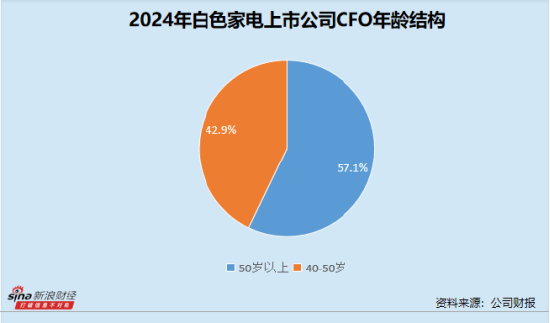
Core Insights - The report highlights the significant role of CFOs in listed companies, with the total salary for A-share CFOs reaching 4.27 billion yuan in 2024, averaging 814,800 yuan per year [1][7]. Salary Overview - The average salary for CFOs in the white goods sector is 2.74 million yuan in 2024, reflecting a year-on-year increase of 9.7%, with a median salary of 2.02 million yuan, up 18.86% [7]. - 71.43% of CFOs in the white goods sector earn over 1 million yuan, with the highest salary being 9.46 million yuan for Midea Group's CFO, Zhong Zheng, which is three times that of the second-highest earner, Gree Electric's CFO, Liao Jianxiong [8][9]. Demographics - The average age of CFOs in the white goods sector is 49 years, with 42.9% aged between 40-50 and 57.1% over 50 [1]. - Male CFOs make up 71.4% of the group, while female CFOs account for 28.6% [1]. Tenure and Education - CFO tenure is evenly distributed, with 28.6% having over 10 years, 28.6% between 5-10 years, and 14.3% between 3-5 years [3]. - Approximately 57.1% of CFOs hold a bachelor's degree, while 42.9% have a master's degree [5]. Salary Disparities - Female CFOs, despite being only 28.6% of the group, have an average salary of 5.41 million yuan, significantly higher than the 1.67 million yuan average for male CFOs, largely due to Zhong Zheng's high salary [7]. - Among the CFOs with master's degrees, the average salary is 4.54 million yuan, which is 50.3% higher than the 1.39 million yuan average for those with bachelor's degrees [7].




白色家电业CFO群体观察:2024白色家电CFO薪酬同比涨9.7% 雪祺电气徐园生36.64万年薪居行业最低
Xin Lang Zheng Quan· 2025-08-05 06:58
就任职期限而言,2024年白色家电行业CFO任职期限分布均衡:10年以上、5-10年和1-3年的各占 28.6%,3-5年的占14.3%。任职时间最长的是海尔智家宫伟。他于2010年开始担任财务总监,长期坚守 岗位达15年。 专题:专题|2024年度A股CFO数据报告:美的集团钟铮年薪946万,比亚迪周亚琳896万 作为上市公司核心管理层关键成员,财务总监CFO的地位与作用至关重要。新浪财经 《2024年度A股 CFO数据报告》 显示,2024年A股上市公司财务总监CFO群体薪酬规模合计达42.70亿元,平均年薪为 81.48万元。 分行业来看,2024年A股市场共有99家家用电器上市公司公开披露了CFO信息,其中7家为白色家电上 市公司。 就年龄结构而言,2024年白色家电上市公司CFO平均年龄为49岁,40-50岁群体约占42.9%,50岁以上群 体约占57.1%。其中,男性占比71.4%,平均年龄为49岁;女性占比28.6%,平均年龄为49岁。 年龄最大的男性CFO为供职于海尔智家的宫伟和供职于格力电器的廖健雄,现已52岁。年龄最大的女性 CFO为供职于澳柯玛的徐玉翠,现已54岁。雪祺电气徐园生年龄最小 ...
白色家电业董秘群体观察:惠而浦孙亚萍全年零接待 长虹美菱李霞日均接待1次
Xin Lang Zheng Quan· 2025-08-05 06:54
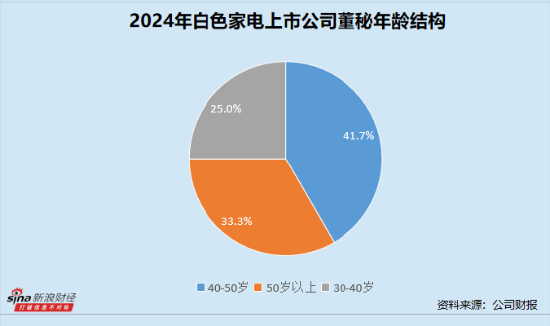
Core Insights - The report highlights that in 2024, the total salary of A-share listed company secretaries reached 4.086 billion yuan, with an average annual salary of 754,300 yuan [1] - Among the white goods sector, the average salary for company secretaries was 843,100 yuan, with 8.33% earning over 1 million yuan [9] - The age distribution of secretaries shows that 41.7% are aged 40-50, while 33.3% are over 50 [1][3] Salary and Employment Data - The average annual salary for white goods company secretaries is 843,100 yuan, with a median salary of 677,150 yuan [9] - There is a significant salary disparity, with the highest earning secretary at 3.36 million yuan and the lowest at 366,400 yuan [9][10] - Compared to 2023, the average and median salaries for white goods company secretaries decreased by 19.11% and 12.80%, respectively [9] Age and Gender Distribution - The average age of secretaries in the white goods sector is 45.42 years, with 58.3% being female [1] - The oldest secretary is 56 years old, while the youngest is 32 years old [1] Tenure and Educational Background - The majority of secretaries (41.7%) have a tenure of 1-3 years, while 25% have been in their roles for less than a year [3] - In terms of education, 50% of the secretaries hold a bachelor's degree, and 50% hold a master's degree [5] Engagement and Interaction - Approximately 41.7% of secretaries receive fewer than 10 inquiries per year, with some, like Whirlpool's secretary, not engaging at all [7] - The highest engagement recorded was 242 inquiries in a year by Changhong Meiling's secretary [7]


白色家电业董秘群体观察:格力电器邓晓博年薪缩水超200万 雪祺电气徐园生36.64万垫底行业
Xin Lang Zheng Quan· 2025-08-05 06:43
专题:专题|2024年度A股董秘数据报告:1144位董秘年薪超百万 占比超21% 就学历而言,在10家白色家电上市公司董秘中,本科和硕士学历各占50%。 董秘作为连接投资者与上市公司的"桥梁",在上市公司资本运作中发挥着关键作用。新浪财经《2024年 度A股董秘数据报告》显示,2024年A股上市公司董秘薪酬合计达40.86亿元,平均年薪75.43万元。 分行业来看,2024年A股市场共有103家家用电器上市公司公开披露了董事会秘书信息,其中10家为白 色家电上市公司。 就年龄结构而言,2024年白色家电上市公司董秘平均年龄为45.42岁,40-50岁群体约占41.7%,50岁以 上群体约占33.3%,30-40岁群体约占25.0%。其中,男性占比41.7%,平均年龄为48.20岁;女性占比 58.3%,平均年龄为43.43岁。 年龄最大的董秘为惠而浦的孙亚萍,现已56岁。值得关注的是,孙亚萍同时也是公司董事会证券事务代 表。新生代代表雪祺电气董秘刘杰出生于1993年,年仅32岁,成为年轻董秘的典型。 就任职期限而言,2024年白色家电上市公司董秘任职期在1-3年的占比最高,约为41.7%;任期1年以内 和10 ...
白色家电业CFO群体观察:美的集团钟铮年薪946万元稳坐第一 海尔智家宫伟任职达15年
Xin Lang Zheng Quan· 2025-08-05 06:37
Core Insights - The report highlights the significant role of CFOs in listed companies, with the total salary for CFOs in A-share companies reaching 4.27 billion yuan in 2024, averaging 814,800 yuan per year [1][7]. Salary Overview - The average salary for CFOs in the white goods sector is 2.74 million yuan in 2024, reflecting a year-on-year increase of 9.7%, with a median salary of 2.02 million yuan, up 18.86% [7]. - 71.43% of CFOs in the white goods sector earn over 1 million yuan, but there is a significant salary disparity, with the highest and lowest salaries differing by 9.09 million yuan [7]. - Female CFOs, although only 28.6% of the total, have an average salary of 5.41 million yuan, significantly higher than the 1.67 million yuan average for male CFOs, largely due to Midea Group's CFO, Zhong Zheng, earning 9.46 million yuan [7]. Demographics and Education - The average age of CFOs in the white goods sector is 49 years, with 42.9% aged between 40-50 and 57.1% over 50 [1]. - Among the 7 CFOs in the white goods sector, 57.1% hold a bachelor's degree, while 42.9% have a master's degree [5]. Tenure and Experience - The tenure distribution of CFOs in the white goods sector is balanced, with 28.6% having over 10 years, 28.6% between 5-10 years, and 14.3% between 3-5 years [3]. - The longest-serving CFO is Gong Wei from Haier Smart Home, who has held the position since 2010, totaling 15 years [3]. Company-Specific Insights - Midea Group's CFO, Zhong Zheng, leads with a salary of 9.46 million yuan, with the company reporting total revenue of 40.91 billion yuan and a net profit of 3.85 billion yuan, reflecting a growth rate of 14.3% [8]. - Haier Smart Home's CFO, Gong Wei, earns 2.14 million yuan, with total revenue of 28.60 billion yuan and a net profit of 1.87 billion yuan, showing a growth rate of 12.9% [8]. - Gree Electric's CFO, Liao Jianxiong, has a salary of 2.87 million yuan, with total revenue of 19.00 billion yuan and a net profit of 3.22 billion yuan, reflecting a growth rate of 10.9% [8].
如何看待海尔智家利润率提升空间?
2025-08-05 03:16
Summary of Haier's Conference Call Company Overview - The conference call discusses Haier, a company focused on home appliances and consumer electronics, particularly its performance in overseas markets and the impact of digital transformation on profitability [1][2]. Key Points and Arguments - **Profit Margin Improvement**: Haier's profit margins have been impacted by high costs associated with its sales model and overseas expansion. However, improvements in management and scale are expected to optimize these factors over time [2]. - **Revenue Growth and Profitability**: Since 2019, Haier has seen continuous improvement in profitability, with gross profit and expenses each contributing 50% to the growth. Digital reforms and marketing optimization have played a significant role, particularly with the high-end brand Casarte, which has seen retail growth exceeding 20% this year [3]. - **Long-term Margin Projections**: Projections indicate that Haier's long-term gross margin could rise to between 29.97% and 32.3%, with expense ratios improving to between 17.34% and 20.07%. Net profit margins are expected to reach between 10.85% and 14.08% [4]. - **Earnings Elasticity**: If revenue growth continues, Haier's earnings elasticity is estimated to release between 56% and 106%. The actual performance may be influenced by investment and management pace, but the overall potential for elasticity is significant [5]. - **Mid-term Investment Value**: Haier presents substantial investment value in the mid-term. The Casarte brand has a leading advantage in the domestic market, while overseas operations are improving through organizational reforms and capacity optimization. The company is also enhancing operational efficiency through digital reforms. With government support and market penetration trends, Haier's growth trajectory looks promising, and its dividend yield is approximately 4.5% [6]. Additional Important Insights - **Cost Structure**: Haier's unique sales model results in higher internalized channel costs, contributing to lower profit margins compared to peers. The air conditioning segment is still in an expansion phase, indicating potential for margin improvement [2]. - **Market Conditions**: The external demand environment will further strengthen Haier's profitability and operational rhythm if conditions remain favorable [5]. This summary encapsulates the key insights from Haier's conference call, highlighting the company's strategies, financial projections, and investment potential.
债券增值税新规推出,高息红利资产优势或较突出
Sou Hu Cai Jing· 2025-08-05 01:55
Core Viewpoint - The announcement of resuming VAT on interest income from newly issued government, local, and financial bonds starting August 8, while existing bonds remain exempt until maturity, is expected to influence market dynamics and investment strategies [1]. Group 1: Market Impact - The demand for existing government, local, and financial bonds is anticipated to rise, potentially leading to a further decline in bond market interest rates [1]. - High dividend yield assets are expected to become more attractive for conservative investors as the interest rate environment remains downward [1]. Group 2: Investment Opportunities - There is a notable opportunity for bank sector allocation, as overall positions in banks have increased, yet there remains a significant under-allocation [1]. - Institutional reforms and the influx of medium to long-term capital into the market are likely to drive additional funds into the banking sector [1]. Group 3: Dividend Yield Analysis - The market's risk appetite may temporarily limit the relative returns of high dividend assets, but certain stable and potential high dividend stocks currently offer attractive yields [1]. - As of August 1, the dividend yield of the CSI Dividend ETF (515080) stands at 4.88%, significantly higher than the 1.71% yield of the ten-year government bond, indicating strong allocation value [1]. - The 40-day return differential between the CSI Dividend Total Return Index and the Wind All A Index is -4.21%, suggesting that the allocation advantage remains prominent in the short term [1].
A股公司回购热情高涨
Shang Hai Zheng Quan Bao· 2025-08-04 18:51
Group 1 - Over 60% of companies have utilized repurchase loans, with 653 companies in the A-share market receiving a total loan support of 141.82 billion yuan, of which 89.42 billion yuan is specifically for share repurchases, accounting for 63.05% [1] - Companies such as Muyuan Foods, BOE Technology Group, and Haier Smart Home have each secured over 1 billion yuan in repurchase loan limits [1] - Muyuan Foods announced a total repurchase of 53.63 million shares, representing 0.98% of its total equity, with a total repurchase amount of 2.16 billion yuan, and the repurchase price ranged from 36.16 yuan to 46.20 yuan per share [1] Group 2 - AVIC Heavy Machinery announced the completion of its share repurchase, having repurchased 11.94 million shares, which is 0.76% of its total equity, using a total of 200 million yuan [2] - Kailong High-Tech received a 25 million yuan repurchase loan and completed its repurchase plan by acquiring 1.69 million shares, which is 1.47% of its total equity, for a total amount of 2.55 million yuan [2] - Other companies like Shandong Road and Bridge and Yanshan Technology also completed their share repurchases quickly after obtaining special loans [3]

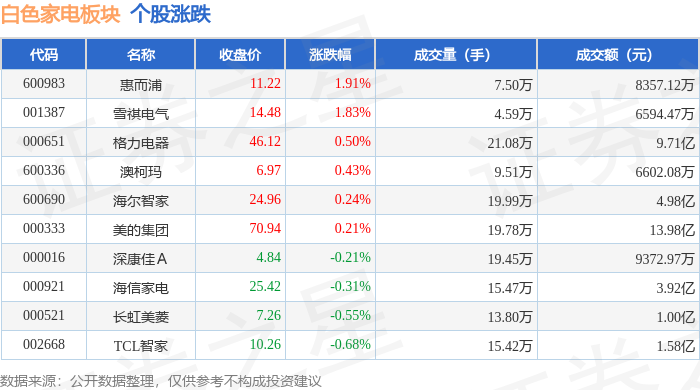
白色家电板块8月4日涨0.28%,惠而浦领涨,主力资金净流入1.34亿元
Zheng Xing Xing Ye Ri Bao· 2025-08-04 08:29
| 代码 | 名称 | 收盘价 | 涨跌幅 | 成交量(手) | 成交额(元) | | --- | --- | --- | --- | --- | --- | | 600983 | 惠両浦 | 11.22 | 1.91% | 7.50万 | 8357.12万 | | 001387 | 雪祺电气 | 14.48 | 1.83% | 4.59万 | 6594.47万 | | 000651 | 格力电器 | 46.12 | 0.50% | 21.08万 | 9.71亿 | | 600336 | 澳柯玛 | 6.97 | 0.43% | 9.51万 | 6602.08万 | | 600690 | 海尔智家 | 24.96 | 0.24% | 19.99万 | 4.98 Z | | 000333 | 美的隻厨 | 70.94 | 0.21% | 19.78万 | 13.98亿 | | 000016 | 深康佳A | 4.84 | -0.21% | 19.45万 | 9372.97万 | | 000921 | 海信家电 | 25.42 | -0.31% | 15.47万 | 3.92亿 | | 000521 | 长虹美菱 ...
策略周报:行业轮动ETF策略周报-20250804
Hengtai Securities· 2025-08-04 07:40
Strategy Overview - The report focuses on constructing a strategy portfolio based on industry and thematic ETFs, utilizing quantitative analysis from previous strategy reports [2]. Strategy Update - For the week of August 4, 2025, the model recommends increasing allocations to sectors such as electricity, joint-stock banks, and liquor, while continuing to hold real estate and agriculture ETFs [2]. - New additions include Green Power ETF, Bank ETF, and Liquor ETF, with ongoing holdings in Real Estate ETF and Agriculture ETF [2]. - As of the last weekend, some ETFs and index trading timing signals provided daily or weekly risk alerts [2]. Performance Tracking - From July 28 to August 1, 2025, the strategy recorded a cumulative net return of approximately -2.19%, with an excess return of about -0.53% compared to the CSI 300 ETF [2]. - Since October 14, 2024, the cumulative return of the strategy outside the sample period is approximately 4.34%, with an excess return of about -2.17% relative to the CSI 300 ETF [2].