高股息红利资产

Search documents
财信证券晨会纪要-20260330
Caixin Securities· 2026-03-30 00:09
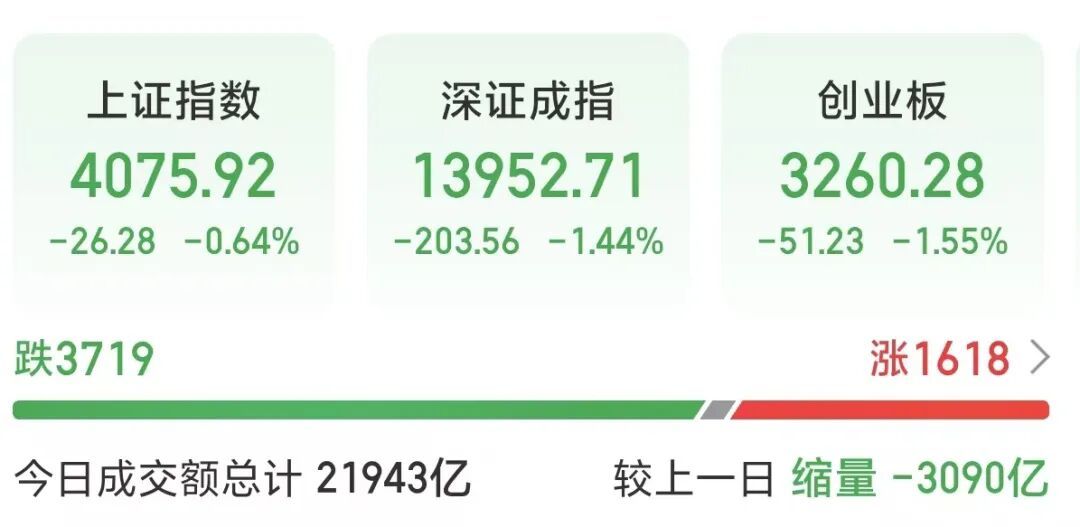
Market Strategy - The market is expected to maintain a volatile bottoming phase, with a focus on buying into high-growth performance sectors [5][11] - The overall market sentiment remains cautious due to external uncertainties, particularly geopolitical tensions in the Middle East, which may suppress market risk appetite [11] - Earnings reports due by the end of April are anticipated to significantly influence market trends, with high-valuation sectors facing potential pressure [11] Economic Insights - In January and February 2026, profits of large-scale industrial enterprises in China grew by 15.2%, totaling 10,245.6 billion yuan [17][18] - State-owned enterprises reported a profit of 3,665.6 billion yuan, a 5.3% increase, while private enterprises saw a 37.2% increase to 2,844.5 billion yuan [18] - The mining sector's profits increased by 9.9%, while the manufacturing sector's profits rose by 18.9% [18] Industry Dynamics - The semiconductor discrete device industry experienced a profit growth of 130.5% in the first two months of 2026 [28] - The U.S. has initiated a 337 investigation into TOPCon solar cell products, affecting several major Chinese manufacturers [26][27] - Guangdong province is optimizing housing provident fund policies to support housing consumption, particularly for families with multiple children [30] Company Updates - Rongchang Bio (688331.SH) reported a revenue of 3.251 billion yuan for 2025, a year-on-year increase of 89.36%, with a net profit of 710 million yuan [33] - Guotou Zhonglu (600962.SH) achieved a net profit of 41 million yuan in 2025, up 39.88% year-on-year [35] - Andeli (605198.SH) reported a net profit of 330 million yuan for 2025, reflecting a 26.71% increase [37] - Muyuan Foods (002714.SZ) reported a net profit of 15.487 billion yuan for 2025, a decline of 13.39% year-on-year due to falling pig prices [40] - Dingtai High-Tech (301377.SZ) plans to invest 5 billion yuan in a smart manufacturing headquarters project, with a revenue increase of 35.70% in 2025 [43][44]


财信证券宏观策略周报(3.9-3.13):市场宽幅震荡,关注资源品及政策利好方向-20260308
Caixin Securities· 2026-03-08 11:28
Group 1 - The report maintains the view that the A-share index will gradually return to its inherent momentum from after the Spring Festival until the end of April, presenting a wide fluctuation trend with increased bidirectional volatility [5][8] - Key factors influencing the market include escalating overseas turmoil, particularly the Middle East conflict affecting oil prices, the weakening of the "calendar effect," and the intensifying global stock market linkage effect [5][8] - Investment opportunities are suggested in sectors such as energy products, oil transportation, precious metals, and military industries due to the Middle East geopolitical conflicts [5][14] Group 2 - The macro policy is expected to focus on quality improvement and efficiency enhancement, with a GDP growth target set between 4.5% and 5% for 2026, emphasizing "safety, technology, high quality, and risk" [8][9] - The "14th Five-Year Plan" highlights the importance of high-quality development, with a target of over 7% annual growth in R&D expenditure and a goal for the digital economy's core industries to account for 12.5% of GDP by the end of the plan [9][10] - The report notes the reform of the listing standards for the ChiNext board, aiming to support innovative enterprises in new consumption and modern service industries [10] Group 3 - The report indicates that the manufacturing PMI for February was significantly affected by the Spring Festival, with a reading of 49.0%, reflecting a decline in both production and new orders [11] - The U.S. non-farm payrolls for February showed a net decrease of 92,000, which was below market expectations, raising concerns about stagflation risks in the U.S. economy [12][13] - The report highlights the impact of rising oil prices on the global economy and asset prices, with significant increases in WTI and Brent crude oil prices, indicating potential long-term effects on inflation and central bank policies [13][14]
财信证券宏观策略周报(3.2-3.6):中东冲突升级,关注商品、军工及“HALO交易”-20260301
Caixin Securities· 2026-03-01 10:36
Group 1 - The report highlights concerns regarding the escalation of conflicts in the Middle East, which may impact market sentiment and risk appetite, particularly due to uncertainties surrounding U.S. tariffs and geopolitical tensions [4][7] - It is anticipated that the A-share market will experience a return to fundamental trends as the spring rally concludes and the earnings disclosure season approaches, with a wide fluctuation expected until the end of April [4][7] - The report suggests that the recent geopolitical tensions have already been priced into global commodity and equity markets, indicating that the current Middle East conflict may only affect short-term market sentiment without altering the overall market direction [4][7] Group 2 - Investment opportunities are identified in sectors such as energy, oil transportation, precious metals, and military industries, driven by the geopolitical conflict [4][14] - The "HALO trading" strategy is highlighted as beneficial for sectors like utilities, transportation infrastructure, and metals, as investors seek hard assets that are less likely to be replaced by technology [11][17] - The report emphasizes the importance of monitoring the upcoming National People's Congress for economic policy directions, which are expected to maintain a "double easing" stance to support economic recovery [8][9] Group 3 - The report notes that the A-share index has shown a positive trend, with the Shanghai Composite Index rising by 1.98% and the Shenzhen Component Index by 2.80% in the previous week [16] - It mentions that the average daily trading volume in the two markets was approximately 24,227.7 billion yuan, indicating robust market activity [16] - The report also discusses the performance of various sectors, with steel, non-ferrous metals, and basic chemicals showing significant gains [16][19]
4分钟涨停,5天3板
Zhong Guo Zheng Quan Bao· 2026-02-05 10:46
Group 1: Consumer Sector - The consumer sector experienced significant gains, with retail concepts seeing a notable rise in the afternoon, highlighted by Maoye Commercial's stock hitting the daily limit within 4 minutes, marking its third consecutive trading day of gains [3][6] - The retail sector's growth is supported by a recent announcement from the Ministry of Finance, Customs, and the State Taxation Administration regarding a "zero tariff" policy for imported goods purchased by residents in Hainan Free Trade Port [8] - The smart retail market is projected to grow to approximately 64.5 billion yuan by 2030, with a compound annual growth rate of 22%, driven by the application of AI technology [9] Group 2: Financial Sector - The financial sector showed strong performance in the afternoon, with banks and securities firms experiencing notable increases, including Xiamen Bank and Huayin Securities hitting the daily limit [10][11] - Predictions indicate that by 2026, new funds entering the insurance sector may exceed 2 trillion yuan, increasing demand for high-dividend assets, particularly in the banking sector [13] - Major securities firms reported positive earnings for 2025, with Citic Securities expecting revenue of 74.83 billion yuan and a net profit of 30.05 billion yuan, both showing significant year-on-year growth [14] Group 3: Aerospace and Photovoltaic Sector - The space photovoltaic concept saw a significant pullback, with stocks like Junda Co. and Mingyang Smart Energy hitting the daily limit down [15][16] - Several listed companies announced they had not engaged in cooperation with Elon Musk's team regarding space photovoltaic projects, highlighting the uncertainty surrounding the commercialization of this technology [19] - The China Photovoltaic Industry Association indicated that space photovoltaic technology is still in the early stages of exploration and verification, with mainstream choices remaining high-efficiency GaAs batteries despite their high costs [20]


开年股价遇冷,机构调研升温,2026年银行股怎么看?
Huan Qiu Wang· 2026-02-04 05:08
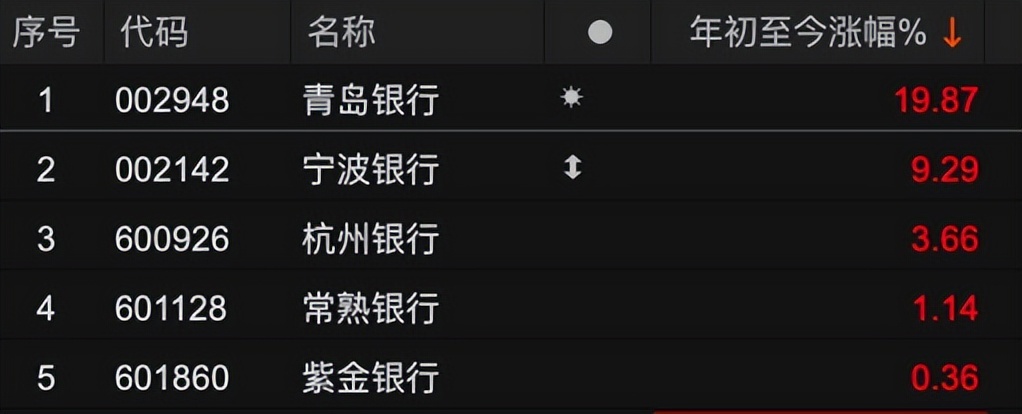
Core Viewpoint - The A-share banking sector has experienced a significant decline of 5.8% year-to-date, contrasting with a 1.1% increase in H-share Chinese banks, indicating a divergence in market performance [1] Group 1: Market Performance - The banking sector's performance has been weak, ranking last among 35 industries in the Wind secondary industry classification [1] - Despite the overall downturn, certain banks like Qingdao Bank and Ningbo Bank have shown strong performance, with increases of 19.87% and 9.29% respectively in January [2] - The average dividend yield for A-share banks remains at approximately 4.5%, which is higher than the 0.5%-2.0% returns of various risk-free assets, making bank stocks attractive for long-term investors [3] Group 2: Fund Flow and Market Sentiment - Since October 2025, there has been a cautious approach from funds towards the banking sector, leading to a period of consolidation [5] - Significant outflows have been recorded, with estimates showing that around 10% of the trading volume has been affected by net outflows from bank-related ETFs, totaling approximately 9111 billion yuan [6] - Despite short-term pressures, there is a belief that the fundamentals of the banking sector are improving, as indicated by increased institutional interest in bank credit issuance [6][9] Group 3: Long-term Opportunities - The banking sector is expected to see internal differentiation, with regional banks like Qingdao Bank and Ningbo Bank performing well against the backdrop of overall sector weakness [7] - Analysts predict that Qingdao Bank will maintain double-digit profit growth in 2026, supported by strong loan issuance capabilities and stable asset quality [8] - The demand for high-dividend assets remains strong, with expectations that insurance funds will inject over 2 trillion yuan into the market in 2026, further supporting bank stocks [9][10] Group 4: Investment Strategies - The current market adjustment reflects short-term fund disturbances, but the long-term outlook remains positive due to improving fundamentals [9] - Institutions are focusing on banks with strong asset quality and those that are improving their cost of liabilities and non-interest income [10] - The banking sector is anticipated to benefit from a stable dividend profile and recovery trading logic, especially as credit issuance continues to grow [10]





近九成投顾看涨全年 市场风格显现均衡迹象
Shang Hai Zheng Quan Bao· 2026-02-03 18:19
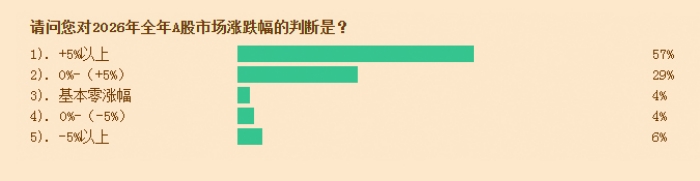
Core Viewpoint - Investment advisors are optimistic about the A-share market in 2026, with nearly 90% expecting an upward trend, and a consensus forming around economic recovery and increased capital inflow [6][7][13]. Group 1: Market Outlook - 88% of investment advisors are bullish on the A-share market for 2026, with 58% expecting an index increase of over 5% [6][14]. - Advisors predict a structural market characterized by fluctuations, with 46% expecting repeated index oscillations and significant gains in certain sectors [14][16]. - The consensus on macroeconomic recovery is strengthening, with 80% of advisors holding optimistic or neutral views on the economy [10][33]. Group 2: Asset Allocation - 67% of advisors recommend increasing allocations to equities, with 68% favoring stocks in the first quarter of 2026 [21][19]. - Advisors are shifting from a focus on growth stocks to a more balanced approach, with 42% expecting growth and dividend styles to converge [16][19]. - High dividend stocks are gaining attention, with 37% of advisors considering them reasonably valued, reflecting a shift in market sentiment [18][19]. Group 3: Investment Strategies - The predominant strategy remains flexible thematic investment, with 47% of advisors advocating for this approach, while 29% are focusing on value investing [22][33]. - Advisors suggest maintaining a higher equity position, with 80% recommending a minimum of 50% equity allocation for clients [22][33]. - The preference for direct stock investments is increasing, with 47% of advisors suggesting this method [21][19]. Group 4: Client Performance and Sentiment - 82% of advisors reported that their clients achieved profits in 2025, a significant increase of 23 percentage points from 2024 [29][27]. - High-net-worth clients are showing increased confidence, with 19% planning to increase their investments, indicating a rising risk appetite [31][27]. - The sentiment towards gold investments is also positive, with 57% of advisors expecting gold prices to continue rising [25][26].
全球降息鼓点趋缓,大类资产配置如何调整?券商首席解读来了
Sou Hu Cai Jing· 2026-01-29 12:07
Group 1 - Major central banks, including the Federal Reserve, have paused interest rate cuts, indicating a slowdown in the global easing cycle rather than a complete tightening of liquidity [1] - The overall liquidity environment remains relatively loose, with expectations for the Federal Reserve to start cutting rates in 2026, providing support for liquidity [1] - The impact of the slowing pace of global liquidity easing on Chinese assets is considered limited, as the core pricing power of Chinese assets is returning to domestic fundamentals [1] Group 2 - In the equity market, a focus on high-growth sectors such as the artificial intelligence industry chain and high-end manufacturing is recommended, along with high-dividend assets for defensive positioning [2] - For gold and the bond market, while short-term fluctuations in gold prices may occur, the long-term investment logic for gold remains unchanged [2] - In the bond market, a focus on coupon strategies is advised, with caution against excessive leverage for capital gains [2]
机构看好红利与科技主线,聚焦自由现金流ETF(159201)配置价值
Mei Ri Jing Ji Xin Wen· 2026-01-21 02:48
Group 1 - The core viewpoint of the article highlights the performance of the Free Cash Flow ETF (159201), which has seen a stable increase in net inflows and has reached new highs in both scale and shares [1] - The Free Cash Flow ETF (159201) has recorded net inflows for 8 out of the last 10 trading days, totaling over 548 million yuan, indicating strong investor interest [1] - The latest scale of the Free Cash Flow ETF (159201) has reached 10.03 billion yuan, with a total of 7.843 billion shares, both marking all-time highs since its inception [1] Group 2 - The chief economist at Debon Securities, Cheng Qiang, predicts a "slow bull" market for A-shares in 2026, supported by stable indices and a focus on technology growth, particularly in artificial intelligence and computing power sectors [1] - High dividend yield assets are expected to provide significant value as a stable cash flow source during periods of weak economic recovery and declining interest rates, with current valuations being relatively low [1] - The Free Cash Flow ETF (159201) and its linked funds are designed to closely track the National Index of Free Cash Flow, selecting stocks with positive and high cash flow, which enhances the index's quality and risk resistance, making it suitable for long-term investment [1]
2025A股收官!沪指日线11连阳,有色、通信年度涨幅断层领先 | 华宝3A日报(2025.12.31)
Xin Lang Cai Jing· 2025-12-31 09:43
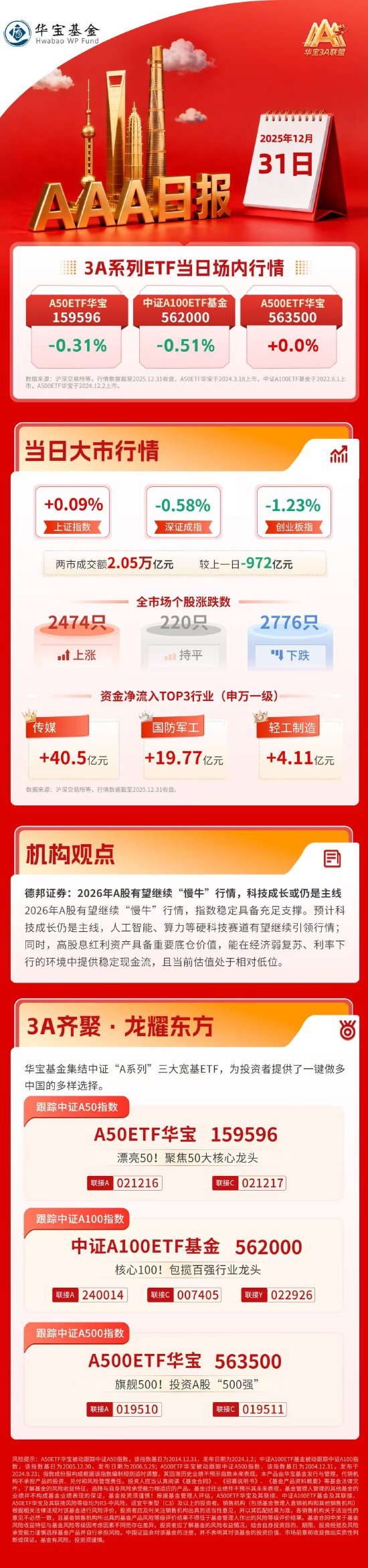
Group 1 - The core viewpoint indicates that the A-share market is expected to continue a "slow bull" trend in 2026, with stable index support and technology growth as the main focus [2][5] - The sectors expected to lead the market include artificial intelligence and computing power, which are part of the hard technology track [2][5] - High dividend yield assets are highlighted as having significant bottom-line value, providing stable cash flow in an environment of weak economic recovery and declining interest rates, with current valuations at relatively low levels [2][5] Group 2 - The total trading volume in the two markets reached 2.05 trillion yuan, a decrease of 972 billion yuan from the previous day [5] - The number of stocks that rose and fell in the market was 2,776 and 2,474 respectively, indicating a mixed performance [5] - The top three sectors for net capital inflow were identified as media, defense, and light manufacturing [5]
A股收评:8连红!沪指收涨0.1%,海南板块再度爆发!
Ge Long Hui· 2025-12-26 07:22
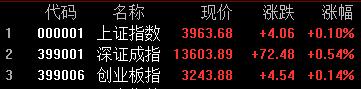
Market Performance - The A-share market indices continued to rise, with the Shanghai Composite Index recording an 8-day increase, while the Shenzhen Component Index and the ChiNext Index saw a 6-day increase [1] - As of the market close, the Shanghai Composite Index rose by 0.1% to 3563 points, the Shenzhen Component Index increased by 0.54%, and the ChiNext Index gained 0.14% [1] Trading Volume - The total market turnover reached 2.18 trillion yuan, an increase of 237.2 billion yuan compared to the previous trading day, with over 3400 stocks declining [1] Sector Performance - The Hainan sector surged, with significant gains in stocks such as Hainan Mining and Hainan Airlines, which hit the daily limit [4] - The industrial metals sector also saw a rise, with Jiangxi Copper hitting the daily limit [4] - The commercial aerospace, small metals, titanium dioxide, and fluorochemical sectors experienced notable increases [4] Notable Stocks - Hainan sector stocks such as Intercontinental Oil and Gas, Hainan Mining, and Jun Da Co. all reached their daily limit [5] - Jiangxi Copper announced a formal offer to acquire SolGold plc for 28 pence per share, targeting the Cascabel project in Ecuador, a significant undeveloped copper-gold deposit [6][7] Battery Sector - The battery sector saw gains, with Haike New Energy hitting the daily limit and Huasheng Lithium gaining over 11% [9] - Haike New Energy signed a strategic cooperation agreement for 270,000 tons of lithium battery materials, following previous agreements totaling nearly 800,000 tons [9] Paper Sector - The paper sector experienced a pullback, with companies like Jiang Tian Technology and Anni Co. seeing declines of over 12% and 3% respectively [12] - Suzano announced a global price increase for hardwood pulp starting January 2026, which may impact the sector [11] Rubber Products and Small Appliances - The rubber products sector declined, with Tian Tie Technology dropping over 13% due to the criminal detention of its controlling shareholder [13][14] - The small appliances sector also faced losses, with Beili Cong falling over 14% amid an investigation into information disclosure violations [15][16] Market Outlook - According to the chief economist of Debon Securities, the A-share market is expected to continue a "slow bull" trend in 2026, supported by stable indices and a focus on technology growth, particularly in AI and computing sectors [16]