
智能手机

Search documents
8点1氪:美国正式退出世卫组织;西贝获新融资;全球最大钻石生产商宣布降价
36氪· 2026-01-22 00:10
Group 1 - The United States has officially withdrawn from the World Health Organization (WHO) after a one-year notice period, but still owes approximately $260 million in dues for the years 2024 and 2025 [2][3] - The issue of the unpaid dues has been added to the agenda of the upcoming WHO Executive Committee meeting [3] Group 2 - Inner Mongolia's Xibei Catering Group has increased its registered capital from approximately 89.9 million RMB to about 102 million RMB, marking a growth of around 13% [4] - The company, established in October 2017, engages in various food-related services and management [4] Group 3 - De Beers, the world's largest diamond producer, has announced a price reduction of 25% for diamonds due to declining demand and the rise of synthetic diamonds [5] - This marks a significant shift in the diamond market, as De Beers had previously resisted price cuts [5] Group 4 - The black strawberry, priced at up to 300 RMB per half kilogram, is gaining popularity as a luxury fruit [6] - The variety, known as the "True Red Meilin Black Strawberry," is marketed as a premium product, with sales records showing over 3000 units sold online [6] Group 5 - Beijing's GDP has surpassed 5 trillion RMB, reaching 5,207.34 billion RMB in 2025, representing a growth of 5.4% from the previous year [7] - This makes Beijing the second city in China to exceed the 5 trillion RMB mark, following Shanghai [7] Group 6 - Ford is recalling over 119,000 vehicles in the U.S. due to a fire risk associated with the engine block heater [7] - The recall is prompted by the potential for coolant leaks and short circuits during operation [7] Group 7 - OpenAI and the Gates Foundation are investing $50 million in a pilot project aimed at advancing AI applications in healthcare across Africa, starting in Rwanda [19] - The initiative, named "Horizon 1000," aims to support 1,000 grassroots healthcare institutions by 2028 [19] Group 8 - Netflix plans to increase its film production spending by 10% in 2026, while also pursuing the acquisition of Warner Bros.' film studio and streaming business [21] - In the fourth quarter, Netflix reported revenues of $12.05 billion, exceeding market expectations [21]


西贝完成新一轮融资,新荣记张勇、蚂蚁前CEO等入股;苹果首款折叠屏手机iPhone Fold模型曝光;俞敏洪开办“退休俱乐部”丨邦早报
创业邦· 2026-01-22 00:09
Group 1 - Xibei Restaurant Group completed a new round of financing, with new shareholders including Zhang Yong, founder of Xinrongji, and Hu Xiaoming, former CEO of Ant Group [2] - The financing round saw shareholding proportions of 4.4209%, 4.4209%, 2.2104%, 0.4421%, and 0.0884% for new investors [2] Group 2 - Apple's first foldable phone, iPhone Fold, is expected to be released in September, featuring a wide aspect ratio and dual screens [3] - The design of the iPhone Fold continues the style of the iPhone 17 Pro series [3] Group 3 - Baidu's Wenxin App is set to introduce a social interaction feature with "multi-agent group chat" capabilities, currently in internal testing [5] - Taobao and Tmall will launch an AI-based initiative to combat fake images in after-sales service this year [5] Group 4 - The AI model series "Qianwen" from Alibaba has surpassed 1 billion downloads, becoming the first open-source large model to achieve this milestone [8] - The average daily downloads of the Qianwen series models are 1.1 million [8] Group 5 - Chang'an Ford's annual sales in China fell below 100,000 units for the first time, with wholesale sales of 121,500 units and retail sales of 99,400 units in 2025 [16] - This marks a significant decline from 247,000 units sold in 2024 [16] Group 6 - OpenAI announced plans to expand its AI infrastructure in the U.S. to 10 GW by 2029, with several sites already in development [15] - The company will cover energy costs to ensure the project does not increase electricity prices [15] Group 7 - SWISSto12 has raised over €100 million for its new satellite project, with €73 million coming from the European Space Agency [17] - The funding will support the development and industrialization of the new "Hummingbird Satellite" platform [17] Group 8 - Energy Fuels announced a $299 million acquisition of Australian Strategic Materials, valuing the company at this amount [18] - This acquisition is part of Energy Fuels' strategy to expand its operations in the rare earth sector [18]

人老实话不多?小米汽车与雷军的成与败
Sou Hu Cai Jing· 2026-01-21 09:49
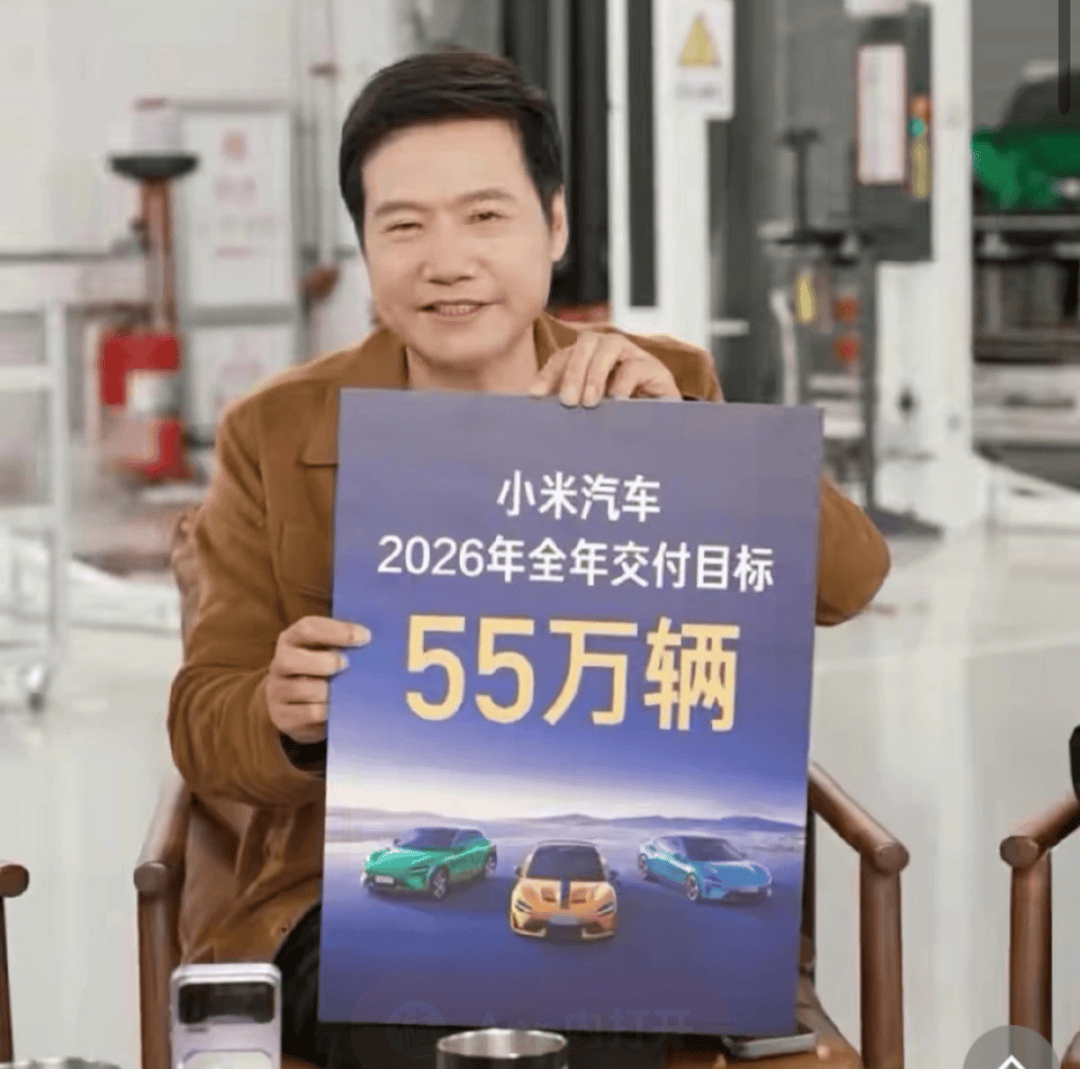
Core Viewpoint - Xiaomi's founder Lei Jun acknowledged the issue of "small print marketing" as an industry malpractice and committed to immediate rectification during the first live broadcast of 2026 [1][3][7]. Group 1: Sales Performance and Targets - In 2025, Xiaomi's automotive business exceeded its annual target by 17%, selling 411,800 units, with a sales target of 550,000 units set for 2026 [3][16]. - Predictions suggest that Xiaomi's electric vehicle sales could potentially surpass Tesla's in 2026, with Bloomberg forecasting a 100% increase, leading to an annual shipment of 782,000 units [16][20]. - Xiaomi's automotive business is expected to contribute 30% to the group's total revenue [20]. Group 2: Marketing Strategy Changes - Lei Jun's live broadcast included a four-hour session where an engineer disassembled a Xiaomi vehicle to showcase its core components, aiming for transparency [4]. - The company has reduced the number of promotional materials containing "small print" from 32 to 13 within a month, indicating a shift towards using larger fonts for better readability [10][12]. - Xiaomi's marketing strategy is evolving to emphasize transparency, with Lei Jun stating that specific voltage values will be clearly marked instead of using generalized terms [20][21].
OPPO周海涛:将流畅进行到底 让千元机也能“长期使用不卡顿”
Guo Ji Jin Rong Bao· 2026-01-21 06:58
Core Viewpoint - The launch of OPPO A6c marks a significant move in the competitive entry-level smartphone market, emphasizing durability and smooth performance at a price point of 1099 yuan, showcasing OPPO's commitment to enhancing user experience in lower-tier devices [1][9]. Group 1: Product Features and Innovations - OPPO A6c is positioned as a "durable entry-level flagship" with three main selling points: ultra-durability, ultra-smooth performance, and ultra-bright display [1]. - The device features the optimized ColorOS 16 system, which is part of OPPO's strategy to democratize technology and improve the user experience for budget smartphones [1][11]. - The "Star Compiler" technology enhances performance by improving algorithm efficiency, resulting in a 26% increase in Android Java core interface performance and a 14% reduction in overall load [2][6]. Group 2: Market Trends and User Demographics - The global smartphone market is experiencing a bifurcation, with low-end and high-end segments expanding while the mid-range market is declining, as indicated by Omdia and Goldman Sachs [9][10]. - The entry-level market (under $200) remains stable, holding a market share of 41%-45%, driven by demand for 5G upgrades in developing countries and consumer preference for affordable devices [10]. Group 3: User Experience and Software Optimization - Traditional Android architecture has been inefficient, causing performance bottlenecks in entry-level devices; the "Star Compiler" addresses this by streamlining communication between software and hardware [5][6]. - The new system allows for direct interaction between Java code and hardware, significantly improving response times and user experience [6][7]. - OPPO aims to redefine the user experience for budget smartphones by ensuring long-term smooth performance, which was previously associated only with flagship models [8][9]. Group 4: Strategic Focus and Future Directions - OPPO's strategy is shifting towards enhancing the performance of entry-level devices, recognizing that a significant portion of users rely on these models for their daily needs [8][9]. - The company is also focusing on integrating AI features and cross-ecosystem collaboration into budget smartphones, making advanced functionalities accessible to a broader audience [11][13].
中国手机厂商开始反击三星苹果们
2 1 Shi Ji Jing Ji Bao Dao· 2026-01-21 06:37
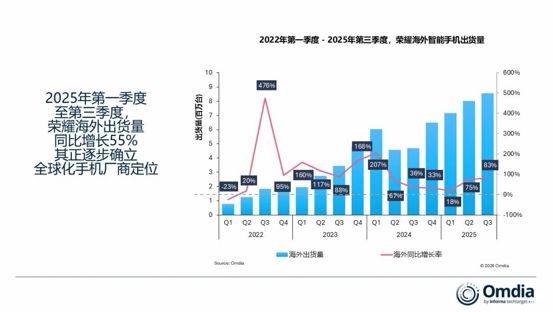
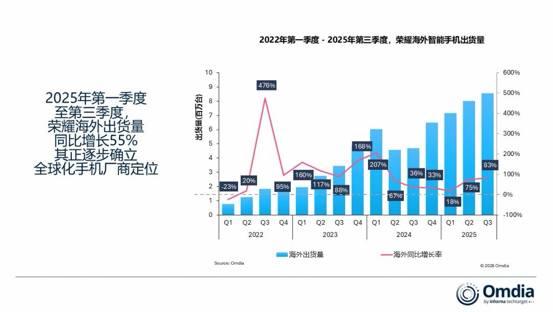
Core Insights - The global smartphone market is expected to grow in 2025, with an annual shipment volume reaching 1.26 billion units, representing a year-on-year increase of 1.9% [1] - Chinese smartphone manufacturers are increasingly focusing on both domestic and overseas markets, with significant growth in international shipments, particularly for Honor [1][4] Group 1: Market Trends - The Chinese smartphone market is evolving, with Honor launching three new models in January 2025, indicating a strategic push in product offerings [1] - Chinese manufacturers account for approximately 60% of global smartphone shipments, with Honor experiencing a notable 55% year-on-year increase in overseas shipments from Q1 to Q3 of 2025 [1][4] Group 2: Strategic Approaches - Chinese companies are adopting two main strategies for overseas expansion: full AI integration and brand premiumization, with a focus on "Glocal" strategies that combine global thinking with local actions [4] - Honor's international business has undergone a structural transformation, with overseas shipments rising from less than 10% of total shipments in early 2021 to nearly 50% by Q3 2025, marking a significant strategic shift [4] Group 3: High-End Market Focus - Honor is positioning itself in the mid-to-high-end market segment, with 23% of its overseas shipments falling within the $300–500 price range during the first three quarters of 2025 [5] - The European market is critical for high-end consumer electronics, and Honor aims to strengthen its presence there, maintaining a top-five market position in key Western European countries [7] Group 4: Product Innovation - Honor has enhanced its product lineup with advanced features, such as the ultra-thin Magic8 Pro Air, which weighs only 155g and is 6.1mm thick while maintaining high performance [10] - The introduction of the ROBOT PHONE, a smartphone integrated with AI capabilities, showcases the innovative direction of Chinese manufacturers [10] Group 5: AI and Technology Advancements - Since 2025, there have been significant advancements in AI capabilities for consumer smartphones, with Honor achieving breakthroughs in on-device AI processing [11] - Huawei's strengths lie in its underlying system capabilities, with the HarmonyOS 6 supporting multi-device AI computing, enhancing the overall user experience [11] Group 6: Future Outlook - 2025 marks a pivotal year for Honor as it transitions from a smartphone manufacturer to a leading AI terminal ecosystem company, with global shipments surpassing 71 million units [12] - The balance between scale expansion, AI capability implementation, and profitability will be crucial for Honor's position in the competitive landscape of smartphones and AI terminals [12]
中国手机厂商开始反击三星苹果们
21世纪经济报道· 2026-01-21 06:27
Core Viewpoint - The global smartphone market is expected to grow, with shipments reaching 1.26 billion units in 2025, reflecting a year-on-year increase of 1.9%. Despite this recovery, the industry faces long-term challenges [1]. Group 1: Market Dynamics - Chinese smartphone manufacturers have established a significant presence in the global market, capturing approximately 60% of global shipments, with brands like OPPO, vivo, Xiaomi, and Honor leading the charge [1]. - Honor has experienced rapid growth, with a reported 55% year-on-year increase in overseas smartphone shipments from Q1 to Q3 of 2025, marking it as the fastest-growing brand among the top ten global smartphone manufacturers [1][4]. Group 2: Strategic Approaches - Chinese companies are adopting two core strategies for international expansion: comprehensive AI integration and high-end branding. This includes a "Glocal" strategy, which combines global thinking with local action [4]. - Honor's international business has undergone a structural transformation, with overseas shipments rising from less than 10% of total shipments in early 2021 to nearly 50% by Q3 2025, indicating a strategic pivot towards international markets [4]. Group 3: Market Segmentation - Historically, Chinese manufacturers dominated the global mid-to-low-end market, but now they are increasingly focusing on the mid-to-high-end segments to balance scale and profitability. Honor is positioning itself in the $300-$500 price range, which accounted for approximately 23% of its overseas shipments in the first three quarters of 2025 [5]. - The high-end market, particularly in Europe, is a critical battleground for consumer electronics, with Honor maintaining a top-five market position in key Western European markets and achieving a 15% year-on-year growth in Central and Eastern Europe [7]. Group 4: Product Innovation - To penetrate the high-end market, product capability is essential. Honor has launched advanced products like the Magic8 series, which features AI-driven capabilities and innovative designs [9]. - The introduction of the ROBOT PHONE, a smartphone integrated with AI and robotics, showcases the innovative direction of Chinese manufacturers, with plans for further details to be revealed at major tech events [10]. Group 5: Future Outlook - The trends of high-end positioning and globalization are expected to continue, with a focus on enhancing product capabilities and user experiences through AI advancements [11]. - For Honor, 2025 marks a pivotal year in its transformation from a smartphone manufacturer to a leading AI terminal ecosystem company, with a global shipment target of over 71 million units and the fastest growth rate among the top ten brands [11][12].

来京东下单联想moto X70 Air Pro 享365天只换不修
Sou Hu Wang· 2026-01-21 06:25
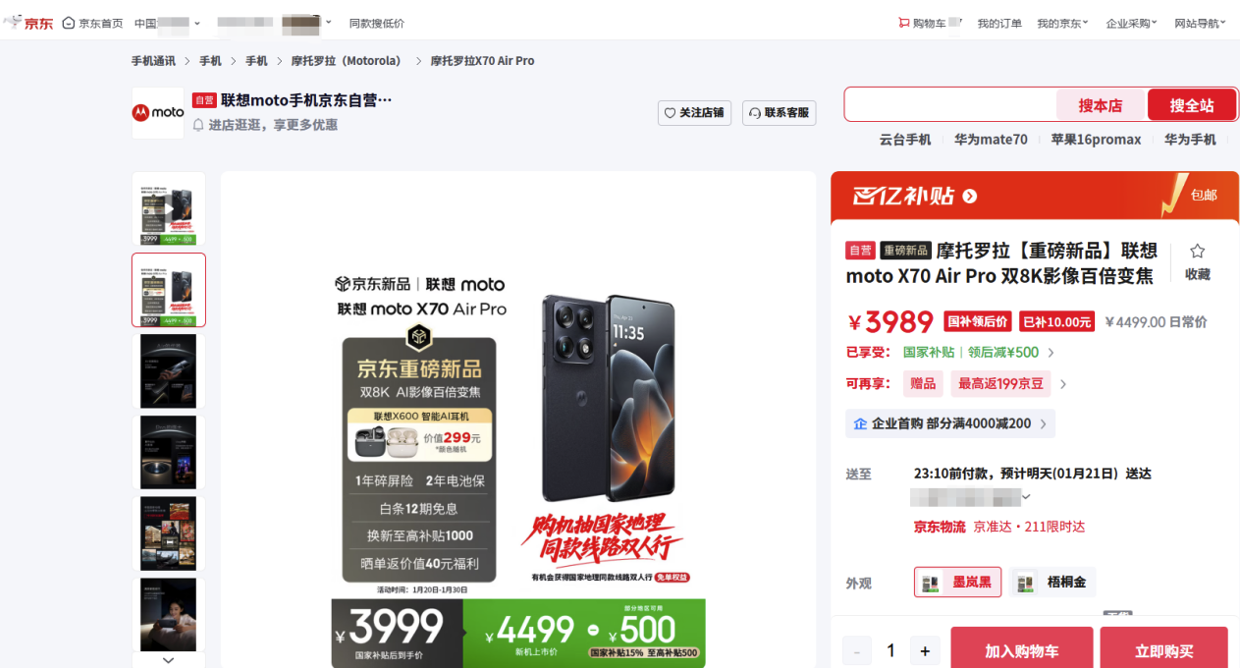
1月20日,联想moto X70 Air Pro正式发布,售价4499元起,现已开售。目前,京东已开售联想moto X70 Air Pro,享国补到手价3999元起,还可享12期免息、赠价值299元X600 AI耳机、1年免费换原厂屏+2年 电池换新服务、以旧换新至高补贴1300元(老用户指定机型换新得300元加补券)、365天只换不修、评价 晒单返40元红包/京豆等福利,限时下单参与抽奖有机会获得国家地理同款线路双人行免单权益,限时 购机并在京东酒旅购指定云南线路、在规定时间内用这款手机打卡拍摄指定景点可得千元红包。一直以 来,京东依托强大的供应链优势,持续携手联想moto等厂商深度合作,通过营销共创、差异化服务、 全渠道能力等给予新品首发助力,实现新品即爆品。 想要换新联想moto X70 Air Pro,那就快来京东下单吧。 联想moto X70 Air Pro搭载1.5K超亮等深屏,采用京东方Q10反光材料,搭配PANTONEⓇ肤色&色彩认 证,更具色彩张力;支持8T LTPO 1—165Hz超高刷新率、6200nits局部峰值亮度、杜比AI动态,画面清 晰;配置超暗模式,获得SGS低蓝光低拖影双认证 ...


中国手机厂商加码海外高端市场 荣耀结构性转变
2 1 Shi Ji Jing Ji Bao Dao· 2026-01-21 03:55
Core Insights - The global smartphone market is projected to grow in 2025, with an expected shipment volume of 1.26 billion units, reflecting a year-on-year increase of 1.9% [1] - Chinese smartphone manufacturers are increasingly focusing on both domestic and overseas markets, with significant growth in international shipments, particularly for Honor [1][3] Industry Overview - The smartphone industry is experiencing a recovery phase, but it still faces long-term challenges [1] - Chinese manufacturers hold approximately 60% of the global smartphone shipment share, with brands like OPPO, vivo, Xiaomi, and Honor leading the market [1] - Honor's overseas smartphone shipments are expected to grow by about 55% year-on-year in the first three quarters of 2025, marking significant international expansion [1][3] Strategic Shifts - Chinese companies are adopting two main strategies for overseas markets: full AI integration and brand premiumization [3] - Honor's international business has undergone a structural transformation, with overseas shipments rising from less than 10% of total shipments in early 2021 to nearly 50% by the third quarter of 2025 [3] - The competition is shifting from a focus on scale to a focus on stability and capability, with high-end positioning becoming essential for profit restructuring and brand recognition [6][9] Market Positioning - Honor is targeting the mid-to-high-end market segment, with 23% of its overseas shipments in the $300–500 price range during the first three quarters of 2025 [4] - Europe is a critical battleground for high-end consumer electronics, and Honor aims to solidify its position in key Western European markets [6] - Latin America and the Middle East and Africa are emerging as core regions for Honor's overseas shipment growth [6] Product Development - Product strength is crucial for penetrating the high-end market, with manufacturers enhancing their high-end offerings [7] - Honor has introduced innovative products like the Magic8 series and the ROBOT PHONE, which integrates AI capabilities and advanced imaging [7][8] - The AI capabilities of Chinese manufacturers are becoming a competitive advantage, with advancements in localized AI applications enhancing user experience [8][9] Future Outlook - The trends of high-end positioning and globalization are expected to continue shaping the market landscape [8][9] - Honor's "Alpha Strategy," launched in March 2025, signifies its transition from a smartphone manufacturer to a leading AI terminal ecosystem company, with global shipments projected to exceed 71 million units [9] - The new management team faces the challenge of balancing scale expansion, AI capability implementation, and profitability to maintain a leading position in the competitive landscape [9]
泡泡玛特联合荣耀发布首款潮玩手机,国补后3999元
Nan Fang Du Shi Bao· 2026-01-21 03:50
Group 1 - The core point of the news is the collaboration between Pop Mart and Honor to launch the "Honor 500 Pro MOLLY 20th Anniversary Limited Edition" smartphone, priced at 4,499 yuan, with a net price of 3,999 yuan after subsidies, set to be officially released on January 25 [1][3] - Following the announcement, Pop Mart's stock surged, with an increase of over 10% at one point, closing at a 9.07% rise, valued at 197.2 HKD per share and a market capitalization of 264.6 billion HKD [1] - Pop Mart clarified that it does not have plans to develop its own smartphone but is engaging in a deep co-creation partnership with a well-known mobile brand, moving beyond simple logo placements [1][3] Group 2 - In the context of the smartphone industry facing saturation, Honor aims to provide emotional value to young consumers rather than just competing on hardware specifications, targeting the demographic of 18-35-year-old women, which aligns with Pop Mart's user profile [3] - For Pop Mart, this collaboration represents an important attempt to find a "second growth curve" for IP monetization, especially as the novelty of blind box products diminishes and some new products face price drops in the secondary market [3] - Additionally, Honor also launched the highly anticipated ultra-light flagship model, the Honor Magic 8 Pro Air, weighing 155g and measuring 6.1mm in thickness, featuring a 6.31-inch OLED display and starting at a price of 4,999 yuan [3]


东海证券晨会纪要-20260121
Donghai Securities· 2026-01-21 02:57
Group 1: Key Recommendations - The report emphasizes the revaluation of private refining companies in the petrochemical industry, highlighting that the petrochemical cycle is under pressure but shows signs of improvement ahead [6][7] - Key drivers for the petrochemical cycle include rising oil prices, supply-side capacity clearance, and demand-side stimulus from a loose monetary environment [6][7] - The report predicts that Brent oil prices will fluctuate between $55 and $75 per barrel in 2026, which could benefit refining profitability [7][8] Group 2: Economic Observations - The nominal GDP growth rate stabilized, with Q4 2025 GDP growth at 4.5%, slightly down from 4.8% in Q3 [11][12] - The contribution rates to GDP from final consumption, capital formation, and net exports were 52.9%, 16.0%, and 31.1% respectively in Q4 2025, indicating strong export support and stable consumption [13] - Investment showed a downward trend, with fixed asset investment growth at -3.8% for the year, highlighting the need for policy support to stabilize investment [15][16] Group 3: Industry Insights - TSMC's capital expenditure for 2026 is projected to be between $52 billion and $56 billion, significantly exceeding market expectations, driven by demand for AI and advanced process technologies [18][20] - The global smartphone market showed resilience in 2025, with a total shipment of 1.26 billion units, a 1.9% increase year-on-year, driven by high-end models and foldable screens [21][22] - The report suggests that the semiconductor industry is experiencing upward price trends, particularly in storage chips, indicating structural investment opportunities [19][23]
