
工业机器人制造

Search documents
增长3% 今年前7个月我国与其他上合组织成员国货物贸易创新高
Yang Shi Xin Wen· 2025-08-20 06:38
Core Insights - In the first seven months of this year, China's trade with other SCO member countries reached 2.11 trillion yuan, marking a 3% increase and setting a historical record for the same period [1] - Exports of industrial robots and agricultural machinery to other SCO member countries grew by 27.1% and 47.8% respectively, while imports of electronic components and agricultural products increased by 12.1% and 6.2% [1] - Since the establishment of the SCO in 2001, trade volume between China and other member countries has surged from 100 billion yuan to 3.65 trillion yuan in 2024, representing an increase of over 30 times [1]
7月国民经济稳中有进 规上工业增加值增长5.7%
Chang Jiang Shang Bao· 2025-08-18 00:05
Economic Overview - The national economy shows a steady growth trend, with industrial added value above designated size increasing by 5.7% year-on-year in July and 6.3% from January to July [1][3] - The service industry continues to grow rapidly, contributing significantly to economic stability [6] Industrial Production - Industrial production maintains robust growth, with high-quality development progressing steadily, showcasing resilience and potential [1] - High-tech manufacturing added value increased by 9.3% year-on-year in July, with significant growth in integrated circuits and electronic materials [2] - Equipment manufacturing and high-tech manufacturing sectors are key contributors, with respective growth rates of 8.4% and 9.3% [1][2] Investment Trends - Fixed asset investment continues to expand, with a total of 288,229 billion yuan from January to July, marking a 1.6% year-on-year increase [3] - Manufacturing investment grew by 6.2%, with high-tech industries such as aerospace and information services seeing substantial increases [3] Consumer Market - Retail sales showed positive growth, with total retail sales reaching 38,780 billion yuan in July, up 3.7% year-on-year [4] - Online retail sales increased by 9.2%, indicating a strong shift towards e-commerce [4][5] - The consumption upgrade policy, including trade-in programs, has positively impacted sales of upgraded goods [5] Service Sector Growth - The service sector's contribution to economic growth is significant, with a 5.5% year-on-year increase in added value in the first half of 2025 [6] - The service production index rose by 5.8% in July, with information technology services growing at 11.9% [6]
向新、向好、向未来!一组数据见证中国经济“含新量”
Yang Shi Xin Wen Ke Hu Duan· 2025-08-15 07:24
Core Insights - China's new quality productivity is steadily growing, contributing to high-quality development and injecting new momentum into the economy [1][5] Group 1: Technological Advancements - In 2024, China's R&D expenditure is expected to exceed 3.6 trillion yuan, with an intensity of 2.68%, surpassing the EU and approaching OECD averages [1] - High-tech industries are experiencing rapid growth, with the value added in the integrated circuit manufacturing and electronic materials sectors increasing by 26.9% and 21.7% year-on-year in July [2] - The digital economy is expanding quickly, with the value added in the digital product manufacturing sector growing by 8.4% year-on-year in July [3] Group 2: Green Development - In July, the production of new energy vehicles and lithium-ion batteries increased by 17.1% and 29.4% year-on-year, respectively [4] - The production of green materials such as carbon fiber and bio-based chemical fibers grew by 43.8% and 19.8% year-on-year [4] - The comprehensive utilization of waste resources saw a year-on-year increase of 11.7% in July [5] Group 3: Investment Trends - Investment in aerospace and equipment manufacturing increased by 33.9% year-on-year from January to July, while investment in computer and office equipment manufacturing grew by 16% [6] - The service sector, particularly in information services and R&D, is also experiencing significant growth, with double-digit revenue increases reported [8] Group 4: Economic Resilience - From January to July, the total retail sales of consumer goods grew by 4.8% year-on-year, indicating stable consumer demand [8] - Despite challenges, China's foreign trade remains resilient, with a 7.3% increase in goods exports during the same period [8][12] - The contribution rate of final consumption expenditure to economic growth reached 52% in the first half of the year, an increase of 7.5 percentage points compared to the previous year [11] Group 5: Policy Impact - The implementation of proactive macroeconomic policies has effectively stimulated production demand and supported stable economic growth [13][14] - The construction of a unified national market and the promotion of integrated domestic and international trade are expected to enhance economic vitality [12]
全国出口的工业机器人1/3来自这里!粤港澳大湾区外贸动能持续释放
Nan Fang Du Shi Bao· 2025-08-07 09:29
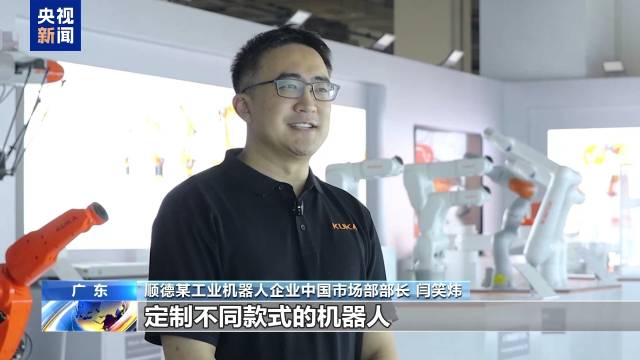
Group 1 - The Guangdong-Hong Kong-Macao Greater Bay Area has seen record high import and export volumes in the past six years, with high-tech products being a significant highlight [1] - The region has established a complete industrial robot manufacturing chain, gathering over 100,000 related enterprises and forming a leading industrial robot manufacturing cluster in the country [1] - In Shunde, an industrial robot production line can assemble a robot in less than 30 minutes [1] Group 2 - A Shunde industrial robot company can customize robots based on customer needs, completing a design to production cycle in as little as 45 days [3] - The company currently offers over 50 types of robots for various industries, with more than 20 additional models in development [3] Group 3 - In the first half of this year, the nine cities in the Greater Bay Area accounted for 32.3% of the national exports of industrial robots, meaning one in three exported robots is manufactured in this region [5] - Private enterprises are the main force in the industrial robot development sector, exporting nearly 60% of the robots from the Greater Bay Area [5] Group 4 - Guangzhou's cross-border e-commerce has ranked first in the country for nine consecutive years, facilitating faster and more convenient access to global products for Chinese consumers [7] - The Nansha Comprehensive Bonded Zone has warehouses that stock over 20,000 types of global goods, effectively serving as a "global supermarket" for high-quality imported products [7]


凯尔达: 2025年半年度报告
Zheng Quan Zhi Xing· 2025-08-04 16:23
Core Viewpoint - The report highlights the financial performance and strategic positioning of Hangzhou Kaierda Welding Robot Co., Ltd. in the industrial robotics and welding equipment sector, emphasizing the challenges faced in profitability and the ongoing investments in R&D to enhance market competitiveness [1][3]. Company Overview and Financial Indicators - Hangzhou Kaierda Welding Robot Co., Ltd. operates in the intelligent manufacturing equipment industry, focusing on industrial robots and welding equipment [3][6]. - The company reported a revenue of approximately 315.72 million RMB for the first half of 2025, a decrease of 1.81% compared to the previous year [4]. - The total profit for the period was a loss of approximately 1.37 million RMB, a significant decline of 105.55% year-on-year [4]. - The net profit attributable to shareholders was approximately 2.37 million RMB, down 89.94% from the previous year [4]. - The company’s total assets increased by 2.53% to approximately 1.21 billion RMB compared to the end of the previous year [4]. Industry Position and Trends - The company is recognized as a high-tech enterprise with independent R&D capabilities in core technologies for industrial robots and high-end welding [6][7]. - The industrial robotics market is experiencing intensified competition, with domestic companies gaining market share against foreign firms, although revenue and profitability gaps remain [6][10]. - The demand for high-end welding equipment is steadily increasing, driven by the transition towards automation and intelligent manufacturing in the industry [6][10]. Business Model and Sales Strategy - The company employs a mixed sales model combining direct sales and distributor partnerships, with approximately 80% of revenue generated through distributors [14][16]. - The overseas sales strategy includes both ODM and proprietary brand sales, with ODM accounting for about 90% of foreign sales revenue [14][16]. - The company focuses on R&D to maintain technological leadership and enhance product competitiveness, with significant investments in new technologies and product development [13][15]. Technological Advancements and Future Outlook - The company is actively developing advanced welding technologies, including servo welding and low-spatter welding, to meet the growing demand for automation in various industries [8][12]. - The integration of artificial intelligence and advanced manufacturing technologies is expected to expand the application scenarios for industrial robots, enhancing their adaptability and efficiency [9][10]. - The trend towards collaborative robots and intelligent welding solutions is anticipated to drive future growth in the industrial robotics sector [9][11].

专访刘尚希:企业要避免“增产不增收”“增收不增利”,当前产业转型升级重在提升全球价值链中地位
Mei Ri Jing Ji Xin Wen· 2025-07-15 15:47
Core Insights - The core viewpoint of the articles emphasizes the significant growth in high-tech manufacturing and emerging industries in China, driven by both market demand and supportive policies, indicating a positive trend in industrial transformation and alignment with national development strategies [1][3][5]. Group 1: Industry Growth Highlights - In the first half of the year, the value added of high-tech manufacturing above designated size increased by 9.5%, with notable production growth in 3D printing equipment (43.1%), new energy vehicles (36.2%), and industrial robots (35.6%) [3][5]. - The rapid growth in related industries is attributed to strong market demand and supportive government policies, such as tax incentives and equipment upgrades [3][5]. Group 2: Global Value Chain Positioning - Despite rapid industrial development, China's industries need to enhance their position in the global value chain, as they currently face challenges in international competitiveness, particularly in terms of value-added products [7][8]. - The manufacturing sector, while large and accounting for about 30% of the global market, still needs to transition from low-end to mid-high-end production to improve competitiveness [7][8]. Group 3: Innovation and Business Models - Technological innovation is crucial for industrial transformation, but it must be complemented by innovative business models to effectively convert technology into value [9][10]. - Historical trends show that every technological revolution is accompanied by business model innovation, which is essential for sustainable development and competitive advantage [10]. Group 4: Employment Market Changes - The transformation of industries has led to structural changes in the labor market, with new job roles emerging that require skilled labor, while traditional roles are declining due to technological advancements [11][12]. - Addressing the mismatch between labor supply and demand necessitates reforms in the education system to better align workforce skills with industry needs [12]. Group 5: Financial Support for Transformation - The current financing structure in China, which relies heavily on indirect financing, does not adequately meet the needs of innovative enterprises that require long-term capital [13]. - To support industrial transformation, there is a need to increase the proportion of direct financing and develop capital markets to provide the necessary funding for innovation and equipment upgrades [13]. Group 6: Policy Recommendations - Fiscal and tax policies should be tailored to support high-tech and innovative industries without disrupting market competition, ensuring that companies remain motivated to innovate and compete in the market [14]. - Government support should focus on market-oriented financial mechanisms rather than solely relying on project-based funding, ensuring that policies effectively promote industrial transformation [14].
溧水:以项目之“进”支撑发展之“稳”
Nan Jing Ri Bao· 2025-06-26 23:59
Core Insights - The article highlights the significant progress in project construction in Lishui District, with 18 major provincial and municipal projects initiated from January to May, achieving a startup rate of 78.3% [1][3] - The "Five Certificates Issued Together" initiative has accelerated project approvals, exemplified by the early commencement of the Botong Industrial Robot Project, which began construction 17 days ahead of schedule [2][5] - Lishui's proactive government support and efficient project management have contributed to the early operation of key projects, such as the Nanjing Yika Intelligent Vehicle Factory, which commenced testing ahead of its planned timeline [4][6] Project Initiatives - From January to May, Lishui District has initiated 18 major projects, with a total investment of 8.712 billion yuan, representing 51.9% of the annual investment plan, exceeding the scheduled progress by 10.2 percentage points [3] - The Botong Industrial Robot Project, with a total investment of 500 million yuan, is expected to produce 1,000 industrial robots annually, generating sales revenue of 250 million yuan [2] - The Nanjing Yika Intelligent Vehicle Factory, with an investment of 3 billion yuan, aims to establish a leading digital intelligent factory for autonomous vehicles, with early testing already underway [4] Government Support and Efficiency - Lishui District has implemented a "Five Certificates Issued Together" mechanism to streamline project approvals, significantly reducing the time required for necessary permits [2][5] - The local government has adopted a "special class promotion" approach, providing on-site support to address project challenges and enhance service efficiency [5][6] - The district's focus on full lifecycle management of projects aims to ensure timely completion and operational readiness, fostering a conducive environment for investment and development [6]
最新增值税发票数据显示——经济向新向好动能增强
Jing Ji Ri Bao· 2025-06-13 20:53
Group 1 - In May, the manufacturing sales revenue accounted for 30.1% of the total sales of national enterprises, indicating stable economic growth and the significant role of the manufacturing sector in supporting the economy [1] - The sales revenue of the equipment manufacturing industry increased by 7.5% year-on-year, with notable growth in railway, shipbuilding, aerospace equipment, computer communication equipment, and electrical machinery manufacturing, which grew by 15.1%, 13.1%, and 8.6% respectively [1] - The stable proportion of manufacturing sales revenue reflects the continuous strengthening of the real economy in China, highlighting the importance of manufacturing as a stabilizing force against external economic shocks [1] Group 2 - In May, the sales revenue of high-tech industries grew by 15% year-on-year, while the core digital economy industries saw an 11.2% increase, indicating a sustained growth momentum [2] - The sales revenue from industrial robot manufacturing and special operation robot manufacturing increased by 13.2% and 28.3% respectively, showcasing the rapid commercialization of AI applications [2] - The development of new productive forces is supporting the innovation and upgrading of traditional industries, while also fostering emerging industries such as AI, quantum computing, and biomedicine [2] Group 3 - Private enterprises' sales revenue growth outpaced the national average by 0.9 percentage points, accounting for 72.3% of total sales revenue, indicating a positive trend in the private economy [3] - The growth rate of sales revenue for private manufacturing and high-tech enterprises exceeded their national counterparts by 1.3 and 0.7 percentage points respectively [3] - The favorable development of the private economy suggests that the national economy is rapidly adapting to the requirements of core technology upgrades and increasing alignment with digital technologies [3] Group 4 - The positive economic trend is supported by a series of precise policy measures, including structural tax reductions and fee cuts, which have benefited private enterprises significantly [4] - In the first four months of the year, tax reductions and refunds for private economic taxpayers reached 351.8 billion yuan, accounting for 64.6% of the total benefits from tax policies [4] - The issuance of 4.4 trillion yuan in new local government special bonds is aimed at supporting infrastructure and new-type projects, creating a favorable environment for innovation and the rapid development of emerging fields like smart cities and the digital economy [4]
国家税务总局:5月份高技术产业销售收入延续较快增长势头
Zheng Quan Ri Bao· 2025-06-13 16:13
Group 1 - The core viewpoint of the articles highlights the stable growth of the economy in May, supported by the manufacturing sector, innovation in high-tech industries, and the positive development of the private economy [1][2][3] Group 2 - In May, the manufacturing sector's sales revenue accounted for 30.1% of total sales, with a year-on-year growth of 7.5% in equipment manufacturing, particularly in railway, shipbuilding, aerospace, and computer communication equipment [1] - High-tech industries saw a sales revenue increase of 15% year-on-year, while the core digital economy industries grew by 11.2%, indicating a deepening integration of digital technology [1][2] - The private sector's sales revenue growth outpaced the national average by 0.9 percentage points, with a share of 72.3% in total sales, reflecting strong vitality in the private economy [3]
增值税发票数据显示:5月份经济保持平稳增长
news flash· 2025-06-13 04:29
Core Insights - The latest VAT invoice data from the National Taxation Administration indicates that the economy maintained stable growth in May, reflecting the effectiveness of a series of existing and new policies since September last year [1] Group 1: Economic Performance - In May, sales revenue in high-tech industries increased by 15% year-on-year, continuing a rapid growth trend [1] - The sales revenue of core digital economy industries rose by 11.2% year-on-year, indicating ongoing deep integration of digital and real economies [1] Group 2: Sector-Specific Growth - The sales revenue of industrial robot manufacturing and special operation robot manufacturing grew by 13.2% and 28.3% year-on-year, respectively, showcasing the advancement of the "AI+" initiative and the accelerated commercialization of embodied intelligence [1]