
汽车经销商

Search documents
中升控股涨近4% 汽车反内卷进一步深入 公司积极优化网络及品牌布局
Zhi Tong Cai Jing· 2025-12-15 04:10
Group 1 - Zhongsheng Holdings (00881) saw a nearly 4% increase in stock price, trading at HKD 11.51 with a transaction volume of HKD 36.1 million [1] - On December 12, the State Administration for Market Regulation released the "Guidelines for Compliance with Pricing Behavior in the Automotive Industry (Draft for Comments)," which regulates pricing behavior in the automotive sector [1] - The guidelines detail compliance requirements for pricing behavior from vehicle production to parts manufacturing, including pricing strategies and sales practices [1] Group 2 - Shenwan Hongyuan noted that the automotive industry is making substantial progress in addressing internal competition, with the market regulation authority demonstrating strong control and determination [1] - Industrial research from Industrial Securities highlighted Zhongsheng Holdings as a leading luxury car dealer in China, focusing on building a high-end automotive service brand to support steady growth in after-sales business [1] - Zhongsheng has actively optimized its network and brand layout, which is expected to enhance the scale and profitability of its new car business [1] - Since November 2024, Zhongsheng has completed its largest network optimization, adding a total of 57 dealerships and 20 service centers, with 48 of the new dealerships being luxury brands [1]

港股异动 | 中升控股(00881)涨近4% 汽车反内卷进一步深入 公司积极优化网络及品牌布局
智通财经网· 2025-12-15 03:13
Core Viewpoint - The release of the "Guidelines for Compliance with Pricing Behavior in the Automotive Industry" by the State Administration for Market Regulation signifies a substantial regulatory effort to standardize pricing practices in the automotive sector, which may positively impact companies like Zhongsheng Holdings [1] Company Summary - Zhongsheng Holdings (00881) experienced a stock price increase of approximately 3.6%, reaching HKD 11.51, with a trading volume of HKD 36.1 million [1] - As a leading luxury car dealer in China, Zhongsheng is focused on building a high-end automotive service brand, which supports steady growth in its after-sales business [1] - The company has made significant progress in optimizing its network and brand layout, which is expected to enhance the scale and profitability of its new car business [1] - Since November 2024, Zhongsheng has completed its largest network optimization to date, adding a total of 57 dealerships and 20 service centers, with 48 of the new dealerships being luxury brands [1] Industry Summary - The newly issued pricing guidelines detail compliance requirements for pricing behavior across all aspects of the automotive industry, from vehicle production to sales strategies [1] - According to Shenwan Hongyuan, the guidelines indicate a significant advancement in addressing internal competition within the industry, reflecting the regulatory authority's commitment to price management [1] - The guidelines are expected to create a more structured pricing environment, potentially benefiting established players like Zhongsheng Holdings [1]
兴业证券:首予中升控股(00881)“买入”评级 全力打造高端汽车服务品牌
智通财经网· 2025-12-15 02:06
Core Viewpoint - The report from Industrial Securities initiates coverage of Zhongsheng Holdings (00881) with a "Buy" rating, highlighting its position as a leading luxury car dealer in China and its focus on building a high-end automotive service brand to support steady growth in after-sales business [1] Group 1: Business Strategy and Market Position - Zhongsheng is committed to creating a "Chinese high-end automotive service brand," focusing on 32 key cities and a customer base of millions of luxury car owners, which enhances its operational strategy in a challenging market environment [1] - As of June 30, 2025, 46% of Zhongsheng's 439 stores are led by local brands, with 89 being exclusive local dealers, indicating a strong local market presence [2] - Zhongsheng services 14.6% of the 2.01 million luxury car owners in its main coverage cities, with an average of 15 dealerships and service centers per city, serving approximately 137,000 active customers [2] Group 2: Financial Performance and Growth - The overall active customer base of Zhongsheng reached 4.54 million, reflecting a year-on-year growth of 15.2% [2] - In the first half of 2025, after-sales service revenue grew by 4.4% year-on-year, with gross profit from after-sales services increasing by 8.1% [2] - The company reported a year-on-year increase in after-sales service revenue of 9.6% in 2024 and 4.4% in the first half of 2025, with gross profit growth of 9.9% and 8.1% respectively [2] Group 3: Network Optimization and Product Improvement - Zhongsheng has undertaken a significant network optimization since November 2024, with over 20% of its stores participating in the adjustment, including the establishment of new dealerships and service centers [3] - The company added 57 new dealerships and 20 service centers during this optimization, with 48 of the new dealerships being luxury brands [3] - Traditional automotive brands are improving their supply-side networks and products, with collaborations on smart models enhancing profitability for dealers [3]

今年11月汽车经销商综合库存系数为1.57
Bei Jing Shang Bao· 2025-12-10 09:42
北京商报讯(记者 刘晓梦)12月10日,中国汽车流通协会发布的数据显示,今年11月汽车经销商综合 库存系数为1.57,环比上升34.2%,同比上升41.4%。 ...
中国汽车流通协会:11月份汽车经销商综合库存系数为1.57
Di Yi Cai Jing· 2025-12-10 09:40
(文章来源:第一财经) 中国汽车流通协会发布2025年11月份"汽车经销商库存"调查结果。11月份汽车经销商综合库存系数为 1.57,环比上升34.2%,同比上升41.4%,库存水平处于警戒线以上,高于合理区间。 ...
中国汽车流通协会:2025年11月份汽车经销商库存系数为1.57
Zheng Quan Shi Bao Wang· 2025-12-10 09:39
人民财讯12月10日电,中国汽车流通协会发布2025年11月份"汽车经销商库存"调查结果:11月份汽车经 销商综合库存系数为1.57,环比上升34.2%,同比上升41.4%,库存水平处于警戒线以上,高于合理区 间。 ...
【库存指数】2025年11月中国汽车经销商库存预警指数为55.6%
乘联分会· 2025-12-03 08:34
Core Viewpoint - The latest Vehicle Inventory Alert Index (VIA) for November 2025 indicates a rise in the inventory warning index to 55.6%, reflecting a decline in the automotive circulation industry's prosperity [2][4]. Market Performance - The automotive market in November showed a "front low and back high" trend, with a relatively flat performance in the first half of the month due to earlier consumption surges and tightening of trade-in policies, leading to increased consumer hesitation [4]. - In the latter half of November, market performance improved significantly, driven by promotional activities like "Double 11," the Guangzhou International Auto Show, and the release of new electric vehicle models [4]. - 80% of dealers expressed pessimism about November's market performance, indicating that overall results did not meet expectations [4]. Inventory and Demand Indicators - The inventory, market demand, average daily sales, employment, and operational status indices all showed a month-on-month decline in November [5]. - The national index for November was 55.6%, with regional indices: North at 57.1%, East at 56.8%, West at 55.2%, and South at 52.0% [7]. Brand Performance - The indices for luxury and imported brands increased month-on-month, while the index for domestic brands decreased [8]. Future Market Outlook - December is expected to see a market uptick as manufacturers and dealers strive to meet sales targets through increased promotional efforts [9]. - Dealers anticipate a month-on-month increase in market demand and sales for December, with a general expectation of slight growth in passenger vehicle sales for 2026 [9]. - 25.4% of dealers expect a year-on-year growth of up to 5%, while 20.8% foresee a decline within the same range [9].

机构调查:仅8%的汽车经销商看好12月经营情况
Di Yi Cai Jing· 2025-12-03 02:13
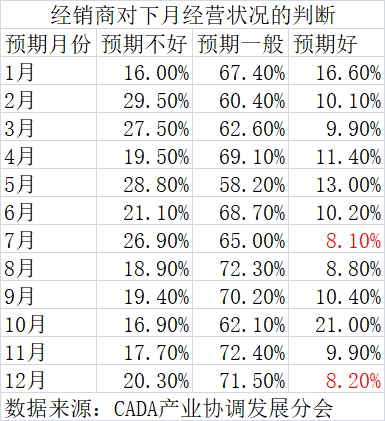
Core Insights - Only 8.2% of automotive dealers expect better operating conditions in December, a decrease of 1.7 percentage points from the previous month, while the proportion expecting poor market conditions has risen to 20.3% [1] - The survey indicates that 32.3% of dealers believe market demand will "decrease" in December, an increase of 7.5 percentage points from the previous month [1] Summary by Categories Dealer Expectations - In December, 20.3% of dealers expect poor conditions, up from 17.7% in November [2] - The percentage of dealers expecting good conditions is only 8.2%, marking the second-lowest level of the year [1][2] Inventory and Market Conditions - The inventory warning index for November was 55.6%, up 3.8 percentage points year-on-year and 3.0 percentage points month-on-month, indicating a decline in the automotive circulation industry's prosperity [2] - 80% of dealers held a pessimistic view of the November market, believing overall performance did not meet expectations [3] Challenges Faced by Dealers - Dealers are facing challenges such as reduced customer traffic, increased market hesitation, and narrowing profit margins on new car sales [3] - Some manufacturers are increasing sales targets for year-end, exacerbating inventory buildup and tightening cash flow for dealers [3] Future Market Outlook - There is a market perspective that the expiration of the vehicle purchase tax exemption in 2026 may trigger consumer buying enthusiasm in December [3] - The China Automobile Circulation Association suggests that dealers should rationally estimate actual market demand and enhance promotion of trade-in and scrapping policies to boost consumer confidence [3]
汽车经销商今日回暖 永达汽车涨超11% 商务部提出全链条扩大汽车消费
Zhi Tong Cai Jing· 2025-11-27 07:52
Core Viewpoint - The automotive dealership sector is experiencing a rebound, with notable stock price increases for several companies, driven by government initiatives to boost automotive consumption and improve market conditions [1] Group 1: Stock Performance - Yongda Automobile (03669) increased by 11.11%, trading at HKD 1.8 [1] - Harmony Auto (03836) rose by 7.95%, trading at HKD 0.95 [1] - Zhongsheng Holdings (00881) saw a 2.5% increase, trading at HKD 11.9 [1] - Meidong Auto (01268) gained 1.27%, trading at HKD 1.6 [1] Group 2: Government Initiatives - The Ministry of Commerce's official Yang Si emphasized that commodity consumption is crucial for promoting consumption and improving livelihoods [1] - Future plans include advancing automotive circulation consumption reforms, expanding the second-hand car market, and developing automotive aftermarket sectors such as modifications, rentals, events, and RV camping [1] Group 3: Industry Conditions - According to Longzhong Information, the inventory warning index for Chinese automotive dealers in October 2025 is at 52.6%, which is a year-on-year increase of 2.1 percentage points and a month-on-month decrease of 1.9 percentage points [1] - The index remains above the neutral line (50%), indicating an improvement in industry sentiment, although inventory pressure has not been fully alleviated [1]
港股异动 | 汽车经销商今日回暖 永达汽车(03669)涨超11% 商务部提出全链条扩大汽车消费
智通财经网· 2025-11-27 07:51
Core Viewpoint - The automotive dealership sector is experiencing a rebound, with notable stock price increases for several companies following government initiatives to boost automotive consumption [1] Group 1: Company Performance - Yongda Automobile (03669) shares rose by 11.11% to HKD 1.8 [1] - Harmony Auto (03836) shares increased by 7.95% to HKD 0.95 [1] - Zhongsheng Holdings (00881) shares went up by 2.5% to HKD 11.9 [1] - Meidong Auto (01268) shares climbed by 1.27% to HKD 1.6 [1] Group 2: Government Initiatives - The Ministry of Commerce's official Yang Si stated that consumer goods consumption is crucial for enhancing livelihoods, and the ministry will promote reforms in automotive circulation [1] - Plans include expanding the second-hand car market and developing the automotive aftermarket, including modifications, rentals, events, and RV camping [1] Group 3: Industry Insights - According to Longzhong Information, the inventory warning index for Chinese automotive dealers in October 2025 is at 52.6%, which is a year-on-year increase of 2.1 percentage points and a month-on-month decrease of 1.9 percentage points [1] - The index remains above the neutral line (50%), indicating an improvement in industry sentiment, although inventory pressure has not been fully alleviated [1]