海洋科研

Search documents
自然资源部第四海洋研究所联合相关科研单位组建广西海洋实验室
Zhong Guo Zi Ran Zi Yuan Bao· 2025-11-06 00:38
Core Viewpoint - The establishment plan for the Guangxi Marine Laboratory has been approved by the Guangxi Zhuang Autonomous Region Science and Technology Committee, aiming to enhance marine technology innovation and support sustainable development in the Beibu Gulf region [1] Group 1: Laboratory Structure and Goals - The laboratory will hold its first council and academic committee meeting on November 1 in Beihai, Guangxi, along with a plaque unveiling ceremony [1] - The laboratory will leverage the research strengths of the Fourth Institute of Oceanography under the Ministry of Natural Resources and the Guangxi Academy of Sciences, integrating various resources and forces [1] Group 2: Research Directions - The laboratory focuses on a "3+1+1" research direction: - "3" main directions addressing core needs of Guangxi's marine industry, including modern fishery technology research, marine new materials and high-end equipment manufacturing, and marine pharmaceuticals and biomedicine [1] - "1" digital foundation to empower industrial development, specifically through AI-based digital construction of marine elements in the Beibu Gulf [1] - "1" open window for international cooperation, linking with marine technology joint research and development between China and ASEAN countries [1] Group 3: Innovation Ecosystem - The goal is to create a marine technology innovation hub that serves the region, radiates nationwide, and connects with ASEAN, focusing on building an integrated innovation ecosystem of "research + industry + talent" [1] - The laboratory aims to provide significant support for promoting sustainable development of the marine economy in the Beibu Gulf region and enhancing marine technology innovation capabilities [1]
权威访谈|国民经济发展“蓝色支撑”稳中有进
Bei Jing Ri Bao Ke Hu Duan· 2025-11-04 12:27
Core Insights - China's marine economy continues to lead globally, with marine GDP growth outpacing national GDP growth by 0.4 percentage points, reaching 7.9 trillion yuan, a 5.6% year-on-year increase [3][9] - The marine fishery sector shows robust growth, with marine product output increasing by 4.8%, and marine aquaculture output rising by 5.7% [3][4] - The shipbuilding industry remains strong, with new orders and completed ship volumes increasing significantly, maintaining a global market share of 63.5% for new orders [6][9] Marine Economy Development - The marine GDP reached 7.9 trillion yuan in the first three quarters, growing by 5.6% year-on-year, providing a solid "blue support" for national economic development [3] - The construction of "blue granaries" is progressing, with marine product output increasing by 4.8%, driven by advancements in marine aquaculture [3][4] - Significant breakthroughs in oil and gas exploration have been achieved, with marine crude oil and natural gas production increasing by 3.0% and 17.7%, respectively [3][4] Marine Energy Sector - The supply of marine clean energy is improving, with offshore wind power generation increasing by 3.7% and new grid-connected capacity rising by 42.1% [4] - Major offshore wind projects have been successfully connected to the grid, indicating a shift towards deeper waters and larger capacities [4] Shipbuilding and Marine Equipment - The shipbuilding industry is stable, with completed ship volumes and order backlogs increasing by 6.7% and 25.7%, respectively [6] - China's marine engineering equipment continues to dominate the international market, with new orders accounting for 60.0% of the global market share [6][9] Technological Advancements - Progress in deep-sea exploration technologies has been made, with successful operations in various marine environments [6] - The introduction of intelligent manufacturing technologies in the marine sector, including AI applications and green shipbuilding initiatives, is on the rise [7] Marine Resource Management - The approval of marine space usage has increased by 19.2%, with investments exceeding 641.9 billion yuan, supporting major projects [9] - A significant proportion of marine enterprises reported growth in revenue, profit, and workforce, indicating a positive trend in the marine economy [9]

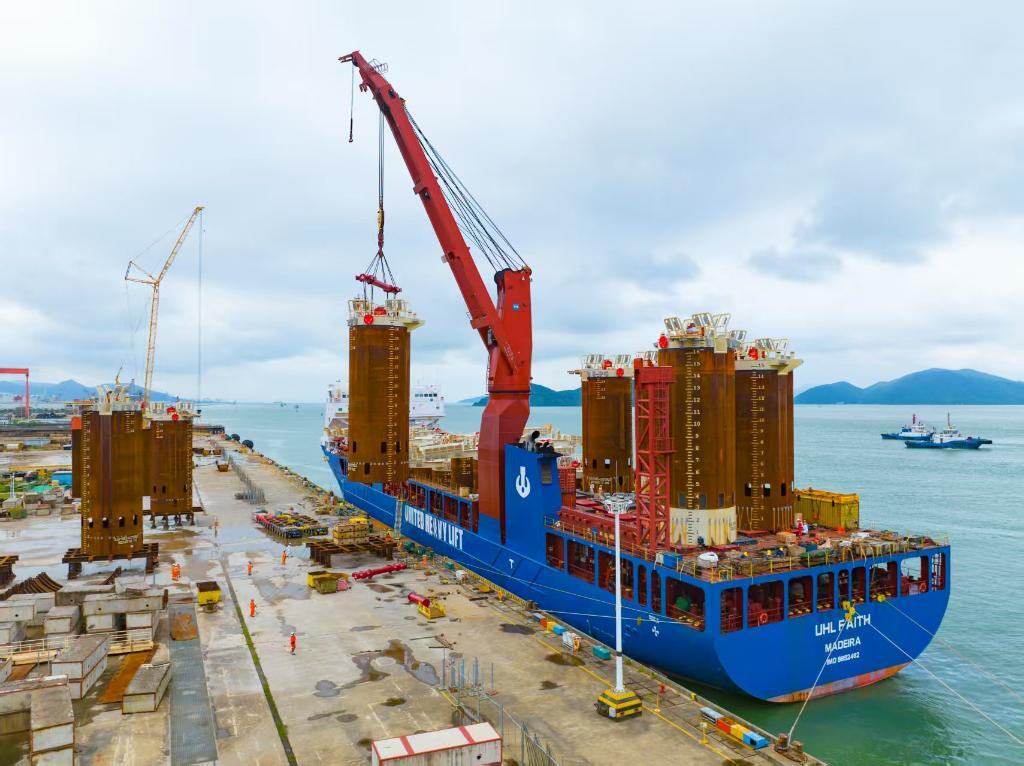
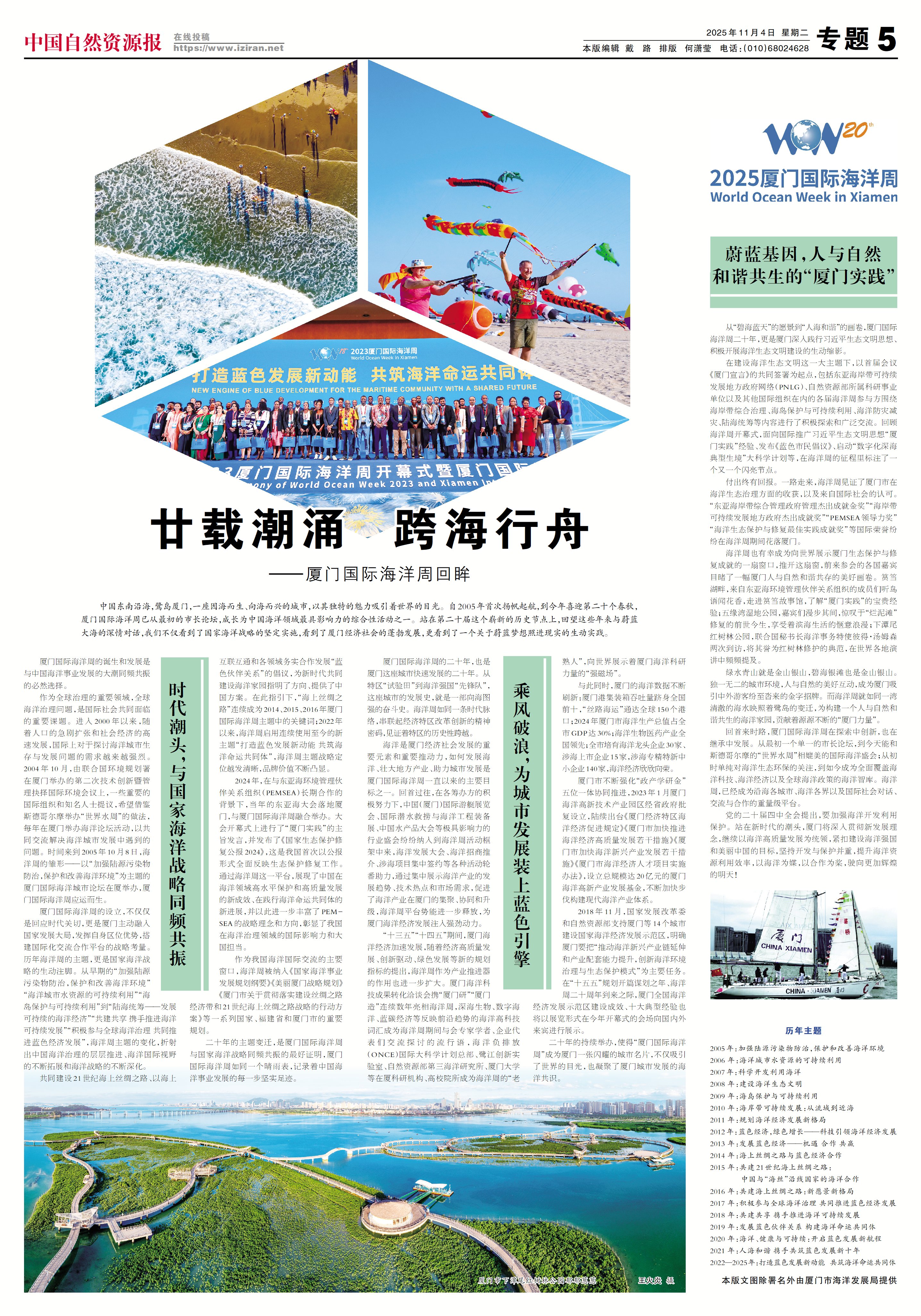
廿载潮涌 跨海行舟——厦门国际海洋周回眸
Zhong Guo Zi Ran Zi Yuan Bao· 2025-11-04 02:15
Core Viewpoint - The Xiamen International Ocean Week has evolved into a significant platform for marine governance and development in China, reflecting the country's commitment to marine strategy and sustainable development over the past two decades [4][8][11]. Group 1: Historical Development - The Xiamen International Ocean Week began in 2005 as a response to the growing need for discussions on marine urban development, inspired by international initiatives like the "World Water Week" in Stockholm [11][12]. - The event has grown from a mayoral forum to one of the most influential marine events in China, marking its 20th anniversary in 2024 [8][19]. Group 2: Strategic Importance - The establishment of the Ocean Week aligns with national development goals, leveraging Xiamen's geographical advantages to create an international cooperation platform [5][12]. - Themes of the Ocean Week have evolved to reflect national marine strategies, with recent themes focusing on sustainable marine economic development and international cooperation [12][30][31]. Group 3: Economic Impact - The Ocean Week has facilitated significant events such as the China (Xiamen) International Yacht Exhibition and various marine industry conferences, promoting the growth of the marine economy in Xiamen [16][17]. - Xiamen's marine economy has seen rapid growth, with projections indicating that marine production value will account for 30% of the city's GDP by 2024 [17]. Group 4: Environmental Initiatives - The Ocean Week serves as a platform for showcasing China's achievements in marine ecological protection and restoration, including the release of the "National Ecological Protection and Restoration Bulletin 2024" [13][25]. - The event has garnered international recognition for Xiamen's efforts in marine ecological governance, receiving various awards for excellence in coastal management and sustainable development [25][26]. Group 5: Future Directions - Moving forward, Xiamen aims to enhance its role in marine high-quality development, focusing on balancing marine resource utilization and environmental protection [27]. - The city is committed to continuing its efforts in building a modern marine industry system, supported by various government initiatives and funding [18].
前三季度海洋生产总值同比增长5.6%
Ke Ji Ri Bao· 2025-11-04 00:42
Core Insights - The marine economy in China has shown a stable and progressive trend in the first three quarters, with a marine GDP of 7.9 trillion yuan, reflecting a year-on-year growth of 5.6% [1] Group 1: Emerging Industries - The development of emerging marine industries has accelerated, with marine engineering equipment deliveries and hand-held order amounts increasing by 13.6% and 7.0% year-on-year, respectively [1] - Significant breakthroughs have been achieved in various marine engineering equipment products, including the delivery of 24 sets of 2000-meter level ultra-deepwater marine equipment and the application of China's first deepwater oil and gas underwater robot with seven functional mechanical arms [1] - The world's largest floating wind power platform, "Three Gorges Pioneer," and the first 80,000-ton marine aquaculture vessel, "Senhai Pioneer," have been successfully delivered [1] - The research and development of marine pharmaceuticals is progressing steadily, with the clinical trial approval of LY104 injection, which has independent intellectual property rights [1] Group 2: Digital Intelligence in Marine Sector - The construction of intelligent capabilities in the marine sector has reached new heights, with the launch of the first trusted data space in the marine field in Zhejiang and the release of "AI + Marine" industry application scenarios in Shenzhen [2] - China Shipbuilding Group has introduced several AI innovations, including the "Smart Sea · Turing" platform and various intelligent product safety testing platforms, which strengthen the foundation for building a digital ecosystem in the shipbuilding industry [2] - The first domestically developed intelligent welding robot system for marine engineering has been completed, filling a gap in intelligent welding equipment in China [2] - The first intelligent coating production line for marine oil and gas equipment has been put into operation, significantly improving work efficiency [2] Group 3: Deep Sea Exploration Advances - New progress has been made in deep-sea polar exploration, with the "Marine Geological No. 2" research vessel successfully collecting and igniting combustible ice at a depth of 1522 meters in the northern South China Sea [2] - The "Insight" autonomous underwater robot has successfully completed operational tests in the Pacific Ocean's nodule mining area [2] - China has successfully deployed the first set of observation buoy systems for depths exceeding 3500 meters in the South China Sea, achieving comprehensive synchronous observation from the atmosphere to underwater [2] - The "Jiaolong" manned submersible has completed its first dive under the Arctic ice [2]
权威访谈|国民经济发展“蓝色支撑”稳中有进——访自然资源部海洋战略规划与经济司负责人
Xin Hua Wang· 2025-11-03 16:44
Core Insights - China's marine economy shows robust growth, with marine GDP reaching 7.9 trillion yuan, a year-on-year increase of 5.6%, outpacing the national GDP growth by 0.4 percentage points [2] - The marine fishery sector continues to thrive, with marine product output increasing by 4.8%, and marine aquaculture output rising by 5.7% [2] - The offshore wind power sector is advancing, with offshore wind power generation increasing by 3.7% and new grid-connected capacity rising by 42.1% [3] Marine Economy Development - The marine economy provides a solid "blue support" for national economic development, with significant contributions from fisheries and energy sectors [2] - The construction of "blue granaries" is progressing, enhancing energy extraction from the ocean [2] - Oil and gas production from marine sources has seen increases of 3.0% for crude oil and 17.7% for natural gas [2] Marine Engineering and Manufacturing - China's shipbuilding industry remains strong, with ship completion and order volumes increasing by 6.7% and 25.7% respectively [4] - New orders, completed ships, and hand-held orders account for 63.5%, 47.3%, and 58.6% of the global market share, respectively [4] - The marine engineering sector continues to lead globally, with new orders and delivery amounts holding 60.0% and 50.8% of the international market [4] Technological Advancements - Significant advancements in deep-sea exploration and marine technology have been achieved, including successful trials of new equipment in extreme environments [4] - The first trustworthy data space in the marine sector has been launched, and various AI innovations are being integrated into marine applications [5] - The share of new green ship orders in the international market has reached 70.6%, indicating a strong push towards sustainable shipping practices [5] Investment and Resource Management - The area approved for marine and island use has increased by 19.2%, with investments exceeding 641.9 billion yuan, supporting major projects [6] - A majority of marine enterprises reported growth in revenue, profit, and workforce, indicating a positive trend in the marine economy [6] - Continuous innovation and investment in R&D are being observed in the marine sector, with significant increases in funding and personnel [6]
9069万元!自然资源部海洋研究所采购大批仪器设备
仪器信息网· 2025-10-31 09:39
Core Insights - The Ministry of Natural Resources has announced procurement intentions for 21 types of instruments and equipment, with a total budget of 90.69 million yuan, expected to be procured between May and October 2025 [2][3]. Instrument Procurement Overview - The procurement includes advanced systems for coastal ecological monitoring, underwater positioning, geological event observation, and various analytical instruments such as multi-parameter water quality analyzers and research-grade stereomicroscopes [3][4][5]. Detailed Instrument Descriptions - **Multi-parameter Water Quality Analyzer**: A high-tech device capable of simultaneously detecting multiple water quality parameters, including COD, ammonia nitrogen, total phosphorus, total nitrogen, and heavy metals, utilizing spectrophotometry and electrochemical sensing technologies [4]. - **Research-grade Stereomicroscope**: Designed for precision observation, this microscope provides a three-dimensional visual effect and is suitable for measuring the internal structure of thick samples like biological tissues [5]. Procurement Schedule and Budget - The total budget for the procurement is 90.69 million yuan, with specific instruments scheduled for acquisition in the period from May to October 2025 [2][3].

青岛|向海图强,激活海洋科创“一池春水”
Da Zhong Ri Bao· 2025-10-29 08:07
Core Insights - Qingdao Rayce Chuangxin Technology Co., Ltd. has developed 3D scanning wind lidar technology, transforming invisible wind data into real-time 3D data, with an output value exceeding 400 million yuan [1] - Qingdao ranks 16th globally among 60 marine cities in the "Global Ocean City Competitiveness Index 2025," with a strong emphasis on marine scientific research and innovation [1] - The city has implemented policies to facilitate the transformation of scientific achievements into production, resulting in significant collaborations and financing in the marine technology sector [2] Group 1 - The 3D scanning wind lidar technology has been widely applied in meteorology, wind power, and aviation, marking a leap from "following" to "keeping pace" with international standards [1] - Qingdao has about 20% of the country's marine research institutions and nearly one-third of high-end research platforms, showcasing its strong marine scientific and educational advantages [1] - The establishment of the first national marine technology market has led to the collection of 13,000 achievement demands and over 300 million yuan in financing [2] Group 2 - Qingdao aims to develop over 10 key deep-sea technologies and cultivate around 10 high-growth companies in niche markets by 2027 [3] - The city is focusing on deep-sea general equipment and unmanned equipment, as well as building an industrial cluster for marine artificial intelligence [3] - Ongoing support for core technology research in underwater communication and navigation is expected to inject new momentum into the construction of a smart ocean [3]
浙江省海洋科学院博士后工作站启动
Zhong Guo Zi Ran Zi Yuan Bao· 2025-10-27 06:02
Core Insights - The Zhejiang Provincial Human Resources and Social Security Department has awarded the "Zhejiang Provincial Postdoctoral Research Station" to the Zhejiang Ocean University, marking the full launch of a high-level talent introduction and training platform [1] Group 1: Research Focus Areas - The research station has identified nine key research directions, including marine spatial resource management and efficient utilization, carbon cycling processes in marine ecosystems, monitoring technologies for estuarine and nearshore continuum, and AI applications in marine data [1] Group 2: Recruitment and Management - The Zhejiang Ocean University officially commenced postdoctoral recruitment in June 2025, with two postdoctoral researchers already engaged in research activities as of the end of September [1] - A comprehensive management system has been established, outlining salary and welfare mechanisms for postdoctoral researchers during their tenure [1] Group 3: Incentive Structure - The research station employs a "basic salary + research rewards" model, with research rewards based on output and no upper limit, aimed at enhancing the research enthusiasm of postdoctoral researchers [1] Group 4: Future Collaboration and Development - The Zhejiang Ocean University plans to use the postdoctoral research station as a key platform to deepen collaboration with marine-related universities and research institutions both domestically and internationally, thereby strengthening high-level talent cultivation [1]
2025中国海洋经济论坛在威海召开
Da Zhong Ri Bao· 2025-10-19 00:34
Core Insights - The 2025 China Marine Economy Forum was held in Weihai, focusing on "Green Low-Carbon Empowerment: Reshaping New Engines for High-Quality Development of the Marine Economy" [1] - Nearly 200 experts, scholars, and graduate students from domestic universities and research institutions participated in the forum [1] Group 1: Key Themes Discussed - Experts concentrated on major national strategic issues such as ecological environment protection, technological innovation breakthroughs, institutional reforms, and deep adjustments in industrial structure during the high-quality development of the marine economy [1] - A roundtable meeting titled "Deans and Entrepreneurs" was held to promote the development of marine humanities and social sciences, as well as to enhance communication among peers [1] Group 2: Participation and Collaboration - The roundtable included experts from over 20 marine-related universities, research institutions, management departments, and marine enterprises [1] - Discussions focused on the construction of marine economy and management disciplines, talent cultivation, and collaborative innovation among government, industry, academia, and research [1]
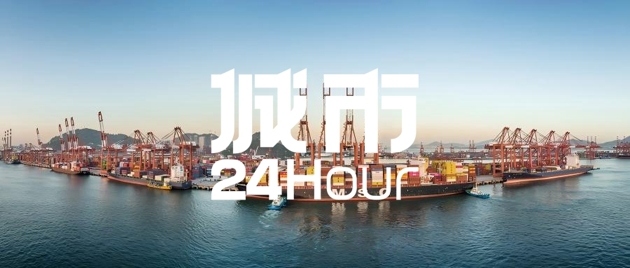
城市24小时 | 海上竞速,深圳如何追上海?
Mei Ri Jing Ji Xin Wen· 2025-10-11 15:25
Core Insights - The "Global Ocean City Competitiveness Index Report (2025)" was released, evaluating 60 global ocean cities based on five dimensions: economic vitality, technological innovation, maritime services, international influence, and urban governance [4] - The report identifies Shanghai, Shenzhen, and Qingdao as the leading ocean economic circles in China, with Shanghai ranked as the global leader in economic vitality and port cargo throughput [4][6] - China's ocean economy has surpassed 10 trillion yuan, with a year-on-year growth of 5.8% in the first half of the year, indicating a strong growth trajectory [6] Economic Circles Overview - The report categorizes global ocean cities into four distinct tiers, with London ranked first globally, followed by New York (3rd), and Singapore (2nd) [5] - Shanghai ranks 4th globally, with its economic vitality and international influence both ranked 2nd, while Shenzhen and Qingdao are positioned in the second tier [6][9] - Shenzhen's ocean production value reached 540.9 billion yuan, accounting for 14.7% of its GDP, while Shanghai's was over 1 trillion yuan, making up 21.1% of its GDP [9] Technological Innovation - Shenzhen ranks 4th globally in technological innovation, supported by its capabilities in marine electronic information, high-end equipment manufacturing, and underwater robotics [4][6] - The report suggests that Shenzhen can leverage technology to enhance its ocean economy, focusing on deep-sea equipment, renewable energy, and smart port operations [9] Future Development Goals - Shenzhen aims to achieve an ocean industrial added value of 215 billion yuan by the end of the 14th Five-Year Plan, with an annual growth rate of over 12% [9] - The report emphasizes the need for Shenzhen to deepen the integration of technology in its ocean economy to compete with Shanghai [9]