网络交易平台

Search documents
市监总局新规《网络交易指南》亮剑 平台“乱收费”乱象能否刹车?
Sou Hu Cai Jing· 2025-08-04 08:56
Core Viewpoint - The newly implemented "Guidelines for Compliance of Charging Behavior on Online Trading Platforms" aims to regulate the charging behaviors of online platforms, addressing issues of excessive fees and unfair practices that hinder the development of small and medium-sized enterprises [1][20]. Summary by Sections 1. Key Prohibitions in the Guidelines - The guidelines prohibit eight types of unreasonable charging behaviors, including repeated charging for the same service, charging without providing corresponding services, and transferring costs that should be borne by the platform to merchants [3][8]. - Specific prohibitions include: - Repeated charging for the same service at different stages [8]. - Charging without adequate service provision [7]. - Transferring platform costs to merchants, such as delivery personnel's social security fees [7][9]. - Charging for basic operational data that should be provided for free [7][9]. - Forcing merchants to participate in promotional activities [9]. - Price discrimination among merchants under similar conditions [9]. 2. Transparency Requirements - The guidelines establish four major transparency requirements to enhance the clarity of charging practices: - Continuous public disclosure of all charging items, rules, and standards on the platform's homepage [11][12]. - A mandatory seven-day public consultation period before any changes to charging rules [11][12]. - Retention of historical versions of charging rules for three years for reference [11][12]. - Clear disclosure of marketing fees and their calculation methods [11][12]. 3. Impact on Platform Economics - The guidelines are expected to reshape the relationship between platforms and merchants, shifting from a "traffic-first" approach to a "value-first" model [14][20]. - Platforms will face pressure to adjust their profit models, as seen in the case of Meituan, where commission income is significant but often includes hidden fees that can exceed 30% for merchants [14][15]. - The guidelines encourage platforms to provide more favorable terms for small and medium-sized merchants, potentially reducing their operational costs [16][20]. 4. Challenges and Future Outlook - Despite the positive implications, challenges remain in enforcing the guidelines, as platforms may find ways to circumvent regulations through rebranding fees or adjusting pricing structures [21][22]. - The effectiveness of the guidelines will depend on the regulatory authorities' ability to enforce compliance and the platforms' willingness to adapt to the new rules [21][24]. - The guidelines represent a significant step towards a more equitable market environment, aiming to stabilize the income of nearly 200 million flexible workers and prevent severe social conflicts [20][27].


降低中小商户负担方能促进平台可持续发展
Di Yi Cai Jing Zi Xun· 2025-08-04 00:48
Core Viewpoint - The newly released "Compliance Guidelines for Charging Behavior of Online Trading Platforms" aims to clarify the principles of platform charging, advocate for reduced burdens on platform operators, and enhance compliance and self-discipline among platforms [2] Industry Overview - The platform economy in China has seen rapid growth, with online shopping users expected to reach 974 million by December 2024, accounting for nearly 90% of internet users. The online retail sales of physical goods are projected to reach 13,081.6 billion yuan, representing 26.8% of total retail sales [2] - The platform economy has created approximately 200 million jobs [2] Issues Identified - There are several issues within the charging practices of platforms, including numerous and complex fees, lack of transparency, and forced participation in paid services or promotional activities [2][4] - The guidelines specifically address unreasonable charging behaviors such as duplicate charges, charging without providing services, and price discrimination among platform operators [4] Compliance Requirements - Charging practices must be compliant with laws and industry standards, promoting self-discipline among platform enterprises [5][6] - The legal basis for compliance includes the Price Law and the E-commerce Law, which mandate fair and lawful pricing practices [6] Support for Small and Medium Enterprises - The guidelines emphasize the need to support small and medium-sized merchants by providing preferential charging policies and encouraging platforms to offer beneficial services [7] - Small operators are particularly vulnerable and lack bargaining power, making their support crucial for the sustainability of the platform economy [7]

降低中小商户负担方能促进平台可持续发展
第一财经· 2025-08-04 00:35
Core Viewpoint - The article discusses the recently released "Compliance Guidelines for Charging Behavior of Online Trading Platforms," which aims to regulate platform charging practices, reduce the burden on platform operators, and promote mutual development between platforms and their operators [2][4]. Summary by Sections Development of Platform Economy - The platform economy in China has seen rapid growth, with online shopping users expected to reach 974 million by December 2024, accounting for nearly 90% of internet users. The online retail sales of physical goods are projected to reach 13,081.6 billion yuan, representing 26.8% of total retail sales [2]. Issues in Charging Practices - There are numerous complaints from merchants regarding the complexity and lack of transparency in platform charging practices. Issues include excessive and unclear fees, forced purchases of services, and hidden charges [2][4]. Focus on Reducing Burden on Operators - The guidelines emphasize the need to reduce the financial burden on platform operators, recognizing that both platforms and operators are in a symbiotic relationship. The success of one is tied to the success of the other [3][6]. Specific Requirements for Charging Practices - The guidelines outline several unreasonable charging behaviors that need to be addressed, such as duplicate charges, charging without providing services, and price discrimination among operators with similar transaction conditions [4][5]. Compliance as a Foundation - Compliance with laws and industry standards is crucial for platform charging practices. The guidelines encourage industry associations to promote self-regulation and establish communication mechanisms with platforms to ensure fair charging practices [5]. Support for Small and Medium-sized Enterprises - The guidelines advocate for platforms to provide preferential services and support for small and medium-sized enterprises (SMEs), recognizing their vulnerable position and the importance of their participation in the platform economy [6][7].

《网络交易平台收费行为合规指南》施行 优化平台经济生态
Zheng Quan Ri Bao· 2025-08-03 16:05
Core Viewpoint - The National Market Supervision Administration has implemented the "Guidelines for Compliance of Charging Behavior on Online Trading Platforms" to regulate the fees charged by platforms to operators, aiming to promote fair competition and optimize the platform economy ecosystem [1][2]. Group 1: Regulation of Charging Behavior - The guidelines aim to standardize the charging behavior of online platforms, which includes commissions, service fees, and promotional fees, to ensure transparency and fairness in the market [2][3]. - Experts highlight issues such as platforms using traffic support as leverage to force merchants into purchasing promotional services, which undermines fair competition [2][3]. - The guidelines require platforms to establish clear charging standards and publicize their fee structures, which will help make hidden costs visible to merchants [3][4]. Group 2: Reducing Burden on Operators - The guidelines encourage platforms to adopt flexible pricing strategies that benefit small and medium-sized merchants, thereby reducing their operational costs and enhancing their profitability [4][5]. - By lowering the financial burden on operators, the guidelines are expected to stimulate market vitality and enhance the survival space for small businesses [4][5]. - The shift in focus from "traffic operation" to "service innovation" is anticipated to create a win-win situation for both platforms and merchants, fostering a more sustainable platform economy [6].
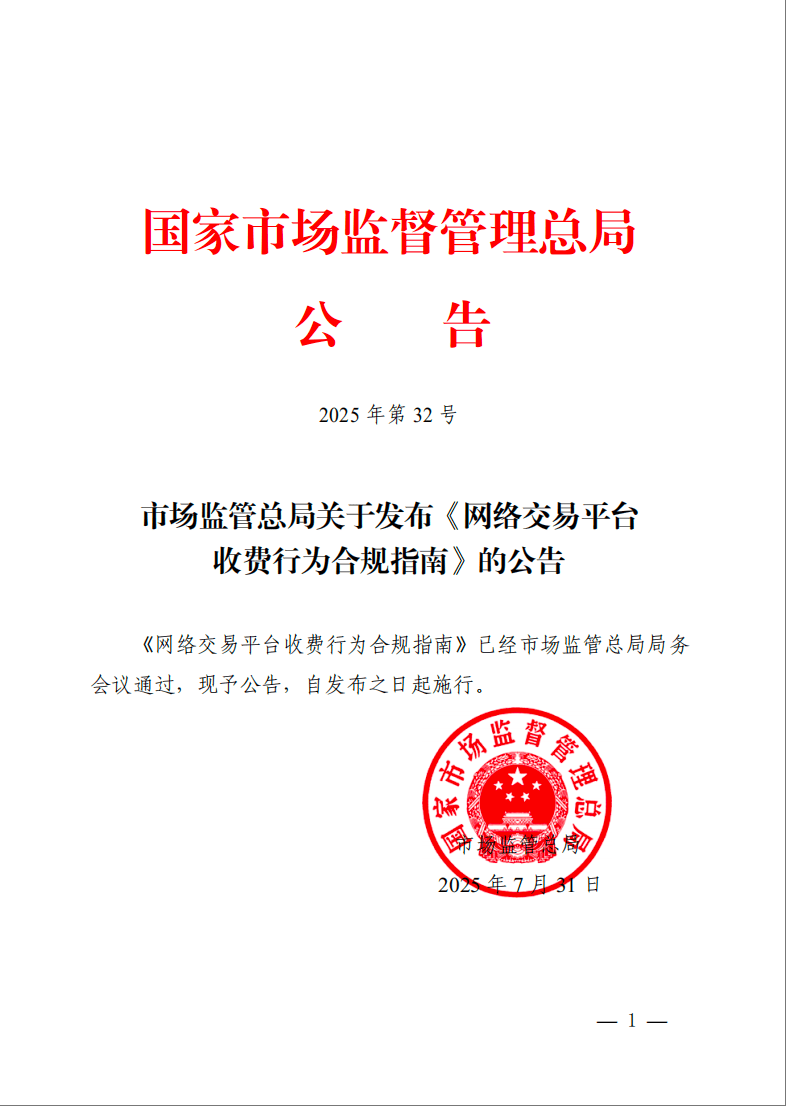
市场监管总局关于发布《网络交易平台收费行为合规指南》的公告2025年第32号
蓝色柳林财税室· 2025-08-03 00:36
Core Viewpoint - The article discusses the implementation of the "Guidelines for Compliance of Charging Behavior of Online Trading Platforms," which aims to regulate the fees charged by online platforms to their operators, ensuring fairness and transparency in the platform economy [1][4]. Summary by Sections Guidelines Overview - The guidelines advocate for reducing the burden on platform operators and emphasize the importance of compliance and self-regulation by platforms [1][2]. - Platforms are required to establish compliance management responsibilities and internal systems to manage and assess risks related to unreasonable charging behaviors [1][9]. Charging Principles - Platforms must not charge operators multiple times for the same service, nor can they impose fees without providing corresponding services [2][38]. - The guidelines prohibit platforms from transferring costs that should be borne by them to the operators and from charging for basic operational data [2][38]. Compliance Management - Platforms are encouraged to create a compliance culture, including training and risk assessment mechanisms to identify and mitigate unreasonable charging risks [9][15]. - The guidelines require platforms to maintain a clear and accessible record of their charging rules and any changes made to them [16][17]. Fee Transparency - Platforms must publicly disclose their charging standards and rules prominently on their homepage, ensuring operators can easily access and understand this information [16][19]. - Any modifications to charging rules must be communicated transparently, allowing operators to provide feedback before changes take effect [15][21]. Support for Operators - The guidelines encourage platforms to offer discounts and support to small and medium-sized businesses, especially during crises such as natural disasters or public health emergencies [8][9]. - Platforms are urged to adopt flexible pricing strategies that consider the operational conditions of their operators [7][8]. Risk Management - Platforms should implement a mechanism to evaluate the necessity of charging deposits and ensure that any such charges are reasonable and transparent [22][25]. - The guidelines promote the use of data technology to monitor and analyze risks associated with unreasonable charging practices [13][30]. Regulatory Compliance - Platforms are required to comply with existing laws and regulations, ensuring that their charging practices do not violate legal standards [26][30]. - The guidelines encourage industry associations to foster self-regulation and communication between platforms and operators to protect the rights of operators, particularly small businesses [31].

市场监管总局发布《网络交易平台收费行为合规指南》 不得向平台内经营者重复收费
Shen Zhen Shang Bao· 2025-08-03 00:27
Core Points - The State Administration for Market Regulation has implemented the "Compliance Guidelines for Charging Behavior of Online Trading Platforms" to regulate the fees charged by platforms to their operators [1][2] - The guidelines emphasize reducing the burden on operators, enhancing compliance self-discipline, and standardizing charging behaviors [1] - Platforms are required to establish compliance management responsibilities and mechanisms to identify and assess risks associated with unreasonable charges [1] Summary by Sections - **Charging Principles**: The guidelines advocate for lowering the financial burden on platform operators and enhancing compliance culture within platforms [1] - **Compliance Management**: Platforms must develop compliance management organizations, appoint compliance personnel, and integrate regulatory systems into their internal compliance protocols [1] - **Fee Transparency**: Platforms are mandated to publicly disclose their charging rules and service agreements prominently on their homepage [1] - **Prohibited Practices**: The guidelines prohibit platforms from charging operators multiple times, charging without providing services, or transferring costs that should be borne by the platform itself [2] - **Data Charges**: Platforms cannot charge operators for providing their basic operational data [2] - **Price Discrimination**: The guidelines prevent platforms from implementing price discrimination against operators with similar transaction conditions [2]
「早报」市场监管总局发文,规范网络交易平台收费;美联储理事库格勒将辞职
Sou Hu Cai Jing· 2025-08-02 23:28
Industry News - China continues to solidify its position as the world's largest industrial robot market, with sales projected to grow from 70,000 units in 2015 to 302,000 units by 2024, marking 12 consecutive years of being the largest market globally [2] - The Zhejiang University Brain-Machine Intelligence National Key Laboratory unveiled a new generation of neuromorphic brain-like computer named "Darwin Monkey" (or "Wukong"), featuring over 2 billion pulse neurons and more than 100 billion synapses, with power consumption around 2000 watts in typical operation [2] Company News - Berkshire Hathaway reported Q2 2025 revenue of $92.515 billion, exceeding expectations [4] - As of August 1, 2025, Tim Cook has served as CEO of Apple for 5,091 days, surpassing Steve Jobs' tenure of 5,090 days, making him the longest-serving CEO in the company's history [4]

《网络交易平台收费行为合规指南》发布
Ren Min Ri Bao· 2025-08-02 21:43
Core Points - The State Administration for Market Regulation has issued and implemented guidelines to regulate the charging behaviors of online trading platforms, aiming to lower the burden on platform operators and enhance compliance and self-discipline within platforms [1][2]. Group 1: Guidelines Overview - The guidelines specify principles that platforms must follow, including the need to establish compliance management responsibilities and organizations, and to integrate regulatory systems into compliance protocols [1]. - Platforms are required to publicly disclose their charging rules prominently on their homepage and must seek public opinion before modifying these rules [1]. Group 2: Prohibited Practices - Platforms are prohibited from charging platform operators multiple times for the same service, charging without providing services, or transferring costs that should be borne by the platform itself [2]. - The guidelines also forbid platforms from charging for basic operational data, coercing operators into purchasing services, or implementing discriminatory pricing practices among operators with similar transaction conditions [2].
规范佣金、抽成等,网络交易平台收费有新规范!
Cai Jing Wang· 2025-08-02 13:18
Core Points - The State Administration for Market Regulation issued the "Compliance Guidelines for Charging Behavior of Online Trading Platforms" on July 31, aiming to standardize the fees charged by platforms to their operators [1] - The guidelines emphasize reducing the burden on operators, enhancing self-discipline, and regulating charging behaviors [1] - Platforms are required to establish compliance management responsibilities and mechanisms to identify and assess unreasonable charging risks [1] Summary by Sections Charging Principles - Platforms must adhere to principles that advocate for lowering the operational burden on platform operators [1] - Compliance management responsibilities must be clearly defined and integrated into the platform's operational framework [1] Fee Disclosure and Management - Platforms are obligated to publicly disclose their charging rules prominently on their homepage [1] - Any changes to charging rules must be publicly consulted [1] - Historical versions of charging rules must be retained for three years [1] Prohibited Practices - Platforms are prohibited from charging operators multiple times for the same service [2] - Platforms cannot charge fees without providing corresponding services [2] - Platforms must not transfer costs that should be borne by them to the operators [2] - Charging for basic operational data from operators is not allowed [2] - Platforms cannot force operators to purchase services or participate in promotional activities [2] - Discriminatory pricing practices among operators under similar trading conditions are forbidden [2]
刚刚发布!事关网络交易平台收费,指南来了!
Sou Hu Cai Jing· 2025-08-02 09:29
Core Points - The National Market Supervision Administration has issued the "Guidelines for Compliance of Charging Behavior of Online Trading Platforms" to regulate the fees charged by platforms to their operators [1][3][5] - The guidelines emphasize the obligation of platforms to publicly disclose their charging rules and service agreements prominently on their homepage [1][5][14] - Platforms are prohibited from charging multiple fees for the same service, imposing fees without providing corresponding services, and transferring costs that should be borne by the platform itself [1][12][13] Summary by Sections Guidelines Overview - The guidelines aim to standardize and guide the charging behavior of online trading platforms, protecting the legitimate rights of operators and promoting sustainable development of the platform economy [5][6] - The guidelines are based on relevant laws such as the Price Law and the E-commerce Law of the People's Republic of China [5][6] Charging Rules - Platforms must establish fair, legal, and honest charging standards based on their operational costs and service agreements [5][6] - Platforms are encouraged to offer flexible pricing strategies and discounts to support small and medium-sized enterprises [6][10] Compliance and Management - Platforms are required to implement compliance management responsibilities and integrate charging compliance into their internal management systems [6][8] - A mechanism for identifying and assessing unreasonable charging risks must be established by the platforms [8][12] Reporting and Transparency - Platforms must maintain transparency by continuously disclosing charging items, rules, and standards to operators [9][14] - Operators can report excessive charges and platforms must respond promptly and negotiate with them [12][13] Prohibited Practices - The guidelines explicitly prohibit practices such as double charging, charging without service, and price discrimination among operators with similar transaction conditions [12][13][10] - Platforms must not impose unreasonable conditions for the refund of deposits or charge for basic operational data [11][12]