农业种植

Search documents
富邦科技前三季度营收增9.19%,科技创新驱动绿色转型
Zheng Quan Shi Bao Wang· 2025-10-26 13:40
Core Insights - Fubon Technology reported a revenue of 1.016 billion yuan for the first three quarters, a year-on-year increase of 9.19%, and a net profit attributable to shareholders of 80.6494 million yuan, with a net profit of 76.4804 million yuan after excluding non-recurring gains and losses [1] - The company is focusing on optimizing its business structure and technological innovation in line with national agricultural development plans [1] - Fubon Technology is advancing its strategic transformation towards precision, green, efficient, and nutritional agricultural products, enhancing product performance and market competitiveness [1] Business Development - The company is deepening the integration of water, fertilizer, pesticides, biotechnology, and digital technology in its modern agriculture sector, establishing partnerships with major agricultural platforms for technology demonstration and application [1] - Fubon Technology has invested 37.8507 million yuan in R&D in the first three quarters, focusing on new green agricultural chemical agents and digital agriculture [2] - The company has been recognized as a "Green Manufacturing List (Green Factory)" in Hubei Province, emphasizing clean production and resource recycling [2] Environmental Initiatives - Fubon Technology has developed a zero-carbon agricultural park model that integrates zero-carbon energy supply, low-carbon agricultural production, and ecological circular development [2] - The company has achieved significant results in carbon reduction through optimizing agricultural input structures and promoting waste resource utilization [2] - The certification of the zero-carbon agricultural park marks a significant advancement in agricultural carbon neutrality technology application, providing a solid foundation for promoting zero-carbon agricultural models [3]

保护黑土地 大国粮仓更稳固(总书记的关切·落地的回响)
Ren Min Ri Bao· 2025-10-25 22:54
Core Points - The Chinese government emphasizes the importance of protecting black soil, referred to as the "panda of arable land," to ensure sustainable agricultural productivity for future generations [1][4] - Significant investments and initiatives are being implemented to combat soil erosion and improve agricultural yields in Northeast China's black soil region [2][3] Group 1: Government Initiatives - The central government has allocated 144.06 billion yuan to the Northeast black soil region during the 14th Five-Year Plan, focusing on the treatment of 57,300 erosion gullies and protecting approximately 13.74 million acres of arable land, resulting in an annual increase of about 330 million jin of grain production [2] - The 2025 Central Document No. 1 highlights the need to strengthen the governance of erosion gullies in the Northeast black soil area [1][3] Group 2: Local Success Stories - In Yongfa Village, Heilongjiang Province, the treatment of a 2,810-meter-long erosion gully has led to a remarkable increase in corn yield from 300 kg per mu to over 1,000 kg per mu [1] - Local farmers are benefiting from various subsidies for black soil protection, including 20 yuan per mu for straw returning, 30 yuan per mu for deep plowing, and 150 yuan per mu for crop rotation, with one farmer receiving nearly 20,000 yuan in total subsidies [2] Group 3: Innovative Approaches - The Ministry of Water Resources is exploring ecological product value transformation to address challenges in valuation, collateral, and monetization of ecological benefits, with a focus on collaborative efforts between central and local governments [3] - The introduction of the "Black Soil Protection Law" aims to provide robust measures for safeguarding this critical agricultural resource, with over 400 million acres of black soil protected during the 14th Five-Year Plan [4]
邮储银行广东龙川县支行用精准服务激活县域经济发展动能
Zheng Quan Ri Bao Zhi Sheng· 2025-10-25 17:10
Core Insights - Postal Savings Bank of China in Longchuan County is leveraging financial innovation to address the financing challenges in agriculture, thereby stimulating local economic development [1][3] Group 1: Agricultural Financing Innovations - The bank has developed a unique assessment model for oil tea plantations, allowing for a credit limit of 4 million yuan for a company based on the potential yield and market conditions [2] - The bank's support has enabled the expansion of oil tea plantations from 2,000 acres to 5,000 acres, resulting in a 50% annual increase in online sales of derived products [2][3] - By September 2025, the bank has provided over 120 million yuan in credit to 20 oil tea enterprises and 26 cooperatives, supporting an annual output value exceeding 1 billion yuan [2][3] Group 2: Support for Technological Innovation - The bank's "Science and Technology Credit Loan" has facilitated a company in the high-end equipment manufacturing sector to secure a 50 million yuan credit line, enabling significant advancements in production capacity and patent development [4][5] - The company’s production capacity increased from 8,000 tons to 12,000 tons, and product quality improved significantly after receiving the loan [5] Group 3: Assistance for Small and Micro Enterprises - The bank has implemented a rapid approval process for small and micro enterprises, reducing loan approval times from 15 days to 7 days, which has been crucial for companies needing to capitalize on market opportunities [6][7] - By September 2025, the bank has provided over 230 million yuan in credit to 26 small and micro enterprises, contributing to a 25% increase in their survival rates and creating over 3,000 jobs [7] Group 4: Overall Impact on Local Economy - The bank's approach emphasizes becoming a growth partner for enterprises and a supportive entity for farmers, thereby enhancing the overall quality of economic development in the region [7]

智慧农业:第三季度净利润48.55万元,同比下降96.64%
Jing Ji Guan Cha Wang· 2025-10-25 07:54
Group 1 - The core viewpoint of the article highlights that Wisdom Agriculture (000816) reported a significant decline in both revenue and net profit for the third quarter of 2025 [1] Group 2 - In the third quarter of 2025, the company achieved an operating income of 326 million yuan, representing a year-on-year decrease of 20.07% [1] - The net profit for the same period was 485,500 yuan, which reflects a substantial year-on-year decline of 96.64% [1]

美国要把事情闹大,连出3招没能镇住中国,特朗普:不能再犹豫了
Sou Hu Cai Jing· 2025-10-25 04:34
Background - The intensification of US-China relations is marked by a series of aggressive measures taken by the US, including tariffs, technology restrictions, and supply chain disruptions, which have not achieved the intended effects [1] US Measures - The US announced a 100% tariff on certain Chinese goods starting November 1, 2025, primarily targeting Chinese manufacturing, which may increase living costs for US consumers but is unlikely to weaken China's economy [1] - The US Department of Commerce has decided to restrict exports of core industrial software to China, including those related to chip design, aerospace, and artificial intelligence, aiming to undermine China's competitiveness in high-tech sectors [1] - The US has threatened to cut off Boeing's supply of parts to China's aviation industry, which could impact China's aviation sector and potentially harm US businesses as well [1] China's Response - China has implemented strict export restrictions on rare earth materials, crucial for high-end chips, military equipment, and electric vehicles, posing a direct threat to the US high-tech industry, which relies on China for over 90% of its rare earth imports [3] - China has imposed special port fees on US ships, increasing operational costs for US shipping companies and shifting global shipping dynamics towards the Chinese market [3] - China has ceased purchasing soybeans from the US and signed a long-term supply agreement with Brazil, putting significant pressure on US agricultural states and diminishing US trade advantages with China [4] International Reactions - Many countries, including Japan and South Korea, have expressed reluctance to take sides in the US-China conflict due to their economic dependence on the Chinese market [4] - India is inclined to maintain a balanced stance between major powers rather than aligning with the US, given tensions over trade agreements and regional issues [4] - European nations generally exhibit caution towards US hardline policies, preferring cooperation with China over confrontation [4] Impact on the US - The US stock market has experienced significant volatility due to tariff threats and supply chain issues, with a market capitalization loss exceeding $1.65 trillion [5] - US farmers face economic losses due to China's halt in soybean purchases, leading to protests in some states [5] - Boeing may lose market share in China due to potential supply chain disruptions, facing dual pressures from the situation [5] Significance for China - China's measures, such as rare earth export controls and port fee responses, effectively protect its economic interests and promote self-reliance in high-tech sectors, showcasing its resilience in the global supply chain [6] - The situation reflects the intense competition between the US and China in economic and technological domains, indicating profound changes in the future international order [6] - China's precise countermeasures not only safeguard its interests but also provide a reference for other countries in addressing unilateralism [6]


泰安市市场监管局以标准为引擎 多领域绘就高质量发展新图景
Qi Lu Wan Bao Wang· 2025-10-24 15:27
Core Viewpoint - The 56th World Standards Day emphasizes the importance of standards in promoting sustainable development and high-quality economic growth, highlighting the role of standardization as a foundation for innovation and industry transformation [1] Group 1: Policy and Institutional Support - The local government has implemented a series of policies to enhance the standardization strategy, providing a solid institutional guarantee for enterprises to engage in standardization activities [2] - High-level standardization events have been organized, such as the ISO/TC221 meeting and the National Textile and Apparel Standard Innovation Conference, to foster collaboration and knowledge sharing [2] - A special action to assist enterprises in standardization has been initiated, involving experts to provide targeted guidance on production and standard alignment challenges [2] Group 2: Industry Integration and Smart Manufacturing - A new standardization mechanism has been established to promote the integration of standards with smart manufacturing and digital transformation [3] - The city has been approved as a national pilot for intelligent factory construction in the power distribution and control equipment sector, integrating advanced technologies like AI and big data [3] - Companies like Shandong Lude New Materials Co., Ltd. are leading the way in standardizing the entire industrial chain for geosynthetic materials, transitioning from fragmented standards to a comprehensive system [3] Group 3: Green and Low-Carbon Development - The focus on green and low-carbon development has led to the collaboration between standard innovation and technology innovation to achieve carbon neutrality goals [4] - Companies such as Taishan Glass Fiber Co., Ltd. have contributed to the development of national standards that support the green transformation of the new materials industry [4] - Taishan Gypsum Co., Ltd. is exploring new models for circular economy development through the establishment of standards for green building materials made from industrial waste [4] Group 4: Agricultural Standardization and Rural Revitalization - The implementation of modern agricultural standardization actions aims to enhance the entire agricultural value chain, with a focus on smart agriculture [5] - The "Taishan Tomato" project has been recognized as a national standardization pilot, promoting precision and efficient planting through advanced technologies [5] Group 5: Social Management and Service Standards - The establishment of national and provincial service standardization pilots in key areas such as tourism and healthcare has significantly improved social management levels [7] - The integration of standards in social management has led to the development of over 100 national, industry, and local standards, optimizing resource allocation [7] Group 6: Local Standard Quality Improvement - The local standard reform pilot is advancing the transition from quantity-focused to quality-focused standardization efforts [8] - The successful inclusion of the "Lu Embroidery Craft Technical Specification" in the provincial local standard project plan aims to enhance the quality and efficiency of the Lu embroidery industry [8]
智慧农业:第三季度净利润1025.27万元,同比下降67.15%
Xin Lang Cai Jing· 2025-10-24 11:10
Group 1 - The core viewpoint of the article indicates that Smart Agriculture has experienced a significant decline in both revenue and net profit in the third quarter and the first three quarters of the year [1] Group 2 - In the third quarter, the company's revenue was 326 million yuan, representing a year-on-year decrease of 20.07% [1] - The net profit for the third quarter was 10.25 million yuan, showing a year-on-year decline of 67.15% [1] - For the first three quarters, the total revenue amounted to 910 million yuan, which is an 18.90% decrease compared to the same period last year [1] - The net profit for the first three quarters was 31.83 million yuan, reflecting a year-on-year drop of 56.73% [1]
“专项贷款”助力秋粮归仓
Qi Lu Wan Bao· 2025-10-24 09:32
Core Insights - The article highlights the financial support provided by China Bank to an agricultural development company in Dezhou, which received a special loan of 6 million yuan to purchase large drying equipment, ensuring the effective storage of autumn grain amidst adverse weather conditions [1][2] Group 1: Company Overview - The agricultural development company, established in 2015, focuses on crop planting, storage, drying, and grain trading [1] - The company has introduced an innovative "Grain Merchant +" business model and has formed a modern agricultural industry chain consortium, earning multiple provincial honors and training over 20 agricultural technicians [1] Group 2: Financial Support and Impact - China Bank's Dezhou branch responded quickly to the company's needs, conducting on-site assessments and providing a loan of 6 million yuan to upgrade existing drying equipment [2] - With the financial support, the company's drying efficiency significantly improved, achieving a daily drying capacity of over 1,000 tons and increasing storage capacity from 8,000 tons to 17,000 tons, addressing storage issues for over 10,000 acres of autumn grain [2] Group 3: Future Plans - China Bank plans to continue supporting key agricultural activities such as autumn harvest and sowing, enhancing policy guidance, and innovating financial services to strengthen credit support for agricultural production and industry revitalization [2]

农行宁夏分行:以金融之“笔”书写“三农”发展塞上新答卷
Zhong Guo Jin Rong Xin Xi Wang· 2025-10-24 07:49
Core Insights - Agricultural Bank of China Ningxia Branch is actively supporting rural development and poverty alleviation through targeted financial services during the 14th Five-Year Plan period, with a focus on enhancing the agricultural sector and assisting ecological migrants [1][4]. Group 1: Agricultural Financing - The agricultural loan balance of Agricultural Bank of China Ningxia Branch increased from 24.75 billion yuan at the end of 2020 to 30.66 billion yuan by the end of August 2025, facilitating the connection between poverty alleviation and rural revitalization in Ningxia [1]. - The bank has focused on six key agricultural industries, including wine, goji berries, milk, beef cattle, Tan sheep, and cool-season vegetables, with a total loan balance of 12.2 billion yuan for these industries, resulting in a compound income growth of 5.8% for farmers over the past three years [2]. - The bank has provided 1.6 billion yuan in loans specifically for the goji berry industry, employing a "company + cooperative + farmer" guarantee model to support market merchants and enhance the supply chain [3]. Group 2: Support for Ecological Migrants - The bank has introduced the "Immigrant Prosperity Loan" to address the financial challenges faced by relocated populations, with a total of 3.19 billion yuan in loans disbursed to support the establishment of a demonstration area for poverty alleviation among relocated migrants in Hongshibao District [4]. - The success stories of relocated individuals, such as Wang Hangdi, highlight the impact of financial support from the bank in establishing profitable agricultural ventures, which in turn benefit the local community [4]. Group 3: Collaboration with Fujian Province - The bank is enhancing financial services in collaboration with Fujian Province, marking the 30th anniversary of the Fujian-Ningxia cooperation in 2026, focusing on mutual benefits and complementary advantages [6]. - A strategic cooperation agreement has been signed with the government of Minning Town to provide comprehensive financial services to over 600 Fujian entrepreneurs operating in Ningxia [6][7]. - The bank's financial support has been crucial for local businesses, such as the Helan Shen Wine Group, which received a 25 million yuan loan to overcome initial funding challenges, subsequently creating approximately 1,500 jobs for local ecological migrants [7].
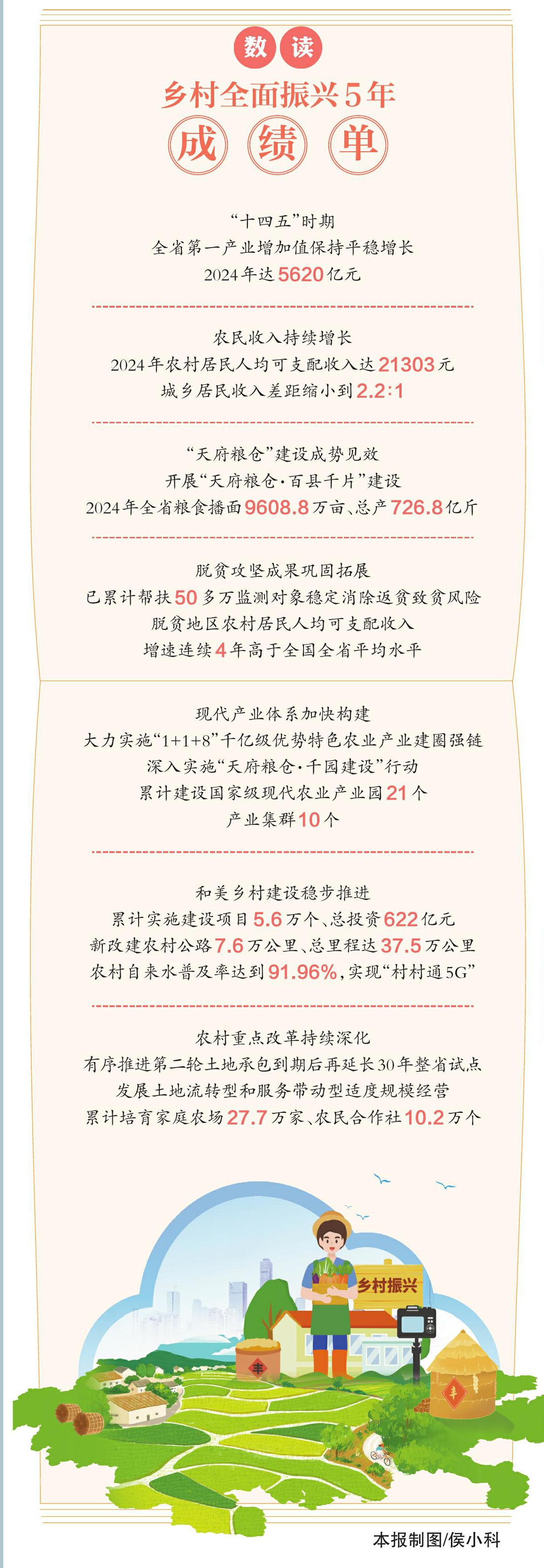
四川“十四五”时期推进乡村全面振兴主要成就发布 乡村产业更强 农村环境更优
Si Chuan Ri Bao· 2025-10-24 00:43
Core Insights - The article highlights the achievements of Sichuan province in promoting rural revitalization during the "14th Five-Year Plan" period, focusing on agricultural development, income growth, and environmental improvements [5][6][8]. Agricultural Development - The primary industry value added in Sichuan is projected to reach 562 billion yuan by 2024, maintaining steady growth [2][5]. - The total grain planting area is expected to be 96.088 million acres, with a total production of 72.68 billion pounds in 2024, marking historical highs in both area and yield [6][7]. - Sichuan has established 21 national modern agricultural industrial parks and 10 industrial clusters, enhancing its agricultural capabilities [7]. Income Growth - The per capita disposable income of rural residents is anticipated to reach 21,303 yuan in 2024, with the urban-rural income gap narrowing to 2.2:1 [2][5]. - The income of residents in poverty-stricken areas has shown consistent growth, with an increase from 14,909 yuan in 2021 to 18,359 yuan in 2024 [8]. Environmental Improvements - The rural sewage treatment rate has increased from less than 20% in 2019 to 78.18% by September 2023 [9]. - The coverage rate of rural waste collection and disposal systems has reached over 99%, with more than 70% of administrative villages equipped with waste sorting facilities [9]. Infrastructure Development - A total of 5.6 million construction projects have been implemented with an investment of 62.2 billion yuan, including the renovation of 76,000 kilometers of rural roads [11]. - The rural tap water coverage rate has reached 91.96%, and 5G connectivity has been achieved in all villages [11].