基金

Search documents
景顺长城基金周寒颖:重点关注有色金属、高端制造与消费服务业三大方向
Zheng Quan Ri Bao Wang· 2026-02-28 03:44
Group 1 - The core viewpoint of the article highlights the introduction of the Invesco Great Wall Hengrui Selected Mixed Fund, managed by Zhou Hanying, in response to the A-share market's wide fluctuations and structural opportunities since 2026 [1] - The fund aims to achieve balanced allocation through multi-dimensional comparisons of individual stocks, industries, and sectors, focusing on cost-effectiveness in investments [1] - Zhou Hanying emphasizes that the essence of investment lies in understanding the business fundamentals and providing reasonable pricing, where cost-effectiveness is a balance of growth potential, valuation, and certainty [1] Group 2 - The recent adjustments in the A-share and Hong Kong stock markets are viewed as providing opportunities for future investments rather than indicating a trend reversal [2] - The fund's stock position is set between 60% to 95%, with a maximum of 50% of the stock assets allocated to Hong Kong Stock Connect targets, allowing for flexible investment opportunities in both A-shares and Hong Kong stocks [2]
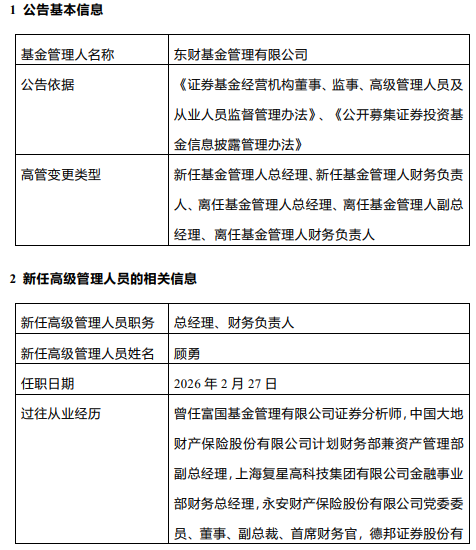
东财基金换帅!副总顾勇升任总经理,原掌门沙福贵任职四年半后离任
Xin Lang Cai Jing· 2026-02-28 03:35
| 新任高级管理人员职务 | 总经理、财务负责人 | | --- | --- | | 新任高级管理人员姓名 | 顾勇 | | 任职日期 | 2026年2月27日 | | 过往从业经历 | 曾任富国基金管理有限公司证券分析师,中国大地 | | | 财产保险股份有限公司计划财务部兼资产管理部 | | | 副总经理,上海复星高科技集团有限公司金融事业 | | | 部财务总经理,永安财产保险股份有限公司党委委 | | | 员、董事、副总裁、首席财务官,德邦证券股份有 | | | 限公司高级总裁助理兼科技金融部总经理、 副总 | | --- | --- | | | 裁,华安证券股份有限公司副总裁、东财基金管理 | | | 有限公司副总经理。 | | 取得的相关从业资格 | 童亲从业资格 | | 国籍 | 中国 | | 学历、学位 | 研究生、硕士 | 2月28日,东财基金管理发布高级管理人员变更公告,沙福贵因工作安排离任总经理、财务负责人,副 总经理顾勇升任公司总经理、财务负责人,任职日期2026年2月27日。同日,沙福贵亦不再担任公司第 三届董事会董事职务,由顾勇接任董事席位。 | 基金管理人名称 | 东财基金管理有 ...

《私募投资基金信息披露监督管理办法》发布
Sou Hu Cai Jing· 2026-02-28 03:19
Core Viewpoint - The China Securities Regulatory Commission (CSRC) has released the "Regulations on Information Disclosure Supervision and Management of Private Investment Funds," which will take effect on September 1, 2026. This regulation aims to enhance the transparency of private fund operations and protect investors' rights by clarifying the disclosure responsibilities of private fund managers and custodians [1]. Group 1: Disclosure Responsibilities - The new regulations impose clear disclosure responsibilities on private fund custodians, requiring them to disclose fund custody agreements, provide regular custodian reports, and review financial information of private securities investment funds [1][4]. - Private fund sales institutions must disclose information accurately and timely, without altering the information provided by fund managers, and must adhere to the agreed-upon disclosure obligations [4][5]. - Related parties must cooperate in the disclosure process by informing fund managers of relevant matters related to information disclosure, including details about shareholders and actual controllers [1][4]. Group 2: Basic Disclosure Requirements - Private fund managers are required to disclose information according to the fund contract, including content, channels, methods, and frequency, ensuring that investors can access this information as stipulated [6][7]. - Fund managers may voluntarily disclose additional information beyond what is legally required, provided it does not conflict with mandatory disclosures or mislead investors [7][9]. - Information must be disclosed through non-public channels, such as mail or email, ensuring consistency across different disclosure methods [10][12]. Group 3: Regular Reporting - Private fund managers must regularly disclose net asset values, cumulative net values, and financial performance, with open-end funds required to disclose net values at least as frequently as the fund's open frequency [13][14]. - Quarterly reports must include details on fund types, investment strategies, financial performance, and any related party transactions [14][15]. - Annual reports must be provided within four months of the fiscal year-end, including audited financial statements and details on related transactions [15][17]. Group 4: Temporary and Liquidation Reports - Fund managers must prepare and disclose temporary reports within five working days for significant events that may impact investor rights, such as changes in management or major transactions [19][20]. - Custodians must report any significant negative impacts on investor rights and ensure timely disclosure of liquidation announcements and reports [22][29]. Group 5: Management of Disclosure Affairs - Fund managers and custodians must establish robust information disclosure management systems, designating responsible departments and personnel [24][25]. - There are strict requirements for managing undisclosed information and ensuring that employees do not misuse confidential information for trading activities [25][26]. Group 6: Supervision and Legal Responsibilities - The CSRC will supervise the information disclosure activities of private fund managers, custodians, and sales institutions, with penalties for non-compliance [27][28]. - Violations of disclosure regulations can result in administrative measures, including warnings and fines, particularly for misleading disclosures or failure to establish proper management systems [30][31].

一级市场再迎活水!510亿元央企战新基金正式“开闸”
Shang Hai Zheng Quan Bao· 2026-02-28 02:58
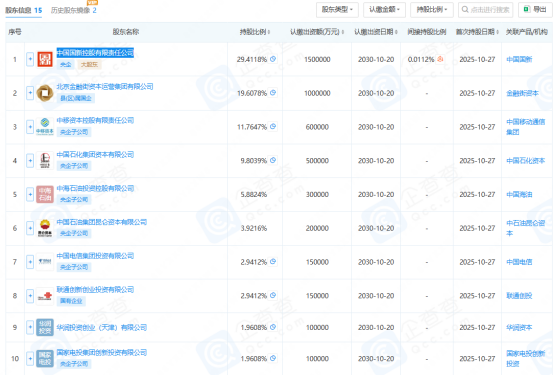
Group 1 - The core point of the article is the launch of the Central Enterprise Strategic Emerging Industry Development Fund, marking its transition to market-oriented investment operations [1][3] - The fund, initiated by the State-owned Assets Supervision and Administration Commission (SASAC), has a total scale of 51 billion yuan, with China Guoxin contributing approximately 15 billion yuan [3][5] - The fund's investment period is set for 5 years, with a total management and exit period of 8 years, extendable to 15 years [3] Group 2 - The fund will focus on investing in sectors such as new generation information technology, artificial intelligence, new energy, new materials, high-end equipment, biomedicine, and quantum technology [3] - At least 70% of the investments will target emerging and future industries, with a significant emphasis on early-stage technology companies and unicorns [3][10] - The fund aims to support key core technology breakthroughs and strengthen the industrial chain, with at least 50% of investments directed towards A-round financing and earlier projects [3] Group 3 - The article highlights the increasing concentration of state-owned capital in strategic emerging industries, as emphasized by national policies [7][9] - By 2025, state-owned fund management entities are projected to dominate the market, managing 70% of the total fund size, with a significant increase in the scale of state-owned funds since 2014 [10] - The government is shifting towards refined management of investment funds, aiming to enhance the role of state-owned capital in driving technological innovation and industrial development [10]
中基协:公募基金总规模升至37.77万亿元,连创十个月新高
Xin Lang Cai Jing· 2026-02-28 02:43
Core Insights - As of January 2026, the total asset management scale of 165 public fund management institutions in China reached 37.77 trillion yuan, marking a slight increase compared to the end of 2025 [1] - This figure represents a continuous record high for ten consecutive months since April 2025 [1] Group 1 - The total assets managed by public fund management institutions in China are 37.77 trillion yuan [1] - The growth in asset management is described as a slight increase from the end of 2025 [1] - The asset management scale has been setting historical highs for ten months in a row since April 2025 [1]
新规后首批,4只互认基金获批,摩根资管等4家拿下入场券
Feng Huang Wang· 2026-02-28 02:39
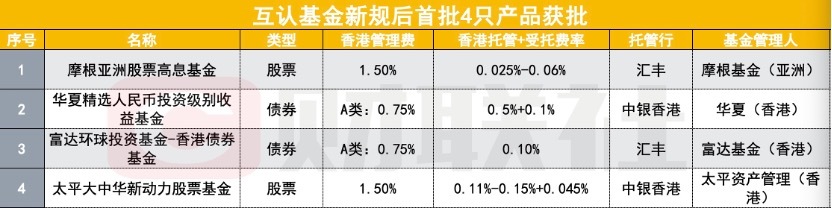
Core Insights - The first batch of four mutual recognition funds has been approved by the China Securities Regulatory Commission (CSRC) following the new regulations released on January 1, 2025, marking a significant step in cross-border investment opportunities for Chinese investors [1][2][4]. Fund Details - The approved funds include two equity funds: Morgan Asia High Dividend Fund and Taiping Greater China New Power Equity Fund, both with a management fee of 1.5% [2][3]. - The two bond funds are Fidelity Global Investment Fund - Hong Kong Bond Fund and Huaxia Select RMB Investment Grade Income Fund, both with an A-class management fee of 0.75% [2][3]. - HSBC and Bank of China Hong Kong are the custodians for these funds, with specific funds assigned to each [2][3]. Regulatory Changes - The new mutual recognition fund regulations have relaxed the sales ratio limit for cross-border funds from 50% to 80%, enhancing the sales potential in the mainland market [7][8]. - The regulations also allow for a broader range of fund types to be included under mutual recognition, providing more options for investors [7]. Market Context - The approval of these mutual recognition funds is seen as a crucial step for Fidelity's cross-border business strategy in China, responding to the growing demand for global asset allocation among Chinese investors [4]. - The mutual recognition framework aims to meet the cross-border wealth management needs of investors in both mainland China and Hong Kong [5]. Market Performance - As of January 2026, Morgan's mutual recognition funds have reached a scale of 84 billion RMB, holding over 40% market share, indicating strong performance in the market [10][12]. - The market has shown a trend where equity funds are attracting significant inflows, while bond funds are experiencing outflows due to increased market risk appetite [9].
中基协:公募基金总规模升至37.77万亿元 连创十个月新高
Yang Shi Xin Wen· 2026-02-28 02:38
Core Insights - As of the end of January 2026, the total asset management scale of 165 public fund management institutions in China reached 37.77 trillion yuan, marking a slight increase compared to the end of 2025 and setting a historical high for ten consecutive months since April 2025 [1] Group 1 - The total asset scale managed by public fund management institutions in China is 37.77 trillion yuan [1] - The growth in asset management has been consistent, with a historical high reached for ten consecutive months [1] - The data is reported by the China Securities Investment Fund Industry Association [1]
中基协:公募基金总规模升至37.77万亿元
Mei Ri Jing Ji Xin Wen· 2026-02-28 02:20
Group 1 - The core viewpoint of the article highlights the growth and stability of China's public fund management industry, with a total of 165 public fund management institutions as of January 2026 [1] - Among these institutions, there are 150 fund management companies and 15 asset management institutions that have obtained public qualification [1] - The total net asset value of public funds managed by these institutions reached 37.77 trillion yuan, showing a slight increase compared to the end of 2025, and has set a historical high for ten consecutive months since April 2025 [1]
公募基金规模再创新高,连续10个月增长,FOF受追捧
Xin Lang Cai Jing· 2026-02-28 02:17
Core Viewpoint - The public fund industry in China has reached a historical high in asset value, with a total net asset value of 37.77 trillion yuan, marking a continuous growth for ten months, despite a slight decrease in fund shares [1][4]. Fund Management Institutions - As of the end of January, there are 165 public fund management institutions in China, with 15 asset management institutions obtaining public qualification [1]. Fund Asset Value and Shares - The total net asset value of public funds is 37.77 trillion yuan, with a month-on-month increase of 0.14%. However, the overall fund shares decreased to 31.91 trillion shares, reflecting a 0.39% decline [1][4]. Fund Product Growth - The total number of public fund products has expanded to 13,725, with 103 new products added in January [5]. Fund Types Performance - Mixed, money market, and other funds are the main contributors to the growth of public fund assets, each achieving a growth of over 100 billion yuan. Fund of Funds (FOF) saw the largest increase, with shares and scale growing by 12.68% and 15.05%, respectively [5]. - By the end of January, FOF shares reached 2,522.76 billion shares, and the scale reached 2,811.78 billion yuan [5]. Mixed and Stock Funds - Mixed funds saw a share of 26 trillion shares and a scale of 4 trillion yuan, with a month-on-month increase of 1.88% and 8.98%, respectively [2][5]. - In contrast, stock funds experienced a decline, with shares at 39.2 trillion and a scale of 57.1 trillion yuan, reflecting decreases of 0.84% and 5.68% [2][5]. Market Outlook - The A-share market is showing positive trends, with the Shanghai Composite Index rising by 2% and nearing the 4,200-point mark. Analysts suggest that the market is supported by various positive factors, including declining risk-free returns and ongoing capital market reforms [6]. - The focus of China's economic work is shifting towards domestic demand, which is expected to drive economic recovery and improve market conditions [6].
公募新规将至,有些机构已经提前动作
Sou Hu Cai Jing· 2026-02-28 01:59
Group 1 - The core viewpoint of the article emphasizes that market movements are often misleading, and understanding the underlying trading behaviors is crucial for making informed investment decisions [1][3][11] - The article discusses the concept of "profit-taking," where investors who have made gains begin to cash out, which can lead to market adjustments despite a seemingly stable or rising price [5][6][8] - It highlights the importance of quantitative data in identifying hidden trading behaviors, allowing investors to see beyond surface-level market trends and make better decisions [8][17] Group 2 - The article illustrates that during times of negative news, such as a significant drop in stock prices, it is essential to analyze the underlying trading actions, like "short covering," which indicates that larger investors may be positioning themselves for future gains [11][14] - It emphasizes that quantitative data can help investors avoid emotional reactions to market fluctuations, leading to more stable and sustainable investment strategies [17][18] - The article concludes that leveraging quantitative analysis can enhance investment capabilities by providing a clearer understanding of market dynamics and reducing reliance on subjective judgment [17]