
华夏精选人民币投资级别收益基金

Search documents
公募基金指数跟踪周报(2026.02.24-2026.02.28):周期成长轮动演绎,冲突政策交织影响-20260302
HWABAO SECURITIES· 2026-03-02 10:33
1. Report Industry Investment Rating No relevant content provided. 2. Core Viewpoints of the Report - In the first week after the Spring Festival (2026.02.24 - 2026.02.27), the market rebounded moderately, with broad - based indexes approaching previous highs. Pro - cyclical sectors like real estate and chemicals rose due to price increase expectations, while the consumer sector回调 after concentrated holiday consumption. AI and other growth sectors spread to upstream semiconductor components. Before the specific policy directions are determined, the market may engage in games around the Two Sessions themes, and the macro - environment is generally optimistic before Trump's planned visit to China at the end of March [3][11][12]. - Last week (2026.02.24 - 2026.02.28), the bond market continued to fluctuate. Although there was an increase in the willingness to take profits after the festival, the sudden geopolitical conflict on Saturday led funds to flow into the bond market for safety, causing the yield to maturity to decline. In the short - term, the bond market is likely to continue the range - bound pattern [4][13]. - On February 27, 2026, the first four products under the new mutual - recognition fund regulations were approved by the China Securities Regulatory Commission, including two stock funds and two bond funds, which released the sales potential of mutual - recognition funds in the Chinese mainland [16]. 3. Summary According to the Directory 3.1 Weekly Market Observation 3.1.1 Equity Market Review and Observation - In the first week after the Spring Festival (2026.02.24 - 2026.02.27), the market rebounded moderately. The Shanghai Composite Index, CSI 300, ChiNext, CSI 500, and CSI 1000 rose by 1.98%, 1.08%, 1.05%, 4.32%, and 4.34% respectively. The total market trading volume rebounded to 2.5 trillion. However, several broad - based index ETFs faced slight capital outflows, with the share of some ETFs decreasing by over 2 billion [11]. - Pro - cyclical sectors like real estate and chemicals rose due to the relaxation of real - estate policies in Shanghai and the geopolitical situation in Iran. AI and other growth sectors spread to upstream semiconductor components, while the consumer sector回调 after the holiday [11]. - Geopolitical events may bring short - term investment opportunities in the stock market, but attention should be paid to whether the conflict will escalate. The market is in a policy observation window before the Two Sessions, and the "wait - and - see" attitude of investors is the core reason for the market's lack of a clear main line [12]. 3.1.2 Pan - Fixed - Income Market Review and Observation - Last week (2026.02.24 - 2026.02.28), the bond market continued to fluctuate. The 1 - year Treasury yield rose 0.23BP to 1.32%, the 10 - year Treasury yield fell 1.46BP to 1.78%, and the 30 - year Treasury yield rose 2.66BP to 2.27%. The short - term adjustment was mainly concentrated in the ultra - long end, and the 10 - year yield recovered quickly [13]. - The sudden geopolitical conflict on Saturday led funds to flow into the bond market for safety, causing the yield to maturity to decline. In the future, the risk of short - and medium - term adjustment is limited, and the short - term is likely to continue the range - bound pattern [13]. - Last week (2026.02.23 - 2026.02.27), U.S. Treasury yields declined across the board. The 1 - year U.S. Treasury yield fell 3BP to 3.48%, the 2 - year U.S. Treasury yield fell 10BP to 3.38%, and the 10 - year U.S. Treasury yield fell 11BP to 3.97% [14]. - Last week (2026.02.24 - 2026.02.27), the CSI REITs Total Return Index fell 1.08% to 1035.78 points. In the primary market, 10 new public REITs made progress [14][15]. 3.1.3 Public Fund Market Dynamics - On February 27, 2026, the first four products under the new mutual - recognition fund regulations were approved by the China Securities Regulatory Commission, including Morgan Asia Equity High - Yield Fund, Taiping Greater China New Dynamic Equity Fund, Fidelity Global Investment Fund - Hong Kong Bond Fund, and Huaxia Select RMB Investment - Grade Income Fund, covering two stock funds and two bond funds [16]. - The new regulations relaxed the sales ratio limit from 50% to 80%, releasing the sales potential of mutual - recognition funds in the Chinese mainland [16]. 3.2 Fund Index Performance Tracking 3.2.1 Equity Strategy Theme Index - **Active Equity Fund Selection**: The index selects 15 funds each period, with equal - weight allocation. The core positions select active equity funds according to performance competitiveness and style stability, and the style distribution is balanced according to the CSI Equity - Oriented Fund Index (930950.CSI). The performance benchmark is the CSI Equity - Oriented Fund Index (930950.CSI) [19][20]. 3.2.2 Investment Style Index - **Value Equity Fund Selection**: The index includes deep - value and quality - value styles. It selects 10 funds based on multi - period style classification. The performance benchmark is the CSI 800 Value Index (H30356.CSI) [23]. - **Balanced Equity Fund Selection**: The index selects 10 funds with relatively balanced and value - growth styles based on multi - period style classification. The performance benchmark is the CSI 800 (000906.SH) [23]. - **Growth Equity Fund Selection**: The index aims to capture the performance and valuation double - click opportunities of high - growth companies. It selects 10 funds based on multi - period style classification. The performance benchmark is the 800 Growth (H30355.CSI) [27][28]. 3.2.3 Industry Theme Index - **Pharmaceutical Equity Fund Selection**: The index selects funds based on the intersection market value ratio of fund equity holdings and the representative index (CITIC Pharmaceutical). It constructs an evaluation system and selects 15 funds. The performance benchmark is the pharmaceutical theme fund index (fitted by Huabao Securities' fund research and investment platform) [30][31]. - **Consumer Equity Fund Selection**: The index selects funds based on the intersection market value ratio of fund equity holdings and representative consumer - related indexes. It constructs an evaluation system and selects 10 funds. The performance benchmark is the consumer theme fund index (fitted by Huabao Securities' fund research and investment platform) [31]. - **Technology Equity Fund Selection**: The index selects funds based on the intersection market value ratio of fund equity holdings and representative technology - related indexes. It constructs an evaluation system and selects 10 funds. The performance benchmark is the technology theme fund index (fitted by Huabao Securities' fund research and investment platform) [35][36]. - **High - end Manufacturing Equity Fund Selection**: The index selects funds based on the intersection market value ratio of fund equity holdings and representative high - end manufacturing - related indexes. It constructs an evaluation system and selects 10 funds. The performance benchmark is the high - end manufacturing theme fund index (fitted by Huabao Securities' fund research and investment platform) [40][41]. - **Cyclical Equity Fund Selection**: The index selects funds based on the intersection market value ratio of fund equity holdings and representative cyclical - related indexes. It constructs an evaluation system and selects 5 funds. The performance benchmark is the cyclical theme fund index (fitted by Huabao Securities' fund research and investment platform) [43][44]. 3.2.4 Money Market Enhancement Index - **Money Market Enhancement Strategy**: The index aims for liquidity management and pursues a curve that exceeds money market funds. It mainly allocates money market funds and passive index - type bond funds (inter - bank certificate of deposit index funds). The performance benchmark is the CSI Money Market Fund Index (H11025.CSI) [46]. 3.2.5 Pure Bond Index - **Short - Term Bond Fund Selection**: The index aims for liquidity management and pursues a smooth curve on the basis of controlling drawdown. It selects 5 funds with stable long - term returns, strict drawdown control, and significant absolute return capabilities. The performance benchmark is 50% * Short - Term Pure Bond Fund Index+50% * Ordinary Money Market Fund Index [50]. - **Medium - and Long - Term Bond Fund Selection**: The index invests in medium - and long - term pure bond funds, aiming for stable returns while controlling drawdown. It selects 5 funds, balances coupon strategies and band - trading operations, and adjusts the duration and the ratio of credit bond funds and interest - rate bond funds according to market conditions [52]. 3.2.6 Fixed - Income Plus Index - **Low - Volatility Fixed - Income Plus Selection**: The index has an equity center of 10% and selects 10 funds each period. It focuses on funds with an equity center (total equity position after considering convertible bond and stock holdings) within 15% in the past three years and recently. The performance benchmark is 10% CSI 800 Index+90% ChinaBond New Composite Full - Price Index (CBA00303.CS) [55]. - **Medium - Volatility Fixed - Income Plus Selection**: The index has an equity center of 20% and selects 5 funds each period. It selects funds with an equity center between 15% and 25% in the past three years and recently. The performance benchmark is 20% CSI 800 Index+80% ChinaBond New Composite Full - Price Index (CBA00303.CS) [58]. - **High - Volatility Fixed - Income Plus Selection**: The index has an equity center of 30% and selects 5 funds each period. It selects funds with an equity center between 25% and 35% in the past three years and recently. The performance benchmark is 30% CSI 800 Index+70% ChinaBond New Composite Full - Price Index (CBA00303.CS) [61]. 3.2.7 Other Pan - Fixed - Income Index - **Convertible Bond Fund Selection**: The index selects bond - type funds with an average proportion of convertible bond investment in bond market value of not less than 60% in the latest period and not less than 80% in the past four quarters. It constructs an evaluation system and selects 5 funds [63]. - **QDII Bond Fund Selection**: The index selects 6 funds with stable returns and good risk control based on credit and duration conditions. The underlying assets of QDII bond funds are overseas bonds [67]. - **REITs Fund Selection**: The index selects 10 funds with stable operation, reasonable valuation, and certain elasticity based on the underlying asset type. The underlying assets of REITs are mainly infrastructure projects [68].
【公募基金】周期成长轮动演绎,冲突政策交织影响——公募基金指数跟踪周报(2026.02.24-2026.02.27)
华宝财富魔方· 2026-03-02 09:11
Equity Market Review and Outlook - The market experienced a mild rebound in the first week after the Spring Festival (February 24-27, 2026), with major indices approaching previous highs. The Shanghai Composite Index, CSI 300, ChiNext, CSI 500, and CSI 1000 saw gains of 1.98%, 1.08%, 1.05%, 4.32%, and 4.34% respectively. The total market turnover rebounded to 2.5 trillion yuan [5][6] - The easing of real estate policies in first-tier cities like Shanghai and geopolitical tensions in Iran boosted cyclical sectors such as real estate and chemicals, which rose on price increase expectations. Growth sectors like AI are beginning to extend from tight computing power to upstream semiconductor components and other supply chain segments, with price hikes observed in sub-sectors like electronic fabrics and capacitors [5][6] - Consumer sectors began to pull back after a concentrated realization of gains during the holiday [5] Fixed Income Market Review and Outlook - The bond market continued to fluctuate during the week (February 24-28, 2026). The 1-year government bond yield rose by 0.23 basis points to 1.32%, while the 10-year yield fell by 1.46 basis points to 1.78%. The 30-year yield increased by 2.66 basis points to 2.27%. Despite a rise in profit-taking sentiment post-holiday, a sudden geopolitical conflict led to a flight to safety, causing yields to drop [7][8] - Looking ahead, as profit-taking gradually exits and external uncertainties increase, even if the upcoming Two Sessions introduce economic targets and policies, there remains potential for exceeding expectations. The risk of mid-term adjustments may be limited, with a high probability of continued range-bound fluctuations in the short term [7][8] Public Fund Market Dynamics - On February 27, 2026, the first batch of four products under the new mutual recognition fund regulations was approved by the China Securities Regulatory Commission. These include Morgan Asia High Dividend Fund, Taiping Greater China New Power Fund, Fidelity Global Investment Fund-Hong Kong Bond Fund, and Huaxia Selected RMB Investment Grade Income Fund, covering two equity funds and two bond funds [9]


新规后首批,4只互认基金获批,摩根资管等4家拿下入场券
Feng Huang Wang· 2026-02-28 02:39
Core Insights - The first batch of four mutual recognition funds has been approved by the China Securities Regulatory Commission (CSRC) following the new regulations released on January 1, 2025, marking a significant step in cross-border investment opportunities for Chinese investors [1][2][4]. Fund Details - The approved funds include two equity funds: Morgan Asia High Dividend Fund and Taiping Greater China New Power Equity Fund, both with a management fee of 1.5% [2][3]. - The two bond funds are Fidelity Global Investment Fund - Hong Kong Bond Fund and Huaxia Select RMB Investment Grade Income Fund, both with an A-class management fee of 0.75% [2][3]. - HSBC and Bank of China Hong Kong are the custodians for these funds, with specific funds assigned to each [2][3]. Regulatory Changes - The new mutual recognition fund regulations have relaxed the sales ratio limit for cross-border funds from 50% to 80%, enhancing the sales potential in the mainland market [7][8]. - The regulations also allow for a broader range of fund types to be included under mutual recognition, providing more options for investors [7]. Market Context - The approval of these mutual recognition funds is seen as a crucial step for Fidelity's cross-border business strategy in China, responding to the growing demand for global asset allocation among Chinese investors [4]. - The mutual recognition framework aims to meet the cross-border wealth management needs of investors in both mainland China and Hong Kong [5]. Market Performance - As of January 2026, Morgan's mutual recognition funds have reached a scale of 84 billion RMB, holding over 40% market share, indicating strong performance in the market [10][12]. - The market has shown a trend where equity funds are attracting significant inflows, while bond funds are experiencing outflows due to increased market risk appetite [9].
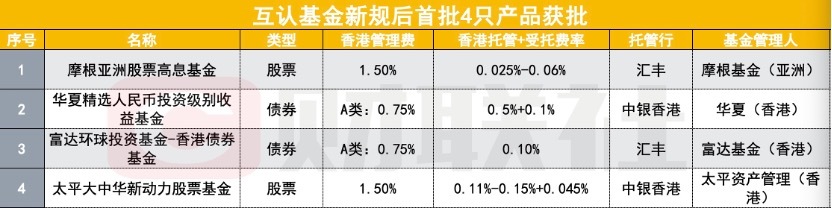
新一批香港互认基金获批
Zhong Guo Ji Jin Bao· 2026-02-27 16:24
Core Viewpoint - The approval of new mutual funds under the Hong Kong Mutual Recognition Fund scheme marks a significant development in cross-border investment opportunities between Hong Kong and mainland China, enhancing the asset allocation options for investors [1][3]. Group 1: New Fund Approvals - Several mutual funds, including Morgan Asia Equity High Dividend Fund and Fidelity Global Investment Fund - Hong Kong Bond Fund, have been approved under the new mutual recognition regulations effective from January 1, 2025 [1]. - This approval represents the latest batch of mutual recognition funds since the implementation of the new regulations [2]. Group 2: Fund Flow and Market Dynamics - As of January 31, 2026, the cumulative net outflow of funds from Hong Kong to mainland China reached approximately 1260.24 billion RMB, maintaining a level above 1200 billion RMB for six consecutive months [4]. - The mutual recognition mechanism has led to a diversification of asset allocation awareness among investors, allowing foreign asset management firms to introduce overseas strategies and products into the Chinese market [5][6]. Group 3: Regulatory Changes and Market Growth - The new mutual recognition regulations optimize the rules by relaxing sales ratio limits, allowing management functions to be delegated to overseas affiliates, and expanding the types of funds eligible for recognition [5]. - The sales of Hong Kong mutual funds in mainland China have seen rapid growth, with net outflows increasing from 426.65 billion RMB at the end of December 2024 to 1260.24 billion RMB by January 31, 2026 [6]. Group 4: Market Competition and Trends - The Hong Kong mutual fund market is characterized by a strong presence of leading firms, with Morgan Asset Management holding over 40% market share, while competition remains intense among mid-tier firms [8]. - The current market shows a divergence where equity products are attracting significant inflows, while bond products are experiencing outflows, indicating shifting investor preferences [8].

互认基金新规后首批产品获批 摩根资管等4家拿下入场券
Xin Lang Cai Jing· 2026-02-27 12:35
Core Viewpoint - The approval of the first four mutual recognition funds marks a significant step in the implementation of the revised Hong Kong Mutual Recognition of Funds regulations, which will enhance cross-border investment opportunities for mainland Chinese residents [1] Group 1: Fund Approvals - The first batch of four mutual recognition funds approved includes Morgan Asia High Dividend Fund, Fidelity Global Investment Fund - Hong Kong Bond Fund, Huaxia Select RMB Investment Grade Income Fund, and Taiping Greater China New Power Equity Fund [1] - This approval is the first since the implementation of the revised regulations on January 1, 2025, which increased the cross-border sales limit for mutual recognition funds from 50% to 80% [1] Group 2: Market Impact - The approval of these mutual recognition funds is expected to enrich the toolkit for cross-border investments, providing new options for mainland Chinese residents to participate in overseas capital markets and optimize their asset allocation [1]
“扬帆出海” 公募持续探索国际化
Shang Hai Zheng Quan Bao· 2025-08-17 13:36
Group 1 - The internationalization of public funds has accelerated in 2023, with numerous fund companies establishing subsidiaries to expand overseas operations [1][2] - Yifangda Fund has received approval from the China Securities Regulatory Commission to set up a company in Macau, aiming to enhance asset management services for investors in the Greater Bay Area [1] - The establishment of overseas subsidiaries is becoming a key vehicle for public funds to deepen international cooperation, as seen with the collaboration between Fuguo Asset Management and Malaysian entities to launch ETF products [1][2] Group 2 - The number of overseas subsidiaries for fund companies continues to grow, with Xingsheng Global Fund's Singapore subsidiary approved to enhance its research and investment capabilities [2] - ETFs are emerging as a leading product for international expansion, with several ETFs launched in overseas markets, including the first ETF tracking the CSI Dividend Index in Singapore [2] - Public funds are actively enriching their cross-border product lines, with various funds recently submitted for approval, including those focused on bonds and global investments [2] Group 3 - QDII funds are evolving their strategies, with many products now covering multiple markets, enhancing risk resilience through regional diversification [3] - The expansion of QDII quotas has provided strong support for the internationalization of public funds, with over 20 fund managers receiving new quotas in June [3]

华夏香港甘添:做金融产品创新破局者
Zhong Guo Zheng Quan Bao· 2025-08-03 23:09
Core Insights - 华夏基金(香港) has been focusing on innovative financial products and positioning itself as a differentiated Chinese institution in the market [1][3] - The CEO, 甘添, believes that the new technology revolution is reshaping the financial industry, providing strategic opportunities for asset management institutions in Hong Kong [1][3] - The offshore RMB bond market is expected to experience explosive growth in the next three to five years, with 华夏香港 already taking the lead in this area [1][5] Company Strategy - 华夏香港 has launched several innovative products, including the first RMB-denominated public fund in Hong Kong and the largest offshore RMB money market ETF, which has grown to a scale of 4.97 billion RMB within two years [3][4] - The company has also introduced the first pure Hong Kong stock biotech ETF and the largest ESG broad-based ETF in Asia (excluding Japan), showcasing its commitment to differentiation in the ETF market [4] Market Outlook - 甘添 predicts that the offshore RMB funds pool could reach approximately 5 trillion RMB by 2030, driven by the internationalization of the RMB and the growth of the dim sum bond market [6][8] - The dim sum bond market has seen significant growth, with the market size increasing from 254 billion RMB in 2020 to nearly 1 trillion RMB currently, indicating a strong demand for these bonds [6][7] Investment Trends - The yield on dim sum bonds is currently more attractive compared to domestic bonds, leading to increased interest from domestic investors facing asset allocation challenges [7][8] - Major domestic enterprises are increasingly using dim sum bonds to replace USD-denominated bonds, reflecting a shift in financing strategies [7][8] Regulatory Environment - The Chinese government is actively supporting the internationalization of the RMB, which is expected to enhance the development of the offshore RMB market [6][8] - Recent policy optimizations, such as the cross-border wealth management connect, are facilitating domestic investors' access to offshore RMB assets, providing a stable funding source for the offshore market [8][9]
华夏香港甘添: 做金融产品创新破局者
Zhong Guo Zheng Quan Bao· 2025-08-03 22:03
Core Viewpoint - 华夏基金(香港) is positioning itself as a differentiated Chinese financial institution, focusing on innovative financial products and capitalizing on emerging market opportunities, particularly in the offshore RMB bond market [1][3][7]. Group 1: Company Strategy and Innovation - 华夏基金(香港) has adopted a forward-looking approach, launching several innovative products, including the first RMB-denominated public fund in Hong Kong, which targets investment-grade bonds [3][7]. - The company has successfully launched the largest offshore RMB money market ETF globally, with a scale of 4.97 billion RMB, demonstrating its ability to identify and capitalize on market trends [3][4]. - The firm has also introduced the first pure Hong Kong stock biotechnology ETF, which has gained significant traction among both domestic and international investors [4][5]. Group 2: Market Outlook and Growth Potential - 甘添, CEO of 华夏基金(香港), predicts explosive growth in the offshore RMB bond market over the next three to five years, with the offshore RMB fund pool expected to reach approximately 5 trillion RMB by 2030 [1][7]. - The point bond market has seen substantial growth, with its scale increasing from 254 billion RMB in 2020 to nearly 1 trillion RMB currently, driven by attractive yields compared to domestic bonds [8][9]. - The company anticipates that the increasing participation of domestic institutions in the offshore RMB market will be fueled by favorable policies and the growing appeal of point bonds [9][10]. Group 3: Regulatory and Market Dynamics - The Chinese government is actively supporting the internationalization of the RMB, which is expected to enhance the development of the offshore RMB market and create a stable liquidity supply channel [7][9]. - Recent policy changes, such as the relaxation of cross-border investment channels, are expected to facilitate domestic investors' access to offshore RMB assets, further boosting market growth [9][10]. - The shift in the Hong Kong stock market's pricing power, with increasing domestic investment, indicates a changing landscape where local investors are becoming more influential [10][11].
做金融产品创新破局者
Zhong Guo Zheng Quan Bao· 2025-08-03 21:12
Core Viewpoint - 华夏基金(香港) is positioning itself as a differentiated Chinese financial institution, focusing on innovative financial products and capitalizing on emerging market opportunities [1][2]. Group 1: Innovation and Market Positioning - 华夏香港 has adopted a forward-looking approach, launching several first-of-their-kind financial products in the Hong Kong market, including the first RMB-denominated public fund and the largest offshore RMB money market ETF [2][3]. - The company has successfully identified and capitalized on market trends, such as the growth of the offshore RMB bond market, by launching products like the 华夏精选人民币投资级别收益基金 during a period of currency volatility [2][3]. Group 2: Offshore RMB Bond Market - 甘添 predicts explosive growth in the offshore RMB bond market over the next three to five years, with the offshore RMB fund pool expected to reach approximately 5 trillion by 2030 [2][5]. - The point bond market has seen significant growth, with its scale increasing from 2.54 trillion in 2020 to nearly 10 trillion currently, driven by a decrease in RMB financing costs [6][7]. Group 3: Investment Opportunities - The point bond market offers attractive yields compared to domestic bonds, with yields for similar maturity bonds being 30-50 basis points higher than their domestic counterparts [6][7]. - Major domestic enterprises are increasingly participating in the point bond market, with significant issuances from companies like 百度 and 蒙牛乳业, indicating strong market demand [7][8]. Group 4: Market Dynamics and Future Outlook - The influx of domestic capital into the Hong Kong stock market is shifting the pricing power, with local investors now holding a significant portion of shares [8]. - The anticipated introduction of a mechanism allowing mainland investors to directly invest in Hong Kong stocks using offshore RMB is expected to enhance participation and pricing power in the market [8].