家电制造

Search documents
家电再生材料使用规范国家标准发布 要求构建追溯机制
Di Yi Cai Jing· 2025-11-19 12:45
相关标准通过明确再生材料评估选择、过程控制、溯源管理要求及使用率计算方法,规范家电产品再生 材料应用,推动行业绿色低碳发展。 11月19日,据市场监管总局官网消息,家电再生材料使用规范国家标准已发布,将于明年5月实施。一 位废旧家电回收处理企业负责人向第一财经记者表示,该标准要求构建追溯机制,这将使家电再生材料 的使用有据可依,促进家电行业资源再利用率的提升。 上述废旧家电回收处理企业负责人向记者分析认为,以前废旧家电回收处理得到的材料,一般降级使用 或不使用,如电视机壳的塑料,只能用来做玩具、塑料桶等;现在家电再生材料利用有据可依,有标准 可以执行,将提高再生材料的利用率。 "这还将提高家电企业对废旧材料的整体利用水平。"这位负责人表示,以前没有标准,回收材料来源不 清晰,家电企业对再生材料的使用有疑虑;现在有了标准,建立了再生材料的溯源机制,家电企业会更 放心地使用再生材料。比如,某空调品牌会更倾向使用从自家品牌废旧空调上回收的再生材料,甚至会 把回收的废旧家电委托给回收处理企业做拆解处理,从而缩短家电再生材料循环利用的链条。 这位负责人还说,欧盟规定家电采用再生材料生产,要有一定的使用率。中国家电产品出 ...
21独家|松下回应:住空间出售包含杭州子公司,不影响在华业务
2 1 Shi Ji Jing Ji Bao Dao· 2025-11-19 10:50
Core Viewpoint - Panasonic Holdings is selling an 80% stake in its wholly-owned subsidiary Panasonic Housing Solutions to YKK Corporation, while retaining a 20% stake, as part of its organizational restructuring and business reform efforts [1][2]. Group 1: Company Overview - Panasonic Housing Solutions (PHS) is closely linked with Panasonic Housing Technology (Hangzhou) Co., Ltd., which focuses on residential equipment and building materials manufacturing and sales [2]. - PHS is categorized as a "restructuring business" under Panasonic's comprehensive organizational adjustments initiated by CEO Yuki Kusumi [2]. Group 2: Acquisition Details - The acquisition by YKK, a leading zipper manufacturer, aims to combine the strengths of both companies to establish a leadership position in the building materials and residential equipment market [3]. - The total business scale of YKK AP and PHS is approximately 1 trillion yen (about 456.79 billion RMB), providing a wide range of products necessary for construction [3]. Group 3: Future Plans - The transfer agreement is expected to be finalized by the end of March 2026, with operations under the new structure starting in April 2026 [3]. - Panasonic aims to leverage its brand and technological advantages in the Chinese market, focusing on modular reconstruction of space value and developing business content tailored to local needs [3]. - The long-term goal is to achieve a combined sales target of 1.5 trillion yen (approximately 685.19 billion RMB) by 2035 [3].
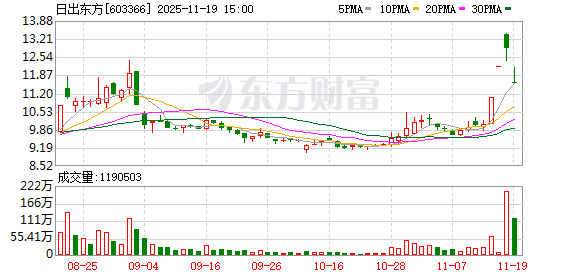
日出东方跌停,沪股通龙虎榜上净卖出3140.07万元
Zheng Quan Shi Bao Wang· 2025-11-19 09:36
证券时报·数据宝统计显示,上榜的前五大买卖营业部合计成交2.14亿元,其中,买入成交额为9012.52 万元,卖出成交额为1.24亿元,合计净卖出3375.26万元。 具体来看,今日上榜的营业部中,沪股通为第一大买入营业部及第一大卖出营业部,买入金额为 2137.26万元,卖出金额为5277.33万元,合计净卖出3140.07万元。 (文章来源:证券时报网) 资金流向方面,今日该股主力资金净流出1.04亿元,其中,特大单净流出8441.02万元,大单资金净流出 2004.15万元。近5日主力资金净流出5011.97万元。 10月28日公司发布的三季报数据显示,前三季度公司共实现营业收入27.90亿元,同比下降14.67%,实 现净利润3668.45万元,同比下降45.46%。(数据宝) 日出东方11月19日交易公开信息 日出东方(603366)今日跌停,全天换手率14.64%,成交额13.95亿元,振幅5.09%。龙虎榜数据显示,沪 股通净卖出3140.07万元,营业部席位合计净卖出235.19万元。 | 买/ | 会员营业部名称 | 买入金额(万 | 卖出金额(万 | | --- | --- | --- | ...


中欧班列(西安)何以成为企业跨境物流优选?
Xin Hua She· 2025-11-19 07:02
Core Insights - The global supply chain is rapidly restructuring, with the China-Europe Railway Express (Xi'an) enhancing its capabilities and attracting more businesses to integrate into the global industrial chain [1] - The "Belt and Road" initiative is significantly boosting Xi'an's foreign trade, with projected import and export volume exceeding 400 billion yuan in 2024 [1] Group 1: Logistics Network - The Xi'an International Port Station features 18 international routes connecting major cities across Europe and Asia, creating a comprehensive logistics network [3] - The multi-channel strategy is crucial for ensuring transportation resilience, with new routes reducing transit times significantly, such as cutting the transport time between China and Europe from over 40 days to around 15 days [3][4] - The Xi'an (Kazakhstan) logistics hub enhances the distribution capabilities between Xi'an and Almaty, facilitating efficient cargo transfer [3] Group 2: Growth Metrics - The China-Europe Railway Express (Xi'an) has seen a dramatic increase in operations, from over 100 trains in its early days to 4,985 trains in 2024, marking a year-on-year growth of 16.3% [4] - The Xi'an International Port Station has undergone three expansions, now featuring 59 operational lines with an annual throughput capacity of 5.4 million TEUs and a transport capacity of 66 million tons [4] Group 3: Transportation Efficiency - The logistics efficiency has improved significantly, with goods like flour from Central Asia reaching Xi'an in just five days, showcasing the operational success of the railway [6] - The introduction of a precise schedule for the trains has led to a 30% improvement in transit times for cross-border e-commerce goods, with costs being less than one-fifth of air freight [6][7] - The automotive industry benefits from reduced shipping times, with companies like BYD and Geely utilizing the railway to expedite exports [6] Group 4: Cost Optimization - Companies like Konka have reported a significant reduction in logistics costs, with production and shipping times optimized due to proximity to the railway [8] - The implementation of a "one order" system for rail-water intermodal transport has reduced transit times and costs for imported goods [7] - Collaborative efforts among local businesses have led to a reduction in cargo assembly and distribution time from an average of 8.5 days to 3.3 days [8] Group 5: Economic Impact - The rapid development of the China-Europe Railway Express (Xi'an) is reshaping the regional industrial ecosystem, with logistics parks attracting various industries and resources [9] - Xi'an is emerging as a significant hub for timber and construction materials, enhancing its role in the inland economy [9]
增强供需适配 柔性制造发展提速
Zheng Quan Ri Bao· 2025-11-18 16:08
Core Viewpoint - The State Council meeting emphasizes enhancing supply-demand adaptability as an effective measure to unleash consumption potential and facilitate economic circulation [1] Group 1: Flexible Manufacturing - Flexible manufacturing is identified as a future direction for manufacturing enterprises to achieve personalized customization in response to increasingly diverse market demands [1][2] - The construction of flexible manufacturing plants in China has transitioned from conceptual exploration to large-scale practical implementation, driven by national strategy and market demand [1][2] - Flexible manufacturing can effectively address the mismatch between supply and demand in traditional mass production, thereby releasing domestic demand potential and creating new demand through high-quality supply [2] Group 2: Market Potential and Growth - The market size of flexible manufacturing was approximately 62 billion yuan in 2020, with expectations to reach 130 billion yuan by 2025, indicating significant growth potential [2] - The penetration of flexible manufacturing is expanding from the automotive and home appliance sectors to include clothing, food, and other industries, with the automotive sector already accounting for 35% of flexible production lines [2] Group 3: Policy Support and Technological Integration - Policies such as the "Implementation Plan for Digital Transformation in Light Industry" aim to enhance flexible production capabilities by promoting the application of smart technologies in various industries [3] - The integration of new information technologies, such as industrial internet platforms and AI, is deepening, providing strong support for rapid production changes and personalized scheduling in flexible manufacturing [3][5] Group 4: Future Trends and Workforce Development - The demand for flexible manufacturing is increasing due to industrial upgrades, which also provide application scenarios for advanced technologies like embodied intelligent robots [4] - The implementation of technologies like digital twins, AI scheduling, and 5G edge computing is expected to drive the development of upstream and downstream industries, creating new job roles in data analysis and algorithm engineering [5] - Strengthening the "digital foundation" and breaking down data barriers across enterprises and industries are essential for the development of flexible manufacturing plants [5]
喜悦智行:接受西部证券证券调研
Mei Ri Jing Ji Xin Wen· 2025-11-18 11:45
Core Insights - Joyy Intelligent (SZ 301198) announced that on November 18, 2025, it will accept a securities research from Western Securities, with the company’s board secretary Cai Chaowei participating in the reception and addressing investor inquiries [1] - For the fiscal year 2024, Joyy Intelligent's revenue composition is as follows: automotive manufacturing accounts for 59.7%, home appliance manufacturing for 22.41%, logistics supply chain services for 10.33%, and others for 7.57% [1] - As of the report date, Joyy Intelligent has a market capitalization of 2.2 billion yuan [2]

日本这些产业仰仗中国
第一财经· 2025-11-17 14:35
Core Viewpoint - The article discusses the impact of recent provocative remarks by Japanese politicians on various Japanese industries, particularly those reliant on the Chinese market, leading to significant stock price declines and potential market share losses in sectors such as retail, automotive, and tourism [3][12]. Automotive Industry - Japanese automotive brands, including Lexus, Toyota, and Subaru, are increasingly dependent on the Chinese market, with Lexus imports reaching 138,412 units in the first nine months of the year, a 4% increase, but showing a declining trend over the past four years [3][4]. - Toyota's imports fell by 5% year-on-year, with total imports around 17,700 units from March to September [5]. - Nissan and its luxury brand Infiniti are experiencing poor sales, with monthly sales around 100 units in China [6]. - The market share of Japanese automakers in China has dropped to 11.2%, a decrease of 3.2 percentage points from 2023, with Toyota's sales down 6.9% to 1.776 million units, Honda down 30.9% to 852,000 units, and Nissan down 12.2% to 696,000 units [7][8]. Consumer Goods and Retail - Japanese retail and consumer goods companies, such as Shiseido, saw stock prices drop significantly, with Shiseido's stock falling by 11% due to the political climate [3]. - ASICS, a well-known Japanese sports brand, reported a sales scale of approximately 5 billion yuan in China for 2024, with a growth rate of nearly 30% [10]. Tourism and Alcohol Industry - The tourism sector is heavily impacted, with Chinese tourists accounting for a significant portion of visitors to Japan, contributing to a consumption expenditure of 1.73 trillion yen [12]. - Japanese whiskey imports to China increased by 41.9% in the first eight months of 2025, with a total import value of 24.36 million USD [11]. Home Appliances - Japanese home appliance exports to China have been declining, with imports dropping from 1.016 billion USD in 2022 to 708 million USD in 2024 [9].

日本汽车、家电边缘化,这些产业仰仗中国
Di Yi Cai Jing· 2025-11-17 13:30
Group 1: Japanese Automotive Industry in China - Japanese automotive brands are experiencing a decline in competitiveness in the Chinese market, with potential further market share shrinkage if the Japanese government does not correct its course [1][3] - The market share of Japanese automakers in China has dropped to 11.2% in 2024, a decrease of 3.2 percentage points from 2023, with major companies like Toyota, Honda, and Nissan facing significant sales declines [3] - Toyota's sales in China for 2024 are projected at 1.776 million units, down 6.9%, while Honda's sales have plummeted by 30.9% to approximately 852,000 units, marking the lowest level since 2014 [3] Group 2: Impact of Political Relations - The deterioration of Sino-Japanese political relations, influenced by provocative statements from Japanese politicians, is expected to adversely affect Japanese industries reliant on the Chinese market, including automotive, alcohol, and tourism [1][8] - Analysts suggest that if political tensions continue, Japanese automotive exports and local sales in China will be significantly impacted [3][4] Group 3: Japanese Consumer Goods and Retail - Japanese retail and consumer goods companies are seeing stock price declines due to their reliance on Chinese consumers, with Shiseido's stock dropping by 11% following political tensions [1] - The import of Japanese household appliances to China has been decreasing, with a drop from $1.016 billion in 2022 to an estimated $708 million in 2024 [5] Group 4: Japanese Alcohol and Tourism - Japan's whiskey imports to China have shown significant growth, with a 41.9% increase in import value in the first eight months of 2025, amounting to $2.436 million [6] - Chinese tourists are a major consumer of Japanese sake, with exports to China growing by 495.9% over the past decade, making China the largest export market for Japanese sake [7] Group 5: Economic Impact of Reduced Tourism - A significant reduction in Chinese tourists visiting Japan could lead to a 0.36% decrease in Japan's GDP, equating to an estimated economic loss of 2.2 trillion yen (approximately 101.16 billion yuan) [9]


客厅里的智能战争
3 6 Ke· 2025-11-17 03:17
Core Insights - The home appliance industry in China is entering an era of full-home intelligence, with traditional appliance companies and tech firms like Huawei and Xiaomi intensifying competition through AI technology and smart ecosystems [1][2][7] Group 1: Market Dynamics - Traditional appliance companies such as Midea, Gree, Haier, and Hisense are seeking new growth points by developing AI technology, expanding product lines, and exploring international markets [1] - Tech companies like Huawei and Xiaomi leverage their established smart ecosystem advantages to enhance competition in the appliance market [1][2] - The trend towards smart appliances is evident, with many brands offering independent smart systems, often named with a prefix like "Xiao" [2] Group 2: Consumer Behavior - Consumers are increasingly drawn to smart appliances, with features like AI voice functionality appealing to families with children and elderly members [3] - A shift in consumer preferences is noted, with many opting for domestic brands over foreign ones, indicating a growing expectation for smart features in appliances [3][4] - The interest in full-home smart systems is rising, but many consumers face challenges due to incompatibility between different brands' systems [4] Group 3: Technological Advancements - Midea's full-home smart system integrates various home environments and appliances, evolving from passive responses to proactive services [5][6] - The interaction between vehicles and home systems is emerging, with Midea collaborating with companies like BYD and Tesla to enhance connectivity [5][6] - A report indicates that the smart home market in China is expected to grow at double-digit rates from 2023 to 2025, with smart security, lighting, and audio-visual products being the fastest-growing categories [6][7] Group 4: Competitive Landscape - Major players in the appliance sector include Gree, Midea, Haier, Hisense, and TCL, with the boundaries of the industry becoming increasingly blurred as companies embrace a broader home ecosystem [7][8] - The competition is intensifying, with a notable price war among domestic brands, as they strive to offer smart services that add higher value beyond traditional hardware manufacturing [8]



一个独具特色的城市发展样本
Ren Min Ri Bao Hai Wai Ban· 2025-11-17 02:07
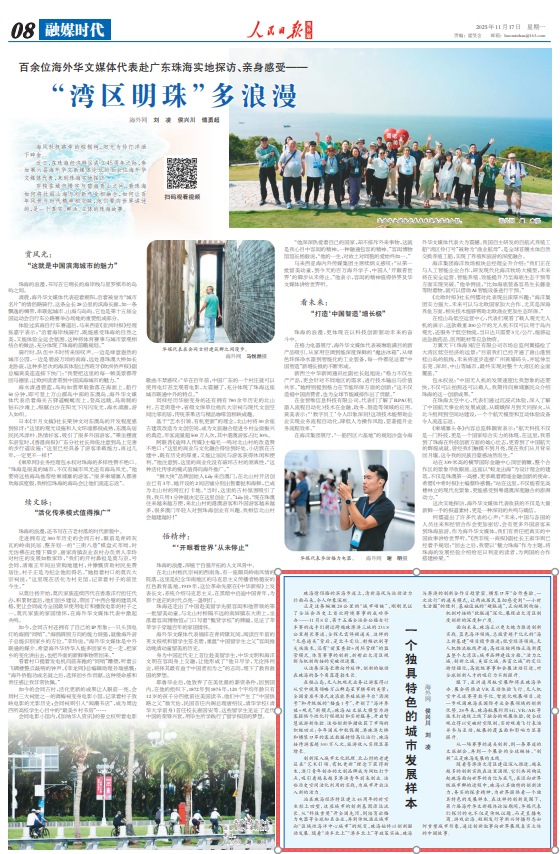
Core Insights - The successful hosting of the first cross-border event in the history of the National Games, specifically the cycling race, highlights significant advancements in the integration of rules and mechanisms within the Greater Bay Area [1][3] Group 1: Innovation in Sports and Tourism - The cycling event featured a 231.8 km route across three regions, utilizing advanced technologies such as Beidou positioning and RFID for seamless border crossing [1] - The introduction of innovative tourism initiatives, including drone sightseeing and semi-submersible wave energy platforms, has enhanced the visitor experience in Zhuhai [2] - During the recent holiday period, Zhuhai welcomed over 3 million tourists, indicating a substantial increase in tourism revenue [2] Group 2: Economic and Infrastructure Development - Zhuhai has transformed from a traditional fishing city to a regional marine center, driven by innovation and significant investments in infrastructure [3] - The implementation of policies like "Hong Kong and Macau vehicles entering the mainland" has strengthened cooperation and connectivity between Zhuhai and its neighboring regions [3] - Major investments exceeding 100 billion yuan in "new marine infrastructure" projects are underway, alongside the development of drone logistics networks [3] Group 3: Cultural and Creative Initiatives - Historical buildings in Beishan Village have been revitalized under the concept of "art-led organic renewal," attracting young entrepreneurs from Macau [2] - The upcoming Asian General Aviation Exhibition will feature digital and interactive experiences, reinforcing Zhuhai's position in the international exhibition sector [4] - The ongoing development of innovative practices in Zhuhai contributes to its unique identity and confidence as it aims to become a world-class city cluster [4]