
电池

Search documents
全固态电池产业化加速 材料和设备端寻求新突破
Zhong Guo Jing Ying Bao· 2026-02-11 06:08
Core Viewpoint - The third China All-Solid-State Battery Innovation Development Summit highlighted that all-solid-state batteries are a crucial development direction for next-generation power battery technology, with an accelerating industrialization process but facing significant challenges in materials, engineering, manufacturing processes, and core equipment [1]. Group 1: Industry Insights - The Chinese battery industry is experiencing rapid growth and technological iteration, expanding application scenarios from automobiles and energy storage to robotics and low-altitude aircraft [1]. - The demand for batteries is surging under the "dual carbon" goals, making all-solid-state batteries an important development direction, yet challenges remain in electrolyte performance, solid-solid interface compatibility, and high specific energy electrode matching [1]. - The penetration rate of all-solid-state batteries is currently low, but increasing collaboration between academia and industry is leading to more battery companies and automakers announcing timelines for all-solid-state battery deployment [4]. Group 2: Technological Developments - Key innovations in materials are being explored, including high-capacity high-voltage positive electrodes, stable negative electrodes, and electrolytes with high ionic conductivity [2]. - Research advancements include microcrystallization of high-nickel ternary materials, lithium-boron framework lithium metal anodes, and interface regulation of iodine ions, which provide new pathways for achieving high energy density and long cycle life in all-solid-state batteries [2]. - The development of solid electrolytes is focusing on sulfide routes and composite routes, with discussions on low-cost production, wide temperature applications, and high energy density cell systems [3]. Group 3: Company Initiatives - Companies like Rongbai Technology are improving the kinetics of high-nickel ternary materials through precursor design and wet coating, achieving a production capacity of 10 tons [2]. - Sichuan Huayi Qing Innovation Materials Technology is addressing silicon-based anode industrialization bottlenecks with new technologies that effectively solve expansion and pressure issues [2]. - Zhejiang Geely Holding Group plans to debut prototype vehicles with solid-state batteries in 2026, with small-scale industrialization by 2027 and mass production of high-end models by 2030 [4].
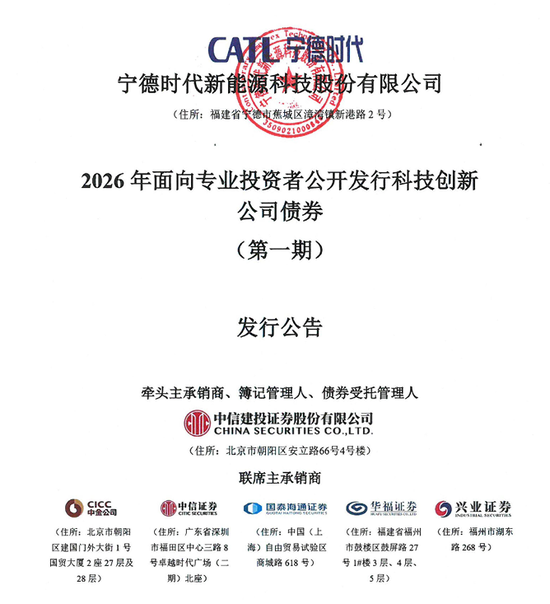
宁德时代,拟发行不逾50亿科技创新公司债券,中信建投证券牵头承销
Xin Lang Cai Jing· 2026-02-11 05:42
Core Viewpoint - CATL (Contemporary Amperex Technology Co., Limited) plans to publicly issue technology innovation corporate bonds to professional institutional investors in mainland China, with a total issuance amount not exceeding 5 billion RMB, aimed at project construction, working capital supplementation, and repayment of interest-bearing liabilities [2][12]. Group 1: Bond Issuance Details - Issuer: CATL New Energy Technology Co., Ltd. [3] - Bond Name: "CATL New Energy Technology Co., Ltd. 2026 Public Issuance of Technology Innovation Corporate Bonds (First Phase)" with the short name "26CATLK1" [3][13]. - Issuance Scale: The bond issuance scale is not exceeding 5 billion RMB (including 5 billion RMB) [4][14]. - Bond Term: The bond has a term of 5 years, with an issuer's option to adjust the coupon rate at the end of the third year and an investor's put option [4][14]. - Face Value: The bond has a face value of 100 RMB [5][15]. - Issuance Price: The bond will be issued at par value [6][16]. Group 2: Bond Characteristics - Credit Enhancement: The bond is unsecured [7][17]. - Bond Form: The bond is a registered book-entry corporate bond, with custody recorded in accounts opened at the securities registration agency [7][17]. - Interest Rate: The bond will have a fixed interest rate determined through offline inquiry and book-building, with annual simple interest calculation [7][17]. - Interest Rate Adjustment: The interest rate will remain fixed for the first three years; if the issuer exercises the adjustment option, the rate for the remaining two years will be adjusted based on the previous rate plus or minus a certain basis point [7][17]. Group 3: Issuance Process - Issuance Method: The bond will be issued through offline inquiries to professional institutional investors, with allocation based on book-building results [7][17]. - Target Investors: The bond is aimed at professional institutional investors with A-share accounts opened at the Shenzhen branch of China Securities Depository and Clearing Corporation Limited, excluding those prohibited by law [7][17]. - Underwriting Method: The bond will be underwritten by the lead underwriter on a balance underwriting basis [8][18].


研报掘金丨兴业证券:首次覆盖正力新能(3677.HK),布局航空动力电池等新兴产品,拓展长期空间
Xin Lang Cai Jing· 2026-02-11 05:21
Core Viewpoint - The report from Industrial Securities indicates that Zhengli New Energy possesses a differentiated strategy with promising profit elasticity, focusing on passenger vehicle power batteries and expanding into emerging products like aviation power batteries [1] Group 1: Company Overview - Jiangsu Zhengli New Energy Battery Technology Co., Ltd. is currently among the top 10 passenger vehicle power battery companies in China, with a clear operational strategy and automotive component genes [1] - The company is enhancing its market share by concentrating on passenger vehicle power batteries and leveraging platform-based products and flexible manufacturing to drive shipment growth and profit realization [1] Group 2: Financial Projections - The company is projected to ship 19.6 GWh, 29.0 GWh, and 40.4 GWh of lithium batteries in 2025, 2026, and 2027 respectively, indicating a compound annual growth rate of 50% over three years [1] - Expected net profit attributable to shareholders for 2025, 2026, and 2027 is forecasted to be 602 million yuan, 1.258 billion yuan, and 1.864 billion yuan respectively, reflecting year-on-year growth rates of 561.1%, 109.0%, and 48.2% [1] Group 3: Investment Recommendation - The report initiates coverage with an "overweight" rating for the company, suggesting that investors pay attention to its growth potential [1]

从“概念”到“送样” 人形机器人催生千倍固态电池需求
Xin Jing Bao· 2026-02-11 04:50
Group 1 - The core viewpoint of the articles highlights the growing interest in the integration of solid-state batteries with humanoid robots, driven by recent announcements from companies like Funeng Technology [1][2] - Funeng Technology has sent samples of its solid-state batteries to a leading humanoid robot client, igniting market enthusiasm and leading to significant stock price increases for related companies [1][2] - TrendForce predicts that humanoid robots will enter a critical commercialization phase by 2026, significantly increasing the demand for next-generation solid-state batteries to address current power limitations [2] Group 2 - The report estimates that global humanoid robot shipments will exceed 50,000 units by 2026, with an annual growth rate surpassing 700%, and by 2035, the demand for solid-state batteries from humanoid robots will exceed 74 GWh, representing over a 1000-fold increase from 2026 [2] - Current humanoid robots face challenges with battery life, typically operating for only 2 to 4 hours, necessitating advancements in battery technology, such as solid-state batteries, to achieve longer operational times [2] - Companies like Funeng Technology are at the forefront of solid-state battery development, leveraging their early advantages in flexible production and various material systems to achieve energy densities of 400-500 Wh/kg [3][4] Group 3 - The Chinese supply chain is poised to replicate its success in the electric vehicle sector for the humanoid robot market, with companies that achieve breakthroughs in solid-state battery technology expected to reap significant industry rewards [3][4] - The solid-state battery industry is supported by a robust supply chain, with key material manufacturers actively advancing in critical areas such as cathodes, anodes, and electrolytes [3] - Overall, the layout of Chinese enterprises in the humanoid robot solid-state battery supply chain is taking shape, with a comprehensive industrial foundation and a promising market environment facilitating future growth [4]


固态电池概念拉升,电池ETF(561910)涨1.21%
Sou Hu Cai Jing· 2026-02-11 03:51
Group 1 - The Shanghai Composite Index rose by 0.27%, while the Shenzhen Component Index increased by 0.08%, and the ChiNext Index fell by 0.60% as of February 11 [2] - Small metals, energy metals, and cobalt sectors showed significant gains, with the battery ETF (561910) increasing by 1.21% [2] - Key stocks such as Greeenmei (002340.SZ) hit the daily limit, while New Zhoubang (300037.SZ), Zhongwei New Materials (300919.SZ), and Duofuduo (002407.SZ) rose over 5% [2] Group 2 - Aijian Securities forecasts that the domestic battery and lithium iron phosphate cathode material production will exceed that of the same period in 2024, with lithium carbonate prices recently declining and energy storage cell prices rising [3] - The implementation of a new pricing mechanism for independent energy storage capacity on the grid side is expected to further drive energy storage demand, promoting growth in the lithium battery industry [3] - Xinyi Securities notes that since the second half of 2024, solid-state battery sector has seen frequent catalytic events, boosting the overall prosperity of the lithium battery sector [3]




利好频频!碳酸锂再涨价,固态电池端产业持续加速!应用端比亚迪出口高增+人形机器人催化,全市场最大电池ETF(159755)盘中涨超2%
Xin Lang Cai Jing· 2026-02-11 03:40
Group 1 - The price of MMLC battery-grade lithium carbonate increased to 138,850 CNY/ton, up by 2,050 CNY/ton from the previous day, indicating a tightening supply-demand situation in the lithium battery industry [1] - The lithium battery supply chain is experiencing historical low prices, with manufacturers strongly advocating for price increases due to three consecutive years of profit pressure [1] - Key materials like lithium carbonate and hexafluorophosphate are expected to see price elasticity as new supply is limited until 2026 [1] Group 2 - BYD's January export sales reached 100,000 units, a year-on-year increase of 43.3%, driven by deepening local production layouts in overseas markets [2] - The global supply chain for power batteries is evolving from "single-point supply" to "regional collaboration," enhancing the market share of leading battery companies [2] - The demand for next-generation power batteries is shifting towards lightweight, high energy density, fast charging, and adaptability to extreme environments, influenced by the acceleration of humanoid robot industrialization [2] Group 3 - As of February 11, 2026, the Guozheng New Energy Vehicle Battery Index rose by 2.31%, and the Battery ETF increased by 2.34%, reflecting strong market performance [3] - The Battery ETF has seen significant growth, with an increase of 8.811 billion CNY in scale over the past six months and a rise of 64.63 million shares [3] - The Battery ETF focuses on leading A-share companies in the battery manufacturing, materials, management systems, and charging pile sectors, closely tracking the performance of the new energy vehicle battery industry [3]

“钠电池热”持续升温,其究竟有哪些过人之处?
Zhong Guo Qi Che Bao Wang· 2026-02-11 03:10
Core Viewpoint - The emergence of sodium-ion batteries marks a significant shift in the energy storage landscape, with expectations for large-scale applications in the passenger vehicle sector, driven by their advantages over traditional lithium-ion batteries [2][3]. Industry Overview - Sodium-ion batteries are gaining traction due to their abundant resource availability, wide temperature range, long cycle life, and high safety, transitioning from laboratory settings to commercial applications in various fields such as start-stop batteries, energy storage, and power batteries [2]. - The rise of sodium-ion batteries is seen as a necessary response to energy challenges and market demands, showcasing theoretical advantages in energy density, charging speed, lifespan, low-temperature performance, and zero-volt recovery compared to lithium-ion batteries [3]. Resource Availability - Lithium resources are becoming increasingly constrained, with only 0.0065% of the Earth's crust containing lithium, primarily concentrated in the "lithium triangle" of South America, leading to supply chain vulnerabilities and cost control issues for the electric vehicle industry [4]. - In contrast, sodium is significantly more abundant, with a crustal content of 2.74%, making it 421 times more plentiful than lithium, thus eliminating resource bottlenecks and geopolitical risks [4]. Technological Advancements - Sodium-ion batteries have undergone significant technological advancements, improving energy density and cycle life, making them commercially viable after being overlooked for decades [6]. - The cost advantages of sodium-ion batteries stem from not requiring expensive rare metals like cobalt and nickel, resulting in a 30%-40% reduction in raw material costs compared to lithium-ion batteries [7]. Performance Characteristics - Sodium-ion batteries excel in low-temperature performance, maintaining over 80% capacity at -20°C, compared to less than 50% for traditional lithium iron phosphate batteries, making them suitable for cold climates [7]. - Safety features of sodium-ion batteries include low heat generation under short-circuit conditions, stability during extreme tests, and the ability to be transported at 0V, enhancing safety during use and logistics [8]. Market Positioning - In the passenger vehicle market, sodium-ion batteries are positioned to complement lithium-ion batteries, with the former targeting entry-level vehicles due to their lower cost and superior low-temperature performance, while lithium-ion batteries dominate the high-end segment [9]. - In the commercial vehicle sector, sodium-ion batteries are advantageous for short-distance applications like urban delivery and sanitation vehicles, where cost and safety are critical, while lithium-ion batteries are preferred for long-haul transport [10]. Future Outlook - The evolution of sodium-ion batteries represents a significant technological advancement in the electric vehicle industry, indicating a dual-track future where both sodium and lithium technologies coexist and drive market diversification [10].

中外巨头合作开发固态电池技术 固态电池概念震荡拉升丨盘中线索
2 1 Shi Ji Jing Ji Bao Dao· 2026-02-11 02:53
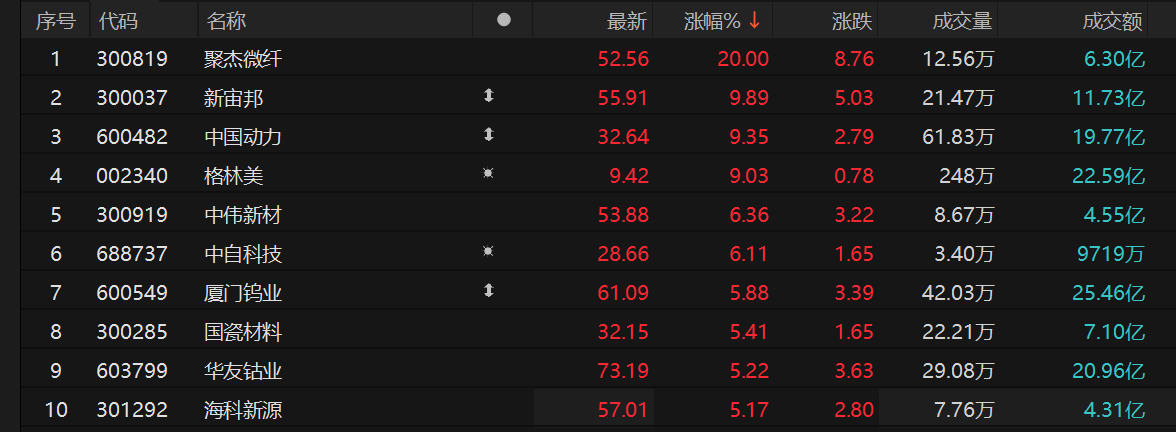
Group 1 - The solid-state battery concept has seen significant market activity, with companies like Xinzhou Bang rising over 10% and Ju Jie Wei Xian hitting a 20% limit up [1] - Other companies such as China Power, Green Beauty, and Zhongwei New Materials also experienced gains, indicating a broader interest in the solid-state battery sector [1][2] Group 2 - Guoxuan High-Tech and BASF have signed a strategic cooperation memorandum to jointly develop next-generation solid-state battery technology, focusing on high-performance materials [2] - The collaboration aims to accelerate the commercialization of innovative results in various applications, including electric vehicles and energy storage [2] - Century Securities notes that the industrialization of semi-solid and solid-state batteries is progressing steadily, with significant breakthroughs in high-pressure module packaging and system lightweight integration [3] - The demand for high-safety, high-energy-density batteries is increasing across various sectors, including electric motorcycles, drones, and distributed energy storage, providing diverse commercialization paths for solid-state batteries [3]


每日市场观察-20260211
Caida Securities· 2026-02-11 02:47
Market Overview - On February 10, the Shanghai Composite Index rose by 0.13%, while the Shenzhen Component increased by 0.02%, and the ChiNext Index fell by 0.37%[3] - The total trading volume on February 10 was 2.12 trillion yuan, a decrease of approximately 150 billion yuan compared to the previous trading day[1] Sector Performance - The media, home appliance, and coal sectors saw significant gains, while real estate, food and beverage, and agriculture sectors experienced declines[1] - Major inflows of capital were observed in the film and television, IT services, and publishing sectors, while outflows were noted in photovoltaic equipment, military electronics, and batteries[3] Market Sentiment - Market strength weakened compared to Monday, reflected in reduced gains and trading volume[1] - The rise in media and entertainment stocks is attributed to the Seedance 2.0 event and the pre-Spring Festival timing, indicating a short-term speculative nature[1] Investment Strategy - Given the market's recent adjustments, a shift away from short-term thinking is advised, focusing on opportunities post-holiday in sectors like technology, non-ferrous metals, and chemicals[1] - Over 60% of private equity firms prefer to hold significant positions during the holiday, with 70% optimistic about post-holiday market performance[12]
【科技日报】我自研电池技术可支撑设备极端低温下“即插即用”
Ke Ji Ri Bao· 2026-02-11 01:53
张盟表示,该成果有望破解极寒地区电池"怕冻"的困境,为我国乃至全球在高寒条件下的森林防 火、电力巡检、应急通信等作业场景注入"温暖能量"。技术的推广应用,将使我国在极寒环境下的能源 自主性与科技装备可靠性将实现战略性提升,也有望为全球面临类似挑战的地区提供中国解决方案。 (原载于《科技日报》 2026-02-11 03版) 记者10日从中国科学院大连化学物理研究所获悉,该所陈忠伟研究员团队在黑龙江漠河完成超低温 锂电池实地测试,标志着我国自主研发的电池技术已能支撑各类设备在极端低温下实现"即插即用",破 解了极寒地区电池能源供给难题。 团队低温电池技术负责人张盟副研究员介绍,团队自主研发的超低温电池技术及配套人工智能电源 管理系统通过创新性地设计耐低温电解液、开发准固态功能性隔膜,并融合先进的AI电池管理算法, 解决了传统锂电池在低温下活性骤降、续航锐减甚至无法工作的行业痛点。据悉,在零下34摄氏度的极 寒环境中,无需任何外部保温措施的超低温锂电池,静置超过8小时后仍能保持超过85%的有效容量, 并成功驱动工业级无人机完成长续航飞行与多项任务模拟。 ...