二手房交易

Search documents
刚需“抄底”上车?九月这23城二手房成交回暖
Di Yi Cai Jing· 2025-10-22 08:36
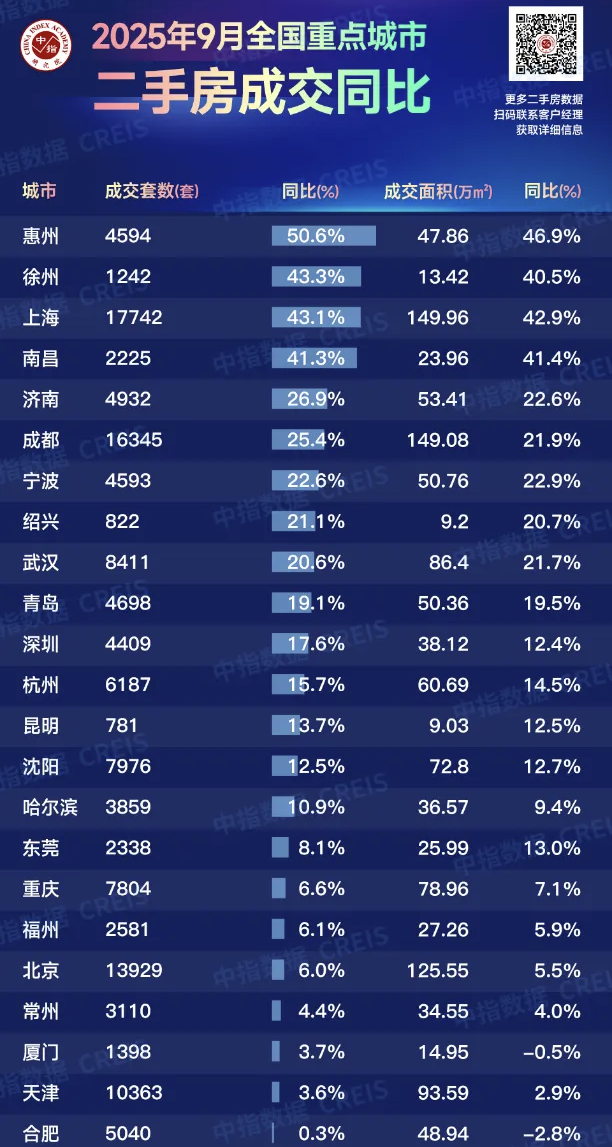
Core Insights - The second-hand housing prices continue to adjust, leading some first-time homebuyers to choose to enter the market [1] - In September 2025, the average price of second-hand residential properties in 100 cities was 13,381 yuan per square meter, with a month-on-month decline of 0.74% and a year-on-year decline of 7.38% [1] - The transaction volume in September showed that 23 cities among key national cities experienced year-on-year increases [2] Price Trends - The cumulative decline in second-hand housing prices across 100 cities for the first three quarters was 5.79% [1] - The average listing duration for second-hand homes reached 95.12 days in September 2025, an increase of 6.65% year-on-year [5] - The overall market is under pressure from high listing volumes, with a total of approximately 2.5842 million second-hand homes listed [5] Transaction Volume Insights - In September, Huizhou and Xuzhou led the transaction increases, with Huizhou seeing a 50.6% year-on-year increase in transaction volume [3][4] - The transaction volume in Huizhou was 4,594 units, while Xuzhou recorded 1,242 units, reflecting significant growth in these smaller cities [3][4] - The trend indicates a shift towards lower-priced housing, with low total price transactions increasing from 25% to 36% [2] Market Characteristics - The second-hand housing market is characterized by three main features: total volume increase, structural differentiation, and policy-driven dynamics [5] - Various local governments have introduced measures such as optimizing housing provident funds, offering purchase subsidies, and lowering mortgage rates to support transaction volumes [5] - The market is experiencing a complex operational state, with a focus on "price for volume" strategies as a prevailing trend [5]

二手房越来越不好卖,为什么房东还是不降价抛售?4大原因很现实
Sou Hu Cai Jing· 2025-10-22 06:12
Core Insights - The article discusses the current challenges in the second-hand housing market, highlighting a significant drop in transaction volumes while prices remain relatively stable despite a buyer's market [1][3]. Group 1: Market Conditions - The transaction volume of second-hand homes in 50 key cities has decreased by 23.7% year-on-year, with the average listing period extending from 45 days in 2023 to 97 days in 2025 [1][3]. - Despite the market downturn, the average listing price of second-hand homes has only decreased by 2.3%, which is much lower than market expectations [1][3]. Group 2: Reasons for Price Resistance - High leverage in home purchases creates financial pressure, making it difficult for homeowners to lower prices. Over 65% of buyers from 2018 to 2022 had down payments below 30%, leading to significant financial losses if they sell at lower prices [3][4]. - The "neighbor effect" and "anchoring bias" influence homeowners' pricing decisions, with 85% of sellers referencing nearby listings rather than actual sale prices, creating an informal "price alliance" [4][5]. - Optimistic expectations about future market conditions lead many homeowners to hold onto their properties rather than sell at a loss. A survey indicated that 57% of homeowners believe prices will rise in the next two years [5][7]. - The "scissors gap" risk for homeowners looking to sell and buy simultaneously discourages price reductions, as they fear selling low and then facing higher prices for new purchases [7][8]. Group 3: Recommendations for Buyers and Sellers - Sellers are advised to set realistic prices based on current market conditions rather than past highs, as the market has shifted to a stock-based environment [8][9]. - Buyers should focus on actual transaction prices rather than listing prices, as the average difference between listing and transaction prices in key cities is 12.7% [9][11]. - It is recommended for buyers to identify properties that have been on the market for extended periods, as sellers may be more willing to negotiate on price [12][13].
二手结构 | 9月京沪深杭小面积低总价成交比重显著上升
克而瑞地产研究· 2025-10-19 01:58
Core Viewpoint - The second-hand housing market in key cities like Beijing, Shanghai, Shenzhen, and Hangzhou shows a significant year-on-year increase in transaction volume, contrasting with a decline in new housing transactions. The market is characterized by a strong demand from first-time buyers and a stable high-end segment, while the middle-tier demand is weakening [2][14]. Summary by Sections Transaction Volume and Structure - In September 2025, the transaction volume of second-hand houses in 30 key cities increased by 9% year-on-year, while new housing transactions showed a declining trend [2]. - The proportion of transactions under 2 million yuan in Beijing, Shanghai, Shenzhen, and Hangzhou has increased, indicating a strong presence of first-time buyers [3][14]. Price Segmentation - The share of transactions priced below 2 million yuan in Shanghai reached 46.56%, with a month-on-month increase of 2.79 percentage points and a year-on-year increase of 7.51 percentage points [3]. - Conversely, the middle-tier segments (500-600 million yuan) in these cities have seen a decline in transaction share, reflecting increased buyer hesitation [3][14]. High-End Market Stability - The high-end market remains stable, with luxury properties priced over 10 million yuan in Beijing and Shanghai showing resilience, while Shenzhen's luxury market (3-5 million yuan) has also seen significant growth [3][14]. Area and Size Trends - The majority of transactions in Beijing, Shanghai, and Shenzhen are concentrated in small-sized properties (under 70 square meters), which account for over 30% of total transactions [7]. - In Hangzhou, there is a notable increase in the transaction share of larger properties (over 160 square meters), catering to buyers looking for long-term living solutions [7][14]. Regional Focus - The transaction share in Shanghai is increasingly concentrated in suburban areas, while Beijing and Hangzhou see a focus on core urban districts [11][14]. - The top three areas with the highest transaction growth in September 2025 include Beijing's Chaoyang District and Shenzhen's Longgang District, indicating a shift in buyer preferences towards more central locations [11][14]. Market Outlook - The second-hand housing market is expected to experience a seasonal decline in October, with prices still in a downward cycle. The market is transitioning to a buyer's market, where buyers are more selective based on location, amenities, and price [14].

9月二手房交易活跃度有所回升
Xin Hua Cai Jing· 2025-10-17 16:28
Core Viewpoint - The second-hand housing market in major cities in China showed signs of recovery in September, with increased transaction volumes, but prices remain under pressure, continuing the trend of "trading price for volume" [1][3]. Group 1: First-tier Cities - In Beijing, the second-hand housing market saw a significant increase in activity, with transaction volumes up nearly 20% month-on-month and year-on-year, totaling 15,843 units, a month-on-month increase of 18.8% and a year-on-year increase of 19.4% [2]. - Despite the increase in transaction volume, Beijing's second-hand residential prices fell by 0.60% month-on-month and 4.27% year-on-year [2]. - Shanghai's second-hand housing transactions increased by 27% year-on-year, with 17,723 units sold, a month-on-month increase of 2.7% [2]. - In Guangzhou, the average listing price for second-hand residential properties fell by 0.97% month-on-month and 6.13% year-on-year [2]. - Shenzhen experienced over a 40% year-on-year increase in transaction volume, while prices remained stable month-on-month [2]. Group 2: Second-tier Cities - In Hangzhou, the market activity improved with the end of high temperatures, but prices continued to fluctuate [3]. - Chengdu saw growth in transaction volumes under the "trading price for volume" strategy, but the month-on-month price decline expanded [3]. - Nanjing's second-hand housing market remained relatively flat, with continued price declines [3]. - Wuhan's transaction volume was stable, but prices faced significant downward pressure [3]. - In Chongqing, second-hand housing prices continued to decline, with an expanding drop [3]. - Tianjin's prices further decreased, particularly in suburban areas [3]. Group 3: Market Outlook - The overall second-hand housing market showed signs of recovery in September, with increased transaction volumes in Beijing, Shanghai, and Shenzhen, as well as some recovery in other core cities like Wuhan and Chengdu [3]. - The Central Index Research Institute expects continued moderate recovery in transaction activity in key cities in October, although last year's fourth-quarter high base may impact year-on-year growth rates [3].
房产中介良心透露:如果二手房超过了这个年限,建议你别买了,划不来!
Sou Hu Cai Jing· 2025-10-13 09:34
Core Viewpoint - The article emphasizes the hidden risks associated with purchasing older second-hand homes, particularly those over twenty years old, despite the allure of lower prices and potential renovations [1]. Group 1: Risks of Older Second-Hand Homes - Many buyers are misled by the low prices and attractive features of older homes, only to face significant renovation costs and hidden issues after purchase [3][4]. - Common problems include shared plumbing with neighboring units, leading to unexpected expenses for repairs and maintenance [4]. - The quality of property management in older neighborhoods is often poor, with inadequate maintenance of common areas and facilities [5]. Group 2: Structural and Safety Concerns - Homes older than twenty years may have deteriorating structural integrity, including aging electrical systems and plumbing, which can lead to costly repairs and safety hazards [6]. - The outdated layouts of older homes may not meet modern living standards, resulting in a subpar living experience and additional renovation costs [8]. Group 3: Marketability and Future Resale - Older homes are becoming increasingly difficult to sell due to a surplus of available properties that meet modern standards, leading to a decline in demand for such homes [10]. - Buyers are advised to prioritize homes that are five to ten years old for better quality and modern design, which can enhance living comfort and resale potential [14]. Group 4: Recommendations for Buyers - It is crucial for buyers to conduct thorough inspections of properties, assess the quality of management, and understand the surrounding environment before making a purchase [15]. - Buyers should also be aware of stricter loan conditions for older homes, which may limit financing options [15]. - A careful evaluation of personal budget and needs is essential to avoid financial strain and ensure the chosen property aligns with long-term goals [15].
北京二手房市场明显回暖,成交环比大涨20.8%
3 6 Ke· 2025-09-23 02:08
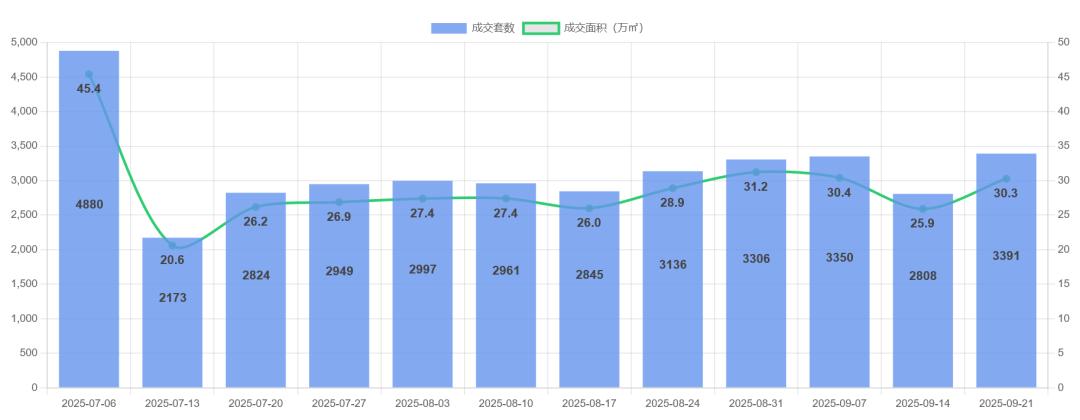
Market Analysis - The Beijing second-hand housing market has shown a significant recovery trend, with 3,391 transactions in the week of September 15-21, 2025, representing a week-on-week increase of 20.8%, the highest in six weeks [4][6] - The total transaction area reached 302,855㎡, with a 17% increase compared to the previous week, indicating enhanced market activity during the traditional "golden September" period [4][6] - The average transaction size decreased to 89㎡, the lowest in six weeks, suggesting an increase in the proportion of smaller units sold [4] Shanghai Market Analysis - The Shanghai second-hand housing market has experienced a moderate recovery, with 4,811 transactions in the same week, reflecting a week-on-week growth of 7.5% [9][10] - The total transaction area was 390,177㎡, with a 5% increase, indicating a steady upward trend since late August [9][10] - The average transaction size decreased from 83㎡ to 81㎡, highlighting increased activity in smaller unit sales [9] Shenzhen Market Analysis - The Shenzhen second-hand housing market has shown a notable recovery, with 1,205 transactions, marking an 18.3% week-on-week increase, the highest in six weeks [13][14] - The total transaction area reached 120,044.36㎡, with a 17.1% increase, indicating a strong market response during the "golden September" season [13][14] - The average transaction size remained stable between 96-102㎡, indicating that demand for entry-level units continues to dominate [13] Hangzhou Market Analysis - The Hangzhou second-hand housing market has shown signs of stabilization and recovery, with 1,129 transactions, a 13.1% week-on-week increase [17][19] - The total transaction area increased by 13.3% to 118,962.89㎡, reflecting a recovery from previous declines [17][19] - The average transaction size remained stable at 105㎡, indicating sustained demand for improved housing options [17] Chengdu Market Analysis - The Chengdu second-hand housing market has shown a fluctuating recovery trend, with 3,367 transactions, an 8.2% week-on-week increase [22][23] - The total transaction area was 321,161.79㎡, with an 8.4% increase, indicating a return to the six-week average level [22][23] - The average transaction size remained stable between 91-96㎡, suggesting that demand for entry-level products continues to be strong [22] Ningbo Market Analysis - The Ningbo second-hand housing market has experienced a significant recovery, with 2,744 transactions, a dramatic 89.5% week-on-week increase, the highest in six weeks [26][28] - The total transaction area reached 286,834.26㎡, with an 85.1% increase, indicating a strong rebound from previous lows [26][28] - The average transaction size remained stable between 105-107㎡, reflecting consistent demand [26] Dongguan Market Analysis - The Dongguan second-hand housing market has shown a moderate recovery, with 561 transactions, a 4.3% week-on-week increase [31][32] - The total transaction area was 61,232.59㎡, with a 2.1% increase, indicating a gradual improvement in market conditions [31][33] - The average transaction size was 109㎡, suggesting ongoing demand for improved housing options [31][33]
中介一不小心说漏嘴:大部分二手房都不值得买,3大弊端超出你的想象
Sou Hu Cai Jing· 2025-09-22 07:56
Core Insights - The article highlights the hidden risks in the second-hand housing market, emphasizing the importance of thorough due diligence before purchasing properties [1][2]. Group 1: Market Overview - In Q1 2025, the transaction volume of second-hand homes in 300 major cities reached 1.573 million units, accounting for 58.6% of the total residential market transactions [1]. - The second-hand housing market has become a significant part of real estate transactions, but it also harbors various issues that need attention [1]. Group 2: Major Issues in the Second-Hand Housing Market - **Ownership and Debt Risks**: 37.2% of disputes in second-hand housing transactions stem from unclear property rights. Issues include ambiguous ownership, hidden mortgages, and potential judicial seizures [3][5]. - **Quality Problems**: Over 65% of second-hand homes have quality issues, with 78% of homes older than 15 years showing signs of aging electrical and plumbing systems [6]. - **Hidden Costs and Tax Burdens**: Transaction costs can account for 30% of the property price, including taxes and fees that buyers often overlook [8][9]. Group 3: Recommendations for Buyers - Buyers are advised to conduct thorough property checks, including hiring professional inspectors and verifying ownership details through official channels [7][11]. - It is recommended to prepare a detailed budget that includes all potential costs, including taxes and renovation expenses, to avoid unexpected financial burdens [11][12]. Group 4: Opportunities in the Second-Hand Housing Market - Despite the risks, second-hand homes can offer advantages such as established locations, better price-to-value ratios, and the ability to assess the property condition firsthand [14]. - Buyers can find valuable properties by following a structured approach, including using reputable agents and conducting multiple site visits [16].


克而瑞:预计整体二手房市场热度仍将进一步回落
智通财经网· 2025-09-19 11:43
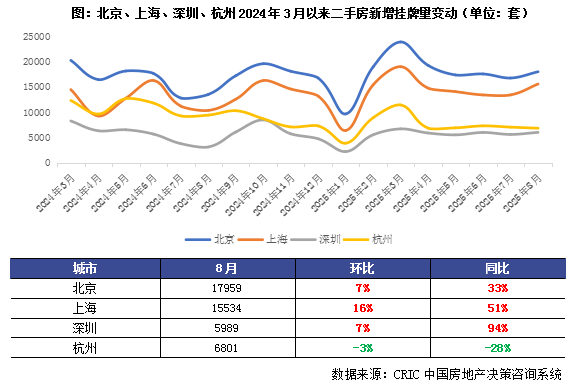
Core Viewpoint - The second-hand housing market in key cities is experiencing a gradual decline in transaction volume, with a 9% month-on-month decrease in transaction area as of August, indicating a slowdown in growth momentum [1] Group 1: Market Trends - The overall second-hand housing market is expected to further cool down, stabilizing at low levels due to increased listings and supply [1] - The traditional marketing peak in September will see new high-quality properties entering the market, which may divert some high-end customer demand from the second-hand market [1] - The transaction cycle may extend further if there are no significant price advantages, particularly affecting older properties in urban and suburban areas [1] Group 2: Listing Data - In August, the number of new listings in Beijing, Shanghai, and Shenzhen increased both month-on-month and year-on-year, with Shanghai and Shenzhen seeing over 50% year-on-year growth [2][6] - Beijing had 17,959 new listings, a 7% month-on-month increase and a 33% year-on-year increase; Shanghai had 15,534 new listings, a 16% month-on-month increase and a 212% year-on-year increase; Shenzhen had 68,866 new listings, a 7% month-on-month increase and a 44% year-on-year increase; only Hangzhou saw a decline in new listings [2] Group 3: Price Segmentation - In Beijing, the number of new listings for properties priced below 500 million yuan has increased, with this segment accounting for over 60% of new listings [3] - In Shanghai and Shenzhen, the proportion of new listings in the 6-8 million yuan price range has significantly increased, with month-on-month growth of 0.37 percentage points and 0.93 percentage points, respectively [3] - Hangzhou shows a decline in the mid-price segment, while the low and high price segments have seen an increase in listings, indicating a "two-headed" market for demand [3] Group 4: Property Size Trends - The increase in new listings in the four cities is primarily concentrated in the 70-140 square meter range, with significant growth in the 90-120 square meter segment in Beijing, catering to family housing needs [5] - In Shanghai and Shenzhen, there is notable growth in both the mid-size and larger property segments, while Hangzhou has seen a rise in listings across smaller size segments [5] - Overall, the second-hand housing market in key cities shows a seasonal increase in new listings, but with significant differentiation among cities, particularly with Shanghai and Shenzhen showing strong year-on-year growth [6]
行业透视 | 8月沪深等新增挂牌600万-800万元房源占比增幅领先
克而瑞地产研究· 2025-09-19 09:42
Core Viewpoint - The second-hand housing market in key cities has shown a seasonal rebound in new listings, but significant differentiation exists among cities, with Beijing, Shanghai, and Shenzhen experiencing increases while Hangzhou sees a decline in owner listing enthusiasm [2][14]. Group 1: New Listings and Market Trends - In August, the new listing volume in Beijing, Shanghai, and Shenzhen increased both month-on-month and year-on-year, with Shanghai showing a year-on-year increase of 51% and Shenzhen at 94%, indicating a recovery in owner confidence and willingness to sell [3][14]. - The new listing volume in Hangzhou, however, decreased by 28% year-on-year and 3% month-on-month, reflecting a cautious market sentiment [14]. Group 2: Price Segmentation - In Beijing, the enthusiasm for listing properties priced below 500 million yuan has increased, with listings in the 100-500 million yuan range accounting for over 60% of new listings [7]. - In Shanghai and Shenzhen, the proportion of new listings in the 600-800 million yuan range has significantly increased, with month-on-month growth rates of 0.37 percentage points and 0.93 percentage points, respectively [7]. - Hangzhou shows a decline in the proportion of mid-range listings, while both low-end (below 300 million yuan) and high-end (above 3 billion yuan) listings have seen increases [7]. Group 3: Area Segmentation - The new listing volume in the 70-140 square meter range has increased significantly across the four cities, with Beijing seeing notable growth in the 90-120 square meter category, which typically meets the needs of families [11]. - In contrast, larger and smaller area segments have seen a decline in new listing proportions [10]. Group 4: Market Outlook - Overall, the second-hand housing market is expected to continue cooling, with increased supply from rising listing volumes and potential demand diversion due to new high-quality products entering the market [14]. - The performance of the first-time buyer segment will largely depend on the willingness of owners to reduce prices, as a lack of significant price advantages may prolong transaction cycles [14].

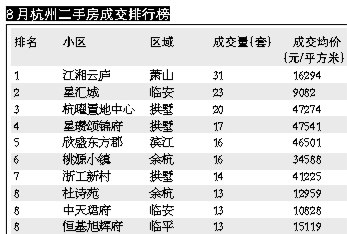
二手房成交“五连降” 这类低价房源成为8月黑马
Mei Ri Shang Bao· 2025-09-03 22:37
Core Viewpoint - After five consecutive months of decline, the second-hand housing market in Hangzhou has shown signs of recovery in August, with a total of 6,633 transactions, marking a slight decrease from July but a stable performance compared to the previous year [2]. Group 1: Market Performance - In August, the average transaction price for second-hand residential properties in the city was 28,178 yuan per square meter, a slight increase of 0.2% from July and a year-on-year increase of 2.0% [2]. - The total number of transactions in August was 6,633, which is higher than January and February but lower than the peak of 12,413 transactions in March [2]. - The proportion of transactions for properties priced below 2 million yuan has risen to 49.4%, indicating a strong demand from first-time buyers [2]. Group 2: Transaction Highlights - Among the top 20 transactions, 8 properties had an average price below 20,000 yuan per square meter, with the lowest being 9,082 yuan per square meter for the Yuexiu Xinghui City, which saw 23 transactions [3]. - Five newly delivered properties with less than one year of occupancy were among the top 20 transactions, indicating a resurgence in demand for quality new homes [3]. - The Jiangxiangyunlu project in Xiaoshan was particularly notable, with 31 transactions and a remarkable 520% increase from the previous month, priced at 16,294 yuan per square meter [4]. Group 3: Emerging Trends - The performance of relocation housing has been outstanding, with three such projects entering the top ten transactions in August, all being newly delivered properties [4]. - The original reconstruction community, Zhejiang Gong University New Village, recorded 14 transactions, a 75% increase from July, with an average price of 41,225 yuan per square meter [5]. - The Du Shiyuan project in Yuhang also performed well, with 13 transactions and a 160% increase from the previous month, priced at 12,959 yuan per square meter [5].