
人工智能与机器人

Search documents
全球资本扎堆深圳!2025招商大会签约超7700亿元
Zheng Quan Shi Bao Wang· 2025-12-05 14:52
Group 1 - The 2025 Shenzhen Global Investment Conference successfully commenced with the theme "Open Chain Global, Innovation Leads the Future," focusing on seven key sectors including AI, biomedicine, new energy, and finance [1] - The conference resulted in over 340 signed projects with a total investment amount exceeding 770 billion, showcasing Shenzhen's strong appeal for high-quality projects and enterprises [1] - Prior to the main event, Shenzhen held five overseas sub-conferences in major cities across North America, Europe, Oceania, and Asia, attracting over 400 representatives from businesses and investment institutions [1] Group 2 - The financial segment of the conference highlighted Shenzhen's achievements in financial innovation and invited influential financial institutions to share their practices [2] - Fubon Bank (Hong Kong) is establishing a financial service platform connecting mainland China and Hong Kong, citing Shenzhen's technological resources and industrial foundation as key reasons for its choice [2] - China Bank has provided comprehensive financial support for the conference, including multilingual services and investment exchange meetings, facilitating global capital connection with Shenzhen opportunities [2] Group 3 - Shenzhen is continuously enhancing its market-oriented, rule-of-law, and international business environment, making it a preferred investment destination globally [3] - As of now, 180 countries and regions have invested in Shenzhen, with over 340 Fortune 500 companies having established a presence in the city [3] - From January to October this year, Shenzhen saw a growth in actual foreign investment, with the number of newly established foreign-invested enterprises exceeding 10,000 [3]

邀约全球 来深“掘金”
Sou Hu Cai Jing· 2025-12-05 00:48
Group 1 - The event will host over 600 participating companies and institutions, including more than 200 Fortune 500 and multinational companies from over 30 countries and regions [2] - There are 7 key thematic investment promotion activities focusing on AI terminals and software, artificial intelligence and robotics, biomedicine and medical devices, new energy and high-performance new materials, finance, cultural tourism and commerce, and marine economy [2] - 13 investment inspection routes will be available for participants [2] Group 2 - The event aims to invite guests to experience the business environment in Shenzhen [3] - An additional 100 "City + AI" scenarios will be opened, building on the previously established 200 scenarios [3]

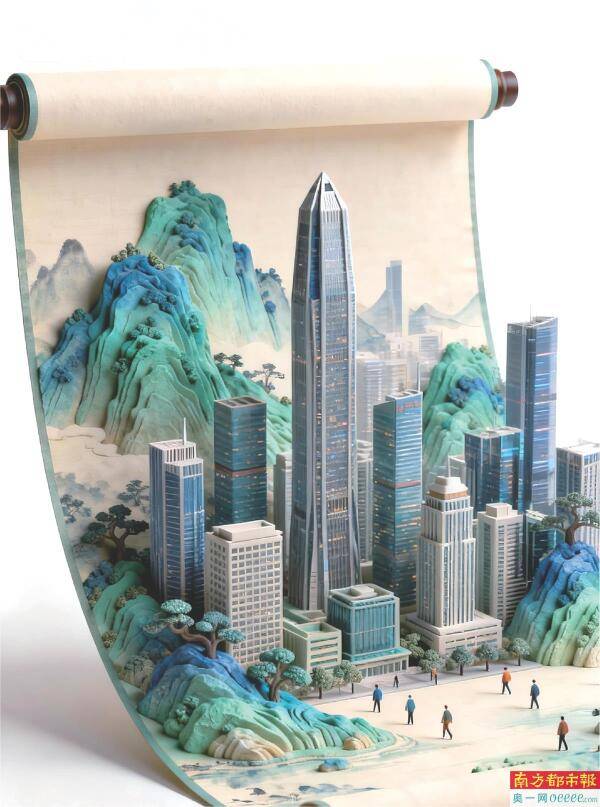
佛山新添百亿规模基金 将重点投向人工智能与机器人产业链
Zheng Quan Shi Bao Wang· 2025-12-03 13:52
该基金作为省级人工智能与机器人产业投资基金集群的关键组成部分,将重点投向人工智能与机器人产 业链,旨在提升核心技术的国产化水平,加速形成新质生产力。 该基金总规模100亿元,首期规模20亿元,存续期为10年,由佛山金控协同广东恒健控股有限公司、工 银金融资产投资有限公司等中央及省属、市属国企共同组建。基金已于11月28日通过佛山市新动能基金 联席会议审议并完成社会公示,佛山出资额在两亿元内。 人民财讯12月3日电,佛山市金融投资控股有限公司最新发布,广东智能机器人产业投资基金成为佛山 新动能产业基金首批(第二期)合作子基金。 ...

从“蓝色粮仓”到“精密关节”,江门新会以智造“链”上大湾区
2 1 Shi Ji Jing Ji Bao Dao· 2025-12-03 07:48
Core Viewpoint - The article highlights the transformation and modernization of the manufacturing industry in Jiangmen, Guangdong, particularly focusing on the innovative ship "Bay Area Lingding" and the advancements in shipbuilding and rail transportation sectors, showcasing the region's upward trajectory in the industrial chain [2][4][10]. Group 1: Innovative Developments - The "Bay Area Lingding" is a new type of aquaculture vessel capable of producing 5,000 tons of fish annually and autonomously locating suitable water areas, symbolizing Guangdong's push towards modern marine ranching [2][4]. - Jiangmen's shipbuilding industry is evolving with the introduction of energy-efficient vessels, with the latest model achieving over 20% market share in the global small handy bulk carrier segment [4][5]. - The construction of the "Bay Area Lingding" faced challenges such as its unique hollow structure and the integration of a hybrid power system, demonstrating significant technological advancements [4][6]. Group 2: Economic Growth and Industrial Upgrading - Jiangmen's manufacturing sector is experiencing a robust transformation, with a projected industrial output value of 150 billion yuan in 2024, reflecting a growth rate of 7% [7][9]. - The region has seen a significant increase in the output value of its shipbuilding and rail transportation industries, with the shipbuilding sector achieving a 68.1% year-on-year growth in 2024 [6][7]. - The local economy is bolstered by over 820 industrial enterprises, including 15 provincial manufacturing powerhouses, indicating a strong industrial foundation [7][9]. Group 3: Strategic Location and Infrastructure Development - The opening of the Shenzhen-Zhongshan Bridge has redefined the geographical advantages of Jiangmen, reducing travel time to Shenzhen to about one hour and facilitating the influx of high-end industries and resources [3][8]. - Jiangmen is actively developing three major industrial parks, aiming to attract significant investments and enhance its industrial capabilities, with plans for 169 projects exceeding 100 million yuan in total investment [9][10]. - The region is fostering a collaborative model with Shenzhen, focusing on integrating R&D and production, which is expected to enhance its competitive edge in the market [8][9].
超200家世界500强及跨国企业将参加深圳全球招商大会
Sou Hu Cai Jing· 2025-11-28 14:52
Core Points - The 2025 Shenzhen Global Investment Conference will be held on December 5 at the Shenzhen Convention and Exhibition Center, with participation from over 200 Fortune 500 companies and multinational corporations from more than 30 countries and regions [1][3] - The theme of the conference is "Open Chain Global, Innovation Leads the Future," aiming to create a comprehensive, broad, and high-level investment cooperation platform to enhance Shenzhen's attractiveness and influence on global resources [1][3] Group 1 - The conference will feature a "1+7+N" series of activities, including one main event, seven themed investment activities, and multiple investment inspection activities combined with overseas sub-conferences [3] - The event will showcase Shenzhen's economic vitality, innovation capability, industrial strength, and investment potential [3] - Key sectors for themed investment activities include AI terminals and software, artificial intelligence and robotics, biomedicine and medical devices, new energy and high-performance materials, finance, cultural tourism and commerce, and marine economy [3] Group 2 - Two AI-related themed investment activities will highlight Shenzhen's industrial foundation, policy support, and resource layout, showcasing emerging enterprises and facilitating connections with policy funds and venture capital institutions [3] - The financial special event will present innovations in financial reform and development, inviting influential global financial institutions to share practices in Shenzhen's financial innovation [3] - Shenzhen's districts, including Dapeng New District and Shenshan Special Cooperation Zone, have designed 13 investment inspection routes for guests to experience the development atmosphere, entrepreneurial ecosystem, and business environment [4]

中晟高科控股公司经营范围变更为AI及智能机器人等
Qi Cha Cha· 2025-11-27 01:56
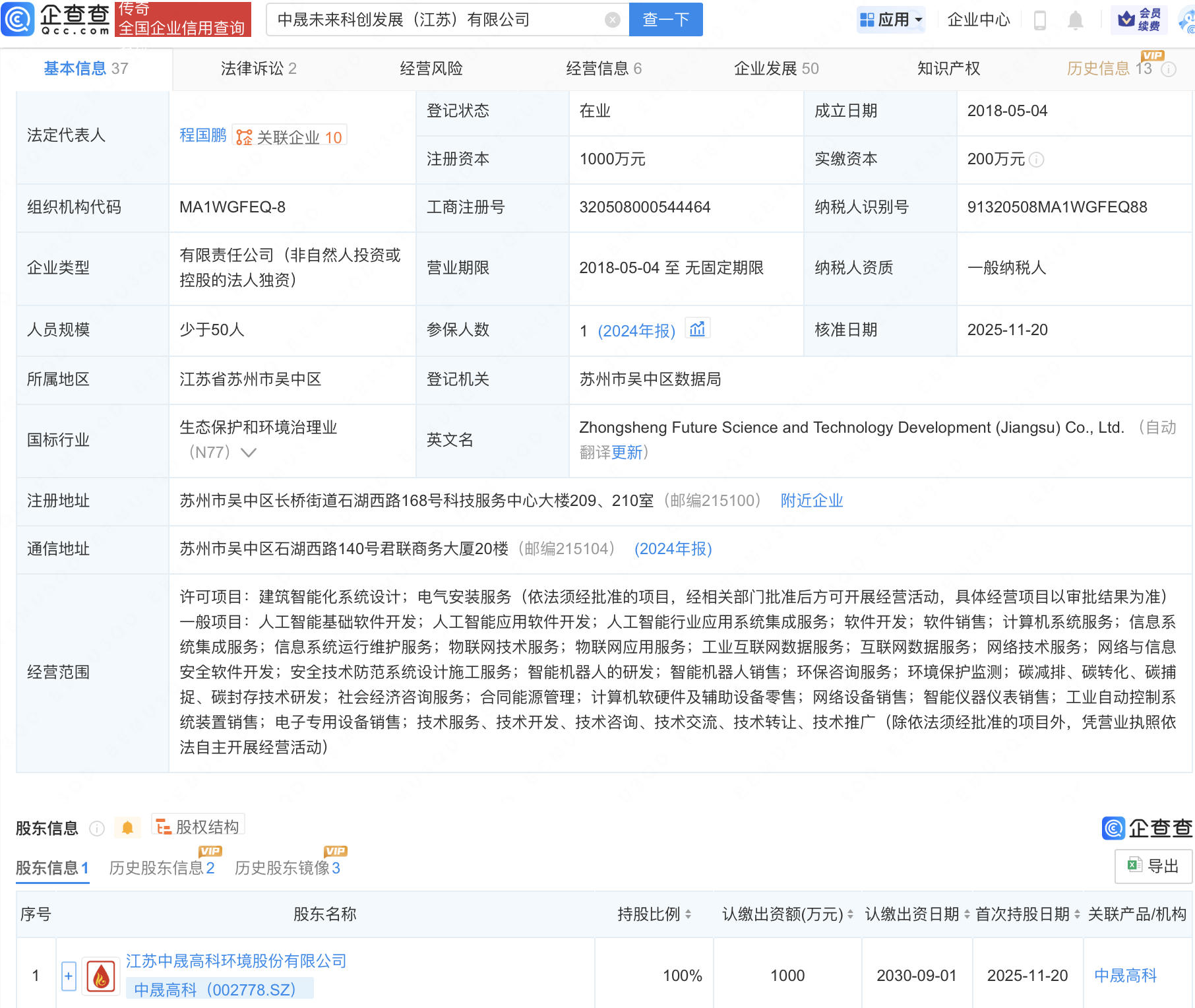
Core Viewpoint - The company formerly known as Suzhou Zhongsheng New Environment Management Co., Ltd. has undergone a name change to Zhongsheng Future Science and Technology Development (Jiangsu) Co., Ltd. and has shifted its business focus towards artificial intelligence and robotics [1][3]. Company Information - The new registered name is Zhongsheng Future Science and Technology Development (Jiangsu) Co., Ltd. with a registered capital of 10 million yuan [2]. - The legal representative is Cheng Guopeng, and the company was established in May 2018 [2]. - The company is located in Suzhou, Jiangsu Province, and operates as a limited liability company [2]. Shareholder Changes - Suzhou Zhongsheng Environmental Restoration Co., Ltd. has exited the shareholder list, and Zhongsheng High-Tech (002778) has become the sole shareholder [1][3]. - The ownership structure now reflects 100% ownership by Jiangsu Zhongsheng High-Tech Environmental Co., Ltd. [2]. Business Scope - The business scope has been updated to include artificial intelligence application software development, AI industry application system integration services, IoT technology services, and research and sales of intelligent robots [1][3]. - The company is also involved in various other services such as environmental consulting and energy management [2].

【深圳特区报】为强国建设注入澎湃动能——从高交会看中国式现代化的创新注脚
Sou Hu Cai Jing· 2025-11-25 08:33
Group 1 - The 27th China International High-Tech Achievements Fair (CIHTAF) showcased over 5,000 cutting-edge achievements and facilitated more than 170 billion yuan in intended transactions and financing, attracting over 450,000 attendees [2][11] - CIHTAF serves as a significant platform for the transformation of high-tech achievements and reflects China's commitment to integrating into the global innovation network through openness and innovation-driven development [2][6] - The fair featured 22 specialized exhibition areas with over 5,000 renowned enterprises and international organizations, highlighting advancements in deep-sea energy development, nuclear power technology, and autonomous systems [4][5] Group 2 - The event marked a shift in China's information industry, showcasing advancements such as Huawei's Ascend 384 super node and non-invasive brain-machine interfaces, indicating a move towards self-reliance in core technologies [5][6] - CIHTAF has evolved significantly since its inception in 1999, expanding from 2 million square meters and 2,856 exhibitors to 400,000 square meters with over 90% of exhibits being high-tech products, including AI, robotics, and commercial aerospace [6][11] - The fair has facilitated 1,023 supply-demand matches and investment projects, with intended transaction and financing amounts exceeding 170 billion yuan, demonstrating its role in driving technological innovation and economic growth [11][12] Group 3 - CIHTAF has become a global innovation magnet, attracting over 120 countries and regions, and fostering international collaboration through specialized pavilions and procurement activities [7][9] - The event has seen participation from major international firms, indicating recognition of China's market potential and innovation environment, with companies like Remote and Hansa Flex seeking deeper cooperation [8][9] - The fair emphasizes the importance of integrating technology research, industry application, and market navigation, creating a comprehensive ecosystem for innovation [12][13]

为强国建设注入澎湃动能——从高交会看中国式现代化的创新注脚
Xin Hua She· 2025-11-24 14:37
Core Viewpoint - The 27th China International High-Tech Achievements Fair showcased over 5,000 cutting-edge results, with more than 170 billion yuan in intended transactions and financing, highlighting China's vibrant technological innovation and its integration into the global innovation network [3][5][19]. Group 1: Technological Innovations - The fair featured advanced technologies such as a bionic drone capable of navigating obstacles autonomously, showcasing China's progress towards self-reliance in technology [3][6]. - Significant displays included CNOOC's first cylindrical floating production storage and offloading unit and CGN's third-generation nuclear power technology, both demonstrating China's capabilities in deep-sea energy development and nuclear technology [3][5]. - Huawei's Ascend 384 super node and Zhejiang Qiang Brain Technology's non-invasive brain-machine interface were highlighted as breakthroughs in computing power and brain-computer interaction [5][6]. Group 2: Growth and Scale of the Fair - The exhibition area expanded from 20,000 square meters in its inaugural year to 400,000 square meters, with over 90% of exhibits being high-tech products, and more than 20% being debut displays [8][19]. - The fair has evolved from 2,856 exhibitors in 1999 to over 5,000 in the current edition, reflecting its growing significance as a platform for technological exchange [8][19]. Group 3: International Collaboration - The fair attracted over 120 countries and regions, showcasing its role as a platform for global technological exchange and collaboration [9][10]. - Companies like Remote and Hansa Fluid Technology participated to explore opportunities in the Chinese market, indicating a strong interest from international firms in China's innovation landscape [10][14]. Group 4: Economic Impact - The fair facilitated 1,023 supply-demand matches and financing projects, with intended transaction amounts exceeding 170 billion yuan, underscoring its role in driving economic growth through technology [19][22]. - The event has historically been a launchpad for major tech companies, contributing to the emergence of firms like Tencent and BYD, and continues to influence the trajectory of China's tech industry [17][22]. Group 5: Ecosystem Development - The fair promotes a comprehensive innovation ecosystem that integrates government, industry, academia, research, and investment, facilitating the entire chain from technology development to industrial application [22]. - The establishment of strategic emerging industry clusters in regions like Bao'an District, with significant output values, illustrates the fair's impact on local economic development [22].

去香港找钱
投资界· 2025-11-21 09:18
Core Viewpoint - The Hong Kong government has launched a HKD 10 billion Innovation and Technology Industry Guiding Fund to attract private investment in key technology sectors, aiming to enhance the local innovation ecosystem and support growth in various industries [5][6][9]. Group 1: Fund Structure and Investment Focus - The Innovation and Technology Industry Guiding Fund is established under the "Innovation and Technology Fund" with a total allocation of HKD 10 billion from the Legislative Council [6]. - The fund will focus on five thematic areas: life and health technology, artificial intelligence and machinery, semiconductors and smart devices, digital transformation, and future sustainable development [6][7]. - Each sub-fund under the main fund will have a target size of at least HKD 400 million, with the government contributing a maximum of HKD 100 million, which cannot exceed 25% of the sub-fund's total size [6][7]. Group 2: Investment Strategy and Requirements - The government aims to attract strategic investors, each contributing no less than HKD 30 million, to co-invest alongside the government in the thematic sub-funds [7][8]. - The fund's investment requirements include: 1. 100% of the fund's size must be invested in enterprises related to Hong Kong's innovation and technology industries [8]. 2. At least 50% must be invested in Hong Kong enterprises or those planning to establish headquarters in Hong Kong [8]. 3. At least 30% must be allocated to companies establishing and operating production bases in Hong Kong [8]. Group 3: Role of Fund Managers - Fund managers will act as general partners (GPs) responsible for establishing sub-funds of at least HKD 20 million, including government contributions, and for managing daily operations and fundraising [8]. - The evaluation criteria for fund managers include their background, team resources, investment strategies, performance, and fundraising capabilities [8]. Group 4: Broader Context and Implications - The launch of the Innovation and Technology Industry Guiding Fund is part of a broader strategy to position Hong Kong as a hub for innovation and technology, emphasizing the importance of attracting talent and investment from overseas [9][10]. - The fund aims to complement existing investment frameworks, such as the HKIC, to create a robust ecosystem for nurturing early-stage and growth-stage technology companies [10].

福龙马新设子公司,含AI及机器人业务
Zheng Quan Shi Bao Wang· 2025-11-18 02:17
Group 1 - The core point of the article is the establishment of Fulongma Environmental Technology (Hangzhou) Co., Ltd., which is fully owned by Fulongma [1] - The company's business scope includes sales of artificial intelligence hardware, sales of intelligent robots, internet data services, and IoT technology services [1]
