
无人机

Search documents
“杭州六小龙”云深处启动IPO;英伟达准备向中国客户交付H200芯片丨Going Global
创业邦· 2025-12-28 10:29
Core Insights - The article highlights significant developments in the global expansion of Chinese companies, focusing on logistics, e-commerce, robotics, and AI technologies, indicating a trend of increasing international collaboration and competition in various sectors. Group 1: Major Events - Temu partners with PostNL to enhance cross-border logistics for local sellers in Europe, aiming to improve delivery flexibility and consumer experience [3][4] - TikTok Shop launches the "One Merchant, Sell Globally" project, enabling merchants to manage multiple stores across regions with integrated functionalities [5] - "Hangzhou Six Dragons" company Yun Shen Chu initiates IPO process after completing over 500 million yuan in Series C financing [7][8] Group 2: Company Responses and Developments - DJI expresses regret over the FCC's decision to list all non-U.S. manufactured drones on a regulated list, emphasizing the impact on market competition and consumer choice [11][12] - Lenovo plans to release the world's first "AI Super Intelligent Agent," aiming to integrate hardware interactions across its ecosystem [14] - MiniMax passes the Hong Kong Stock Exchange hearing, potentially becoming the first publicly listed company focused on general artificial intelligence (AGI) [15][17] Group 3: Market Trends and Financial Insights - OpenAI reports a computing profit margin of 70%, significantly higher than previous estimates, although it still faces challenges in achieving overall profitability [24][29][31] - Dyson founder James Dyson transfers £624 million to Singapore, indicating a strategic shift in wealth management and investment focus [26][27] Group 4: Future Plans and Innovations - Baidu's autonomous driving service platform, "萝卜快跑," plans to launch in London by 2026, marking a significant expansion into right-hand drive markets [18] - Nvidia is set to deliver H200 chips to Chinese customers, with expected shipments between 5,000 to 10,000 modules, despite regulatory uncertainties [24][26]




两项标准于明年5月1日起正式实施 破解无人机“谁能飞”“谁在飞”难题
Jing Ji Ri Bao· 2025-12-28 03:20
Core Viewpoint - The rapid expansion of China's drone industry has led to significant safety concerns, prompting the introduction of mandatory national standards for real-name registration and operational identification of drones, effective from May 1 next year [1][2]. Group 1: New Standards Implementation - The newly released standards aim to enhance the quality of civil drones and regulate flight activities, ensuring the safety of people's lives and property [1]. - The "Real-name Registration and Activation Requirements" standard mandates that drone systems must clearly indicate registration requirements and include features for activation control, user verification, and firmware updates [1][2]. - The "Operational Identification Specification" requires drones to have both broadcast and network-based identification capabilities, ensuring real-time reporting of identity, location, speed, and status to regulatory authorities [2]. Group 2: Technical Requirements - Drones must not be able to fly before activation and after deactivation, addressing the issue of "who can fly" from a technical standpoint [2]. - The standards stipulate that drones should continuously report their operational data throughout the flight, with safeguards against tampering of identification information [2]. - If the identification module fails before takeoff, the drone will be unable to launch, and any failure during flight must trigger an alarm and enable emergency landing procedures [2]. Group 3: Transition Period and Compliance - A transition period has been established for existing drones, allowing manufacturers 12 months to retrofit operational identification modules to comply with the new standards [3]. - New drones produced after the implementation date must adhere to the standards immediately, while existing drones will have a grace period for compliance starting from the 13th month after the standards take effect [3]. Group 4: Future Developments - The regulatory body plans to develop certification rules for drone products and accelerate the establishment of safety and testing standards for the drone industry [4]. - Training programs will be implemented for industry stakeholders, including manufacturers and testing institutions, to ensure comprehensive understanding and compliance with the new standards [4].
智能无人机助力三峡库区海事监管
Xin Hua She· 2025-12-28 02:56
Core Insights - The introduction of a new six-rotor intelligent patrol drone enhances maritime supervision in the Three Gorges Reservoir area, featuring advanced capabilities for efficient monitoring [2] Group 1: Drone Capabilities - The drone has a maximum flight altitude of 400 meters and a round-trip distance exceeding 30 kilometers, with a flight duration of over 45 minutes [2] - It includes features such as personalized route customization, real-time hovering for image capture, remote one-click patrol, and intelligent warning alerts [2] Group 2: Impact on Maritime Safety - The deployment of this drone technology is expected to inject new technological momentum into the safety supervision of shipping in the Yangtze River within the reservoir area [2]
破解无人机“谁能飞”“谁在飞”难题
Xin Lang Cai Jing· 2025-12-27 22:49
Core Viewpoint - The rapid expansion of China's drone industry is accompanied by safety concerns, prompting the introduction of mandatory national standards for real-name registration and operational identification of drones, effective from May 1 next year [2][3]. Group 1: New Regulations - The newly released standards aim to enhance the quality of civil drones and regulate flight activities, ensuring public safety [2]. - The "Real-name Registration and Activation Requirements" standard outlines the process for registering and activating civil drones, mandating that owners complete these steps before use [2][4]. - The standard requires drones to display registration and activation requirements prominently and include features for activation control, user verification, and firmware updates [2]. Group 2: Operational Identification - The "Operational Identification Specification" mandates that drones must have both broadcast and network-based identification capabilities, with information updates occurring at intervals no longer than one second [3]. - Drones are required to continuously report their identity, location, speed, and status throughout the flight, ensuring real-time monitoring by regulatory authorities [3]. - If the identification module fails before takeoff, the drone will be unable to fly, and any failure during flight must trigger an alarm and enable emergency landing capabilities [3]. Group 3: Transition Period and Future Plans - A transition period has been established for existing drones, allowing manufacturers 12 months to retrofit operational identification modules to comply with the new standards [4]. - New drones must adhere to the standards from the implementation date, while existing drones will have until the 13th month post-implementation to complete registration and activation [4]. - Future plans include the development of certification rules for drone products and the acceleration of standardization efforts across various aspects of the drone industry [4].
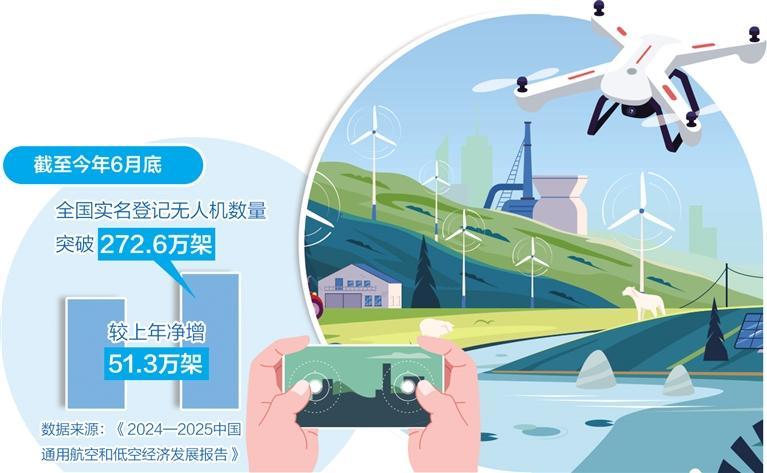
两项标准于明年5月1日起正式实施—— 破解无人机“谁能飞”“谁在飞”难题
Jing Ji Ri Bao· 2025-12-27 22:01
Core Viewpoint - The rapid expansion of China's drone industry is accompanied by safety concerns, prompting the introduction of mandatory national standards for real-name registration and operational identification of drones, effective from May 1 next year [1][2]. Group 1: New Standards Implementation - The newly released standards aim to enhance the quality of civil drones and regulate flight activities, ensuring the safety of people's lives and property [1]. - The "Real-name Registration and Activation Requirements" standard outlines the process for registering and activating civil drones, requiring clear display of registration information and functionalities for activation control and firmware updates [1][2]. - The "Operational Identification Specification" mandates that drones must have both broadcast and network-based identification capabilities, continuously reporting their identity, location, speed, and status to regulatory authorities throughout the flight [2]. Group 2: Technical Requirements - Drones must not be able to fly before activation and after deactivation, addressing the issue of "who can fly" from a technical standpoint [2]. - The standards require that if the identification module fails before takeoff, the drone cannot take off, and if the broadcast function fails during flight, an alarm must be triggered, with capabilities for hovering, returning, and landing [2]. - Drones must store operational identification information for at least 120 flight hours, ensuring traceability and regulatory oversight [2]. Group 3: Transition Period and Compliance - A transition period has been established for existing drones, allowing manufacturers 12 months to retrofit operational identification modules to comply with the new standards [3]. - New drones produced after the implementation date must adhere to the standards immediately, while existing drones will have a grace period to complete registration and activation [3]. Group 4: Future Developments - The regulatory body plans to develop certification rules for drone products and accelerate the establishment of safety and testing standards for the drone industry [4]. - Training programs will be implemented for industry stakeholders, including manufacturers and testing institutions, to ensure compliance and promote healthy industry development [4].
赤心不改,忠诚如一——走近2025年“最美退役军人”
Xin Hua She· 2025-12-27 15:27
Group 1 - The article highlights the dedication and contributions of retired military personnel who continue to serve society in various capacities, showcasing their unwavering loyalty and commitment to public service [1][2] - It features inspiring stories of individuals who have transitioned from military service to impactful roles in emergency rescue, law enforcement, and community support, emphasizing their ongoing mission to protect and assist others [3][4][5] Group 2 - The article presents examples of retired veterans who have engaged in social welfare and community development, such as promoting agricultural initiatives and supporting education for underprivileged students [7][8] - It also highlights the achievements of veterans in various fields, including sports, technology, and education, demonstrating their resilience and ability to adapt to new challenges after military service [9][10][11]
国产涡扇发动机点火、低空动力产业园亮相 四川天府新区低空经济赛道破局突围
Mei Ri Jing Ji Xin Wen· 2025-12-27 13:30
Core Insights - The Tianfu New Area has successfully ignited a 2000-kilogram thrust turbofan engine, marking a significant milestone in the development of the low-altitude economy in Sichuan Province [1] - The region aims to establish a comprehensive industrial chain covering safety networks, technology research and development, equipment manufacturing, application scenarios, and market promotion to tap into the trillion-level low-altitude economic sector [1] Group 1: Low-altitude Economy Development - The Sichuan low-altitude economy is being supported by a "smart hub" that integrates data from the Sichuan Low-altitude Airspace Operation Service Center and the Chengdu Low-altitude Traffic Management Service Platform, creating a unified network across the province [1] - By 2026, the low-altitude airspace reporting system is expected to cover all 21 cities (prefectures) in the province, with an estimated annual flight reporting exceeding 250,000 flights [2] Group 2: Technological Advancements - Chengdu Kongyu Technology has developed a "full-domain digital low-altitude safety control platform" with a false alarm rate of less than 0.5%, enhancing the safety of low-altitude operations [2] - The F918 turbofan engine, developed by Sichuan Tianfu Light Power Technology Co., has advanced performance metrics, including a maximum flight altitude of nearly 20 kilometers and a maximum flight Mach number of 0.9, significantly expanding the application boundaries in general aviation [2] Group 3: Industrial Infrastructure - The Tianfu New Area features substantial infrastructure support for the low-altitude economy, including a 49,000 square meter low-altitude economic industrial park and a 12.8 square kilometer aviation power technology innovation zone [3] - Specialized parks like Fengqi Valley Technology Innovation Park and Tianfu Haichuang Park are strategically positioned to foster clusters in low-altitude power, composite materials, and industrial drones, facilitating a complete industrial chain from manufacturing to core components and supporting services [3] Group 4: Collaborative Ecosystem - The first application scenario release event in March highlighted a focus on urban management through five application scenarios, including urban inspections and forest fire prevention, emphasizing collaboration among industry players [3] - The Tianfu New Area is described as a "low-altitude economic circle," where companies can collaborate and innovate, supported by an ecosystem that encourages rapid testing and validation of new applications [3]
影石让谁睡不着觉?
半佛仙人· 2025-12-27 09:05
Core Viewpoint - The article discusses the competitive landscape surrounding the new drone product from Ying Shi, highlighting the intense reactions from competitors as a form of recognition of its capabilities [3][4][5]. Group 1: Market Reaction - Ying Shi's new drone product has faced significant public backlash, which the company interprets as a form of acknowledgment of its strength in the market [3][4]. - The aggressive tactics employed by competitors indicate a level of fear and respect for Ying Shi's capabilities, suggesting that the product is perceived as a serious threat [5][6]. - The sales performance of the drone, achieving 30 million in sales within 48 hours, has triggered a defensive response from industry peers [4][5]. Group 2: Industry Dynamics - The competitive environment is described as one where companies must demonstrate their true capabilities, as the introduction of Ying Shi's product has raised the stakes for all players in the industry [6][7]. - The article emphasizes that the true battle is not just about individual products but about the overall market dynamics and the potential for reshaping industry standards [9][11]. - The emergence of new players like Ying Shi is seen as a catalyst for increased competition, which is beneficial for consumers as it drives innovation and better pricing [14]. Group 3: Implications for the Future - The article suggests that if Ying Shi can establish itself in the market, it could lead to a reevaluation of existing industry narratives and the perceived strength of established players [11][12]. - The competitive pressure created by Ying Shi's entry is expected to force other companies to improve their offerings, ultimately benefiting the market as a whole [14]. - The notion of confidence within the industry is highlighted, indicating that the attacks on Ying Shi are also a reflection of competitors' insecurities about their own positions [12][13].

低空智能体创新中心落地成都高新区新川创新科技园
Mei Ri Jing Ji Xin Wen· 2025-12-27 07:31
以科技为纽带,以赛事为载体。12月26日,世界无人机运动会暨低空智控赛在成都高新区新川之心机器 人公园开幕。活动现场,低空智能体创新中心共建计划发布,落地成都高新区新川创新科技园。本次运 动会设置无人机篮球、举重、击剑、马术表演等竞赛项目,为企业、高校及广大青少年提供了展示创新 活力与竞技能力的平台。 新川创新科技园作为中国西部首个中新(新加坡与四川)合作共建园区,也是成都高新区"1+4+X"发展 格局中的重要产业极核,正积极推进"低空+"与城市发展的深度融合,率先实现无人机高楼幕墙清洗应 用,其作业效率达人工20倍以上,标志着该技术已从试点迈向实际交付。接下来,园区将以新川之心机 器人公园与新加坡创新中心为核心载体,全域推广覆盖低空治理、无人作业等多场景的人机共融超级场 景体系,致力打造全国智慧园区标杆,以持续的场景创新驱动低空经济高质量发展。 作为国家级人工智能"双试点"核心区,成都高新区坚持"科技兴产、算力引产、场景育产、生态强产"的 发展路径,形成了从国产算力芯片、通用大模型、到人形机器人应用的完整自主产业链,目前汇聚人工 智能相关企业超600家,其中省级链主企业4家,专精特新企业超130家,高能级创 ...
农业无人机报废有什么相应政策吗?
Xin Lang Cai Jing· 2025-12-27 01:13
Group 1 - The inquiry regarding the availability of a scrapping policy for agricultural drones was raised, specifically about DJI agricultural drones [1] - The response from relevant authorities indicated that while agricultural drones are included in the scrapping update directory, there is currently no scrapping update program for drones in Hebei Province [1] - It was noted that there are no established drone scrapping implementation plans or recovery enterprises in the province, and the scrapping work for drones has not commenced statewide [1]