
无人机

Search documents
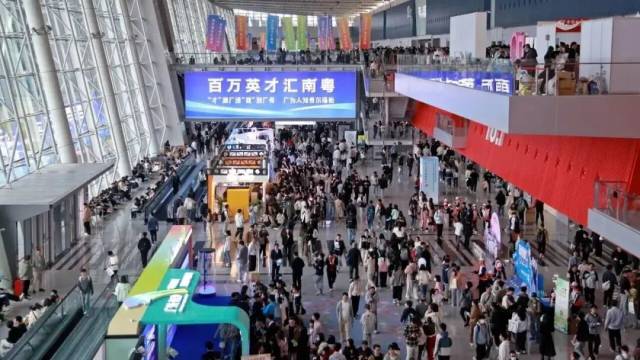
超1600家用人单位,投放逾6.5万个岗位!“百万英才汇南粤”大型综合招聘会今日在深圳举办
2 1 Shi Ji Jing Ji Bao Dao· 2025-12-27 01:08
Group 1 - The "Million Talents Gathering in Nanyue" recruitment fair will be held at the Shenzhen Convention Center on December 27-28, featuring over 1,600 key employers offering more than 65,000 quality job positions [1] - The event will include a "Recruitment Express" where representatives from 12 well-known companies will conduct face-to-face interviews and sign contracts on-site, enhancing direct engagement and opportunities for job seekers [1] - Online recruitment will be facilitated by 14 companies offering over 3,000 positions, with four specialized online interview booths connecting with global overseas students [1] Group 2 - The recruitment fair will showcase a "Future Avenue" with dedicated city image display areas for 21 cities in the province and regions like Hong Kong and Macau, allowing job seekers to understand the industrial advantages and talent policies of the Guangdong-Hong Kong-Macao Greater Bay Area [2] - Leading companies in the smart technology sector, such as ViewSonic and UBTECH, will demonstrate the appeal of the robotics industry, alongside displays of the latest electric supercars and new manned drones [2] - The event will provide personalized job-seeking services, including employment guidance from experienced consultants and professional image makeover services to enhance job-seeking efficiency [2]




曾经他们说:中国只会代工
Xin Lang Cai Jing· 2025-12-27 00:17
Core Viewpoint - The article discusses the transformation of China's manufacturing capabilities over the past two decades, highlighting its shift from low-end manufacturing to becoming a leader in advanced manufacturing and technology, challenging previous Western narratives about China's industrial limitations [6][15][24]. Group 1: Manufacturing and Technological Advancements - China's share in global industrial production increased from less than 5% in 1995 to 32% in 2025, while Western countries' share fell below 50% [6]. - The article emphasizes that China's advancements in high-speed rail, shipbuilding, and aviation demonstrate its ability to develop core technologies and set industry standards [8][9][12]. - In the electric vehicle sector, China produced nearly 15 million new energy vehicles in the first 11 months of 2025, with exports growing over 100% year-on-year [12]. Group 2: Innovation and Systemic Changes - China has established a complete lithium battery supply chain, with 80% of global lithium batteries produced by Chinese manufacturers, showcasing its comprehensive industrial ecosystem [12]. - The article notes that China is not only a user of technology but is becoming a provider of systemic solutions, as seen in the advancements in robotics and artificial intelligence [14][20]. - China's R&D investment has increased nearly fivefold from 2007 to 2023, approaching levels seen in the United States, indicating a significant shift in innovation capabilities [20]. Group 3: Global Standards and Market Influence - China is increasingly participating in and even leading the formulation of global standards, such as those for new energy vehicle batteries and 5G technology, which alters the narrative of China as merely a low-end manufacturer [15][17]. - The article highlights that the ability to set standards translates to control over market access, technology pathways, and long-term profitability [17]. - International assessments are shifting, with experts acknowledging China's rise as a technology power in various fields, including AI and advanced manufacturing [21].
2025年第八期政企恳谈会召开
Shan Xi Ri Bao· 2025-12-27 00:06
12月26日,省委常委、常务副省长王晓主持召开政企恳谈会,与企业家代表面对面座谈交流,认真 听取意见建议,协调解决相关问题。 座谈会上,王晓和省直有关部门负责同志与来自航空、无人机产业领域的9名企业家代表深入互动 交流,对企业发展取得的新成效给予肯定,认真回应企业诉求建议。他表示,要深入学习贯彻党的二十 届四中全会精神,贯通落实习近平总书记关于发展通用航空和低空经济的重要论述重要指示批示精神和 历次来陕考察重要讲话重要指示,认真落实党中央、国务院决策部署和省委、省政府工作要求,突出高 质量发展导向,坚持把积极有为和量力而行结合起来,把战略逻辑和市场逻辑结合起来,抓住西安区域 科技创新中心建设机遇,用好"三项改革"、秦创原创新驱动平台、教育科技人才一体发展效应,深化产 学研用金介云合作,加力推进科技创新、建设产业链群、拓展应用场景、推动标准提升、优化营商环 境,促进科技创新和产业创新深度融合发展,强化科技与产业协同、战略协作和集群化发展,推进技 术、产业、标准一体融合,持续提升产业链韧性、产能和竞争力,有效防范化解重点领域风险,服务支 持企业发展壮大,推动航空、无人机产业发展再上新台阶,全力交好"十四五"工作答 ...
天赢居:2025年12月26日直播
Jin Rong Jie· 2025-12-26 07:59
Core Viewpoint - The market is experiencing a strong upward trend with a series of gains, indicating a healthy momentum and potential for further growth, particularly in the technology hardware and non-ferrous metals sectors [1][2][4]. Market Performance - The main index has shown a stable recovery, crossing key moving averages, with a notable increase in the number of stocks hitting the daily limit, suggesting a broadening profit effect attracting outside capital [1][2]. - The trading volume has increased moderately, indicating that funds are not retreating but are actively participating in a "walking and switching" manner, maintaining a bullish trend [1][2]. Sector Rotation - The market structure reflects a characteristic of "strong main lines and rotating sub-lines," with technology hardware and non-ferrous metals taking turns leading the gains [2][5]. - After a two-day surge in technology hardware, there was a strategic shift to focus on non-ferrous metals, which proved to be a correct call as these sectors are interlinked in the supply chain [2][5]. Technical Analysis - The current market is in a typical "strong trend but short-term prone to fluctuations" state, with indicators showing overbought conditions, suggesting a need for consolidation through minor corrections [2][4]. - The recent upward movement is part of a larger bullish cycle, with the index expected to face resistance near the 4018 level, necessitating caution as it approaches this key point [1][6]. Investment Strategy - The strategy emphasizes "going with the trend and focusing on strong stocks," advising investors to reduce exposure to weaker or declining sectors while concentrating on those with stronger consensus and trends [3][4]. - The market's current phase is seen as an opportunity for disciplined buying during pullbacks, particularly in sectors that are showing resilience and potential for further gains [4][6]. Conclusion - The market is characterized by a healthy upward trajectory, with a focus on sector rotation between technology hardware and non-ferrous metals, supported by a solid technical foundation and strategic investment approaches [5][9].
三瑞智能IPO:核心产品营收增速持续放缓 规模被好盈科技反超排名下滑?
Xi Niu Cai Jing· 2025-12-26 07:58
Group 1 - The core viewpoint of the news is that Nanchang Sanrui Intelligent Technology Co., Ltd. is preparing for its IPO on the ChiNext board, scheduled for December 26, after responding to the review center's feedback [2] - The company aims to raise approximately 768.88 million yuan through the IPO, which will be allocated to projects including the expansion of drone and robot power systems, the construction of a research and development center and headquarters, and upgrades to information technology and smart warehousing [3] - Sanrui Intelligent was established in 2009 and specializes in the research, production, and sales of electric power systems for drones and robots [3] Group 2 - According to a Frost & Sullivan industry report, Sanrui Intelligent holds a 7.1% market share in the global civil drone electric power system market (excluding power batteries), ranking second globally after DJI [4] - In the first half of 2025, the revenue from Sanrui Intelligent's drone power system products is expected to grow by 29.62% year-on-year to 372 million yuan, although the growth rate for the first three quarters has decreased to 24.18%, which is still above industry forecasts but lower than the overall growth rates for 2023 and 2024 [4] - Competitor Haoying Technology, which is also pursuing a listing on the Sci-Tech Innovation Board, reported a significant revenue increase of 147.17% in the first half of 2025, surpassing Sanrui Intelligent in revenue scale, market share, and ranking [4]
A股“无人机方阵”将再扩容,道通智能启动IPO辅导
2 1 Shi Ji Jing Ji Bao Dao· 2025-12-26 07:03
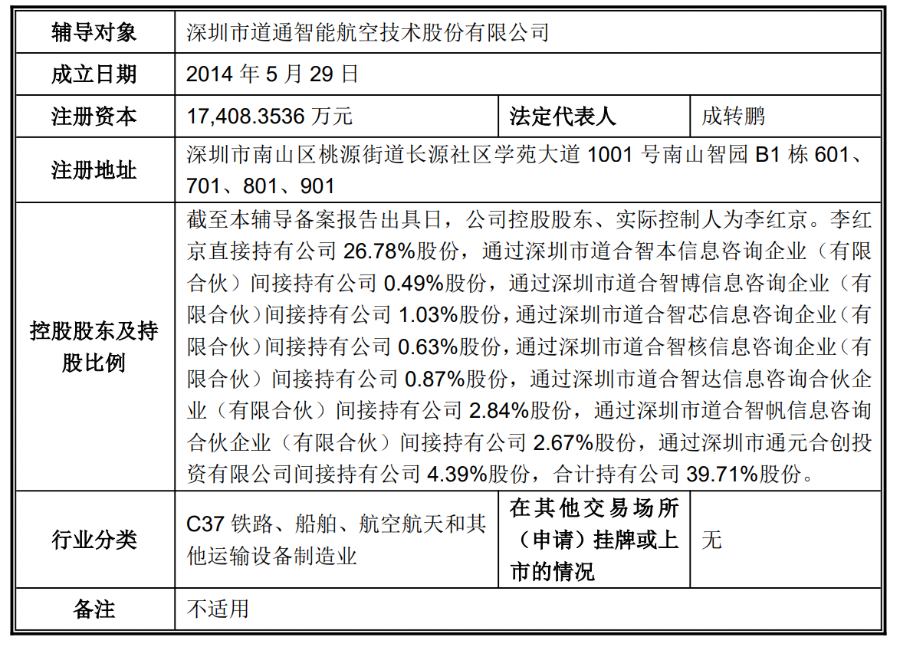
Core Viewpoint - Daotong Intelligent Aviation Technology Co., Ltd. is preparing for an IPO, having filed for guidance registration with the Shenzhen Securities Regulatory Bureau, with the aim to expand its presence in the drone industry [1] Group 1: Company Overview - Daotong Intelligent was established on May 29, 2014, and is headquartered in Shenzhen, with overseas branches and R&D bases in locations such as Seattle, Munich, Italy, Singapore, and Vietnam [2] - The controlling shareholder and actual controller of the company is Li Hongjing, who holds a 26.78% direct stake and an additional 12.93% through various partnerships, totaling 39.71% [2] Group 2: Product Development - The company started with multi-rotor drones, launching its first model, the X-STAR, in 2015, followed by the EVO series, which includes consumer and industry-grade drones [3] - Daotong Intelligent has also developed tilt-rotor drones, including the KESTREL and the Daotong Longyu series, which combine the advantages of vertical takeoff and fixed-wing endurance [3] Group 3: Ecosystem and Applications - Since 2022, Daotong Intelligent has introduced various ecosystem products such as command centers and smart antennas, focusing on security, energy, and transportation applications [4] - The company offers integrated solutions for various scenarios, including law enforcement, emergency rescue, and infrastructure inspections, highlighting the growing importance of low-altitude inspection technology [5] Group 4: Market Trends and Future Strategy - The global low-altitude inspection market is projected to reach $27.39 billion in 2024, with a 22.47% growth from 2023, driven by sectors like power inspection and transportation infrastructure [5] - Daotong Technology plans to launch a new "air-ground integrated cluster intelligence" business by the end of 2024, aiming to enhance inspection efficiency through the integration of drones and ground robots [5] - The company is embracing AI to transform drones into intelligent robots capable of thinking, executing tasks, and providing feedback, as stated by its market director [6]
酝酿8年,美国对大疆发禁令,中方采取行动,74吨稀土禁售美国
Xin Lang Cai Jing· 2025-12-26 03:28
特别声明:以上文章内容仅代表作者本人观点,不代表新浪网观点或立场。如有关于作品内容、版权或其它问 题请于作品发表后的30日内与新浪网联系。 ...
科技日报:美国无人机产业不会因贸易保护主义而强大
Ke Ji Ri Bao· 2025-12-26 00:36
Core Viewpoint - The FCC's announcement to add all non-U.S. manufactured drone systems and key components to a "regulated list" is primarily aimed at restricting Chinese drone products under the guise of national security risks [1][2][3]. Group 1: Regulatory Actions - The FCC's ban means that the U.S. will no longer import new foreign drones and related components, only allowing the sale of previously approved older products [1]. - The ban is seen as a culmination of years of efforts to curb Chinese drone influence in the U.S. market, with China accounting for 70% to 80% of the global civilian drone market and 90% of the U.S. consumer market [1]. Group 2: Security Claims - The term "national security risk" is viewed as a pretext for banning Chinese drones, despite multiple tests by U.S. agencies confirming the safety and data privacy of DJI products [2]. - Various assessments from reputable firms have consistently validated the data security measures of Chinese drones, indicating that they meet U.S. and EU cybersecurity standards [2]. Group 3: Economic Implications - The U.S. government's actions are perceived as a means to protect and promote the domestic drone industry by limiting foreign competition, which could stifle innovation and increase costs for U.S. consumers [3][4]. - A survey indicated that 43% of U.S. drone users believe the ban will have a severely negative impact on their businesses, with some users stockpiling drones and components in anticipation of supply issues [4]. Group 4: Market Dynamics - The absence of Chinese components could lead to a significant increase in costs for U.S. drone users, potentially making non-Chinese drones up to ten times more expensive [4]. - The restriction on Chinese products is expected to hinder technological advancement and cost reduction in the U.S. drone industry, leading to a decline in competitiveness [4].
背离开放的安全保护行不通
Jing Ji Ri Bao· 2025-12-25 22:04
Core Viewpoint - The U.S. Federal Communications Commission (FCC) has added all foreign-manufactured drone systems and their key components to a "untrusted supplier list" under the guise of "national security," specifically targeting Chinese company DJI, which restricts its products from being imported and sold in the U.S. This action reflects a broader trend of the U.S. misusing the concept of national security to suppress foreign companies and disrupt market operations [1][2]. Group 1: Industry Impact - The drone industry is highly globalized, relying on international collaboration for research, manufacturing, and application, which has led to rapid innovation through competition and technology exchange [1]. - The U.S. decision to label all non-American manufactured drones as "risky" undermines market mechanisms and competition rules, disregarding the industry's development principles and consumer needs [1][3]. Group 2: Evidence and Market Reaction - U.S. claims of "security risks" lack factual support, as Chinese drone products, including those from DJI, have been widely used in various sectors such as agriculture, emergency rescue, and film production, passing evaluations from multiple authoritative third-party organizations [2]. - Reports indicate that many U.S. drone operators and commercial users are stockpiling Chinese drones and components, expressing concerns to lawmakers about the lack of reliable alternatives, highlighting the disconnect between the U.S. government's actions and industry realities [2]. Group 3: Long-term Consequences - The U.S. strategy of creating trade barriers and administrative restrictions to support its domestic drone industry contradicts the principles of technological development, which thrive on standard recognition, collaborative rules, and healthy competition [3]. - Historical evidence shows that blocking and suppressing competition does not halt technological progress but instead raises costs and reduces efficiency, ultimately weakening the domestic industry's innovation capacity and international competitiveness [3]. - The U.S. approach disrupts fair competition and undermines the stability of global supply chains, eroding international trust in the U.S. market environment [3].
成都首批低空血液配送专线开通
Xin Lang Cai Jing· 2025-12-25 18:26
Core Viewpoint - The launch of low-altitude blood delivery routes in Chengdu represents a significant advancement in medical logistics, utilizing drone technology to enhance emergency healthcare response capabilities [1][2]. Group 1: Low-Altitude Blood Delivery - Chengdu has opened its first low-altitude blood delivery routes, utilizing drones equipped with smart temperature-controlled logistics boxes that maintain a temperature variance of 0.5°C, meeting cold chain transport requirements for blood [1]. - The drones used for blood transport are capable of autonomous flight with AL-4 level automation, allowing them to complete the entire transportation process independently [1]. - These drones can operate under adverse weather conditions, including light rain, snow, and winds up to level six, ensuring the safe delivery of emergency blood and medical samples [1]. Group 2: Expansion of Low-Altitude Medical Logistics - The establishment of low-altitude transport routes for medical samples is not unique to Chengdu; for instance, Sichuan University West China Hospital has launched a drone delivery route that reduces sample transfer time to 15 minutes [2]. - In 2024, Longquanyi District plans to implement a regular low-altitude medical supply delivery project, with 15 drone takeoff and landing points and 15 low-altitude routes connecting various medical institutions and health clinics [2]. - The Chengdu Health Commission emphasizes that low-altitude blood delivery is a crucial measure for enhancing urban public health emergency response capabilities through technological innovation [2].