
保险

Search documents
友邦保险(01299):NBV延续稳定增长,利润持续优化
Guoxin Securities· 2026-03-19 13:18
Investment Rating - The investment rating for AIA Group Limited is "Outperform the Market" [6] Core Insights - The company achieved a new business value (NBV) of USD 5.516 billion in 2025, representing a year-on-year growth of 15% at constant exchange rates. The NBV margin improved by 3.6 percentage points to 58.5%, driven by product mix optimization in Hong Kong and Thailand, as well as repricing of products in mainland China [1][2] - The NBV in Hong Kong, the group's most important growth engine, grew by 28% to USD 2.256 billion, with local customer business increasing by 21% and mainland visitor business growing by 35% post-border reopening. The mainland market saw a 2% increase in NBV, with a notable acceleration of 14% in the second half of the year [2] - The "Top Agents" and partner distribution channels drove growth, with the "Top Agents" channel contributing 73% of the NBV, which grew by 13% to USD 4.273 billion. The partner distribution channel saw a 22% increase to USD 1.593 billion, benefiting from long-term collaborations with leading banks in Asia [3] - The company maintained a stable dividend policy, with a 10% increase in annual dividends, and announced a new share buyback plan of USD 1.7 billion to enhance shareholder returns [3] Financial Projections - The company forecasts insurance service performance to grow from USD 5.749 billion in 2024 to USD 11.176 billion in 2028, with annual growth rates ranging from 14.54% to 20.80% [5] - The diluted earnings per share (EPS) is projected to increase from USD 0.55 in 2024 to USD 0.86 in 2028, reflecting a steady growth trajectory [5] - The price-to-embedded value (P/EV) ratio is expected to decline from 1.42 in 2024 to 0.92 in 2028, indicating a potential undervaluation of the stock over the forecast period [11]
艾迪康控股(09860):新力量NewForce总第4983期
First Shanghai Securities· 2026-03-19 13:09
Group 1 - Investment Rating: Buy for Haitan International (1882) with a target price of HKD 30.00, and Buy for Kangzhe Pharmaceutical (867) with a target price of HKD 19.30 [2] - Haitan International is expected to achieve a revenue of HKD 177.33 billion in 2025, representing a year-on-year growth of 10.0%, and a net profit of HKD 33.01 billion, up 7.2% year-on-year [7][10] - Kangzhe Pharmaceutical's revenue is projected to increase by 9.9% to HKD 82.1 billion in 2025, with a notable growth in exclusive and innovative drug sales [12][14] Group 2 - Haitan International's overseas sales are expected to grow significantly, with a 26.4% increase year-on-year, contributing to 42.9% of total revenue [9] - Kangzhe Pharmaceutical's innovative products are anticipated to drive growth, with new drug approvals expected to significantly boost revenue in the coming years [13][14] - The report highlights the strategic importance of the "ICL+CRO" model for Aidi Kang Holdings, which aims to enhance its value proposition through integrated laboratory services [17][27] Group 3 - Haitan International's gross margin improved to 32.7%, benefiting from supply chain management and increased overseas sales [7] - Kangzhe Pharmaceutical's gross margin decreased to 71.5%, influenced by various factors including increased R&D expenses [12] - Aidi Kang Holdings reported a gross profit margin of 35.8% in 2025, with a focus on optimizing costs and enhancing operational efficiency [17][21] Group 4 - Haitan International's target price reflects a 12/11/10 times forecasted P/E ratio for 2026-28 [10] - Kangzhe Pharmaceutical's target price indicates a potential upside of 40.2% from its current price [14] - Aidi Kang Holdings is positioned to leverage its dual-platform strategy to capture growth in both diagnostic and drug development sectors [36][37]
中国平安:关于召开2025年度业绩发布会的公告
Zheng Quan Ri Bao· 2026-03-19 12:39
Group 1 - The company, China Ping An, announced that it will hold its 2025 annual performance briefing on March 27, 2026 [1]

中国平安2026春招启动:面向全球招聘超4500岗位,聚焦科技、医疗、养老人才
Xin Lang Cai Jing· 2026-03-19 12:18
Group 1 - China Ping An officially launched its 2026 Spring Global Campus Recruitment on March 18 [1][2] - The recruitment will involve over 3,000 positions and 1,500 internship roles across more than 10 subsidiaries, including life insurance, property insurance, banking, health insurance, securities, technology, and medical services [1][2] - The recruitment process will utilize AI technology throughout to enhance the application experience and efficiency for students [1][2] Group 2 - The recruitment will be conducted through a series of online live broadcasts and offline campus events [1][2] - A significant number of positions will be available outside of the financial sector, including roles in technology, healthcare, and elderly care [1][2]
新业务价值再创新高,友邦保险开启新一轮17亿美元回购计划
第一财经· 2026-03-19 12:17
Core Viewpoint - AIA Group (01299.HK) reported a record high in new business value for 2025, reaching USD 5.516 billion, although the growth rate of 15% is slightly lower than the 18% growth in 2024 [3]. Financial Performance - The company's earnings per share (EPS) for operating profit after tax increased by 12%, while basic free surplus per share rose by 11% [3]. - The board proposed a final dividend increase of 10% to HKD 1.4408 per share, bringing the total annual dividend to HKD 1.9308, a 10% increase from 2024 [3]. Share Buyback Plan - AIA announced a new share buyback plan totaling USD 1.7 billion, which includes USD 700 million aligned with the target payout ratio of 75% of annual free surplus and an additional USD 1 billion based on capital condition reviews [4]. - Since the buyback program began in March 2022, approximately 1.603 billion shares have been repurchased, reducing the number of shares outstanding by 13% [5]. Business Segments Performance - AIA's subsidiary in mainland China, AIA Life, saw a 2% increase in new business value for 2025, with total weighted premium income growing by 14% [5]. - The new business value growth for AIA Life accelerated in the second half of 2025, with a year-on-year increase of 14%, continuing into the first two months of 2026 with over 20% growth [5]. Marketing and Product Strategy - The number of new agents increased by 14% in 2025, with the bancassurance channel contributing 15% to new business value [5]. - Protection products remain the core of AIA's product strategy, with 44% of new business value from the agent channel in the second half of 2025 coming from these products [5]. Market Expansion - AIA Life's new markets contributed significantly to growth, with a 45% increase in new business value in 2025, accounting for over 9% of total new business value [6]. - The company operates in 14 regions, expanding by 9 regions since obtaining independent legal status, and aims for a compound annual growth rate of 40% in new business value from these new markets between 2025 and 2030 [6].


友邦保险(01299):2025:NBV增长稳健
HTSC· 2026-03-19 11:49
Investment Rating - The investment rating for AIA Group Limited is maintained at "Buy" with a target price of HKD 100.00 [1][11] Core Insights - AIA Group Limited reported a robust growth in new business value (NBV), which increased by 15% year-on-year, primarily driven by the Hong Kong market. The NBV in Hong Kong saw a strong growth of 28%, while the mainland China market experienced a modest increase of 2% due to assumption adjustments [6][7] - The operating profit after tax (OPAT) per share grew by 12% year-on-year, and the dividend per share (DPS) increased by 10% to HKD 1.93. The company’s solid earnings performance and steady increase in NBV support the "Buy" rating [6][10] Summary by Sections Financial Performance - For the fiscal year 2025, the gross premium income is projected to be USD 21.618 billion, reflecting an 11.93% increase. The total investment income is expected to be USD 17.979 billion, showing a significant increase of 50.62% [5] - The net profit attributable to shareholders is forecasted to be USD 6.234 billion, with a year-on-year decrease of 8.81%. The earnings per share (EPS) is expected to be USD 0.59, while the dividend per share (DPS) is projected to be USD 0.25 [5] Market Analysis - The Hong Kong market is the largest contributor to AIA's NBV growth, with a notable increase in both local residents and mainland visitors. The agent channel's NBV grew by 26%, and the bancassurance channel saw a 41% increase [7] - The mainland China market's NBV growth was limited to 2% due to economic assumption adjustments, but it showed a recovery in the second half of the year with a 14% increase [8] Regional Performance - Southeast Asia markets, including Thailand, Singapore, and Malaysia, showed varied performance with NBV growth of 13%, 14%, and 0% respectively. The overall growth in these markets is expected to be around 5% in 2026 [9] - The new regional markets in mainland China are projected to grow at a compound annual growth rate (CAGR) of 40% from 2025 to 2030, contributing positively to the overall NBV [8] Operational Metrics - The operating return on equity (ROE) for 2025 is expected to be 15.5%, reflecting a year-on-year increase of 0.7 percentage points. The company plans to initiate a new share buyback program worth USD 1.7 billion in 2026 [10][11] - The forecast for EPS has been slightly adjusted to USD 0.72 for 2026, with an expected NBV growth of 16% [11]
友邦保险(01299):港股公司点评:NBV增长15%,新增17亿美元回购
SINOLINK SECURITIES· 2026-03-19 11:19
Investment Rating - The report assigns a "Buy" rating, expecting a price increase of over 15% in the next 6-12 months [11]. Core Insights - The company reported a 15% year-on-year increase in New Business Value (NBV) for 2025 at constant exchange rates, with a margin improvement of 3.6 percentage points to 58.5% [2][4]. - The operating profit after tax grew by 7%, with a significant increase in the release of Contractual Service Margin (CSM) by 10%, leading to an overall insurance service performance increase of 18% [3]. - The company has initiated a share buyback plan worth $1.743 billion, which includes $743 million based on free surplus and an additional $1 billion, projecting a shareholder return rate of 4.0% for 2026 [3]. Summary by Sections Performance Analysis - The NBV growth was driven by various regions: - Mainland China saw a 2% increase in NBV, with a notable 14% growth in H2 and over 20% in the first two months of 2026 [2]. - Hong Kong's NBV increased by 28%, with local customers and new Hong Kong residents contributing significantly [2]. - Thailand and Singapore reported NBV growths of 13% and 14%, respectively, with strong demand for wealth management products [2]. - Malaysia's NBV remained flat, while other markets experienced a 7% increase [2]. Financial Forecast and Valuation - The company anticipates continued resilience in NBV growth, projecting double-digit growth in the future, particularly driven by strong demand in Hong Kong and the mainland [4]. - As of March 18, the projected Price to Embedded Value (PEV) for 2026 is 1.31 times, indicating a focus on long-term value [4]. Key Financial Metrics - Insurance revenue is projected to grow from $19.314 billion in 2024 to $30.214 billion by 2028, reflecting a compound annual growth rate of approximately 11.2% [9]. - The Return on Equity (ROE) is expected to stabilize around 16% in the coming years, with a Price to Earnings (P/E) ratio decreasing from 16.58 to 12.40 by 2028 [9][10].
友邦保险2025年新业务价值同比升15%至55亿美元,微众银行董事长顾敏获任为董事
Sou Hu Cai Jing· 2026-03-19 11:11
瑞财经 王敏 3月19日,友邦保险(01299)发布截至2025年12月31日止年度业绩。 Shulamite N K Khoo,64岁,自2020年11月起担任香格里拉(亚洲)有限公司(于香港联合交易所及新 加坡交易所上市)独立非执行董事,并自2020年5月起担任CIMB Group HoldingsBerhad(于马来西亚证 券交易所上市)之独立董事。她亦曾于2017年至2021年期间担任嘉里物流联网有限公司(于香港联合交 易所上市)独立非执行董事。 Khoo女士自2022年10月起担任友邦保险有限公司(公司之全资附属公司)独立非执行董事。她亦曾于 2011年至2018年期间担任本公司集团首席人力资源总监。在加入集团前,Khoo女士曾担任安盛集团 (AXA group)集团执行副总裁及环球人力资源总监,以巴黎为基地。 Khoo女士于1983年取得多伦多大学(University of Toronto)理学学士学位,并于2013年获认可为英国特 许人事发展协会(Chartered Institute of Personnel and Development)资深会员。 顾敏,52岁,自2014年12月起担任 ...
新业务价值再创新高,友邦保险开启新一轮17亿美元回购计划
Di Yi Cai Jing· 2026-03-19 10:46
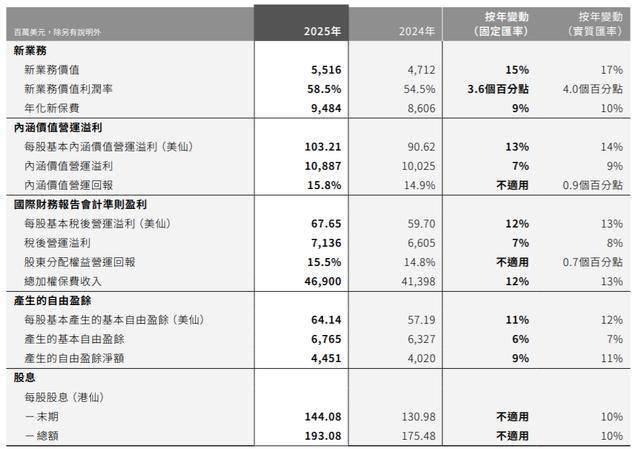
Core Viewpoint - AIA Group's new business value reached a record high in 2025, driven by growth in annual new premiums and an increase in new business value margin [2] Group 1: Financial Performance - In 2025, AIA's new business value increased by 15% to $5.516 billion, although this was a slight decline from the 18% growth rate in 2024 [2] - The company's earnings per share (EPS) for operating profit rose by 12%, while basic free surplus per share increased by 11% [2] - AIA's board proposed a final dividend increase of 10% to HKD 1.4408 per share, bringing the total annual dividend to HKD 1.9308, a 10% increase from 2024 [2] Group 2: Share Buyback and Capital Management - AIA announced a new share buyback plan totaling $1.7 billion, which includes $700 million aligned with the target payout ratio of 75% of annual free surplus and an additional $1 billion based on capital condition reviews [2] - Since the buyback program began in March 2022, AIA has repurchased approximately 1.603 billion shares, reducing the number of shares outstanding by 13% [3] Group 3: Business Segments and Growth Drivers - AIA's wholly-owned subsidiary in mainland China, AIA Life, saw a 2% increase in new business value for 2025, with total weighted premium income growing by 14% [3] - The new business value growth for AIA Life accelerated in the second half of 2025, with a year-on-year increase of 14%, continuing into the first two months of 2026 with over 20% growth [3] - The number of new agents increased by 14% in 2025, with the bancassurance channel contributing 15% to new business value [3] Group 4: Market Expansion - AIA Life's new markets experienced a 45% growth in new business value in 2025, contributing over 9% to the total new business value [4] - The company has expanded its operations to 14 regions, adding 9 new areas since obtaining independent legal status, and expects a compound annual growth rate of 40% in new business value from these new markets between 2025 and 2030 [4]
友邦保险去年税后营运溢利超71亿美元 友邦人寿全年新业务价值增2%
Xin Lang Cai Jing· 2026-03-19 10:41
3月19日,友邦保险控股有限公司(友邦保险,01299.HK)发布的2025年度业绩报告显示,2025年,友 邦保险实现税后营运溢利约71.36亿美元,按固定汇率同比增长7%;实现新业务价值55.16亿美元,同比 上升15%,新业务价值利润率同比增长3.6个百分点至58.5%。 ...