
纺织业

Search documents
纺织用“巧手” 火箭有“慧心”(迈向“十五五”的创新图景)
Ren Min Ri Bao· 2025-11-17 22:01
Group 1 - The core viewpoint emphasizes the necessity of technological transformation and digitalization in traditional industries to enhance competitiveness and efficiency [2][3] - The company Wuxi Cotton Textile Group has implemented intelligent inspection and connection robots to address production challenges, improving efficiency and product quality [2][3] - The digital transformation has led to a reduction in labor intensity by 30%, a decrease in production costs by 11%, and an increase in production efficiency by 15% [3] Group 2 - The high-end textile industry cluster in Wuxi has surpassed a scale of 200 billion yuan, driven by intelligent, green, and integrated development [3] - The aerospace sector, represented by Deep Blue Aerospace, is utilizing 3D printing technology for manufacturing rocket engines, significantly reducing costs and delivery times [3] - The upcoming attempt for in-orbit recovery of rockets could lower launch costs by over 70%, with the potential for the Wuxi base to produce 10 liquid launch vehicles and 100 rocket engines annually, generating over 3 billion yuan in revenue [4]
数智化赋能 培育竞争新优势(专家点评)
Ren Min Ri Bao· 2025-11-17 21:51
Group 1 - The core viewpoint emphasizes the importance of transforming traditional industries through intelligent upgrades, green development, and integrated innovation to seize opportunities in the new technological revolution and industrial transformation [1][2]. - Traditional industries are considered the foundation of China's manufacturing sector, and their revitalization relies on smart upgrades, including equipment replacement, automation, and production line changes [1]. - Green development is highlighted as a crucial strategy, focusing on energy-saving technologies, green products, and sustainable supply chains [1]. - Integrated innovation is essential for fostering deep connections between advanced manufacturing and modern services, encouraging companies to transition into comprehensive service providers [1]. Group 2 - Emerging industries are identified as the growth engine of China's manufacturing sector, with a focus on strengthening innovation in fields such as new energy, new materials, aerospace, and low-altitude economy [2]. - The development of emerging industries is driven by application scenarios, which provide testing grounds for new technologies and products, exploring viable business models [2]. - The establishment of an innovative ecosystem is crucial for the large-scale development of emerging industries, involving the construction of innovation facilities, R&D, and product upgrades [2]. - The outlook for the 14th Five-Year Plan includes a dual drive for optimizing traditional industries and nurturing emerging industries, leveraging the advantages of a new national system [2].
孚日集团股份有限公司关于公司股价严重异常波动的公告
Shang Hai Zheng Quan Bao· 2025-11-17 19:45
登录新浪财经APP 搜索【信披】查看更多考评等级 股票代码:002083 股票简称:孚日股份 公告编号:临2025-066 孚日集团股份有限公司 关于公司股价严重异常波动的公告 本公司及董事、高管全体成员保证公告内容的真实、准确和完整,没有虚假记载、误导性陈述或者重大 遗漏。 重要内容提示: 1、孚日集团股份有限公司(以下简称"公司")股票交易价格10个交易日收盘价格涨跌幅偏离值累计异 常,连续8个交易日累计偏离113.94%,根据《深圳证券交易所交易规则》等有关规定,属于股票交易 严重异常波动情形。 2、2025年前三季度,公司营业收入384,099.59万元,同比下降4.45%,公司子公司山东孚日新能源材料 有限公司(以下简称"孚日新能源")于2021年投资建设了锂电池电解液添加剂项目,2025年前三季度孚 日新能源营业收入16,839.81万元,占公司前三季度营业收入的4.38%,收入占公司主营业务收入比例较 小,对公司业绩影响有限。 3、2025年前三季度,公司净利润29,596.87万元,同比下降12.05%,其中,孚日新能源前三季度净利润 亏损约3032万元,由于下游锂电行业的恢复仍面临着不确定性 ...

华升股份11月17日龙虎榜数据
Zheng Quan Shi Bao Wang· 2025-11-17 09:58
Core Viewpoint - Huasheng Co., Ltd. (600156) experienced a trading halt today with a daily turnover rate of 4.00% and a transaction amount of 158 million yuan, showing a price fluctuation of 8.96% [2] Trading Activity - The stock was listed on the Shanghai Stock Exchange due to a daily price deviation of 10.49%, with institutional investors net selling 2.5663 million yuan [2] - The top five trading departments had a total transaction amount of 81.3125 million yuan, with a buying amount of 58.9083 million yuan and a selling amount of 22.4042 million yuan, resulting in a net buying of 36.5041 million yuan [2] Institutional Participation - Among the trading departments, one institutional seat was noted, which was the fifth seller, with a net sell of 2.5663 million yuan [3] Stock Performance - Over the past six months, the stock has appeared on the trading list seven times, with an average price increase of 2.58% the day after being listed and an average increase of 0.96% over the following five days [4] - The stock saw a net inflow of 49.1893 million yuan today, with a significant single order net inflow of 52.6443 million yuan, while large orders experienced a net outflow of 3.4550 million yuan [4] Financial Results - The company reported a total operating revenue of 657 million yuan for the first three quarters, representing a year-on-year growth of 32.62%, but recorded a net loss of 15.4448 million yuan [4]


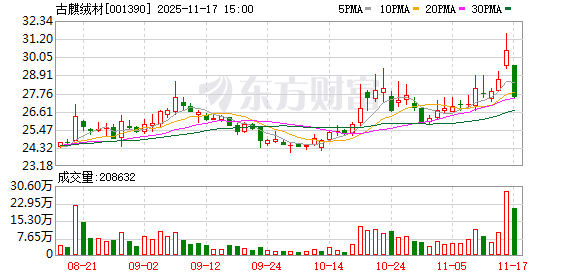
古麒绒材跌9.62%,龙虎榜上机构买入416.42万元,卖出1572.74万元
Zheng Quan Shi Bao Wang· 2025-11-17 09:08
Core Viewpoint - The stock of Guqi Rongcai experienced a significant decline of 9.62% today, with a turnover rate of 42.58% and a trading volume of 584 million yuan, indicating high volatility and selling pressure [2]. Trading Activity - The stock was listed on the Dragon and Tiger list due to a turnover rate of 42.58% and a price drop deviation of -9.63% [2]. - Institutional investors net sold 11.56 million yuan, while total net selling from brokerage seats reached 73.95 million yuan [2]. - The top five brokerage seats accounted for a total trading volume of 154 million yuan, with buying amounting to 34.37 million yuan and selling at 120 million yuan, resulting in a net selling of 85.52 million yuan [2]. Institutional Participation - Among the brokerage seats, one institutional seat was noted, with a buying amount of 4.16 million yuan and a selling amount of 15.73 million yuan, leading to a net selling of 11.56 million yuan [2][3]. - Over the past six months, the stock has appeared on the Dragon and Tiger list six times, with an average price drop of 5.44% the day after being listed and an average decline of 8.51% in the following five days [2]. Capital Flow - The stock saw a net outflow of 76.77 million yuan in main funds today, with a significant outflow of 59.57 million yuan from large orders and 17.20 million yuan from major funds [2]. - In the last five days, the stock experienced a net inflow of 43.07 million yuan in main funds [2].
先锋新材股价涨5.85%,渤海汇金资管旗下1只基金重仓,持有24.4万股浮盈赚取7.08万元
Xin Lang Cai Jing· 2025-11-17 06:48
Group 1 - The core point of the news is that Vanguard New Materials Co., Ltd. experienced a stock price increase of 5.85%, reaching 5.25 CNY per share, with a trading volume of 324 million CNY and a turnover rate of 13.88%, resulting in a total market capitalization of 2.489 billion CNY [1] - Vanguard New Materials, established on March 7, 2003, and listed on January 13, 2011, is primarily engaged in the production and sales of sunshade fabric products, with revenue composition being 49.39% from window decorations and shading products, 44.61% from sunshade fabrics, and 6.00% from other supplementary products [1] Group 2 - From the perspective of fund holdings, one fund under Bohai Huijin Asset Management has Vanguard New Materials as a top ten holding, with Bohai Huijin New Momentum Theme Mixed A (010584) holding 244,000 shares, accounting for 1.82% of the fund's net value, ranking as the tenth largest holding [2] - The fund has achieved a year-to-date return of 61.48%, ranking 412 out of 8,213 in its category, and a one-year return of 50.69%, ranking 619 out of 8,130 [2] Group 3 - The fund manager of Bohai Huijin New Momentum Theme Mixed A is He Xiang, who has been in the position for 8 years and 118 days, with the fund's total asset size at 47.6137 million CNY [3] - During his tenure, the best fund return was 51.68%, while the worst was -17.42% [3]

孚日股份股价涨10.03%,新华基金旗下1只基金重仓,持有21.15万股浮盈赚取24.53万元
Xin Lang Cai Jing· 2025-11-17 01:55
Group 1 - The core point of the news is that Fuzhi Co., Ltd. has seen a significant stock price increase of 98.28% over the past nine days, with a current price of 12.72 CNY per share and a market capitalization of 12.041 billion CNY [1] - Fuzhi Co., Ltd. was established on August 11, 1999, and went public on November 24, 2006. The company specializes in the production and sale of towel series products and decorative fabric series products, with the main revenue composition being 62.86% from towel series, 9.96% from others, 9.25% from thermal power products, 6.96% from bedding series, 3.88% from chemical products, 3.78% from coating materials, and 3.31% from motor products [1] Group 2 - Xinhua Fund has a significant holding in Fuzhi Co., Ltd., with its Xinhua Industry Leader Theme Stock Fund (011457) holding 211,500 shares, accounting for 1.88% of the fund's net value, making it the second-largest holding. The fund has gained approximately 245,300 CNY today and 1,211,900 CNY during the nine-day price increase [2] - The Xinhua Industry Leader Theme Stock Fund (011457) was established on March 24, 2021, with a current scale of 54.6941 million CNY. Year-to-date returns are 15.27%, ranking 3211 out of 4216 in its category, while the one-year return is 2.5%, ranking 3659 out of 3956. Since inception, the fund has experienced a loss of 31.52% [2]
全球投资仍未走出低谷
Jing Ji Wang· 2025-11-17 01:39
Global Investment Trends - Global investment conditions remain sluggish in the first half of 2025, with foreign direct investment (FDI) declining by 3%, marking the third consecutive year of decline [1][2] - Geopolitical tensions, trade frictions, and companies reassessing supply chain risks contribute to cautious investment sentiment [1][2] Greenfield Investment - Greenfield investment, a key indicator of new capital expenditure and future production capacity, has seen a significant decline, with a 17% drop in global projects [2] - Developed and developing countries experienced declines of 20% and 12% respectively, contrasting with the recovery period from 2023 to 2024 [2] - Manufacturing greenfield projects decreased by 26%, particularly in sectors related to global supply chains such as electronics, machinery, automotive, and textiles [2] International Project Financing - International project financing, primarily in infrastructure sectors like energy and transportation, has sharply decreased due to high interest rates and rising geopolitical risks [3] - Renewable energy projects saw a 9% decline, while other electricity projects experienced a 38% drop in project numbers and a 52% decrease in investment amounts [3] - Domestic project financing has increased by 39% in number and 29% in amount, indicating a shift as local capital attempts to fill the gap left by international capital withdrawal [3] Cross-Border Mergers and Acquisitions - Cross-border M&A activity has significantly decreased, with total deal value dropping from $448 billion in 2024 to $172 billion in 2025 [4] - The U.S. and U.K. saw declines of 33% and 59% respectively, with overall European M&A activity down by approximately 1% [4] - There is an increase in divestitures and withdrawals, leading to instability in M&A activities in developing countries [4] Sustainable Development Goals Impact - The weak international investment climate negatively affects the achievement of sustainable development goals, with related project numbers declining by 10% and investment amounts down by 7% [4] - This trend indicates a reduction in both the number of projects and the average size of individual projects, further weakening capital formation capabilities in developing countries [4] Future Investment Landscape - The global investment landscape is expected to become more "regionalized" and "friend-shored," with investments favoring politically friendly countries [5] - Manufacturing related to supply chains will continue to face pressure, with developed countries likely to repatriate critical manufacturing processes [5] - Digital economy and artificial intelligence are projected to be the only bright spots for global investment growth, driven by strategic emphasis on AI and semiconductor development [5]
联合国贸发会议报告显示 全球投资仍未走出低谷
Jing Ji Ri Bao· 2025-11-17 00:31
Global Investment Trends - Global investment conditions remain sluggish in the first half of 2025, with foreign direct investment (FDI) declining by 3%, marking the third consecutive year of decline [1][2] - The report indicates that geopolitical tensions, trade frictions, and companies reassessing supply chain risks contribute to cautious investment sentiment [1][2] Types of International Investment - Greenfield investments, a key indicator of new capital expenditure and future production capacity, have significantly decreased, with a 17% drop in global projects [2] - Developed countries experienced a 20% decline in greenfield investments, while developing countries saw a 12% decrease [2] - Manufacturing greenfield projects faced the most significant decline, with a 26% reduction, particularly in sectors related to global supply chains such as electronics, machinery, automotive, and textiles [2] International Project Financing - International project financing, primarily in infrastructure sectors like energy and transportation, has sharply declined due to high global interest rates and increased geopolitical risks [3] - Renewable energy projects saw a 9% decrease, while other electricity projects experienced a 38% drop in project numbers and a 52% decline in investment amounts [3] - Domestic project financing has increased by 39% in number and 29% in amount, indicating a shift as local capital attempts to fill the gap left by international capital withdrawal [3] Cross-Border Mergers and Acquisitions - Cross-border M&A activity has decreased significantly, with total deal value dropping from $448 billion in 2024 to $172 billion in the first half of 2025 [4] - The U.S. saw a 33% decline in M&A activity, while the UK experienced a 59% drop, and Europe overall declined by approximately 1% [4] - There is a notable increase in divestitures and withdrawals, leading to instability in M&A activities in developing countries [4] Impact on Sustainable Development - The decline in international investment activities negatively impacts the achievement of sustainable development goals, with related project numbers decreasing by 10% and investment amounts down by 7% [4] - This trend indicates not only fewer projects but also a reduction in the average size of individual projects, further weakening capital formation capabilities in developing countries [4] Future Investment Landscape - The global investment landscape is expected to become more "regionalized" and "friend-shored," with investments favoring politically friendly countries [5] - Supply chain-related manufacturing will continue to face pressure, and developed countries are likely to repatriate critical manufacturing processes [5] - Digital economy and artificial intelligence are projected to be the only bright spots for global investment growth, driven by strategic emphasis on AI and semiconductor development [5]
联合国贸发会议报告显示:全球投资仍未走出低谷
Jing Ji Ri Bao· 2025-11-16 23:14
Core Insights - Global investment conditions remain sluggish in the first half of 2025, with foreign direct investment declining by 3% for the third consecutive year, influenced by escalating global trade tensions, geopolitical uncertainties, and corporate reassessment of supply chain risks [1][2] Group 1: Greenfield Investment - Greenfield investment, a key indicator of new capital expenditure and future production capacity, has significantly contracted, with a 17% decrease in global projects. Developed and developing countries saw declines of 20% and 12%, respectively [2] - Manufacturing greenfield projects experienced the most substantial drop, with a 26% reduction, particularly in sectors related to global supply chains such as electronics, machinery, automotive, and textiles [2] - The decline in greenfield investment is attributed to rising U.S. tariff barriers, which have notably pressured manufacturing investments in countries like Vietnam, India, Brazil, and South Africa [2] Group 2: International Project Financing - International project financing, primarily in infrastructure sectors like energy, renewable resources, and transportation, has seen a significant downturn due to high global interest rates and increased geopolitical risks [3] - Renewable energy project numbers fell by 9%, while other electricity projects saw a 38% decrease in quantity and a 52% drop in value, indicating a weak performance across various sectors [3] - Domestic financing is replacing international financing, with domestic project financing increasing by 39% in quantity and 29% in value, highlighting a shift as international capital withdraws [3] Group 3: Cross-Border Mergers and Acquisitions - Cross-border M&A activity has sharply declined, with total deal value dropping from $448 billion in 2024 to $172 billion in the first half of 2025. The U.S. and U.K. experienced the largest declines, with decreases of 33% and 59%, respectively [4] - Service and manufacturing sectors saw significant reductions in M&A activity, with service sector deals down by 25% and manufacturing by 12% [4] - Increased divestments and spin-offs have led to greater instability in M&A activities in developing countries [4] Group 4: Sustainable Development Goals - The weak international investment climate negatively impacts the achievement of sustainable development goals, with related project numbers declining by 10% and investment amounts down by 7% in key areas such as renewable energy, infrastructure, and health [4] - The average size of individual projects is shrinking, further undermining the capital formation capacity of developing countries in critical sustainable development sectors [4] Group 5: Future Investment Trends - The global investment landscape is expected to become more "regionalized" and "friend-shored," with investments increasingly flowing between politically friendly nations, shifting from a globalized to a group-based approach [5] - Manufacturing sectors related to supply chains will continue to face pressure, with developed countries likely to repatriate key manufacturing processes to domestic or friendly economies [5] - Digital economy and artificial intelligence are projected to be the only bright spots for global investment growth, driven by strategic emphasis on AI and semiconductor development, as well as intensified technological competition among nations [5]