医药生物

Search documents
深市“双提升”:471家率先行动,分红占净利润比重2年提升近11个百分点
Di Yi Cai Jing· 2025-12-27 03:07
Core Insights - The "Quality Return Dual Improvement" initiative launched by the Shenzhen Stock Exchange aims to enhance the development quality and investment value return capabilities of listed companies, with 471 companies having disclosed action plans by November 2025 [1][2] Group 1: Company Participation and Industry Coverage - Among the 471 companies, 293 are part of the Shenzhen Component Index, 88 are in the CSI 300 Index, and 82 belong to the ChiNext Index, collectively representing about 50% of the total market capitalization of Shenzhen [2] - The participating companies span 30 industries, including electronics, power equipment, pharmaceuticals, and computers, with a significant presence of private enterprises, accounting for nearly 70% of the participants [2] Group 2: Focus Areas of Improvement - The action plans from the listed companies emphasize three main focuses: enhancing core business awareness, improving technological innovation capabilities, and strengthening regulatory operations [2] - Specific examples include Mindray Medical (300760.SZ) increasing R&D investment and global expansion, and BYD (002594.SZ) planning R&D expenditures of 54.2 billion yuan in 2024 [2] Group 3: Shareholder Returns and Buybacks - Companies are increasing dividend and buyback efforts, with firms like BOE Technology Group (000725.SZ) disclosing future shareholder return plans, and Anke Bio (300009.SZ) maintaining 16 consecutive years of cash dividends [3] - The average annual dividend growth rate for "dual improvement" companies from 2022 to 2024 is 10.0%, with 2024 dividends accounting for 43.6% of net profits, a 10.9 percentage point increase from 2022 [5] Group 4: Financial Performance and Market Response - In terms of financial performance, "dual improvement" companies achieved a total revenue of 9.8 trillion yuan in 2024, a 3.6% year-on-year increase, and a net profit of 743.39 billion yuan [4] - The average stock price increase for these companies from February 2024 to November 2025 was 77.2%, surpassing the Shenzhen Component Index, with a total market capitalization of 21.2 trillion yuan by November 2025 [6]
12月26日沪深两市强势个股与概念板块
2 1 Shi Ji Jing Ji Bao Dao· 2025-12-26 12:13
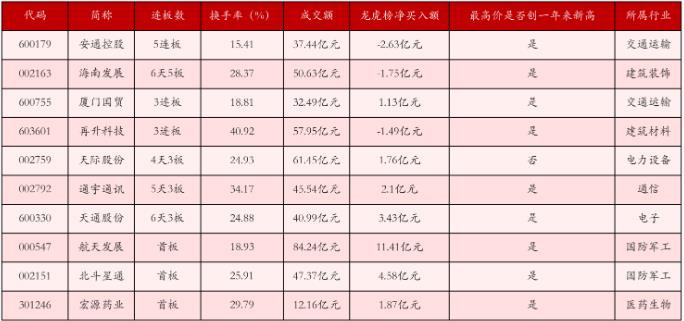
Strong Stocks - As of December 26, the Shanghai Composite Index rose by 0.1% to 3963.68 points, the Shenzhen Component Index increased by 0.54% to 13603.89 points, and the ChiNext Index went up by 0.14% to 3243.88 points [1] - A total of 91 stocks in the A-share market hit the daily limit up, with the top three strong stocks being: Antong Holdings (600179), Hainan Development (002163), and Xiamen Guomao (600755) [1] - The detailed data for the top 10 strong stocks includes metrics such as consecutive limit up days, turnover rates, trading volumes, and net buying amounts from the Dragon and Tiger List [1] Strong Concept Sectors - The top three concept sectors based on A-share performance are Hainan Free Trade Zone, Metal Zinc, and Metal Lead, with respective increases of 4.32%, 3.61%, and 3.3% [2] - The detailed data for the top 10 concept sectors includes metrics such as percentage of limit up stocks, percentage of rising stocks, and percentage of falling stocks [2]


【26日资金路线图】有色金属板块净流入逾183亿元居首 龙虎榜机构抢筹多股
Zheng Quan Shi Bao· 2025-12-26 10:49
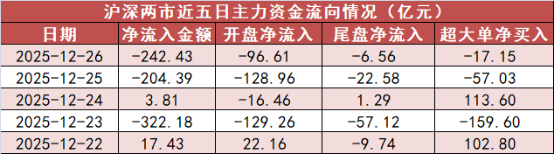
Market Overview - The A-share market showed mixed results on December 26, with the Shanghai Composite Index closing at 3963.68 points, up 0.1%, and the Shenzhen Component Index at 13603.89 points, up 0.54% [1] - Total trading volume in the A-share market reached 21812.64 billion yuan, an increase of 2372.04 billion yuan compared to the previous trading day [1] Capital Flow - The main capital outflow in the A-share market was 242.43 billion yuan, with an opening net outflow of 96.61 billion yuan and a closing net outflow of 6.56 billion yuan [2] - The CSI 300 index experienced a net outflow of 54.39 billion yuan, while the ChiNext saw a net outflow of 133.96 billion yuan and the STAR Market had a net outflow of 20.89 billion yuan [4] Sector Performance - The non-ferrous metals sector led with a net inflow of 183.35 billion yuan, marking a 2.35% increase [6] - Other sectors with net inflows included non-bank financials (40.67 billion yuan), power equipment (16.91 billion yuan), steel (8.29 billion yuan), and agriculture, forestry, animal husbandry, and fishery (2.00 billion yuan) [7] Individual Stock Activity - The stock with the highest net inflow was Sungrow Power Supply, attracting 23.72 billion yuan [8] - Institutions showed significant interest in several stocks, with notable net purchases in Aerospace Development (48.18 million yuan) and Demingli (20.50 million yuan) [10][11] Institutional Focus - Recent institutional ratings highlighted several stocks, including Jiu Mining Energy with a target price of 16.27 yuan, indicating a potential upside of 21.15% from its closing price [13]

【26日资金路线图】有色金属板块净流入逾183亿元居首 龙虎榜机构抢筹多股
证券时报· 2025-12-26 10:48
Market Overview - The A-share market showed mixed performance on December 26, with the Shanghai Composite Index closing at 3963.68 points, up 0.1%, and the Shenzhen Component Index at 13603.89 points, up 0.54% [1] - Total market turnover reached 21812.64 billion, an increase of 2372.04 billion compared to the previous trading day [1] Capital Flow - The main capital in the A-share market experienced a net outflow of 242.43 billion, with an opening net outflow of 96.61 billion and a closing net outflow of 6.56 billion [2] - The CSI 300 index saw a net outflow of 54.39 billion, while the ChiNext index had a net outflow of 133.96 billion and the STAR Market a net outflow of 20.89 billion [4] Sector Performance - The non-ferrous metals sector led with a net inflow of 183.35 billion, showing a rise of 2.35% [6][7] - Other sectors with net inflows included non-bank financials (40.67 billion) and electric power equipment (16.91 billion) [7] - The electronics sector faced the largest net outflow at -173.32 billion, followed by machinery equipment at -86.84 billion and pharmaceuticals at -39.51 billion [7] Notable Stocks - Yangguang Electric Power saw the highest net inflow of 23.72 billion [8] - Institutional buying was noted in several stocks, including Aerospace Development with a net purchase of 481.76 million [11][12]

主力资金丨主力重金布局5股!
Zheng Quan Shi Bao Wang· 2025-12-26 10:46
Group 1 - The core point of the news is that the power equipment industry saw a significant net inflow of funds amounting to 77.52 billion yuan, which is notably higher than other sectors [1] - On December 26, the A-share market experienced a slight increase, with the Shanghai Composite Index achieving an eight-day consecutive rise [1] - Among the 25 industries with net outflows, the electronics, communications, and machinery sectors had the highest outflows, each exceeding 4 billion yuan [1] Group 2 - From individual stocks, 49 stocks had net inflows exceeding 2 billion yuan, with five stocks seeing inflows over 10 billion yuan [2] - Yangguang Electric Power led with a net inflow of 23.72 billion yuan, attributed to a surge in the photovoltaic sector following the "2025 China Photovoltaic Industry Annual Conference" [2] - Aerospace Development followed with a net inflow of 20.72 billion yuan, with significant buying from institutional investors [2] Group 3 - At the market close, there was a net outflow of 6.56 billion yuan, but the power equipment and defense industries attracted over 1 billion yuan in net buying [3] - Individual stocks such as Xiechuang Data and Yangguang Electric Power had net inflows exceeding 1 billion yuan at the close [3] - Other stocks like China Satellite Communications and Zhejiang Sebao also saw substantial net inflows, each exceeding 800 million yuan [3] Group 4 - On the outflow side, stocks like Xinwei Communication, Yingweike, and Lixun Precision experienced the highest net outflows at the market close [4]
创业板指本周实现日线5连阳,创业板ETF(159915)等产品助力布局“春季躁动”行情
Sou Hu Cai Jing· 2025-12-26 10:17
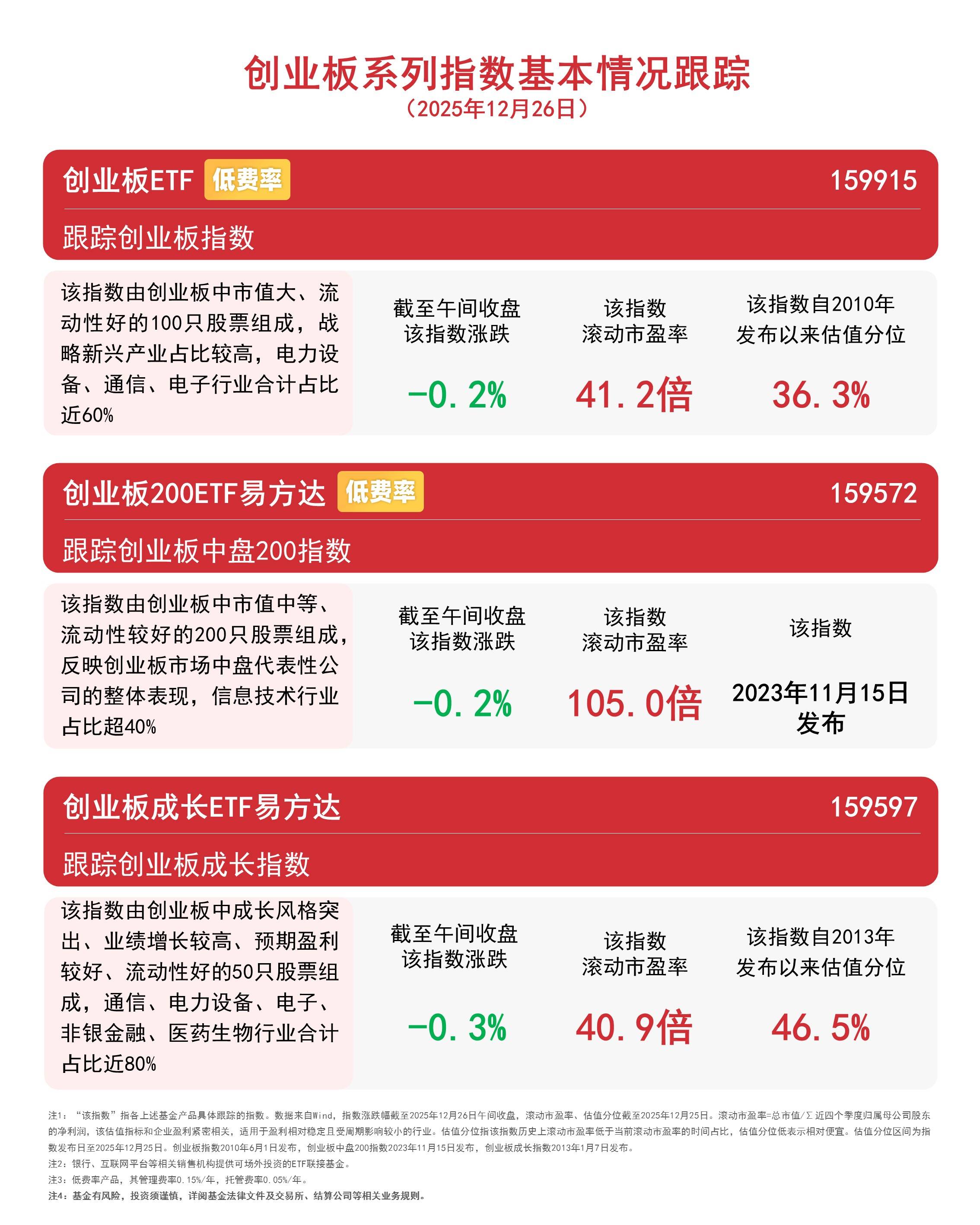
Group 1 - The ChiNext Growth Index rose by 4.4%, the ChiNext Mid-Cap 200 Index increased by 4.2%, and the ChiNext Index gained 3.9%, achieving five consecutive days of gains [1][3] - China Galaxy Securities indicates that the A-share market is entering a critical window for cross-year layout as 2026 approaches, with expectations for a small rally around New Year's [1] - The year 2026 marks the beginning of the "14th Five-Year Plan," with anticipated policy benefits being released earlier, leading to structural opportunities concentrated in sectors aligned with policy direction and industry prosperity [1] Group 2 - The strategic emerging industries account for a significant portion, with the power equipment, communication, and electronics sectors collectively representing nearly 60% of the ChiNext Mid-Cap 200 Index [5] - The ChiNext Mid-Cap 200 Index consists of 200 stocks with medium market capitalization and good liquidity, reflecting the overall performance of representative companies in the ChiNext market, with over 40% of the index comprised of the information technology sector [5] - The ChiNext Growth Index is made up of 50 stocks that exhibit strong growth characteristics and good liquidity, with the power equipment, pharmaceutical, and communication sectors accounting for approximately 60% [5] Group 3 - As of December 26, 2025, the rolling price-to-earnings (P/E) ratios for the ChiNext Index, ChiNext Mid-Cap 200 Index, and ChiNext Growth Index are 41.2x, 105.0x, and 40.9x respectively [3][6] - The cumulative performance of the indices shows a year-to-date increase of 51.5% for the ChiNext Index, 29.1% for the ChiNext Mid-Cap 200 Index, and 72.4% for the ChiNext Growth Index [8] - The historical cumulative performance over the past year indicates a rise of 47.1% for the ChiNext Index, 23.6% for the ChiNext Mid-Cap 200 Index, and 66.1% for the ChiNext Growth Index [8]


180股筹码连续3期集中
Zheng Quan Shi Bao Wang· 2025-12-26 08:56
Group 1 - The article highlights that 835 companies reported their latest shareholder numbers as of December 20, with 180 companies experiencing a continuous decline in shareholder numbers for more than three periods, indicating a trend of increasing concentration of shares [1][2] - Notable companies with significant declines in shareholder numbers include Yihau New Materials, which has seen a 37.94% decrease over 12 periods, and Zhukebo Design, with a 27.40% decrease over 11 periods [1][2] - The companies with the largest recent declines in shareholder numbers include Hewei Electric, Guoji Precision, and Dalian Heavy Industry, with decreases of 15.15%, 13.33%, and 11.90% respectively [1][2] Group 2 - Among the companies with declining shareholder numbers, 44 have seen their stock prices rise, while 135 have experienced declines, with notable gainers including Shibu Detection, Guoji Precision, and Quanyin High-Tech, which increased by 60.21%, 57.31%, and 29.84% respectively [2] - The sectors with the highest concentration of companies experiencing declining shareholder numbers include basic chemicals, machinery equipment, and pharmaceutical biology, with 24, 20, and 18 companies respectively [2] - In terms of institutional interest, 25 companies with declining shareholder numbers were surveyed by institutions in the past month, with Shengda Resources, Guoji Precision, and Baowu Magnesium receiving the most attention [2]




创业板系列指数小幅回踩,关注创业板ETF(159915)、创业板200ETF易方达(159572)等产品投资机遇
Sou Hu Cai Jing· 2025-12-26 05:06
Group 1 - The ChiNext Index and ChiNext Mid-Cap 200 Index both declined by 0.2%, while the ChiNext Growth Index fell by 0.3% as of the midday close [1] - Huazhong Securities' report indicates that price improvements will boost nominal GDP, leading to a continuous recovery in corporate profits, which will serve as a strong fundamental support for the market [1] - It is estimated that the overall profit growth rate for the A-share market will increase from 8.2% in 2025 to 10.3% in 2026, with the profit growth rate excluding financials reaching 7.7% [1] Group 2 - The ChiNext is expected to benefit from a new round of industrial cycles, with a projected profit growth rate of 31.7% in 2026 [1] - The ChiNext Growth ETF tracks the ChiNext Growth Index, which consists of 50 stocks characterized by growth style, high performance, good profit expectations, and strong liquidity, with the information technology sector accounting for over 40% [3] - The communication, power equipment, electronics, non-bank financials, and pharmaceutical sectors collectively account for nearly 80% of the ChiNext Growth Index [3]
12月25日融资余额25205.48亿元,相较上个交易日增加37.84亿元
Sou Hu Cai Jing· 2025-12-26 00:56
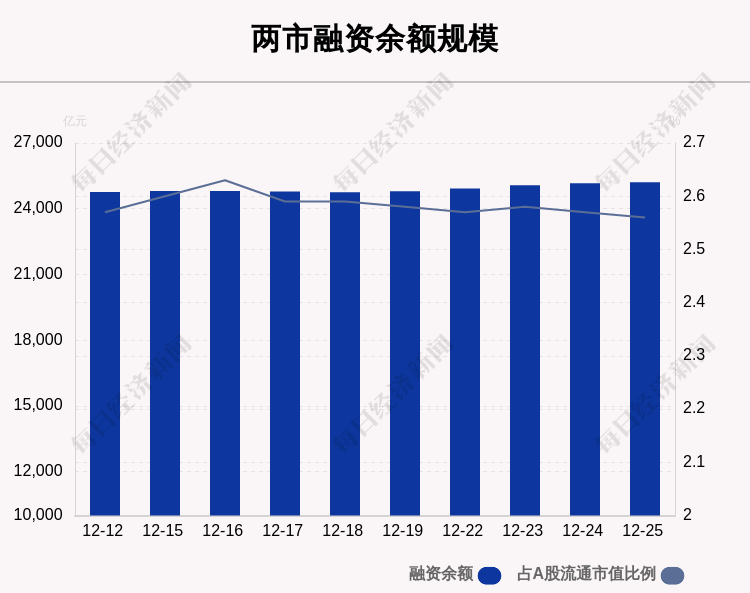
Summary of Key Points Core Viewpoint - As of December 25, the margin financing and securities lending balance in the Shanghai and Shenzhen markets reached 25,374.79 billion yuan, reflecting an increase of 37.55 billion yuan from the previous trading day [1]. Group 1: Market Overview - The financing balance was 25,205.48 billion yuan, which is an increase of 37.84 billion yuan compared to the previous trading day [1]. - In the Shanghai market, the margin balance decreased by 22.64 billion yuan to 12,847.13 billion yuan, while the Shenzhen market saw an increase of 60.19 billion yuan to 12,527.66 billion yuan [1]. Group 2: Stock Performance - A total of 1,690 stocks experienced net inflows of financing funds, with 58 stocks having net buy amounts exceeding 10% of their total trading volume [2]. - The top three stocks by net buy percentage were: - Jiuzhou Yigui (26.05%) - Southern Pump Industry (23.37%) - Hailier (19.69%) [2][4]. Group 3: Significant Net Inflows - There were 51 stocks with net buy amounts exceeding 100 million yuan, with the top three being: - Industrial Fulian (813 million yuan) - Aerospace Electronics (757 million yuan) - Goldwind Technology (555 million yuan) [7].


兴业证券:哪些行业股价与人民币汇率相关性较强?
智通财经网· 2025-12-25 12:13
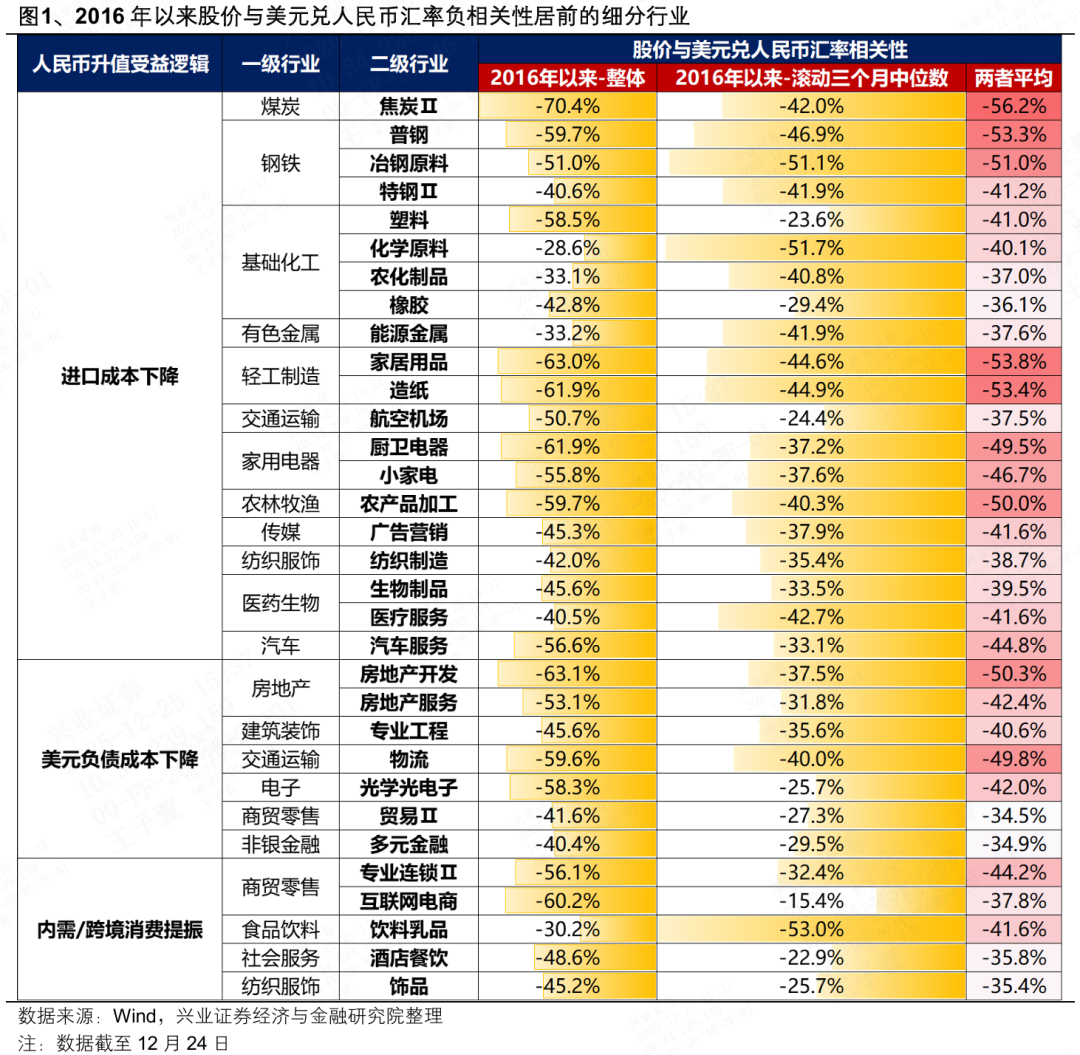
Core Viewpoint - The report from Industrial Securities highlights the negative correlation between stock prices and the USD/CNY exchange rate since 2016, indicating that a stronger RMB tends to drive stock prices higher across various sectors [1] Group 1: Industries Benefiting from RMB Appreciation - Industries with high reliance on imported raw materials benefit from RMB appreciation, leading to reduced import costs. Key sectors include coke, steel, certain chemicals (plastics, chemical raw materials, agricultural chemicals, rubber), energy metals, paper, airport operations, and agricultural product processing [1] - The construction and real estate sectors, which have high USD-denominated debt, see a decrease in financing costs due to RMB appreciation. This includes real estate development, real estate services, and specialized engineering [1] - The service and high-end consumption sectors, such as cross-border e-commerce, hotel and catering services, and jewelry, benefit from increased domestic demand and cross-border consumption driven by enhanced RMB purchasing power [1] Group 2: Correlation Data - The median negative correlation between stock prices and the USD/CNY exchange rate since 2016 shows significant figures for various sectors: - Coke: -70.4% overall, -42.0% rolling three months - Steel: -59.7% overall, -46.9% rolling three months - Basic chemicals: -58.5% overall, -23.6% rolling three months - Transportation (airports): -50.7% overall, -24.4% rolling three months - Real estate development: -63.1% overall, -37.5% rolling three months [2] Group 3: Impact on Financing Costs - Industries with high USD debt benefit from RMB appreciation, leading to lower financing costs. This includes logistics, optical electronics, trade, and diversified finance sectors [1] - Specific correlations include: - Logistics: -59.6% overall, -40.0% rolling three months - Optical electronics: -58.3% overall, -25.7% rolling three months - Trade: -41.6% overall, -27.3% rolling three months [2] Group 4: Domestic Demand and Cross-Border Consumption - The sectors benefiting from increased domestic demand and cross-border consumption include: - Food and beverage (dairy products): -30.2% overall, -53.0% rolling three months - Hospitality (hotels and restaurants): -48.6% overall, -22.9% rolling three months - Textiles (jewelry): -45.2% overall, -25.7% rolling three months [2]