
有色金属冶炼和压延加工业

Search documents
1月核心CPI温和上涨 节前重要民生商品量足价稳
Bei Jing Shang Bao· 2026-02-11 11:01
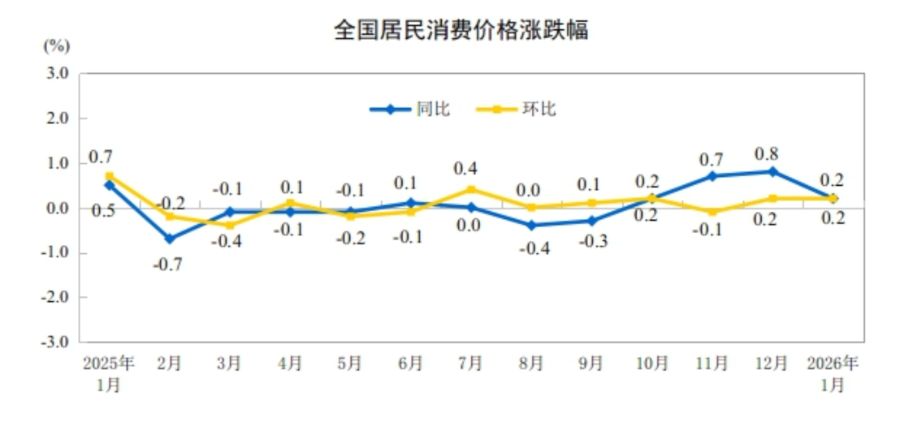
Group 1 - In January, the national consumer price index (CPI) increased by 0.2% year-on-year, with core CPI (excluding food and energy) rising by 0.8% [1][3] - The CPI increase was influenced by the Spring Festival timing and a significant drop in energy prices due to international oil price fluctuations [1][3] - The new base year for CPI and producer price index (PPI) is set to 2025, with the impact of this base year change on CPI and PPI monthly year-on-year indices averaging approximately 0.06 and 0.08 percentage points, respectively [1][8] Group 2 - Food prices decreased by 0.7%, contributing to a 0.11 percentage point decline in the year-on-year CPI, while non-food prices increased by 0.4% [4][5] - Core CPI showed a moderate increase, with a 0.3% month-on-month rise, marking the highest level in six months, driven by rising prices in travel and household services [5] - The PPI decreased by 1.4% year-on-year but increased by 0.4% month-on-month, marking four consecutive months of month-on-month increases [6][7] Group 3 - The new base year CPI classification includes adjustments to better reflect changes in consumer spending, with new categories added such as home security devices and internet medical services [8][9] - The overall weight changes in the CPI categories are minimal compared to the 2020 base year, with an increase in service weights and a decrease in consumer goods weights [9]


格林美:终止全资下属公司增资扩股实施股权改组事项
Ge Long Hui A P P· 2026-02-11 10:19
Core Viewpoint - The company Greenmei (002340.SZ) has decided to terminate the capital increase and equity restructuring of its wholly-owned subsidiary PT INDONESIA QINGMEI ENERGY MATERIALS due to changes in internal and external circumstances, aiming to mitigate financial risks associated with the transaction [1] Group 1 - The board meeting will be held on February 11, 2026, to review and approve the decision [1] - The termination ensures that the target company remains a wholly-owned subsidiary, preventing any external financial support from the company [1] - This decision is intended to safeguard the integrity of the company's business and the security of its funds, thereby protecting the interests of the company and its investors [1]

永兴材料股价震荡,机构关注度一般
Jing Ji Guan Cha Wang· 2026-02-11 10:09
经济观察网 永兴材料(002756)近7天股价呈现波动走势。截至2026年2月11日最新数据,股价报48.69 元,当日上涨2.08%,成交额3.71亿元,换手率1.97%。近7天区间涨跌幅为-1.12%,振幅达7.74%,其中 2月5日单日下跌4.55%,2月6日反弹上涨3.79%,2月10日再次下跌2.07%。资金面上,2月11日主力资金 净流入1831.77万元,但近3日主力净流出2142.65万元,显示短期资金分歧。技术面显示股价处于震荡区 间,20日布林带压力位57.27元,支撑位45.7元,MACD指标偏弱。 近期事件 2026年2月9日,永兴材料在互动平台回应投资者时表示,公司锂离子电池业务专注于钛酸锂电池研发, 主要产品为方形铝壳钛酸锂电池及系统,可应用于电网调频、可再生能源、轨道交通等领域。该回应未 涉及具体财务数据,但强调了业务布局。 机构观点 机构对永兴材料关注度一般,最新综合目标价为56.80元,较当前股价有15.35%的上涨空间。盈利预测 显示,2025年净利润同比预计下滑17.69%,2026年有望实现106.90%增长,主要基于锂价回升预期。近 期机构评级以中性为主,无新增买入或 ...

固定收益点评:物价上涨一定伴随利率上升吗?
GOLDEN SUN SECURITIES· 2026-02-11 09:10
1. Report Industry Investment Rating - No relevant information provided 2. Core Viewpoints of the Report - The current price increase is not a comprehensive upward movement, and it is difficult to have a trend impact on interest rates. The structural recovery of prices due to supply - side issues makes the foundation for overall economic recovery and comprehensive price increases unstable. The central bank may keep the monetary policy stable or make only minor adjustments, and the bond market pressure is limited [5][29] 3. Summary by Related Content CPI and PPI Data in January - CPI growth slowed down in January, with the year - on - year increase narrowing by 0.6 percentage points to 0.2% and a month - on - month increase of 0.2%. PPI decline narrowed, with a year - on - year decline of 1.4%, and the decline narrowed by 0.5 percentage points compared with the previous month. The month - on - month growth rate rebounded, with a 0.4% increase [1][8] Factors Affecting CPI - The Spring Festival factor pulled down the CPI in January. After excluding the Spring Festival factor, the year - on - year CPI growth rate in January was about 0.8%, basically the same as the previous month. The core CPI year - on - year increase was 0.8%, with a 0.4 - percentage - point decline from the previous month, also largely affected by the Spring Festival [1][8] - The price of gold still had a significant impact on CPI. The other supplies and services industry had a year - on - year growth of 13.2% in January. After excluding this item, the year - on - year CPI and core CPI in January were - 0.2% and 0.1% respectively, and the overall price level remained low [2][10] - The Spring Festival factor had the greatest impact on food prices, which was the main reason for the CPI decline. In January, food prices decreased by 0.7% from 1.1% in the previous month. The tourism service price was weak due to the Spring Festival misalignment effect [15][17] Factors Affecting PPI - The recovery of industrial product prices accelerated, mainly due to the increase in the prices of imported non - ferrous metals and electronic products. In January, the prices of non - ferrous metal mining, smelting and processing industries increased by 5.7% and 5.2% respectively month - on - month. The price of the computer, communication and other electronic equipment manufacturing industry increased by 0.5% month - on - month [2][19] - In January, the PPI of living materials decreased by 1.7% year - on - year, with the decline expanding by 0.4 percentage points compared with the previous month [19] Relationship between Price Increase and Interest Rate - Generally, price increases are accompanied by rising interest rates through supply and demand channels. However, the current single and imported price increase has not improved corporate profitability and is unlikely to increase financing demand. The central bank may not significantly respond to this type of price increase [3][23]
最新公布!CPI统计口径调整,新增洗碗机、医美服务等新消费分类
证券时报· 2026-02-11 09:02
Core Viewpoint - The article discusses the release of the Consumer Price Index (CPI) and Producer Price Index (PPI) data for January, marking the first data release based on the new 2025 benchmark, indicating a slight overall impact from the benchmark rotation on the indices [1][3]. Group 1: CPI Analysis - In January, the CPI increased by 0.2% month-on-month and year-on-year, with core CPI (excluding food and energy) showing a moderate increase [1][8]. - The CPI's year-on-year growth was affected by the Spring Festival's timing and international oil price fluctuations, with food prices decreasing by 0.7%, impacting the CPI by approximately 0.11 percentage points [8]. - The core CPI rose by 0.8% year-on-year, indicating a continued recovery in consumer demand, with a month-on-month increase of 0.3%, the highest in six months [8]. Group 2: PPI Analysis - The PPI rose by 0.4% month-on-month, marking the fourth consecutive month of increase, while the year-on-year decline narrowed to 1.4% [10]. - The increase in PPI is attributed to the ongoing construction of a unified national market, which has led to price increases in certain industries, such as cement and lithium-ion battery manufacturing [10][11]. - Input factors, including international metal prices, have influenced domestic prices, with significant increases in the prices of silver, copper, and aluminum [11]. Group 3: Benchmark Rotation Changes - The benchmark rotation introduced new categories reflecting modern consumption trends, such as home security devices and internet medical services, expanding the coverage of new economic sectors [3][4]. - The number of CPI survey points increased to approximately 120,000, covering around 620,000 specifications, which is a significant expansion compared to the previous benchmark [3]. - The new weightings in the CPI are more aligned with current consumer spending patterns, with an increase in the service category's weight and a decrease in consumer goods [5][6].

中国PPI环比连续4个月上涨
Zhong Guo Xin Wen Wang· 2026-02-11 08:48
Core Viewpoint - In January, China's Producer Price Index (PPI) increased by 0.4% month-on-month but decreased by 1.4% year-on-year, influenced by the ongoing construction of a unified national market, increased demand in certain industries, and the transmission of international commodity prices [1][2] Group 1: Monthly PPI Changes - The PPI rose by 0.4% month-on-month in January, marking a positive trend [1] - Key industries such as cement manufacturing and lithium-ion battery manufacturing saw prices increase by 0.1% month-on-month, continuing a four-month upward trend [1] - Prices for photovoltaic equipment and components shifted from a 0.2% decrease in the previous month to a 1.9% increase in January [1] Group 2: Sector-Specific Price Movements - The rapid development of digital technologies, including artificial intelligence, has led to a 0.5% month-on-month price increase in the computer communication and other electronic equipment manufacturing sector [1] - Specific price increases in this sector included electronic semiconductor materials and external storage devices, which rose by 5.9% and 4.0%, respectively [1] - Increased demand for gifts and food ahead of the Spring Festival contributed to a 4.1% increase in the price of arts and crafts and ceremonial goods, and a 0.3% increase in the agricultural and sideline food processing industry [1] Group 3: Impact of International Prices - The prices in China's non-ferrous metals and petroleum-related industries showed divergence due to external factors [1] - International prices for non-ferrous metals rose, leading to a 5.7% increase in the domestic non-ferrous metal mining and selection industry and a 5.2% increase in the non-ferrous metal smelting and rolling industry [1] - Conversely, fluctuations in international crude oil prices resulted in a 3.1% decrease in domestic oil extraction and a 2.5% decrease in refined petroleum product manufacturing prices [1] Group 4: Year-on-Year PPI Trends - Year-on-year, the PPI decreased by 1.4%, with the decline narrowing by 0.5 percentage points compared to the previous month [2] - The effectiveness of capacity governance in key industries is evident, with reduced year-on-year price declines in non-metallic mineral products, black metal smelting and rolling, and computer communication and other electronic equipment manufacturing [2]
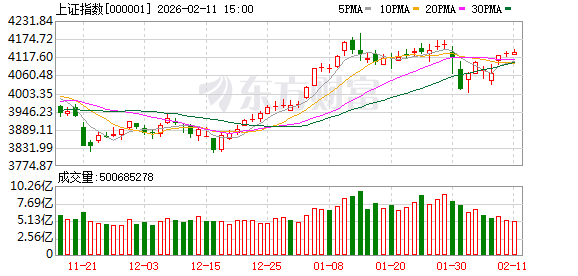
年内首次 两市成交额不足2万亿元!但沪指走出7连阳 如何理解?
Mei Ri Jing Ji Xin Wen· 2026-02-11 08:39
Market Performance - The three major indices showed mixed results, with the Shanghai Composite Index rising by 0.09%, while the Shenzhen Component Index fell by 0.35% and the ChiNext Index dropped by 1.08% [2] - Over 3,200 stocks in the market declined, and the trading volume in the Shanghai and Shenzhen markets decreased by 121.3 billion yuan, falling below 2 trillion yuan for the first time in 31 trading days [3] Sector Analysis - The chemical sector has shown strength recently, with the glass fiber concept rapidly rising, while the film and cinema sector experienced a collective decline [2] - The commercial aerospace concept, which had been consolidating, became active following the successful launch of the Long March 10 rocket but weakened in the afternoon [5] - Funds concentrated in cyclical stocks such as non-ferrous metals and chemicals emerged as the biggest winners of the day [7] Price Movements - Prices of rare earth products have significantly increased, with praseodymium-neodymium oxide and neodymium metal prices rising by approximately 50,000 yuan per ton [8] - The price of 65% black tungsten concentrate rose by 48.9% since the beginning of the year, while the price of ammonium paratungstate (APT) increased by 49.3% [8] - The latest data from the National Bureau of Statistics indicated a 22.7% increase in the price of non-ferrous metal mining and selection industries in January 2026 [10] Company Performance - Notable stock performances included Zhongji Xuchuang, which fell by 4.28%, and Xinyi Media, which rose by 5.09% [4] - The non-ferrous metal sector saw significant contributions to the Shanghai Composite Index's performance, with many leading stocks from this sector contributing to the index's rise [10] Market Outlook - Analysts suggest that in the current market environment, maintaining a rapid rotation among various hotspots is crucial for capturing opportunities [6] - The market is expected to become more active after the Spring Festival, with potential strong themes emerging post-holiday [15]

黄金饰品价格同比涨超7成!1月PPI环比连续4个月上涨
2 1 Shi Ji Jing Ji Bao Dao· 2026-02-11 07:58
Group 1: Consumer Price Index (CPI) Insights - In January, the Consumer Price Index (CPI) increased by 0.2% month-on-month and year-on-year, with the core CPI (excluding food and energy) rising by 0.8% year-on-year, marking a six-month high [1][4][8] - The decline in food prices by 0.7% contributed to a decrease in the CPI's year-on-year growth, with the previous year's high base due to the Spring Festival affecting the current comparison [5][6] - The core CPI's month-on-month increase of 0.3% indicates a sustained recovery in consumer demand, with significant price increases in services such as air tickets and travel agency fees [7][8] Group 2: Producer Price Index (PPI) Insights - The Producer Price Index (PPI) rose by 0.4% month-on-month in January, marking the fourth consecutive month of increase, with a growth rate expansion of 0.2 percentage points compared to the previous month [1][9] - Year-on-year, the PPI decreased by 1.4%, but the decline was less severe than in the previous month, indicating a potential stabilization in industrial pricing [11] - Various sectors, including non-ferrous metal mining and manufacturing, showed significant price increases, while energy-related industries continued to experience price declines [10][11] Group 3: Economic Outlook - Analysts expect a potential rebound in CPI growth in February due to the timing of the Spring Festival, which may influence consumer spending patterns [6][11] - The overall inflation trend is anticipated to align with the central bank's goal of a "moderate recovery," with PPI growth expected to steadily rise while CPI remains relatively stable [11][12]
国家统计局:2026年1月份CPI同比上涨,PPI同比降幅收窄
Jin Rong Jie· 2026-02-11 07:43
Group 1 - In January, consumer demand continued to recover, with the Consumer Price Index (CPI) rising 0.2% month-on-month and 0.2% year-on-year, while the core CPI, excluding food and energy, increased by 0.8% year-on-year [1] - The year-on-year increase in CPI was affected by the timing of the Spring Festival, leading to a high base comparison from the previous year, particularly in food and service prices [1] - Food prices decreased by 0.7%, contributing to a 0.11 percentage point decline in CPI year-on-year, while energy prices fell by 5.0%, impacting CPI by approximately 0.34 percentage points [1] Group 2 - The core CPI continued to rise, with a month-on-month increase of 0.3%, marking the highest level in six months, driven by higher prices in air tickets and travel services [2] - The Producer Price Index (PPI) rose 0.4% month-on-month, marking the fourth consecutive month of increase, with significant contributions from sectors like cement manufacturing and lithium-ion battery production [2] - Year-on-year, PPI decreased by 1.4%, but the decline was narrower by 0.5 percentage points compared to the previous month, with notable price increases in non-ferrous metal mining and manufacturing sectors [3]
国家统计局:1月份PPI环比继续上涨,同比降幅收窄
Ren Min Wang· 2026-02-11 06:09
Group 1 - The Producer Price Index (PPI) increased by 0.4% month-on-month in January, while it decreased by 1.4% year-on-year, indicating a mixed trend in industrial prices [1][2] - The PPI has risen for four consecutive months, with the month-on-month increase expanding by 0.2 percentage points compared to the previous month [1] - The construction of a unified national market has driven price increases in certain industries, such as cement and lithium-ion battery manufacturing, both of which saw a 0.1% increase month-on-month [1] Group 2 - Increased demand in various sectors has contributed to price rises, particularly in the computer communication and electronic device manufacturing industries, which saw a 0.5% month-on-month increase [1] - The prices of electronic semiconductor materials and external storage devices rose significantly, by 5.9% and 4.0% respectively [1] - The prices in the non-ferrous metal mining and smelting industries increased by 5.7% and 5.2% respectively, driven by rising international metal prices [2] Group 3 - Year-on-year, the PPI decline has narrowed by 0.5 percentage points, with notable increases in non-ferrous metal mining (22.7%) and cultural and sports goods manufacturing (21.2%) [2] - Certain industries, such as non-metallic mineral products and black metal smelting, experienced price declines of 5.4% and 3.7% respectively, although these declines were less severe than in the previous month [2] - Energy-related industries continue to see price decreases, with oil and gas extraction prices down by 16.7% and coal mining prices down by 9.8% [2]