通信技术服务

Search documents
三维通信:8月25日召开董事会会议
Mei Ri Jing Ji Xin Wen· 2025-08-26 22:39
Group 1 - The core point of the article is that Sanwei Communication (SZ 002115) held its 16th meeting of the 7th board of directors on August 25, 2025, to review the agenda including the 2025 semi-annual report and its summary [1] - For the first half of 2025, the revenue composition of Sanwei Communication is as follows: Internet information services accounted for 90.27%, communication equipment manufacturing accounted for 4.81%, communication technology services accounted for 4.08%, and other businesses accounted for 0.84% [1] Group 2 - The pet industry is experiencing a significant boom, with a market size of 300 billion yuan, leading to a surge in stock prices for related listed companies [1]

润建股份股价微跌0.45% 上半年净利润同比下滑83.37%
Jin Rong Jie· 2025-08-26 18:30
Group 1 - The company's stock closed at 51.29 yuan on August 26, with a decrease of 0.23 yuan, representing a decline of 0.45% [1] - The trading volume for the day was 144,700 hands, with a total transaction value of 749 million yuan [1] - The stock reached a high of 52.99 yuan and a low of 50.50 yuan during the day, resulting in a fluctuation of 4.83% [1] Group 2 - The company's main business is communication technology services, which includes communication network construction, maintenance, and optimization [1] - In the first half of 2025, the company achieved a net profit attributable to shareholders of 39.23 million yuan, a decrease of 83.37% compared to the same period last year [1] Group 3 - On August 26, the net outflow of main funds was 25.70 million yuan, with a cumulative net outflow of 62.43 million yuan over the past five trading days [1] - Recent trends indicate a continuous outflow of funds [1]
北纬科技股价震荡下行 盘中振幅超8%引关注
Jin Rong Jie· 2025-08-20 18:34
Group 1 - The stock price of Beiwai Technology as of August 20, 2025, is 12.58 yuan, down 0.63% from the previous trading day [1] - The opening price for the day was 12.50 yuan, with an intraday high of 13.11 yuan and a low of 12.05 yuan, resulting in a volatility of 8.37% [1] - The total trading volume for the day was 1.0954 million hands, with a transaction amount of 1.397 billion yuan and a turnover rate of 24.38% [1] Group 2 - Beiwai Technology's main business includes communication technology services, focusing on emerging fields such as low-altitude economy, robotics, and digital economy [1] - The company's total market capitalization is 7.032 billion yuan, with a circulating market value of 5.652 billion yuan, and the current price-to-earnings ratio is negative [1] Group 3 - On August 20, the net inflow of main funds was 59.6654 million yuan, accounting for 1.06% of the circulating market value [1] - However, over the past five trading days, there has been an overall net outflow of funds totaling 716 million yuan, which is 12.67% of the circulating market value [1] - The stock experienced rapid fluctuations during the day, with significant rebounds and pullbacks occurring shortly after the market opened [1]

元道通信(301139.SZ):未涉及光模块和光通信业务
Ge Long Hui· 2025-08-20 07:15
Core Viewpoint - Yuan Dao Communication (301139.SZ) focuses on providing network construction, maintenance, and optimization services to ensure effective operation of information communication networks for telecom operators and other clients, delivering a stable and high-quality network environment for end users [1] Company Overview - The company currently does not engage in optical modules and optical communication business [1]
普天科技股价下跌1.24% 广东发布商业航天支持政策
Sou Hu Cai Jing· 2025-08-19 16:54
Company Overview - Potevio Technology's stock price on August 19 was 23.87 yuan, down 0.30 yuan from the previous trading day, representing a decline of 1.24% [1] - The opening price for the day was 24.12 yuan, with a high of 24.26 yuan and a low of 23.70 yuan, and the trading volume reached 143,400 hands with a transaction amount of 343 million yuan [1] - The company specializes in communication technology services, including communication network construction, maintenance, and optimization services, and is registered in Guangzhou, Guangdong Province [1] Industry Developments - Guangdong Province recently issued policies aimed at promoting high-quality development in commercial aerospace, focusing on creating application scenarios and supporting enterprises in core technology breakthroughs [1] - The policy encourages companies to concentrate on satellite constellation networking, measurement and control, and direct satellite communication [1] Financial Activity - On August 19, Potevio Technology experienced a net outflow of main funds amounting to 21.89 million yuan, with a cumulative net outflow of 41.26 million yuan over the past five trading days [1]

宜通世纪: 2025年半年度报告
Zheng Quan Zhi Xing· 2025-08-15 16:03
Core Viewpoint - The report highlights the financial performance and operational status of Eastone Century Technology Co., Ltd. for the first half of 2025, indicating a decline in net profit and revenue, while emphasizing the company's strategic focus on communication network technology services and digital transformation opportunities in the context of the growing digital economy [1][3][5]. Financial Performance - The company's operating revenue for the first half of 2025 was approximately 1.22 billion yuan, a decrease of 0.54% compared to the same period last year [3]. - The net profit attributable to shareholders was a loss of approximately 1.77 million yuan, representing a decline of 104.92% year-on-year [3]. - The basic earnings per share were -0.0020 yuan, down 104.91% from the previous year [3]. - The total assets at the end of the reporting period were approximately 3.10 billion yuan, a slight decrease of 0.11% from the end of the previous year [3]. Business Overview - The company operates in communication network technology services, system solutions, communication equipment production and sales, and IoT platform operations [3][5]. - The communication network technology services include engineering, maintenance, and optimization services, primarily for telecom operators [3][5]. - The system solutions leverage ICT technologies to provide integrated digital solutions for telecom operators and other enterprises [3][5]. Industry Context - The telecommunications industry is experiencing stable growth, with telecom business revenue reaching 905.5 billion yuan in the first half of 2025, a year-on-year increase of 1% [3][5]. - The number of fixed broadband users reached 684 million, with mobile IoT terminal users at 2.83 billion, indicating a robust demand for communication services [3][5]. - The growth of 5G and IoT applications is driving the demand for network maintenance and optimization services, which are considered essential in the industry [5][6]. Strategic Initiatives - The company is focusing on enhancing its capabilities in 5G network services, edge computing, and AI applications to meet the evolving needs of the digital economy [7][12]. - Collaborations with major telecom equipment manufacturers like Huawei and Ericsson are aimed at expanding service capabilities and market reach [8][9]. - The company is actively pursuing opportunities in emerging sectors such as smart agriculture, smart manufacturing, and low-altitude economy, leveraging its expertise in IoT and AI technologies [12][14].

华星创业(300025.SZ):不涉及eSIM方面的业务
Ge Long Hui· 2025-08-13 07:23
Core Viewpoint - Huaxing Chuangye (300025.SZ) primarily provides mobile communication technology services and does not engage in eSIM-related business [1] Company Summary - The company has clarified its business focus on mobile communication technology services [1]

中证香港300通信服务指数报1578.18点,前十大权重包含网易-S等
Jin Rong Jie· 2025-08-11 07:45
Core Points - The Shanghai Composite Index increased by 0.34%, while the China Securities Hong Kong 300 Communication Services Index (H300 Communication) reported a value of 1578.18 points [1] - The H300 Communication Index has seen a rise of 4.79% over the past month, 16.90% over the past three months, and 32.48% year-to-date [1] Group 1: Index Overview - The China Securities Hong Kong 300 Industry Index series classifies securities based on the China Securities Industry Classification Standard, reflecting the overall performance of different sectors in the Hong Kong market [1] - The base date for the index is December 31, 2004, with a base point of 1000.0 [1] Group 2: Top Holdings - The top ten holdings of the H300 Communication Index are Tencent Holdings (15.07%), NetEase-S (13.89%), China Mobile (13.81%), Baidu Group-SW (12.96%), Kuaishou-W (12.72%), Cheung Kong (7.38%), China Telecom (4.5%), China Unicom (3.24%), China Tower (2.93%), and Bilibili-W (2.79%) [1] Group 3: Sector Composition - The sector composition of the H300 Communication Index includes Digital Media (47.10%), Telecom Services (30.30%), Cultural Entertainment (15.78%), Communication Technology Services (2.93%), Data Centers (2.03%), Communication Equipment (0.99%), and Marketing & Advertising (0.86%) [2] Group 4: Sample Adjustment - The index sample is adjusted biannually, with adjustments occurring on the next trading day after the second Friday of June and December [2] - Weight factors are adjusted in accordance with the sample changes, and any temporary adjustments will follow the same protocol as the index sample adjustments [2]




阅峰 | 光大研究热门研报阅读榜 20250803-20250809
光大证券研究· 2025-08-10 00:03
Group 1: Company Insights - Jizhi Jia is recognized as the world's largest AMR warehouse robot manufacturer, leveraging a full-stack platform technology and a global service network to build competitive advantages [3][4] - The company offers a range of AMR solutions including shelf-to-person, box-to-person, and pallet-to-person picking, as well as intelligent handling, and supports modular expansion [4] - Jizhi Jia has served over 800 clients across more than 40 countries/regions, with a key customer repurchase rate of 84.3%, validating the value of its technology [4] Group 2: Financial Performance - The company is expected to see a decline in expense ratios and the release of scale effects from 2022 to 2024, indicating a potential profitability inflection point [4] - For China Shenhua (601088.SH), the asset injection is anticipated to enhance business scale and further highlight scale effects, with projected net profits of 49.77 billion, 51.25 billion, and 52.20 billion for 2025-2027, corresponding to EPS of 2.50, 2.58, and 2.63 [9] - Newan Co. (600596.SH) is expected to face profit pressure due to low prices of its main products, with revised net profit forecasts of 283 million, 472 million, and 684 million for 2025-2027, reflecting a 29.7% downward adjustment for 2025 [13] Group 3: Market Trends - Dongfang Yuhong (002271.SZ) reported a revenue decline of 10.8% year-on-year for H1 2025, with net profit down 40.2%, but maintains a strong domestic position and potential for overseas expansion [16] - Ying Shi Network (688475.SH) achieved a revenue of 1.447 billion in Q2 2025, reflecting a year-on-year growth of 7.48%, supported by competitive product offerings and market investments [18] - Shangmei Co. (2145.HK) expects a revenue increase of 16.8% to 17.3% year-on-year for H1 2025, with net profit growth of 30.9% to 35.8%, indicating strong performance in its multi-brand strategy [21] Group 4: Export and Import Dynamics - In July, China's exports showed strong growth due to diversification strategies and resilient demand from emerging markets, alongside a "grab export" effect [29] - The import growth rate is expected to rise due to domestic demand, although short-term export pressures may arise as the "grab export" effect diminishes [29]


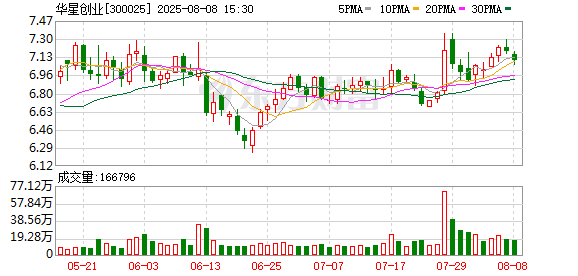
华星创业:公司目前主要是为民用网络提供技术服务
Zheng Quan Ri Bao· 2025-08-08 15:41
Group 1 - The company, Huaxing Chuangye, is focused on the mobile communication industry, providing network optimization services to telecom operators and major equipment manufacturers [2] - Currently, the company primarily offers technical services for civilian networks [2]