
高分子材料

Search documents
春季攻势聚焦三大投资方向
摩尔投研精选· 2026-01-05 10:30
Group 1 - The article highlights the expectation of a continued upward trend in A-shares in January, driven by accelerated issuance of local government special bonds and improved investment data, indicating a marginal improvement in the economic fundamentals [1] - January marks the time for listed companies to disclose performance forecasts, with a significant rebound in year-on-year growth expected due to a low performance base in Q4 2024 [1] - The article notes an increase in domestic capital inflow into A-shares, supported by a positive wealth effect and a notable appreciation of the RMB, which is likely to attract foreign investment back into the market [1] Group 2 - The article discusses the growth potential of thermoplastic polyurethane (TPU) in the humanoid robotics industry, emphasizing its mechanical properties and versatility compared to general plastics and rubber [2] - TPU is identified as a core material for flexible protective layers and various durable components in robotics, with leading manufacturers exploring its applications in robot "skin" and "muscle" [2] - The consumption of TPU in China is projected to grow at an annual rate of approximately 10%, reaching 72,000 tons by 2024, driven by demand from the footwear market and increasing penetration in high-end sectors like films and electronic injection molding [3]


三个切片 透视天府新区眉山片区崛起
Si Chuan Ri Bao· 2026-01-04 07:05
Core Insights - The Tianfu New Area Meishan District has successfully attracted significant foreign investment, including six American companies for the California Smart City project, highlighting its international reputation and regional strength [1] - The district has implemented innovative mechanisms to optimize the business environment, which has led to rapid project approvals and construction, exemplified by Lenovo's relocation of its cloud computer factory [2][3] - The area has introduced policies to revitalize idle assets, such as the "tenglong huan niao" (腾笼换鸟) strategy, which has successfully relocated companies to better-suited facilities [5][6] - Environmental initiatives, including the transformation of the Chaisang River into an ecological wetland park, reflect the district's commitment to sustainable urban development [8][9] Group 1: Investment and Economic Development - The Tianfu New Area Meishan District has attracted over 37 high-quality projects with a total investment exceeding 400 billion yuan, including 19 projects with investments over 1 billion yuan [6] - The district's economic structure has shifted, with the tertiary industry increasing from 7.5% to 30%, indicating a move towards higher-value sectors [6] Group 2: Business Environment Optimization - The district has established a professional service team to support major projects, completing agreements and construction in record time, which is referred to as "Meishan Speed" [3][4] - Administrative powers have been streamlined, with 5,541 administrative items now managed at the district level, enhancing service efficiency for businesses [4] Group 3: Environmental and Urban Development - The investment in the Chaisang River project has increased from an initial 700 million yuan to 2.9 billion yuan, demonstrating a significant commitment to ecological restoration [8] - The district aims to maintain a minimum of 70% of land for agriculture and ecology, with a per capita green space of no less than 12 square meters, promoting a sustainable urban landscape [9]
2025年十大牛熊股出炉:18倍上纬新材夺魁 算力硬件概念股受题材资金追捧
Xin Lang Cai Jing· 2025-12-31 08:55
Group 1: Core Insights - The top ten stocks of 2025 have all seen price increases exceeding 500%, with the highest being a staggering 1821% for Shangwei New Materials [3][7] - The surge in stock prices is primarily driven by advancements in technology, particularly in computing power, with significant contributions from companies involved in robotics and AI [3][11] Group 2: Individual Stock Performances - Shangwei New Materials has transformed from a traditional chemical materials company to a key player in the robotics industry, benefiting from national policies supporting humanoid robot innovation, resulting in a 23.73% year-on-year revenue growth and a 49.66% increase in net profit for Q3 [7] - Tianpu Co., Ltd. ranks second with a 1662% increase, driven by the TPU theme and expectations surrounding the acquisition by Zhonghao Xinying, with a notable rise in stock price following the positive developments in domestic computing power [11] - *ST Yushun and *ST Yazhen follow with increases of 719% and 636% respectively, indicating a strong performance among ST stocks [3][6] - Shenghong Technology, with a 588% increase, has capitalized on the demand for AI-driven PCB products, reporting a 324% increase in net profit for the first three quarters [12]

科建股份北交所IPO获受理
Zheng Quan Shi Bao Wang· 2025-12-31 01:46
根据北交所公开发行并上市信息,科建高分子材料(上海)股份有限公司(科建股份)北交所IPO已获 受理。 公司主营业务为密封、粘接、阻尼、降噪等功能性材料的研发、生产和销售。 财务数据显示,2022年—2024年公司实现营业收入分别为3.59亿元、4.25亿元、4.38亿元,实现净利润 分别为4053.19万元、5926.65万元、5921.08万元。(数据宝) 公司主要财务指标 | 财务指标/时间 | 2024年 | 2023年 | 2022年 | | --- | --- | --- | --- | | 营业收入(万元) | 43810.74 | 42505.11 | 35878.96 | | 归属母公司股东的净利润(万元) | 5921.08 | 5926.65 | 4053.19 | | 扣除非经常损益后归属母公司所有者净利润(万元) | 5799.30 | 5934.62 | 3721.22 | | 基本每股收益(元) | 1.1000 | 1.1000 | 0.7700 | | 稀释每股收益(元) | 1.1000 | 1.1000 | 0.7700 | | 加权平均净资产收益率(%) | 18.94 ...
键邦股份12月30日获融资买入826.30万元,融资余额1.01亿元
Xin Lang Cai Jing· 2025-12-31 01:31
Group 1 - The core viewpoint of the news is that Jianbang Co., Ltd. experienced a decline in stock price and trading volume, with significant financing and margin trading activities indicating high market interest [1][2]. - On December 30, Jianbang Co., Ltd. saw a stock price drop of 1.22%, with a trading volume of 49.035 million yuan. The financing buy amount was 8.263 million yuan, while the financing repayment was 11.026 million yuan, resulting in a net financing buy of -2.7627 million yuan [1]. - As of December 30, the total margin trading balance for Jianbang Co., Ltd. was 101 million yuan, accounting for 6.65% of the circulating market value, which is above the 80th percentile of the past year [1]. Group 2 - As of September 30, Jianbang Co., Ltd. had 15,400 shareholders, an increase of 0.12% from the previous period, with an average of 4,042 circulating shares per person, up by 55.56% [2]. - For the period from January to September 2025, Jianbang Co., Ltd. reported operating revenue of 469 million yuan, a year-on-year decrease of 9.45%, and a net profit attributable to shareholders of 107 million yuan, down 17.71% year-on-year [2]. - Since its A-share listing, Jianbang Co., Ltd. has distributed a total of 192 million yuan in dividends [3].
大涨187%!中石化的客户和“对手”,高分子“小巨人”上市
DT新材料· 2025-12-30 16:03
Core Viewpoint - Inner Mongolia Shuangxin Environmental Protection Materials Co., Ltd. (Shuangxin Environmental) was listed on the Shenzhen Stock Exchange on December 30, with a closing price of 19.68 yuan, an increase of 187% from the issue price. The company plans to raise 1.865 billion yuan for various projects, marking the largest IPO in the chemical industry in A-shares in the past two years [1]. Fundraising Projects - The company plans to invest the raised funds in several projects, including: - Annual production of 16,000 tons of PVB resin and functional films, with an investment of 557.53 million yuan [2]. - Annual production of 60,000 tons of water-based adhesives, with an investment of 351.58 million yuan [2]. - Energy-saving and efficiency improvement projects for the PVA industry chain and calcium carbide production line, with investments of 170.50 million yuan and 120 million yuan respectively [2]. - Construction of a PVA product pilot device and a research center, with investments of 79.26 million yuan and 169.02 million yuan respectively [2]. - Total planned investment amounts to 1.877 billion yuan [2]. Industry Position - Shuangxin Environmental was established in 2009 and has built a complete industrial chain from limestone to special fibers. It is recognized as a national-level "little giant" enterprise specializing in new technologies [2]. - The company is a leading producer of polyvinyl alcohol (PVA) in China, with a production capacity of 130,000 tons per year, accounting for approximately 13% of the domestic market share [3][4]. Market Dynamics - The global PVA production capacity is approximately 1.834 million tons per year, with the Asia-Pacific region accounting for over 82% of the total. China is the largest producer, with a capacity of about 1.096 million tons [3]. - The market for PVA products is expanding, particularly in high-value applications such as PVB films and biodegradable water-soluble films, as international giants exit the market [5]. Financial Performance - The company's revenue for 2022-2024 is projected to be 5.06 billion yuan, 3.78 billion yuan, and 3.486 billion yuan respectively, with net profits of 807 million yuan, 558 million yuan, and 521 million yuan [6]. - As of the first half of 2025, the company reported revenue of 1.797 billion yuan and a net profit of 281 million yuan [6][7].

Mini LED相关企业完成IPO关键一步
Sou Hu Cai Jing· 2025-12-30 07:09
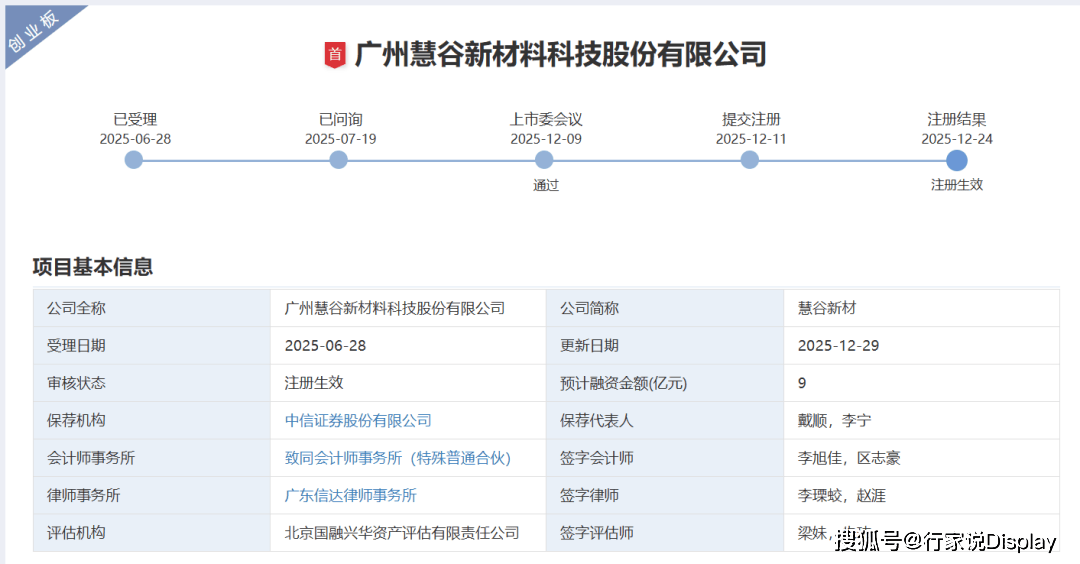
Core Viewpoint - Guangzhou Huigu New Materials Technology Co., Ltd. has successfully completed all review procedures for its IPO on the ChiNext board, with registration effective on December 24 [1][3] Group 1: IPO Process - Huigu New Materials submitted its IPO application in June and received acceptance, completing the IPO inquiry and passing the listing committee review within six months [3] - The company submitted its registration on December 11, marking the final step in the IPO process [3] Group 2: Company Overview - Huigu New Materials specializes in polymer materials, focusing on functional coating materials driven by independent research and development [3] - The company holds over 60% market share in energy-saving coating materials for heat exchangers and over 30% in metal packaging aluminum cap coating materials in the domestic market [3] - It is one of the few domestic suppliers achieving localization in fluid coating materials and Mini LED optical coating materials [3] Group 3: Future Plans - The company aims to leverage its IPO to enhance its dual technology platforms in functional resins and coating materials, solidifying its leading position in niche markets [3] - Huigu New Materials plans to accelerate market expansion in new energy and electronics sectors, promoting the localization of fluid coating materials and Mini LED optical coating products [3] Group 4: Fundraising Details - The IPO plans to publicly issue no more than 15.7791 million shares, with raised funds primarily allocated for an annual production expansion project of 130,000 tons of environmentally friendly coatings and resins, a research and development center project, and production line technology renovation projects [3]
【兴平】一份“清单”引凤来
Shan Xi Ri Bao· 2025-12-28 23:43
Core Insights - The article highlights the innovative talent recruitment mechanisms in Xingping City, focusing on the polymer materials industry and its collaboration with local universities to address talent shortages and enhance local economic development [1][3][4]. Group 1: Talent Recruitment Mechanisms - Xingping City has established a "four single docking" talent recruitment mechanism, which includes industry, project, enterprise, and livelihood components, to attract high-level talent [1]. - The city has created an "Industry Talent Demand List" to identify and address the specific needs for talent in key sectors, particularly in the polymer materials industry [1][3]. - The collaboration between enterprises and universities has been strengthened through the "academic mentor + industry mentor" dual mentorship model, facilitating better alignment of talent supply and demand [3]. Group 2: Industry Development - The polymer materials and aerospace equipment industries in Xingping City are expanding, with a total of 4,763 high-level R&D talents currently gathered in these sectors [2]. - The city has successfully introduced 2,150 management and technical talents through targeted recruitment for key projects, enhancing local talent capabilities [4]. - The establishment of the "Project Talent Demand List" has played a crucial role in attracting external talents to support significant projects, thereby fostering local talent development [4]. Group 3: Impact on Livelihood and Community - In the agricultural sector, the city has deployed 184 specialized technical talents to support 102 bases, benefiting over 370,000 local residents through enhanced agricultural practices [5]. - The initiative has also led to the cultivation of over 5,600 backup talents in various fields, contributing to community development and knowledge transfer [5].
新恒泰北交所IPO过会
Bei Jing Shang Bao· 2025-12-28 09:39
在上市委会议现场,上市委要求新恒泰结合部分客户主要订单的签署执行情况,说明相关销售收入是否 真实准确。另外,说明2024年营业收入与净利润变动趋势差异较大的原因及合理性,相关因素是否可能 影响公司持续经营能力。 北京商报讯(记者 马换换 王蔓蕾)近日,北交所官网显示,浙江新恒泰新材料股份有限公司(以下简 称"新恒泰")IPO上会获得通过。 据了解,新恒泰专注于功能性高分子发泡材料的研发、制造和销售,公司本次冲击上市拟募集资金约 3.8亿元。 上市委还要求新恒泰说明核心技术、研发能力和创新能力的具体体现;说明在研项目进展情况、预计研 发成果以及应用方向,是否符合当前行业技术迭代发展方向。 ...
慧谷新材创业板IPO注册生效
Bei Jing Shang Bao· 2025-12-28 03:41
本次冲击上市,慧谷新材拟募集资金约9亿元,扣除发行费用后将用于清远慧谷新材料技术有限公司年 产13万吨环保型涂料及树脂扩建项目、清远慧谷新材料研发中心项目、慧谷新材生产线技术改造项目、 补充流动资金。 据了解,慧谷新材是一家专注于高分子材料领域,基于自主研发驱动的平台型功能性涂层材料企业,公 司IPO于2025年6月28日获得受理,当年7月19日进入问询阶段;2025年12月9日公司上会获得通过,并 于12月11日提交注册。 北京商报讯(记者马换换王蔓蕾)近日,深交所官网显示,广州慧谷新材料科技股份有限公司(以下简 称"慧谷新材")创业板IPO注册生效。 ...
