
高技术制造业

Search documents
高技术制造业PMI连续两个月为52.0%及以上 新动能延续扩张态势
Jing Ji Ri Bao· 2026-02-01 01:30
国家统计局服务业调查中心、中国物流与采购联合会1月31日发布数据显示,2026年1月份,制造业采购 经理指数(PMI)、非制造业商务活动指数和综合PMI产出指数分别为49.3%、49.4%和49.8%,比上月下降 0.8个、0.8个和0.9个百分点,经济景气水平有所回落。 服务业运行稳定 1月份,受建筑业等行业景气度下降等因素影响,非制造业商务活动指数为49.4%,比上月下降0.8个百 分点,非制造业总体景气水平有所回落。 "但从企业感受来看,市场需求不足的问题趋于缓解。"中国物流信息中心专家文韬表示,1月份反映市 场需求不足的制造业企业比重为54.9%,较上月下降9.4个百分点,意味着当前的市场需求放缓属于正常 变化,市场需求趋稳运行态势没有改变。 新动能延续扩张态势,产业结构持续优化。1月份,高技术制造业PMI为52.0%,连续两个月位于52.0% 及以上较高水平,相关行业发展态势持续向好;装备制造业PMI为50.1%,保持在扩张区间;消费品行 业和高耗能行业PMI分别为48.3%和47.9%,景气水平有所回落。 从价格看,受近期部分大宗商品价格上涨等因素影响,主要原材料购进价格指数和出厂价格指数分别为 ...
2026年1月PMI点评:节前景气回落,结构分化加剧
Orient Securities· 2026-01-31 23:30
Economic Indicators - The Manufacturing PMI for January 2026 is at 49.3%, falling below the expansion threshold of 50.1%[7] - The Production and New Orders PMI are recorded at 50.6% and 49.2% respectively, both showing significant declines from previous levels[7] Sector Performance - High-tech manufacturing PMI stands at 52%, slightly down from 52.5%, but remains near the second-highest level since the implementation of equal tariff policies in April 2025[7] - The construction sector's activity has slowed significantly, with the PMI dropping below 40% due to adverse weather and the upcoming holiday[7] Demand Dynamics - New Orders PMI has seen a year-on-year decline, marking the second-lowest drop for this period, indicating insufficient domestic demand[7] - New Export Orders PMI decreased by 1.2 percentage points to 47.8%, influenced by prior export surges and trade policy adjustments from key partners[7] Price Trends - Major raw material purchase price index and factory price index have risen to 56.1% and 50.6% respectively, indicating a return to expansion after 20 months[7] - Prices in the non-ferrous metal sector are driving overall price increases, while sectors with weak internal demand, like wood processing, show price contraction[7] Future Outlook - The report suggests that geopolitical changes and investment demand in technology will continue to drive global capital expenditure and commodity prices, particularly in non-energy commodities[7] - The ongoing contradiction of strong supply versus weak demand in the domestic market remains a critical issue, with the ability of upstream prices to transmit to downstream still uncertain[7]
新动能延续扩张态势
Xin Lang Cai Jing· 2026-01-31 22:37
Group 1: Manufacturing Sector - In January 2026, the Manufacturing Purchasing Managers' Index (PMI) was reported at 49.3%, indicating a decrease of 0.8 percentage points from the previous month, reflecting a decline in economic sentiment [1] - The production index stood at 50.6%, indicating continued expansion in manufacturing production, while the new orders index fell to 49.2%, suggesting a decrease in market demand [2] - High-tech manufacturing PMI was at 52.0%, remaining above 52.0% for two consecutive months, indicating a positive development trend in related industries [2] - Large enterprises reported a PMI of 50.3%, indicating sustained expansion and a strong supporting role in the manufacturing sector [3] Group 2: Non-Manufacturing Sector - The Non-Manufacturing Business Activity Index was reported at 49.4%, down 0.8 percentage points from the previous month, indicating a decline in overall non-manufacturing sentiment [4] - The financial sector's business activity index rose above 65%, showing a significant increase compared to the same period last year, providing a favorable financing environment for growth [4] - The service sector's business activity expectation index rose to over 57%, indicating optimism among enterprises regarding the impact of the upcoming Spring Festival on service sector demand [4][5] Group 3: Economic Outlook - Experts suggest that the market demand issue is gradually easing, with a decrease in the proportion of manufacturing enterprises reporting insufficient demand, down 9.4 percentage points to 54.9% [2] - The manufacturing production and operational activity expectation index was at 52.6%, indicating confidence in future manufacturing activities [3] - Post-Spring Festival, it is anticipated that investment-related demand will be released, potentially boosting the construction sector's sentiment [5]
高技术制造业PMI连续两个月为52.0%及以上—— 新动能延续扩张态势
Jing Ji Ri Bao· 2026-01-31 22:09
企业预期保持乐观 "1月份,部分制造业行业进入传统淡季,加之市场有效需求仍显不足,制造业景气水平较上月下 降。"国家统计局服务业调查中心首席统计师霍丽慧说。 从供需两端看,生产指数为50.6%,高于临界点,制造业生产保持扩张;新订单指数为49.2%,市场需 求有所回落。 国家统计局服务业调查中心、中国物流与采购联合会1月31日发布数据显示,2026年1月份,制造业采购 经理指数(PMI)、非制造业商务活动指数和综合PMI产出指数分别为49.3%、49.4%和49.8%,比上月 下降0.8个、0.8个和0.9个百分点,经济景气水平有所回落。 1月份,制造业生产经营活动预期指数为52.6%,继续高于临界点。农副食品加工、食品及酒饮料精制 茶等行业生产经营活动预期指数连续两个月位于56.0%以上较高景气区间,相关企业对近期行业发展信 心较强。 文韬认为,1月份,受季节性因素和外部因素影响,制造业运行有所波动,但市场需求有趋稳迹象,生 产活动保持扩张,市场价格联动上升,产业结构继续优化,制造业后市回稳运行具备基础。预计2月 份,受春节假期影响,制造业运行或继续有所放缓。随着春节过后经济社会回归正常运行,制造业将继 续 ...
2025年南京GDP近2万亿元,同比增长5.2%
Xin Lang Cai Jing· 2026-01-31 16:27
1月30日,记者从南京市统计局获悉,根据地区生产总值统一核算结果,2025年全市地区生产总值 19428.78 亿元,按不变价格计算,同比增长5.2%。分产业看,第一产业增加值338.50 亿元,同比增长 3.4%;第二产业增加值5873.07 亿元,增长3.7%;第三产业增加值13217.21 亿元,增长6.0%。 农业生产形势稳定粮食产量实现增长 2025年,全市农林牧渔业增加值可比增长3.8%。粮食产量稳步增长。全年粮食播种面积214.70万亩,增 长0.6%;总产量100.78万吨,增长0.5%。畜牧业产能提升。全年生猪出栏37.39万头,增长5.0%;家禽 出栏1741.20万只,增长10.1%。 2025年,全市社会消费品零售总额8135.85亿元,同比增长3.5%。促消费政策带动明显。限额以上单位 家用电器和音像器材类商品零售额增长9.8%,其中智能家用电器和音像器材增长78.2%;汽车类商品零 售额增长3.4%,高于全国平均水平4.9个百分点,其中新能源汽车增长33.1%。网上零售蓬勃发展。限额 以上单位实物商品网上零售额增长17.7%,占限上社零比重达31.1%,占比较上年提升3.9个百分点 ...
数据点评 | 1月PMI:春节效应前置(申万宏观·赵伟团队)
Xin Lang Cai Jing· 2026-01-31 16:26
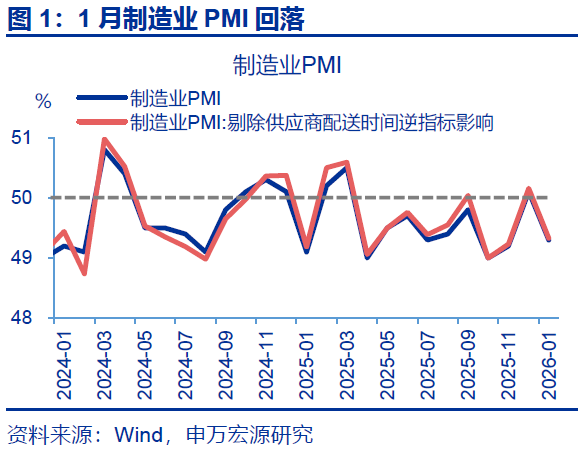
Core Viewpoint - The significant decline in January PMI is attributed to the early return of workers for the Spring Festival and weak domestic demand, with manufacturing PMI dropping to 49.3% from 50.1% and non-manufacturing PMI falling to 49.4% from 50.2% [1][6][7] Group 1: Manufacturing PMI Analysis - The manufacturing PMI fell below the growth threshold, decreasing by 0.8 percentage points to 49.3%, influenced by statistical factors and the early return of workers for the Spring Festival [1][7] - The production index decreased by 1.1 percentage points to 50.6%, while the new orders index fell by 1.6 percentage points to 49.2%, indicating a decline in manufacturing activity [4][38] - The purchasing index dropped significantly by 2.4 percentage points to 48.7%, reflecting a weaker supply side due to the early return of workers [2][16] Group 2: Sector-Specific Insights - Labor-intensive sectors such as consumer goods and high-energy industries experienced a more pronounced decline in PMI, with consumer goods PMI down 2.1 percentage points to 48.3% and high-energy PMI down 1 percentage point to 47.9% [2][22] - In contrast, capital-intensive sectors like high-tech and equipment manufacturing saw smaller declines, with PMIs of 52% and 50.1%, respectively, remaining above the growth threshold [2][22] Group 3: Non-Manufacturing PMI Insights - The non-manufacturing PMI also showed a decline, dropping by 0.8 percentage points to 49.4%, primarily due to a significant decrease in the construction sector, which fell by 4 percentage points to 48.8% [4][43] - The service sector PMI remained relatively resilient, only decreasing by 0.2 percentage points to 49.5%, with certain areas like railway transport showing strong performance [3][25] Group 4: Economic Outlook - The early Spring Festival may distort PMI readings for January and February, but the overall economic recovery trend is expected to continue, supported by consumer demand and service sector policies [3][32] - Despite short-term weaknesses in manufacturing and construction, the average PMI over the next two months is anticipated to reflect ongoing economic recovery [3][32]

数据点评 | 1月PMI:春节效应前置(申万宏观·赵伟团队)
赵伟宏观探索· 2026-01-31 16:03
Core Viewpoint - The significant decline in January PMI is primarily attributed to the early return of workers for the 2026 Spring Festival and weak domestic demand, with manufacturing PMI dropping to 49.3% from 50.1% and non-manufacturing PMI falling to 49.4% from 50.2% [2][8][61] Group 1: Manufacturing PMI Analysis - The manufacturing PMI fell below the neutral line, decreasing by 0.8 percentage points to 49.3%, influenced by statistical factors and the early return of workers [2][8][61] - The manufacturing production index declined by 1.1 percentage points to 50.6%, while the new orders index decreased by 1.6 percentage points to 49.2% [5][41] - The purchasing index for manufacturing dropped significantly by 2.4 percentage points to 48.7%, indicating a notable contraction in supply [3][15][62] Group 2: Sector-Specific Insights - Labor-intensive sectors such as consumer goods and high-energy industries experienced a more pronounced decline in PMI, with consumer goods PMI falling by 2.1 percentage points to 48.3% and high-energy PMI down by 1 percentage point to 47.9% [3][22][62] - In contrast, capital-intensive sectors like high-tech and equipment manufacturing saw smaller declines, with PMIs of 52% and 50.1%, respectively [3][22][62] Group 3: Non-Manufacturing PMI Insights - The non-manufacturing PMI showed asymmetric characteristics, with the construction PMI dropping to 48.8%, a decline of 4 percentage points, while the service sector PMI only slightly decreased by 0.2 percentage points to 49.5% [4][25][62] - The construction sector's decline is more significant than historical averages, indicating a substantial impact from the early return of workers [4][25][62] Group 4: Economic Outlook - The early Spring Festival may disrupt PMI readings for January and February, but the overall economic outlook remains positive, with expectations of recovery in the coming months [4][34][63] - Recent trends in service consumption and travel during the Spring Festival are expected to support service sector growth, highlighting the importance of monitoring consumer demand [4][34][63]
1月制造业PMI为49.3%:高技术制造业持续领跑
Zhong Guo Jing Ying Bao· 2026-01-31 15:34
2026年1月31日,国家统计局服务业调查中心和中国物流与采购联合会发布数据显示,1月份制造业采购 经理指数(PMI)为49.3%,比上月下降0.8个百分点,制造业景气水平有所回落。 展望未来,付一夫认为,制造业PMI走势无须过度担忧:短期看,春节后企业集中复工复产,叠加逆周 期调节政策有望加码,2月PMI大概率稳中有升;中期看,政策对制造业的支持力度持续,高技术与装 备制造业的扩张韧性将带动整体复苏,全年PMI预计稳定在荣枯线上方,呈现短期修复、中期稳升态 势。 苏商银行特约研究员付一夫在接受《中国经营报》记者采访时分析称:"1月制造业PMI有所回落,主要 源于季节性扰动与需求不足叠加的短期现象。春节临近导致企业提前停工、生产节奏放缓,叠加建筑业 淡季间接拖累需求,构成季节性主导因素;而内外需偏弱则是核心基本面制约。" 东方金诚统计数据显示,剔除2023年极端值后,过去十年中,1月制造业PMI指数呈现"八降二升",平 均下行0.3个百分点。国家统计局服务业调查中心首席统计师霍丽慧解读称,1月份部分制造业行业进入 传统淡季,加之市场有效需求仍显不足,制造业景气水平较上月有所下降。 中国企业资本联盟副理事长柏文 ...
数据点评 | 1月PMI:春节效应前置(申万宏观·赵伟团队)
申万宏源宏观· 2026-01-31 14:49
Core Viewpoint - The significant decline in January PMI is primarily attributed to the early return of workers for the 2026 Spring Festival and weak domestic demand, with manufacturing PMI dropping to 49.3% from 50.1% and non-manufacturing PMI falling to 49.4% from 50.2% [2][7][61] Group 1: Manufacturing PMI Analysis - The manufacturing PMI fell below the neutral line, decreasing by 0.8 percentage points to 49.3%, influenced by statistical factors and the early return of workers [2][8][61] - The manufacturing production index declined by 1.1 percentage points to 50.6%, while the new orders index decreased by 1.6 percentage points to 49.2% [5][41][64] - The purchasing index for manufacturing dropped significantly by 2.4 percentage points to 48.7%, indicating a notable contraction in supply [3][15][62] Group 2: Sector-Specific Insights - Labor-intensive sectors such as consumer goods and high-energy industries experienced a more pronounced decline in PMI, with consumer goods PMI falling by 2.1 percentage points to 48.3% and high-energy PMI down by 1 percentage point to 47.9% [3][22][62] - In contrast, capital-intensive sectors like high-tech and equipment manufacturing saw smaller declines, with PMIs of 52% and 50.1%, respectively [3][22][62] Group 3: Non-Manufacturing PMI Insights - The non-manufacturing sector showed asymmetric effects from the early return of workers, with the construction PMI dropping to 48.8%, a decline of 4 percentage points, while the service sector PMI only slightly decreased by 0.2 percentage points to 49.5% [4][25][62] - The construction sector's decline is more significant than the average historical drop of 1.4 percentage points for January since 2017 [4][25][62] Group 4: Economic Outlook - The early Spring Festival may disrupt PMI readings for January and February, but the overall economic recovery trend is expected to continue, supported by travel and consumption during the holiday [4][34][63] - Recent policies aimed at boosting service consumption are anticipated to support the service sector's recovery, with a focus on changes in consumer demand [4][34][63]
黑龙江:今年将发放政府消费券8亿元以上
Jin Rong Jie· 2026-01-31 14:13
今日开幕的黑龙江省第十四届人民代表大会第四次会议上,扩内需、促消费再次成为政府工作报告里的 重点工作,2026年,黑龙江省将举办"购在龙江"等促消费活动超2000场,发放政府消费券8亿元以上。 2025年,黑龙江省开展提振消费专项行动,扩围实施消费品以旧换新,组织系列促消费活动,拉动消费 728.4亿元。激发 首发经济、直播电商等有潜能消费,新设国际国内知名 首店15家,网上零售额同比增 长14.7%。投资结构持续优化,高技术制造业投资同比增长11.5%,民间投资占比提高2.2个百分点。 ...