
电信

Search documents
“924”一周年:高喊“买入一切中国资产”的David Tepper说对了
Hua Er Jie Jian Wen· 2025-09-25 03:14
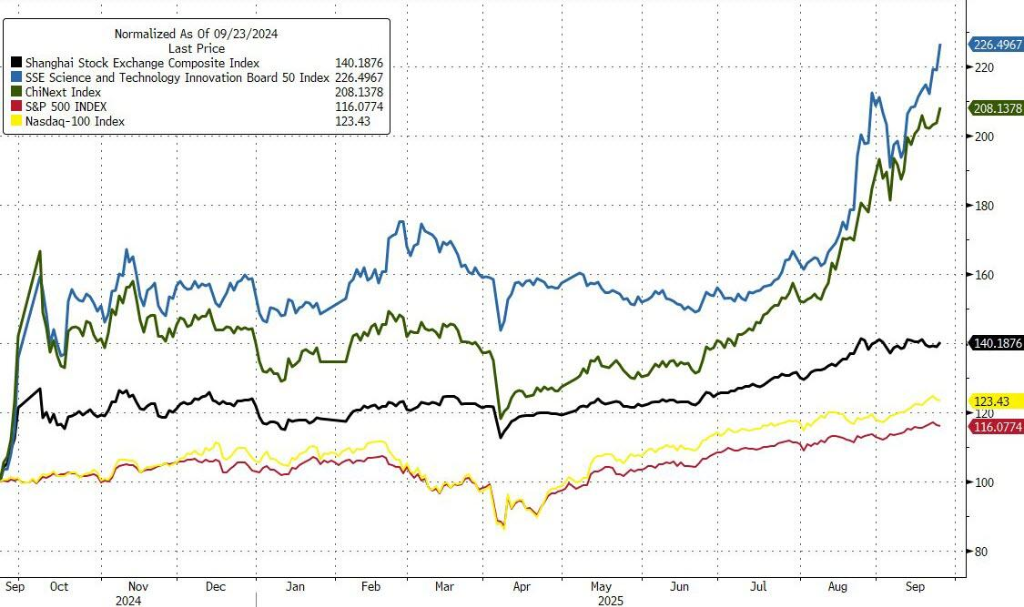
Core Viewpoint - The financial policies introduced by Chinese regulatory authorities on September 24 last year have led to a significant recovery in the Chinese stock market, resulting in a strong bull market that has outperformed major global markets [1][2]. Market Performance - The total market capitalization of A-shares has increased from approximately 70 trillion yuan to over 100 trillion yuan, marking a 45% growth [2]. - The Shanghai Composite Index surged from around 2700 points to 3900 points, while the STAR Market and ChiNext indices recorded remarkable gains of 115% and 110% respectively [1][2]. Stock Performance - Over 3000 A-share stocks have risen by more than 50%, with nearly 1500 stocks doubling in price during this period [3]. - Technology stocks have led the market rally, with telecommunications, electronics, and computer sectors showing the highest gains [5]. Sector Highlights - Alibaba's stock rose nearly 10% in a single day, with a month-to-date increase of 50%, reaching a four-year high [5]. - Regulatory measures in the internet sector have positively impacted stocks like Meituan and JD.com, which saw increases of 1.2% and 3.3% respectively [5]. - The semiconductor sector also performed well, with a 4.6% rise in the index due to positive earnings outlooks from Micron Technology and Huawei's optimistic three-year vision [5]. Future Outlook - Goldman Sachs suggests that the current market conditions for A-shares are more favorable for a "slow bull" market than ever before, with high trading activity and a long duration of market engagement [6]. - There is significant potential for market inflows, as retail investors have not yet overly invested in stocks, with only 11% of household assets allocated to equities compared to 55% in real estate [6]. - Approximately 80 trillion yuan in household savings has accumulated since 2020, with a large portion facing reallocation needs [6]. - Institutional investors have low exposure to A-shares, with potential inflows estimated between 20 to 40 trillion yuan [7].

史诗级暴涨!这个国家,“沸腾了”
Zhong Guo Ji Jin Bao· 2025-09-24 12:04
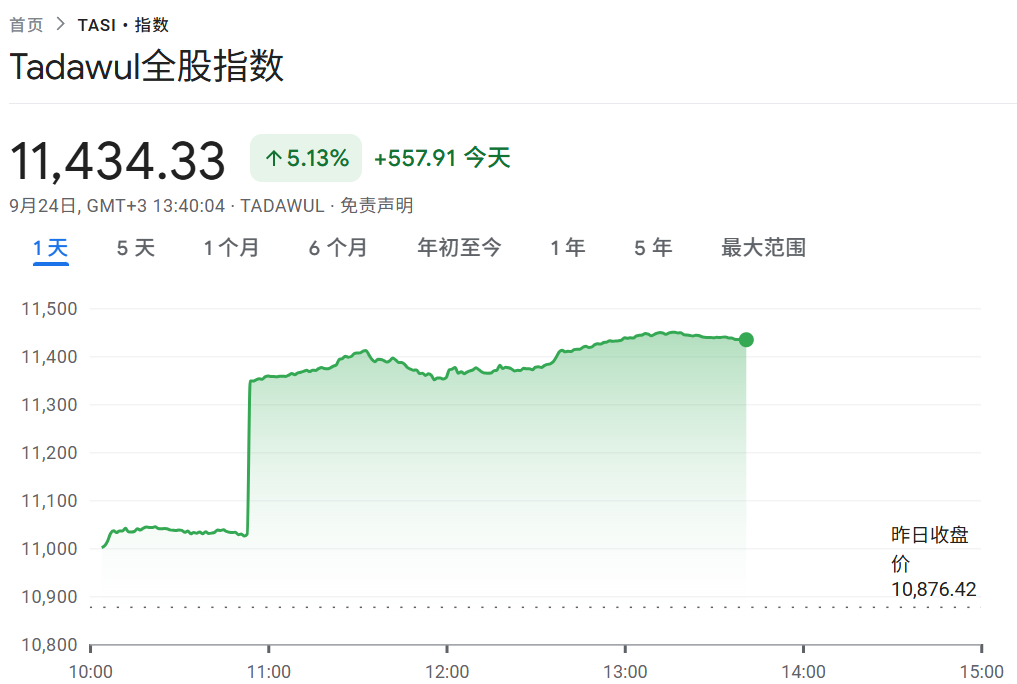
Core Viewpoint - Saudi stock market experienced a significant surge of approximately 5% on September 24, with a total market capitalization increase of $123 billion, driven by the announcement of easing foreign ownership restrictions [1][4]. Group 1: Market Reaction - The Saudi Capital Market Authority (CMA) announced plans to relax foreign ownership limits, potentially allowing foreign investors to hold more than 49% in listed companies, which is expected to attract billions in foreign investment [4][6]. - All sectors in the Saudi market saw gains, with banking stocks reaching record highs, particularly a 9% increase in Saudi bank shares [4]. Group 2: Investment Projections - JPMorgan estimates that if the CMA raises the foreign ownership limit to 100%, it could lead to an influx of $10.6 billion in foreign capital [6]. - Al Rajhi Bank's stock surged by 10%, with projections indicating it could attract $5 to $6 billion from foreign investors, making it one of the biggest beneficiaries of the potential policy change [6]. Group 3: Implications for Market Weighting - The easing of foreign ownership restrictions is expected to enhance the weight of Saudi stocks in the MSCI index, potentially increasing from approximately 3.3% to around 4% in the MSCI Emerging Markets Index [11]. - Companies with the highest foreign ownership in Saudi Arabia include Tawuniya, Rasan, and Etihad Etisalat (Mobily), with foreign ownership percentages ranging from 20% to 25% [11].
德银:“资本开支牛市”的宿命--运河、铁路和电信技术革命中的股市沉浮
美股IPO· 2025-09-24 10:53
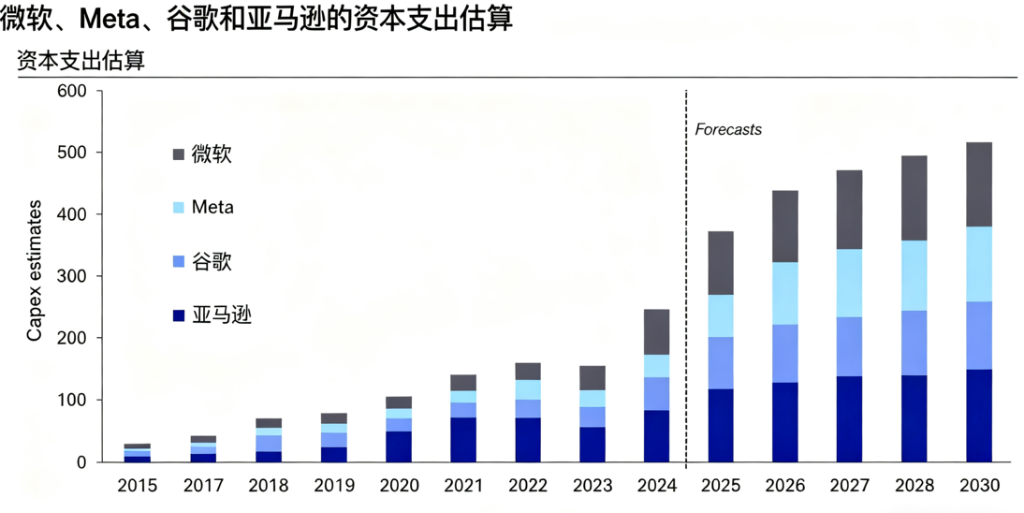
Core Viewpoint - The report highlights a significant AI capital expenditure race among major tech giants like Microsoft, Meta, Google, and Amazon, warning that such technology-driven capital spending booms often lead to "boom-bust" cycles, resulting in stock market bubbles and substantial investor losses [1][6]. Group 1: Capital Expenditure Trends - Since 2015, capital expenditures by the "Big Four" tech companies have been on a continuous rise, with an explosive growth expected to exceed $200 billion in 2024 and approach $400 billion in 2025 [2]. - This growth trend is projected to continue at least until 2030, with total annual capital expenditures potentially surpassing $500 billion by that year [3]. Group 2: Historical Context and Lessons - The report draws parallels with historical capital expenditure bubbles, specifically the "Canal Mania" of the late 18th century and the "Railway Mania" of the 19th century, both of which saw significant stock price surges followed by rapid collapses [7][8]. - It emphasizes that while canals and railways permanently altered economic landscapes, investors who bought at the peak suffered substantial financial losses, illustrating the disconnect between technological advancement and investor returns [11]. Group 3: Recent Warnings from the Telecom Bubble - The 2000 telecom bubble serves as a more recent cautionary tale, where despite the widespread adoption of telecom technology, stock prices in the sector have not returned to their peak levels from that era, highlighting the disparity between technology success and early investor returns [14]. Group 4: Current Market Dynamics - The report notes that the current AI-driven market has reached extreme valuation levels, with the CAPE ratio nearing historical highs, suggesting potential negative returns in the following decade [17]. - Additionally, market concentration is a significant concern, as the top five companies in the S&P 500 now account for nearly 30% of the index, indicating a heavy reliance on a few firms for overall market performance [19]. Group 5: Investor Caution - The historical analysis serves as a wake-up call for investors, urging caution regarding the potential detachment of capital expenditure-driven stock price surges from fundamental values, as the end of such fervor often leads to harsh corrections [20].




刚刚,重大救市!19万亿,狂飙!
券商中国· 2025-09-24 10:33
Group 1 - Saudi stock market experienced a sudden surge, with the overall index rising by 5% and bank stocks increasing by over 9% [1][2] - The total market capitalization of Saudi listed companies is approximately 19 trillion RMB [1] - The Saudi Capital Market Authority plans to relax the foreign ownership limit of 49% in local companies, potentially allowing foreign investors to hold majority stakes [4][5] Group 2 - The relaxation of foreign ownership limits is expected to increase Saudi's weight in the MSCI Emerging Markets Index, attracting more capital into the market [4][5] - Currently, Saudi's main board companies have a market value of $2.3 trillion, accounting for 3.3% of the MSCI index [5] - The Saudi stock market has seen a decline of 9.6% this year, making it the worst performer in the region, while the MSCI Emerging Markets Index has risen by 25% [5] Group 3 - Saudi's non-oil exports grew by 17.8% in Q2 2025, offsetting weak oil sales, with oil exports down by 15.8% [7] - Non-oil revenue reached 1,498.61 billion Riyals in Q2, accounting for nearly half of the government's total revenue [8] - The growth in non-oil revenue is primarily driven by tax increases, with VAT revenue at 749.50 billion Riyals [8]

“资本开支牛市”的宿命--运河、铁路和电信技术革命中的股市沉浮
Hua Er Jie Jian Wen· 2025-09-24 07:54
Core Insights - The report from Deutsche Bank highlights a significant capital expenditure race among major tech giants like Microsoft, Meta, Google, and Amazon, driven by the AI revolution, which poses high risks and potential high returns [1][6] - Historical patterns of capital expenditure booms, such as those seen in the canal, railway, and telecom revolutions, often lead to boom-bust cycles, resulting in substantial losses for investors [1][10] Group 1: Capital Expenditure Trends - The capital expenditures of the "Big Four" tech companies have been on a continuous rise since 2015, with an explosive growth expected to exceed $200 billion in 2024 and approach $400 billion in 2025 [2] - This growth trend is projected to continue at least until 2030, with total annual capital expenditures potentially surpassing $500 billion by that year [3] Group 2: Historical Context and Lessons - The report reviews historical capital expenditure bubbles, specifically the "Canal Mania" of the late 18th century and the "Railway Mania" of the 19th century, both of which saw rapid stock price increases followed by significant crashes [7][10] - The telecom bubble of 2000 serves as a more recent cautionary tale, where despite the widespread adoption of mobile technology, stock prices in the telecom sector have not recovered to their peak levels from that era [11][14] Group 3: Market Dynamics and Valuation Concerns - The current AI-driven market has pushed valuations to historical extremes, with the CAPE ratio nearing levels seen during the 2000 tech bubble, suggesting potential negative returns in the following decade [18] - Market concentration is another concern, as the top five companies in the S&P 500 now account for nearly 30% of the index, indicating a heavy reliance on a few firms for overall market performance [20][22]

金价再度走高;今日一只新股申购……盘前重要消息还有这些
Zheng Quan Shi Bao· 2025-09-24 05:39
New Stock Offerings - Changjiang Nengke has a subscription code of 920158, with an issue price of 5.33 yuan per share and a subscription limit of 1.425 million shares [1] Electricity Consumption Data - In August, the total electricity consumption reached 10,154 billion kWh, a year-on-year increase of 5.0%. The first industry consumed 164 billion kWh (up 9.7%), the second industry 5,981 billion kWh (up 5.0%), the third industry 2,046 billion kWh (up 7.2%), and urban and rural residents consumed 1,963 billion kWh (up 2.4%) [2] - From January to August, total electricity consumption accumulated to 68,788 billion kWh, a year-on-year increase of 4.6%, with industrial power generation at 64,193 billion kWh [2] Telecommunications Industry - As of the end of August, the total number of fixed internet broadband access users reached 689 million, with a net increase of 18.85 million users since the end of last year. Users with access speeds of 100 Mbps and above reached 655 million, accounting for 95.2% of total users [3] - Users with access speeds of 1,000 Mbps and above reached 233 million, with a net increase of 26.64 million users, representing 33.9% of total users, an increase of 3 percentage points compared to the end of last year [3] Regulatory Actions - The State Administration for Market Regulation has urged Huo Lala to comply with antitrust laws and ensure fair market competition [4] - The National Internet Information Office has taken measures against the Toutiao platform for failing to manage content responsibly, including warnings and demands for corrections [4] - Similar actions were taken against the UC platform for presenting sensitive content, with penalties and demands for compliance [4] Economic Outlook - The OECD has projected a global economic growth rate of 3.2% for 2025, an increase of 0.3 percentage points from the previous forecast, while growth is expected to slow to 2.9% in 2026 [4] Gold Prices - On September 23, gold prices rose significantly, with London gold exceeding $3,790 per ounce and COMEX gold surpassing $3,820 per ounce, both reaching historical highs [4] Company News - Tianpu Co. has announced another suspension of trading for stock verification due to a 15 consecutive trading limit increase [5] - Haili Co. has denied rumors regarding shell mergers and asset injections [6] - Guiguan Network has refuted rumors about significant collaborations with Huawei Cloud [6] - Huakai Yibai's chairman's spouse plans to increase shareholding by no less than 20 million yuan [6] - Kanta Medical has received CE certification for its color Doppler ultrasound diagnostic system [6] - Pinggao Electric has won a bid for a project worth approximately 1.369 billion yuan from the State Grid [6] Industry Insights - Zhongyuan Securities maintains a "stronger than market" investment rating for the automotive industry, highlighting the government's growth stabilization plan and its potential impact on the market [7] - Minsheng Securities notes that the year marks the beginning of a significant opportunity for Chinese internet giants in the overseas cloud computing market, driven by demand for AI applications [8]
金价再度走高;今日一只新股申购……盘前重要消息还有这些
证券时报· 2025-09-23 23:43
Key Points - The article discusses various economic indicators and regulatory actions impacting different industries, highlighting potential investment opportunities and market trends. Group 1: Economic Data - In August, the total electricity consumption in China reached 10,154 billion kWh, a year-on-year increase of 5.0% [3] - For the first eight months of the year, total electricity consumption accumulated to 68,788 billion kWh, growing by 4.6% year-on-year [3] - The fixed broadband internet access user base reached 689 million by the end of August, with a net increase of 18.85 million users compared to the end of the previous year [4] - The number of users with internet access speeds of 1,000 Mbps or higher reached 233 million, representing 33.9% of total users, an increase of 3 percentage points from the previous year [4] Group 2: Regulatory Actions - The State Administration for Market Regulation has urged Huo La La to comply with antitrust laws and ensure fair market competition [4] - The National Internet Information Office has taken measures against platforms like Toutiao and UC for failing to manage harmful content, including warnings and demands for corrections [5][6] - A new regulatory framework for live e-commerce is being drafted to enhance supervision and protect consumer rights [5] Group 3: Market Trends - The OECD has revised its global economic growth forecast for 2025 to 3.2%, an increase of 0.3 percentage points from previous estimates [8] - Gold prices have surged, with London gold reaching over $3,790 per ounce, marking a historical high [6] - The automotive industry is expected to benefit from a new growth plan aimed at stabilizing the market, with a focus on trade-in policies and technological advancements [9]

前8个月通信业呈现平稳运行态势 电信业务量收保持增长
Guo Ji Jin Rong Bao· 2025-09-23 09:10
Core Viewpoint - The telecommunications industry has shown stable performance in the first eight months, with steady growth in telecom business volume and orderly progress in new infrastructure construction, particularly in 5G, gigabit, and IoT user scale expansion [1] Group 1: Telecom Business Performance - As of the end of August, the total number of fixed internet broadband access users among the three major telecom companies reached 689 million, with a net increase of 18.85 million users compared to the end of the previous year [1] - Users with fixed internet broadband access speeds of 100 Mbps and above reached 655 million, accounting for 95.2% of total users; those with speeds of 1000 Mbps and above reached 233 million, with a net increase of 26.64 million users, representing 33.9% of total users, an increase of 3 percentage points compared to the end of the previous year [1] Group 2: Mobile User Growth - The total number of mobile phone users among the three major telecom companies and China Broadcasting reached 1.819 billion, with a net increase of 29.53 million users compared to the end of the previous year [1] - The number of 5G mobile phone users reached 1.154 billion, with a net increase of 14 million users, accounting for 63.4% of mobile phone users [1] Group 3: IoT and IPTV Growth - The number of mobile IoT terminal users grew rapidly, reaching 2.872 billion, with a net increase of 21.6 million users compared to the end of the previous year [1] - The number of internet television (IPTV, OTT) users reached 412 million, with a net increase of 4.246 million users compared to the end of the previous year [1]
工信部:前8月电信收入累计完成11821亿元 同比增长0.8%
智通财经网· 2025-09-23 02:31
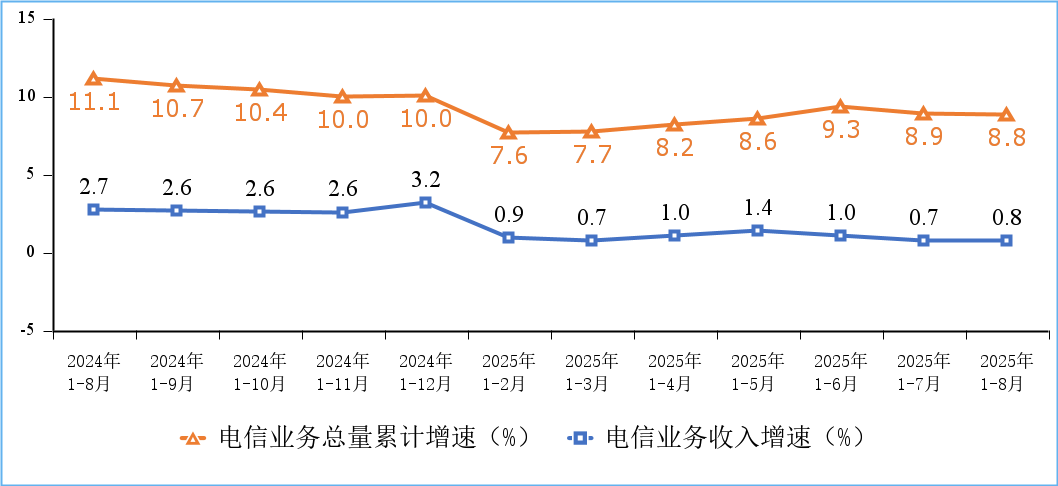
Core Viewpoint - The telecommunications industry in China has shown stable operational performance in the first eight months of 2025, with steady growth in telecom business volume and ongoing advancements in new infrastructure, particularly in 5G, gigabit, and IoT user scales [1][3]. Overall Operational Situation - Telecom business revenue reached 1.1821 trillion yuan, reflecting a year-on-year growth of 0.8%. When adjusted for last year's prices, the total telecom business volume grew by 8.8% [4]. Telecom User Development - The number of fixed broadband access users increased steadily, with gigabit users rising. By the end of August, the total number of fixed internet broadband access users reached 689 million, a net increase of 18.85 million from the end of last year. Users with access speeds of 100 Mbps and above totaled 655 million, accounting for 95.2% of total users, while those with speeds of 1000 Mbps and above reached 233 million, a net increase of 26.64 million, representing 33.9% of total users, up 3 percentage points from last year [5]. - Mobile phone users also saw stable growth, with 5G user numbers expanding. By the end of August, the total number of mobile phone users reached 1.819 billion, a net increase of 29.53 million. Among them, 5G mobile phone users reached 1.154 billion, a net increase of 14 million, making up 63.4% of mobile phone users [5]. Telecom Business Usage - Mobile internet traffic continued to grow rapidly, with cumulative traffic reaching 2.534 trillion GB, a year-on-year increase of 16.4%. By the end of August, the number of mobile internet users reached 1.601 billion, a net increase of 31.32 million. The average mobile internet access traffic (DOU) per user in August was 20.87 GB per month, up 14.3% year-on-year [9]. - Mobile phone call duration decreased, while mobile SMS volume grew rapidly. The total duration of outgoing mobile calls was 14 trillion minutes, down 5.4% year-on-year, while SMS volume increased by 21.9% [9]. Communication Capability Situation - The construction of gigabit fiber broadband networks progressed steadily. By the end of August, the total number of internet broadband access ports reached 1.239 billion, a net increase of 37.1 million. Among them, fiber access ports reached 1.198 billion, accounting for 96.7% of total broadband access ports [10]. - The number of 5G base stations reached 4.646 million, a net increase of 395,000, accounting for 36.3% of total mobile base stations, an increase of 0.3 percentage points from the previous seven months [10]. Regional Development Situation - The penetration rates of gigabit and 5G users continued to rise across regions. By the end of August, the penetration rates for fixed broadband access users with speeds of 1000 Mbps and above were 33.9% in the East, 33.5% in the Central, 35.7% in the West, and 27.1% in the Northeast, all showing increases from last year [11]. - Mobile internet access traffic growth remained in double digits across regions, with the East, Central, West, and Northeast regions reaching 1.063 trillion GB, 595.2 billion GB, 724.7 billion GB, and 150.5 billion GB respectively, with year-on-year growth rates of 16.4%, 16.2%, 15%, and 25.2% [11].
工信部:固定宽带接入用户规模稳步扩大,千兆用户数持续增加
Zheng Quan Shi Bao Wang· 2025-09-23 02:25
人民财讯9月23日电,工信部发布2025年前8个月通信业经济运行情况,固定宽带接入用户规模稳步扩 大,千兆用户数持续增加。截至8月末,三家基础电信企业的固定互联网宽带接入用户总数达6.89亿 户,比上年末净增1885万户。其中,100Mbps及以上接入速率的固定互联网宽带接入用户达6.55亿户, 占总用户数的95.2%;1000Mbps及以上接入速率的固定互联网宽带接入用户达2.33亿户,比上年末净增 2664万户,占总用户数的33.9%,占比较上年末提升3个百分点。 ...