显示面板

Search documents
群智咨询:2025年上半年全球车载显示面板出货约1.2亿片 同比增长5.6%
Zhi Tong Cai Jing· 2025-09-23 10:00
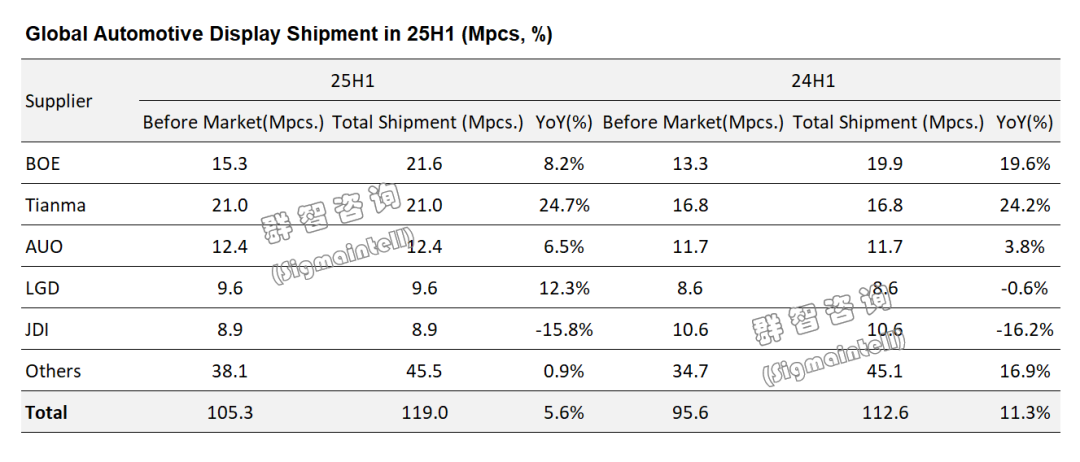
Core Insights - The global automotive display panel shipment is projected to reach approximately 120 million units in the first half of 2025, reflecting a year-on-year growth of 5.6%, with the front-mounted market contributing significantly at 88.5% [1] - The automotive industry is experiencing a slowdown in overall sales growth, which is limiting the substantial increase in demand for automotive display panels, yet the demand for diversified and high-end displays in smart cockpits continues to drive market stability [1][6] - The competitive landscape in the automotive display panel market remains intense, characterized by a concentration of leading players and clear tier distinctions, with BOE and Tianma leading the first tier [1][2] Company Summaries - **BOE**: As a leading player in the display industry, BOE's shipments reached approximately 21.6 million units in the first half of 2025, marking an 8.2% increase year-on-year, capturing 18.1% of the global market share. The company is actively expanding its product matrix across various display technologies [1][4] - **Tianma**: With a focus on automotive display business, Tianma's shipments totaled around 21 million units, reflecting a significant year-on-year growth of 24.7%. The company has established a strong foothold in the mid-sized display market and is expanding into new applications [2][4] - **AUO**: After acquiring BHTC, AUO is transitioning from a single panel supplier to a comprehensive cockpit display solution provider. In the first half of 2025, AUO's shipments reached 12.4 million units, with a year-on-year growth of 6.5% [3][4] - **LG Display**: LG Display shipped approximately 9.7 million units in the first half of 2025, leveraging its expertise in LTPS LCD and OLED technologies to maintain a presence in the high-end automotive display market [3][4] - **Japan Display (JDI)**: JDI faced significant challenges, with shipments declining to 8.9 million units in the first half of 2025, impacted by financial difficulties and intense market competition [3][4] Market Outlook - The automotive display panel market is expected to experience a "short-term demand pulse growth" alongside "long-term development uncertainties." The overall shipment for 2025 is projected to grow by 4.0%, reaching 240 million units [6] - In 2026, the automotive market is likely to face constraints from policies, consumer behavior, and supply chain issues, leading to a slowdown in growth and structural optimization [6] - Manufacturers are advised to be cautious of "passive capacity expansion" risks, as blind expansion to meet short-term demands could lead to inventory buildup and price wars [6]



面板价格观察 | 9月电视面板价格持平,笔电面板需求第三季预估将季增5.1%
TrendForce集邦· 2025-09-23 09:04
Core Viewpoint - The panel prices for televisions, monitors, and laptops are expected to remain stable in September 2025, with no significant changes observed in the market dynamics [5][7][9]. Group 1: Television Panel Prices - Television panel prices for various sizes, including 65" and 55", have remained unchanged at $173 and $124 respectively, indicating a stable pricing environment [4]. - The overall demand for television panels has strengthened due to brand clients preparing for year-end promotions and increased stocking by agents [5][7]. Group 2: Monitor Panel Prices - Monitor panel demand has shown slight signs of slowing down, primarily due to some manufacturers reducing production of mainstream sizes that are currently unprofitable [8]. - Despite a tight supply situation for FHD mainstream sizes, brand clients are unwilling to compromise on prices, leading to a consensus on maintaining price stability [8]. Group 3: Laptop Panel Prices - Laptop panel demand remains strong, with an expected quarter-on-quarter increase of 5.1% in the third quarter [9]. - Brand clients are focusing on securing panel quantities while ignoring potential tariff impacts, aiming to capture more end-user demand before year-end [9]. - Although there is a competitive environment among panel manufacturers, they are hesitant to raise prices due to anticipated demand declines in the fourth quarter [9].

不停机、不投料,今年液晶电视面板龙头企业拟国庆放假约一周
Di Yi Cai Jing· 2025-09-23 00:36
Core Viewpoint - The planned production halt by major Chinese LCD TV panel manufacturers during the National Day holiday is expected to stabilize panel prices in October, following a similar effect observed last year [1][3][4]. Group 1: Production Plans and Capacity Utilization - Major Chinese LCD TV panel manufacturers will take a holiday break of approximately 3 to 7 days for different production lines during the National Day holiday [4]. - The capacity utilization rate for LCD TV panels is projected to decrease from around 90% in September to below 80% in October due to the holiday [3][4]. - The capacity utilization rates for October 2023 and 2024 are expected to be 79% [3]. Group 2: Market Impact and Price Stability - The production halt is a strategic move to prevent a decline in panel prices due to reduced demand in the fourth quarter [4]. - The shipment volume of LCD TV panels from major Chinese manufacturers is expected to reach a peak in September, with the National Day holiday serving as a critical preparation period for the upcoming "Double 11" sales event [4]. - The global LCD TV panel prices have stabilized in August and remained flat in September, with expectations for October prices to hold steady as well [5].

和辉光电-U大宗交易成交1000.00万股 成交额2740.00万元
Zheng Quan Shi Bao Wang· 2025-09-22 13:32
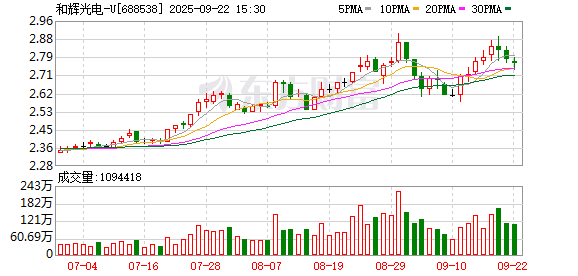
Group 1 - The core transaction on September 22 involved a block trade of 10 million shares of Hehui Optoelectronics, with a transaction value of 27.4 million yuan and a price of 2.74 yuan per share, reflecting a discount of 0.72% compared to the closing price of the day [2][3] - The buyer of the block trade was CITIC Securities Co., Ltd., while the seller was Guotai Junan Securities Co., Ltd. from the Shanghai Jing'an District [2][3] - Over the past three months, Hehui Optoelectronics has recorded a total of three block trades, amounting to a cumulative transaction value of 83 million yuan [2] Group 2 - The latest margin financing balance for Hehui Optoelectronics is 372 million yuan, with a decrease of 425,800 yuan over the past five days, representing a decline of 0.11% [3] - As of September 22, the closing price of Hehui Optoelectronics was 2.76 yuan, down 0.72%, with a daily turnover rate of 1.90% and a total transaction amount of 302 million yuan [2][3] - In the last five days, the stock has seen a cumulative decline of 0.36%, with a total net outflow of funds amounting to 98.7 million yuan [2]

2025年9月面板价格
WitsView睿智显示· 2025-09-22 09:08
Core Viewpoint - TrendForce's latest report indicates that panel prices for TVs, monitors, and laptops are expected to remain stable through September 2025, aligning with earlier forecasts [2]. Panel Price Summary TV Panels - The average price for a 65-inch TV panel is projected to be $173, with a minimum of $167 and a maximum of $176. - The average price for a 55-inch TV panel is $124, with a minimum of $118 and a maximum of $127. - The average price for a 43-inch TV panel is $64, with a minimum of $62 and a maximum of $66. - The average price for a 32-inch TV panel is $35, with a minimum of $34 and a maximum of $36 [5]. Monitor Panels - The average price for a 27-inch IPS monitor panel is $63, with a minimum of $57.6 and a maximum of $65.8. - The average price for a 23.8-inch IPS monitor panel is $49.9, with a minimum of $47.1 and a maximum of $51.4 [6]. Laptop Panels - The average price for a 17.3-inch TN laptop panel has stabilized at $38.3, with a minimum of $37.7 and a maximum of $39.8. - The average price for a 15.6-inch Value IPS laptop panel is projected to be $40.3, remaining unchanged from the previous month, with a minimum of $38.6 and a maximum of $41.9. - The average price for a 14.0-inch TN laptop panel has stabilized at $26.9, with a minimum of $26.4 and a maximum of $28.1. - The average price for an 11.6-inch TN laptop panel has stabilized at $25.1, with a minimum of $24.2 and a maximum of $26.5 [7][8].

最新面板价格趋势(2025年9月)
TrendForce集邦· 2025-09-22 09:04
Core Viewpoint - The panel prices for TVs, monitors, and laptops are expected to remain stable as of September 2025, aligning with earlier forecasts by TrendForce [2]. TV Panel Prices - The average price for a 65-inch TV panel is $173, with a minimum price of $167 and a maximum of $176 [5]. - The average price for a 55-inch TV panel is $124, with a minimum price of $118 and a maximum of $127 [7]. - The average price for a 43-inch TV panel is $64, with a minimum price of $62 and a maximum of $66 [8]. - The average price for a 32-inch TV panel is $35, with a minimum price of $34 and a maximum of $36 [8]. Monitor Panel Prices - The average price for a 27-inch IPS monitor panel is $63, with a minimum price of $57.6 and a maximum of $65.8 [10]. - The average price for a 23.8-inch IPS monitor panel is $49.9, with a minimum price of $47.1 and a maximum of $51.4 [11]. Laptop Panel Prices - The average price for a 17.3-inch TN laptop panel has remained stable at $38.3, with a minimum price of $37.7 and a maximum of $39.8 [13]. - The average price for a 15.6-inch Value IPS laptop panel is expected to be $40.3, consistent with the previous month, with a minimum price of $38.6 and a maximum of $41.9 [13]. - The average price for a 14.0-inch TN laptop panel has stabilized at $26.9, with a minimum price of $26.4 and a maximum of $28.1 [13]. - The average price for an 11.6-inch TN laptop panel has remained stable at $25.1, with a minimum price of $24.2 and a maximum of $26.5 [13].

不止三折叠,中国给高端屏立标杆|供应链隐形冠军
Tai Mei Ti A P P· 2025-09-22 07:08
Core Insights - China has transitioned from a manufacturing powerhouse to a leader in intelligent manufacturing, particularly in the display panel industry, achieving a market size of 396.2 billion yuan in 2022, accounting for 68.2% of the global market share [1][3] - Tianma Microelectronics has emerged as a significant player in the OLED market, ranking third globally in flexible OLED smartphone displays and first in LTPS smartphone display modules since 2018 [3][4] - The global AMOLED smartphone panel shipment is projected to reach approximately 420 million units in the first half of 2025, with Chinese manufacturers holding a 51.7% market share, reflecting a 1 percentage point increase year-on-year [4][9] Industry Trends - The adoption of OLED technology is accelerating across various sectors, including automotive displays, which are expected to grow from $480 million in 2023 to $2.18 billion by 2027 [9] - Tianma is focusing on enhancing the reliability and performance of OLED displays for automotive applications, indicating a shift towards more stringent standards compared to consumer electronics [9][10] Company Developments - Tianma is investing approximately 1.57 billion yuan in R&D for flexible AMOLED technologies, aiming to cover all major domestic smartphone brands with its products [10][15] - The company has developed a G-shaped foldable display with advanced SLOD technology, which reduces power consumption by 30% and extends lifespan significantly compared to single-layer displays [11][15] - Tianma's TM18 factory, the largest single-site flexible AMOLED factory in China, has seen a significant improvement in profitability, with over a 50% year-on-year increase in its flexible AMOLED mobile business [15][20] Product Innovations - Tianma has launched a new high-end OLED technology brand, "Tianma Tiangong Screen," focusing on eye protection and high refresh rates, with capabilities supporting up to 240Hz [16][19] - The "Tiangong Screen" features a peak brightness of 8000 nits and covers 95% of the BT.2020 color gamut, enhancing visual experience and detail precision [17][19] Financial Performance - In the first half of 2025, Tianma reported total revenue of 17.475 billion yuan, a year-on-year increase of 9.93%, and a net profit of 206 million yuan, marking a turnaround from previous losses [20]

深天马新一届核心管理团队正式确立 年内多家电子深企高管变动
Shen Zhen Shang Bao· 2025-09-22 07:07
Group 1: Company Updates - Tianma Microelectronics Co., Ltd. announced the appointment of Cheng Wei as the chairman of the board, with a term aligned with the current board's tenure [1] - Cheng Wei, born in 1981, joined Tianma in 2007 and has progressed through various key roles in technology R&D and corporate management, currently holding 7,700 shares in the company [1] - The company focuses on customized display solutions, with core businesses in mobile displays and automotive displays, and rapid growth in IT displays [1] Group 2: Management Changes in the Industry - China Electronics has appointed Li Ligong as the party secretary and chairman, with the company being a significant state-owned enterprise in the information technology sector [2] - China Electronics employs 189,000 staff and has total assets of 433.6 billion, with operations in over 60 countries and regions [2] - Konka Group has undergone management restructuring, with a significant number of board members and executives having backgrounds in China Resources, indicating a strategic shift in management [2]

手机厂商与面板巨头加深捆绑
2 1 Shi Ji Jing Ji Bao Dao· 2025-09-22 04:47
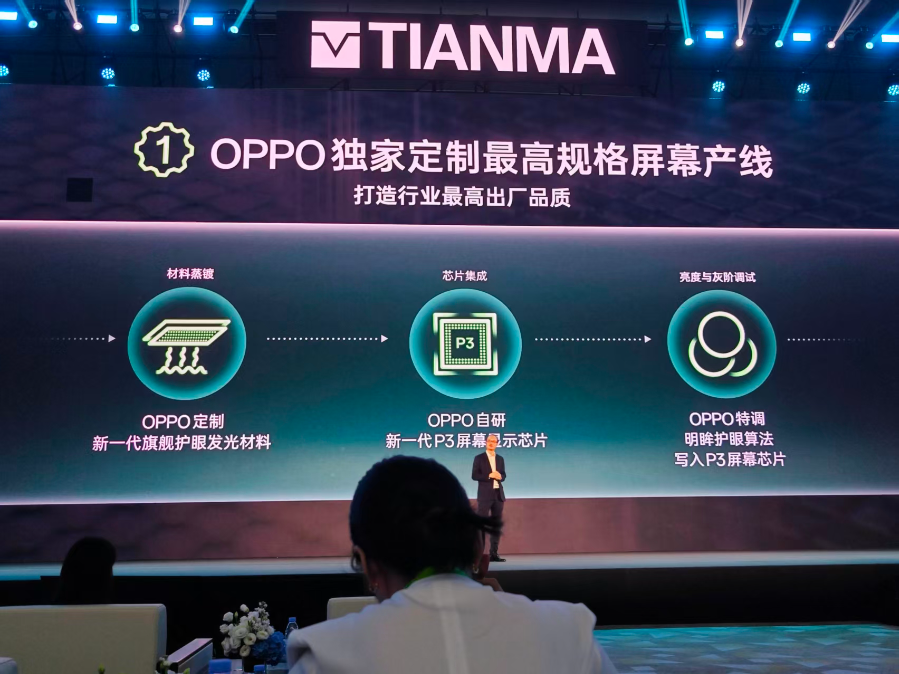
Core Viewpoint - The smartphone industry is witnessing a shift from a traditional "buyer-supplier" relationship to a collaborative model where manufacturers engage deeply in the definition, development, and production of display technologies, reshaping the competitive landscape of the display panel industry [2][4][8]. Group 1: New Collaboration Paradigm - Smartphone manufacturers are no longer passive purchasers but are becoming strategic partners with panel manufacturers, engaging in joint research and deep customization [2][4]. - OPPO has invested over 1 billion in establishing its own "display science production line," allowing it to control the entire process from design to production [4][5]. - The collaboration between Xiaomi and TCL Huaxing has evolved into a long-term partnership, creating an "innovation display joint laboratory" to streamline technology development and production [5][8]. Group 2: Industry Dynamics - The traditional supply chain structure is being transformed from a linear model to a networked "industry alliance," enhancing the bargaining power of smartphone manufacturers [8][9]. - Chinese panel manufacturers are expected to capture over 70% of the global smartphone panel market by 2025, providing manufacturers with more options and stronger negotiation capabilities [8][10]. - The shift to deep collaboration is accelerating technological iteration and redefining market competition rules, moving the focus from macro parameters to underlying technologies [10][11]. Group 3: Technological Advancements - The competition in the smartphone market is increasingly centered around display technology, with companies like OPPO and Tianma developing advanced features such as precise light control at ultra-low brightness [10][11]. - The joint development model allows manufacturers to align market needs with technological paths early in the research phase, significantly reducing the time from lab to market [10][11]. - The relationship between Apple and Samsung exemplifies a unique "co-opetition," where stringent standards and large orders from Apple drive Samsung to innovate continuously [6][10].
手机厂商与面板巨头加深捆绑
21世纪经济报道· 2025-09-22 04:41
Core Viewpoint - The article discusses the evolving relationship between smartphone manufacturers and panel suppliers, highlighting a shift from a traditional procurement model to a collaborative co-creation model, which enhances competitive advantages in the smartphone market [2][10]. Group 1: New Collaboration Paradigm - Smartphone manufacturers are no longer passive "purchasers" but are deeply involved in defining, developing, and producing display technologies, forming strategic partnerships with panel giants [2][5]. - This shift from "procurement" to "co-creation" is a natural outcome of the smartphone industry's transition from product-level competition to supply chain-level competition, accelerating technology iteration and reshaping the global display panel industry's power dynamics [2][10]. Group 2: Case Studies of Collaboration - OPPO has invested over 1 billion in establishing its own "display science production line" and has customized a dedicated production line with Tianma, allowing it to control the entire process from design to production [5][11]. - Xiaomi and TCL Huaxing have established an "Innovation Display Joint Laboratory," creating a complete closed loop from technology research to mass production, which enhances their collaborative growth [6][10]. - The relationship between Apple and Samsung is characterized by a unique "co-opetition," where Apple drives Samsung's technological innovation through stringent standards and large orders, influencing industry technology trends [7][10]. Group 3: Industry Impact and Market Dynamics - The deepening collaboration between smartphone manufacturers and panel suppliers is fundamentally reshaping the supply chain's power structure and the speed of technology iteration [9][10]. - The rise of Chinese panel manufacturers like BOE and TCL Huaxing is changing the competitive landscape, with predictions that their market share in the global smartphone panel market will exceed 70% by 2025 [10]. - The traditional linear supply chain is evolving into a networked "industry alliance," where smartphone manufacturers provide precise market demands and panel manufacturers contribute their expertise in materials and processes [10][11]. Group 4: Future Considerations - The deep customization and joint development require significant upfront investment, raising questions about whether these costs will be passed on to consumers, potentially increasing flagship smartphone prices [12]. - The trend towards exclusive custom screens may reduce their universality, leading to higher repair costs for consumers, prompting ongoing observation of whether the industry will continue down a path of deeper customization or establish new, higher industry standards [12].