
职业教育

Search documents
粉笔事业单位AI刷题班上线,AI产品矩阵全面落地,商业化进程加速
Cai Jing Wang· 2025-08-26 07:31
Core Insights - The company has launched an AI-based exam preparation product, the "AI Brush Class," enhancing its offerings in the vocational education sector [1][3] - The AI Brush Class utilizes a self-developed domain-specific AI model to create a comprehensive "test-learn-practice-examine" learning loop, tailored to meet the unique needs of civil service exam candidates [1][3] Product Development - The AI Brush Class is an upgrade from existing products, designed specifically for the diverse and complex needs of civil service exam candidates, which traditional preparation methods cannot effectively address [1][3] - The product has already shown strong market performance, with approximately 50,000 sales and revenue of about 20 million yuan by June 30 [3] Market Impact - The AI series products are expected to be a significant driver for the company's market expansion and profit improvement, providing new growth opportunities [3][5] - The successful integration of AI products has led to a substantial user base, with over 72 million users engaged in exam preparation [5] User Engagement - The AI Brush Class has effectively converted previously non-paying users, with 90% of participants being active users of the app prior to the product launch [7] - High user satisfaction is indicated by a 98.43% recommendation rate for the AI mock interview product among participants [7] Business Model - The company has validated its commercial model, establishing a replicable and scalable profit framework through various AI products that cater to frequent practice, immediate score improvement, and long-term systematic preparation [7] - The company plans to expand its AI course offerings in the written exam phase, aiming to capture more market share [7] Stock Performance - Following the successful launch of AI products, the company's stock price has risen over 25% since August [7]


粉笔加速AI产品商业化:正式上线事业单位AI刷题班
Xin Lang Ke Ji· 2025-08-26 04:52
Core Insights - The article highlights the launch of a new AI-based exam preparation product by Fenbi, aimed at the civil service examination sector, enhancing the company's AI product matrix in vocational education [1] Group 1: Product Overview - Fenbi has introduced the "AI Brush Class" for civil service exam preparation, which is designed to meet the unique needs of a diverse and complex candidate pool [1] - The product utilizes Fenbi's self-developed domain-specific AI model to create a comprehensive "test-learn-practice-assess" learning loop, focusing on personalized learning paths [1] Group 2: Market Performance - The first AI Brush Class was launched in April 2023 and has shown strong market performance, with approximately 50,000 sales and revenue of about 20 million yuan by June 30, 2023 [1] Group 3: Personalized Learning Approach - The AI Brush Class generates personalized study paths for users through a subject capability radar chart, tailoring daily study plans and dynamically adjusting based on real-time performance [2]
1.84亿元!天津市职业大学采购大批仪器设备
仪器信息网· 2025-08-26 03:58
特别提示 微信机制调整,点击顶部"仪器信息网" → 右上方"…" → 设为 ★ 星标,否则很可能无法看到我们的推送。 近日, 天津市职业大学 围绕大科学装置发布多批政府采购意向,仪器信息网特对其进行梳理,统计出 3 9 项仪器设备 采购意向,预算总额达 1 . 8 4亿 元,涉及工控机及控制系统、AI大模型开发及运维平台 、智学导航系统、便携式多种 类智能检测与评估系统和AI智造与检测创新实践平台 等,预计采购时间为2 0 2 5 年 4~1 0 月。 详细采购清单: 导读: 近日,天津市职业大学发布多批政府采购意向,仪器信息网特对其中的仪器设备品目进行梳理,统计出39项仪器设备采购意 旅游 管理 学院 智慧 智能 化提 升项 目 第一包:1.实现虚拟环境中模拟真实的旅游场景,这种模更好地理 解和拿握相关知识,还能让身临其境地感受旅游行业的实际工作 场景。2.集成景区大数据实训资源,对相关数据进行收集、挖掘 和可视化处理3.通过将正技术与"岗课嘉证"融合,旅游专业可以 构建更加完善的人才培养体系4.实现虚拟的景区规划、旅游产品 策划等,培养创新思维和实践能力从而有效的提高业务水平乐.实 现对世界主流海上邮轮、 ...

辽宁职业院校深化产教融合:教室当车间 作品成产品
Ren Min Ri Bao· 2025-08-26 02:27
核心阅读 促进专业与产业精准对接 耐心去除地面浮浆、旧涂层,再用吸尘器彻底吸附灰尘……机器的阵阵轰鸣声,没有干扰学生们的专 注。在沈阳职业技术学院科迪美地坪产业学院实训车间,同学们专心致志地学习环氧自流平、无机磨石 等地坪施工工艺。"老师会从设计、材料、施工工艺、技术要点和质量控制等各方面为我们进行讲解, 然后让我们动手操作,课程一点都不枯燥。"学生纪文倩说。 纪文倩在读的学院,是沈阳职业技术学院与科迪美(辽宁)地坪科技有限公司合作,联合辽宁省土木建 筑学会和西卡中国、上海典跃等企业,共同打造的地坪产业学院。"从引进德国'双元制',到如今形成 中国特色学徒制,我们走过了近40年产教融合探索之路。"沈阳职业技术学院党委书记李宏印说,行业 企业深度参与人才培养全过程,校企共同制定人才培养方案、组建混编教学创新团队、开发教学资源、 开展技术攻关,现在与沈鼓集团、华晨宝马等企业共建了20个订单班,创新"教室即车间、作品即产 品"的培养模式。 近年来,辽宁紧扣产业结构调整,坚持以教促产、以产助教、产学合作,不断深化校地合作,延伸教育 链、服务产业链、支撑供应链、提升价值链,加快形成产教深度融合发展格局。今年7月,辽宁省 ...
教室当车间 作品成产品(民生一线)
Ren Min Ri Bao· 2025-08-25 22:27
Core Viewpoint - Liaoning is focusing on the integration of industry and education, cultivating skilled craftsmen, and promoting international cooperation to explore high-quality development paths in vocational education [1][2]. Group 1: Industry-Education Integration - Liaoning has implemented measures such as training workshops and "order classes" in collaboration with enterprises to align vocational education with industry needs [1][3]. - The province has established 20 order classes in partnership with companies like Shenyang Blower Works and Brilliance BMW, innovating a model where classrooms double as workshops [3][4]. - Over the past three years, Liaoning's vocational colleges have averaged the delivery of 230,000 high-quality skilled talents annually, with over 85% of graduates choosing to work and start businesses in the province [2][4]. Group 2: Cultivation of Future Craftsmen - The "Xingliao Future Craftsman" program aims to nurture skilled workers by tailoring training plans for outstanding employees from frontline enterprises [5][6]. - Liaoning has integrated practical training into the curriculum, allowing students to learn directly from industry professionals and gain hands-on experience [6][7]. - The province has 647,000 vocational students engaged in various fields, closely aligning talent development with the local industrial system [6][7]. Group 3: International Cooperation - Liaoning is establishing overseas industrial colleges, such as the "Mozi Workshop," to enhance international capacity cooperation and export vocational education [7][8]. - The province has signed contracts for 10 construction projects covering nine countries, including Russia and Ghana, focusing on modern agriculture and advanced manufacturing [7][8]. - Liaoning's international education strategy includes inviting foreign students to experience its vocational training, showcasing the professionalism and innovation of Chinese vocational education [8].
两连板后 300192回应
Shang Hai Zheng Quan Bao· 2025-08-25 15:38
Core Viewpoint - Kede Education's stock price has experienced significant fluctuations, with a cumulative increase of over 30% in two trading days, primarily due to its stake in Zhonghao Xinying and its strategic focus on AI+ education [2][4]. Group 1: Investment and Business Strategy - Kede Education holds a 5.53% stake in Zhonghao Xinying, which is not a controlling interest and does not significantly impact its profits [2]. - The company invested a total of 130 million yuan in Zhonghao Xinying to acquire an 8.38% stake, aiming to enhance its presence in the AI+ education sector [3]. - Kede Education has developed an AI learning software called Kede AI Learning, targeting various professional certifications and currently has nearly 30,000 users [6]. Group 2: Financial Performance and Impact - Kede Education's investment in Zhonghao Xinying contributed 592.99 million yuan to its profits in 2024, but a subsequent loss of 456.66 million yuan in 2025 negatively affected its net profit [6]. - The company reported a revenue of 183 million yuan in the first quarter, reflecting a year-on-year decline of 2.27%, attributed to seasonal fluctuations in its ink business [9]. Group 3: Corporate Governance and Control - Kede Education had previously planned to undergo a change in control by transferring shares to a state-owned entity, but this plan was ultimately abandoned [7][8]. - The company remains under the control of its current major shareholder, Wu Xianliang, following the termination of the proposed share transfer [8].

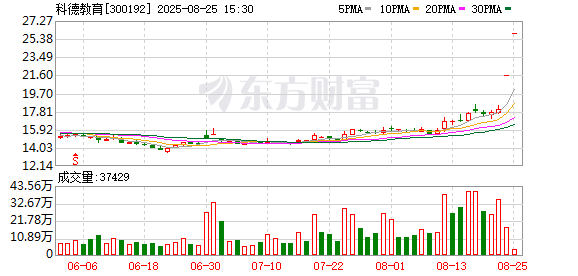
两连板后,300192回应
Shang Hai Zheng Quan Bao· 2025-08-25 15:35
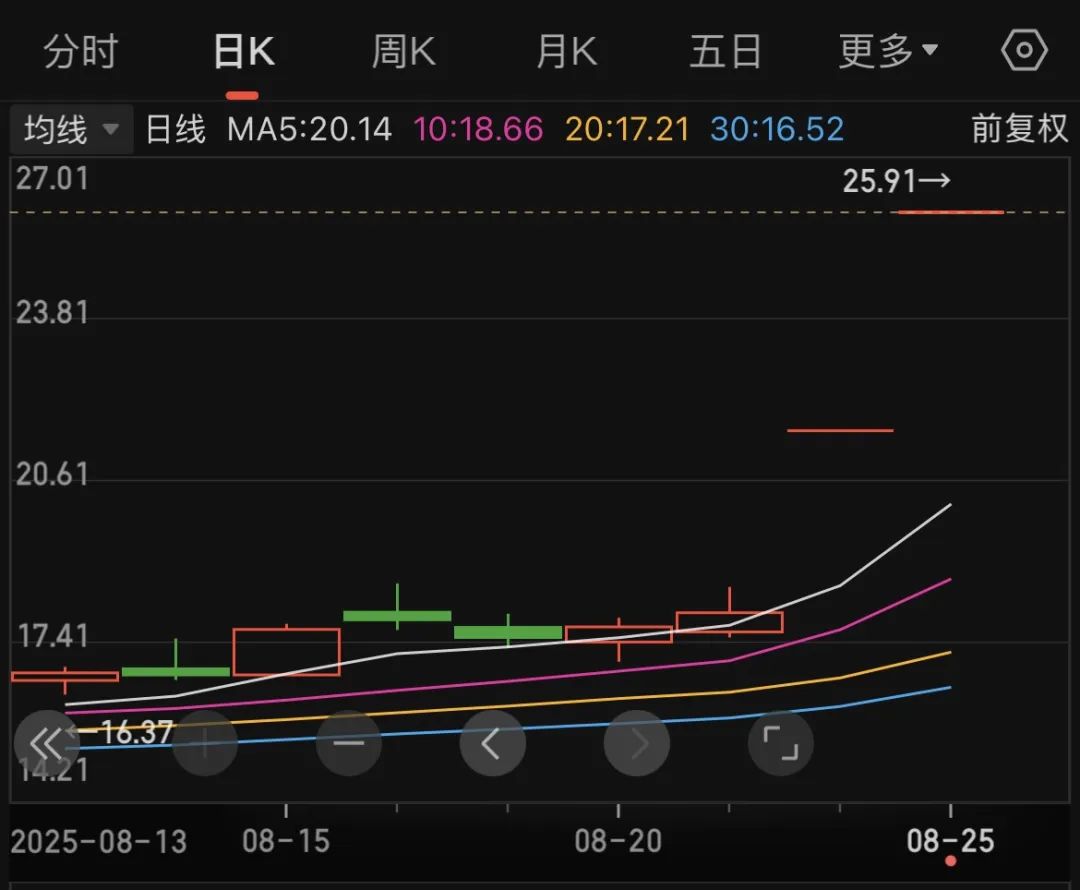
Core Viewpoint - Kede Education's stock has experienced significant growth, achieving a closing price of 25.91 yuan per share with a 20.01% increase on August 25, following two consecutive trading days of price deviations exceeding 30% [1][3]. Group 1: Stock Performance - Kede Education's stock price has risen sharply, with a cumulative increase of over 30% in two trading days [3]. - The company reported a closing price of 25.91 yuan per share on August 25, marking a 20.01% increase [1]. Group 2: Investment in Zhonghao Xinying - Kede Education holds a 5.53% stake in Zhonghao Xinying, which does not constitute a controlling interest and is not included in the consolidated financial statements [3]. - The investment in Zhonghao Xinying aims to accelerate Kede Education's layout in the AI + education sector, with a total investment of 130 million yuan for an 8.38% stake [4]. - Following a dilution of shares due to subsequent financing rounds, Kede Education's stake in Zhonghao Xinying decreased to 5.99% by April 28, 2025 [4]. Group 3: AI + Education Development - Kede Education's subsidiary, Kede Huiying, has launched an AI intelligent learning software called Kede AI Learning, targeting over 20 popular professional certifications [5]. - The software integrates various large models and is currently in the market promotion phase, with nearly 30,000 users [5]. - The partnership with Zhonghao Xinying is not expected to yield continuous profits, as Kede Education reported a profit of 592.99 million yuan from Zhonghao Xinying in 2024, followed by a loss of 456.66 million yuan in the first quarter of 2025 [5]. Group 4: Corporate Restructuring Attempts - Kede Education previously planned a change of control by transferring 23.57% of shares to a state-owned enterprise for 1.142 billion yuan, but this plan was ultimately unsuccessful [8][9]. - The company has reaffirmed its commitment to stable operations and focusing on core business development following the termination of the restructuring plan [10]. Group 5: Financial Performance - In the first quarter of the year, Kede Education reported revenue of 183 million yuan, a year-on-year decrease of 2.27%, attributed to seasonal fluctuations in the ink business [10].
创业黑马:2025年上半年净亏损1165.59万元,同比收窄65.30%
Xin Lang Cai Jing· 2025-08-25 11:54
创业黑马公告,2025年上半年营业收入7055.91万元,同比下降30.09%。净亏损1165.59万元,上年同期 净亏损3359.48万元,同比收窄65.30%。公司计划不派发现金红利,不送红股,不以公积金转增股本。 ...

参股“准独角兽”中昊芯英 科德教育再次收涨20%
Zheng Quan Shi Bao Wang· 2025-08-25 08:28
Core Viewpoint - The strong performance of Kede Education is attributed to its stake in the AI chip "unicorn" Zhonghao Xinying, leading to a significant increase in its market value and stock price [2][3]. Group 1: Kede Education's Performance - Kede Education's stock price surged by 20% on August 25, reaching a market capitalization of 8.5 billion yuan, following a previous 20% increase on August 22, resulting in a total gain of 46% over two trading days [2]. - The company primarily engages in education and ink businesses, with its education segment including vocational schools and training [2]. Group 2: Investment in Zhonghao Xinying - Kede Education invested 130 million yuan in Zhonghao Xinying, acquiring an 8.3791% stake, which was later diluted to 7.7971% due to further financing by Zhonghao Xinying [3]. - As of April 2023, Kede Education's stake in Zhonghao Xinying was reported at 5.9933% [4]. Group 3: Market Reactions and Other Investments - Other companies, including Tianpu Co., also experienced stock price increases following the announcement of the share transfer to Zhonghao Xinying, with Tianpu Co. hitting a price limit on August 22 and again on August 25 [3]. - Zhejiang Shuju Culture announced a 20 million yuan investment in a fund that holds a 3.78% stake in Zhonghao Xinying, indicating broader interest in the company among investors [4][5].

教育数字化:职业院校创新型人才培养的新引擎
Yang Shi Wang· 2025-08-25 06:28
Core Viewpoint - Education digitization is a crucial breakthrough for developing new advantages in China's education sector and is recognized as a national strategy since the 19th National Congress of the Communist Party of China [1][2] Policy Level - The Ministry of Education is actively implementing a digital strategy, with vocational schools participating widely to reshape teaching models, curriculum systems, and talent objectives [2] - Education digitization is now a core driver for innovation in vocational education and high-quality talent cultivation, breaking traditional limitations and providing new opportunities for nurturing innovative talents needed in the digital age [2] Theoretical Exploration - The definition and characteristics of innovative talents have evolved, emphasizing digital literacy and cross-disciplinary integration as core traits in the digital era [3] - Education digitization is not merely an extension of educational informatization; it focuses on data-driven restructuring of the educational ecosystem and business transformation [3] Empowerment Mechanism - Education digitization empowers vocational schools through a systematic process involving "data-driven, scenario reconstruction, and ecological collaboration" [4][5] - Data-driven approaches allow for comprehensive collection and analysis of student learning data, enabling personalized learning paths and resource recommendations [4] - Scenario reconstruction through digital technologies creates immersive learning environments that enhance students' problem-solving abilities [4] - Ecological collaboration fosters deep integration between vocational schools and enterprises, creating an open and collaborative educational ecosystem [5] Key Elements and Implementation Path - The core elements for digital transformation in vocational education include infrastructure, teacher capabilities, curriculum ecology, and evaluation systems [6] - The implementation path consists of three phases: - Foundation phase (0-1 year): Focus on building digital infrastructure [7] - Deep integration phase (1-3 years): Innovate teaching models and curriculum systems through digital technology [9] - Ecological reconstruction phase (3-5 years): Establish a digital innovation talent ecosystem through collaboration with industries [10] Challenges and Solutions - Challenges include the digital divide, teacher capability gaps, and outdated evaluation systems [11] - Solutions involve government support for infrastructure, regular teacher training, and reforming evaluation mechanisms to include diverse assessment criteria [12] Future Outlook - The future of vocational education will focus on innovation capabilities, digital literacy, and lifelong learning, adapting to the digital economy [13] - Blended learning will become the norm, with deep integration of technologies like virtual simulation and artificial intelligence [13]