
石油开采

Search documents
光控资本A股:大盘精准跌到3913点,本周即将变盘,牛市行情这么走!
Sou Hu Cai Jing· 2025-10-23 03:29
10月23日周三,A股三大指数团体收跌,沪指微跌0.07%报3913.76点,但意味深长的是,这已经是沪指 第四次在3900点关口稳稳站住。 全商场成交量缩到了1.74万亿,连续四天下降,但盘面却透露出一个要害信号:这不是惊惧,而是"刻 意控盘"。 一边是能源、国企改革板块逆势上涨,德石股份涨超10%,神开股份、石化机械等深地概念股一字板涨 停; 另一边却是近3000只个股跌落,燃气、黄金前期热门板块掉头调整。 这种极致的分解背后,是资金在 重大事件前的谨慎挑选。 深圳放出大招,发布《深圳市推进并购重组高质量发展举动方案(2025—2027年)》,明确到2027年 末,境内外上市公司总市值要打破20万亿元。 这比原方针足足多了5万亿,配套的是未来三年完结200单并购、花1000亿搞重组,还要拉起万亿级工业 基金群。 几乎一起,高盛发布报告给商场喂下一颗定心丸:我国股市到2027年末还有约30%的上涨空间,慢牛行 情正在形成。 依照报告逻辑,现在3900点邻近的A股,下一年能破4500点,2027年能到5000点。 随后商场在10月18日周五呈现大幅调整,沪指跌落1.95%收于3839.76点,近4800只个股 ...


胜利油田水资源管理迈向智慧化、精细化新阶段
Qi Lu Wan Bao Wang· 2025-10-23 02:57
据了解,油田深入贯彻落实"四水四定"原则,强化水资源消耗总量和强度指标刚性约束,依托水资源管 控平台推动管理指标持续细化,有效降低吨油耗水量与用水总量,为实现油田节水规划目标提供系统保 障。 2023年12月,胜利油田成立水资源管控平台建设项目组,在生产管理运行中心统筹下,由供水分公司牵 头推进平台开发。经过一年多的建设,一期项目已完成七大功能模块搭建,同步整合跨部门业务需求44 项。目前,水资源管控平台已向各单位开放权限,实时汇聚用水数据,并推动一级、二级远传水表的更 新与装配,为系统功能完善奠定基础。 当前,水资源管控平台二期建设已进入可行性研究阶段。项目将聚焦"1张图+7大模块+2项提升"总体框 架,构建"GIS管网拓扑+业务数据中台"双轮驱动体系,创新打造"供水运营+多元业务"水管家服务矩 阵,并在用水考核中引入六维动态评价机制,实现节水成效与配额分配的智能联动,未来将建成具有油 田特色的智慧用水管理体系。(大众新闻记者 顾松 通讯员 赵雪 任苹苹) 打开系统界面,胜利油田各单位计划水量、实时取水量、管网漏失率等关键数据一目了然,吨油耗水指 标实现动态排名,漏损异常实时报警…… 日前,由胜利油田自主建 ...
10月23日外盘头条:美国制裁俄罗斯两大石油巨头 特斯拉第三季度利润逊于预期 谷歌称Willo...
Xin Lang Cai Jing· 2025-10-22 22:06
Group 1: U.S. Sanctions on Russian Oil Companies - The U.S. has imposed sanctions on Russia's largest oil producers, Rosneft and Lukoil, as part of efforts to pressure President Putin to end the Ukraine conflict, marking the most significant action to date [4][6] - The U.S. Treasury stated that these sanctions aim to weaken Moscow's ability to fund its military operations [4] Group 2: Tesla's Third Quarter Performance - Tesla reported a 12% increase in revenue for Q3, reaching $28.1 billion, but net profit fell by 37% to $1.37 billion, missing analyst expectations [11] - The decline in profit is attributed to reduced electric vehicle prices and a 50% increase in operating expenses related to AI and other R&D projects [11] Group 3: Google's Quantum Computing Breakthrough - Google announced a breakthrough with its "Willow" quantum computing chip, which runs an algorithm outperforming traditional supercomputers by 13,000 times [13] - This advancement is expected to pave the way for practical applications of quantum technology within the next five years, particularly in medicine and materials science [13] Group 4: Amazon's New Robotics System - Amazon introduced a new robotic system named "Blue Jay," designed to perform multiple tasks simultaneously in its warehouses [17][18] - The system integrates three independent robotic workstations into a single efficient unit, enhancing operational efficiency in a smaller physical space [18]




每天三分钟公告很轻松 | 中国联通拟分拆子公司智网科技至深交所创业板上市
Shang Hai Zheng Quan Bao· 2025-10-22 15:19
Group 1: Earnings Reports - Tonghuashun reported a 39.67% increase in revenue to 3.261 billion yuan for the first three quarters of 2025, with a net profit increase of 85.29% to 1.206 billion yuan [2] - Weihua New Materials experienced a 15.18% decline in revenue to approximately 660 million yuan for the first three quarters, but a significant net profit increase of 250.04% in Q3 to approximately 25.38 million yuan [1] - Yanjing Co. achieved a 22.99% revenue growth to 1.295 billion yuan for the first three quarters, with a net profit increase of 27.95% to approximately 42.5 million yuan [1] - XH Technology reported a 26.47% revenue increase to approximately 742 million yuan for the first three quarters, with a net profit increase of 186.19% to approximately 95.47 million yuan [5] - Dongtian Micro reported a 53.91% revenue increase to approximately 637 million yuan for the first three quarters, with a net profit increase of 99.2% to approximately 80.03 million yuan [6] Group 2: Corporate Actions - China Unicom plans to spin off its subsidiary, Unicom Smart Network Technology, for listing on the Shenzhen Stock Exchange's Growth Enterprise Market, aiming to enhance innovation and competitiveness in the vehicle networking industry [3] - Kailer Co. is planning to acquire at least 50% of Kesheng Electromechanical, aiming to enter the high-end coating equipment sector [11] - Huitong Technology is preparing for an H-share listing in Hong Kong, with management authorized to initiate the process [11] Group 3: Other Notable Developments - Hengyi Petrochemical's subsidiary has successfully entered the trial production phase of a new project aimed at increasing its nylon production capacity [12] - Sichuan Chengyu's subsidiary signed a sand and gravel supply contract for a highway project, with a total transaction amount expected to be under 100 million yuan [14] - Sanwang Communication's board received a proposal for a share buyback plan, with a total amount not less than 20 million yuan [14]


热点切换加速,板块分化加剧,择机布局还是落袋为安?
Ge Long Hui· 2025-10-22 11:27
Group 1 - The three major indices collectively declined, with the Shanghai Composite Index down 0.44%, the Shenzhen Component down 0.81%, and the ChiNext down 0.89% [1] - Over 2,700 stocks in the two markets fell, with a total trading volume of 1.1 trillion [1] Group 2 - The deep earth economy concept continued to show strength, with stocks like ShenKai Co. and Petrochemical Machinery achieving three consecutive trading limits [3] - The Hubei state-owned assets concept remained strong, with stocks such as Wuhan Holdings and Hubei Broadcasting achieving two consecutive trading limits [3] - The controllable nuclear fusion concept strengthened again, with AnTai Technology and Atlantic both hitting the daily limit [3] - Other sectors like combustible ice, lab-grown meat, and wind power equipment followed closely behind [3] Group 3 - Precious metals opened lower and collectively retreated, with a drop of 5.21%, including Hunan Silver hitting the daily limit down and XiaoCheng Technology down 7.09% [3] - The natural gas sector weakened, with China New Energy hitting the daily limit down [3] Group 4 - Agricultural Bank recorded a 14-day consecutive rise, also refreshing its historical high for the fourth consecutive trading day [3] - Spot gold experienced significant fluctuations, narrowly holding above the $4,000 mark before returning above $4,100 [3] - The probability of a 25 basis point rate cut by the Federal Reserve in October is 98.9% [3]
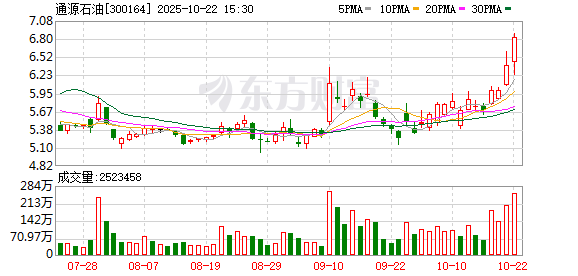
通源石油龙虎榜数据(10月22日)
Zheng Quan Shi Bao Wang· 2025-10-22 10:04
Core Points - Tongyuan Petroleum's stock increased by 7.05% with a turnover rate of 43.27% and a trading volume of 1.659 billion yuan, indicating significant market activity [2] - Institutional investors net bought 17.088 million yuan, while brokerage seats collectively net sold 9.9917 million yuan, reflecting mixed investor sentiment [2] - The stock has appeared on the "Dragon and Tiger List" 13 times in the past six months, with an average price increase of 0.08% the day after being listed and an average decline of 5.15% over the following five days [2] Trading Data - The top five brokerage seats accounted for a total trading volume of 312 million yuan, with a net buying amount of 7.0961 million yuan [2] - Specific trading details show that four institutional seats were involved in buying, with a total buying amount of 121 million yuan and selling amount of 104 million yuan, resulting in a net buying of 17.088 million yuan [2] - The main capital flow for the stock showed a net inflow of 7.7097 million yuan today, with large orders contributing a net inflow of 31.6874 million yuan and large orders seeing a net outflow of 23.9777 million yuan over the past five days [2]

港股22日跌0.94% 收报25781.77点
Xin Hua Wang· 2025-10-22 09:59
Market Overview - The Hang Seng Index fell by 245.78 points, a decrease of 0.94%, closing at 25,781.77 points [1] - The total turnover for the day was 227.536 billion HKD [1] - The Hang Seng China Enterprises Index dropped by 78.88 points, closing at 9,223.78 points, a decline of 0.85% [1] - The Hang Seng Tech Index decreased by 84.85 points, closing at 5,923.09 points, a drop of 1.41% [1] Blue-Chip Stocks - Tencent Holdings decreased by 1.11%, closing at 623.5 HKD [1] - Hong Kong Exchanges and Clearing fell by 1.58%, closing at 422.4 HKD [1] - China Mobile declined by 0.88%, closing at 84.45 HKD [1] - HSBC Holdings increased by 0.1%, closing at 102.5 HKD [1] Local Hong Kong Stocks - Cheung Kong Holdings fell by 0.26%, closing at 37.86 HKD [1] - Sun Hung Kai Properties decreased by 1.44%, closing at 92.35 HKD [1] - Henderson Land Development dropped by 0.87%, closing at 27.3 HKD [1] Chinese Financial Stocks - Bank of China decreased by 0.23%, closing at 4.36 HKD [1] - China Construction Bank fell by 0.13%, closing at 7.81 HKD [1] - Industrial and Commercial Bank of China increased by 0.17%, closing at 5.96 HKD [1] - Ping An Insurance dropped by 0.72%, closing at 55.5 HKD [1] - China Life Insurance decreased by 2.33%, closing at 24.36 HKD [1] Oil and Petrochemical Stocks - Sinopec increased by 0.24%, closing at 4.13 HKD [1] - PetroChina rose by 1.15%, closing at 7.89 HKD [1] - CNOOC increased by 0.93%, closing at 19.5 HKD [1]






A股收评:沪指微跌0.07%,全市场成交额不足1.7万亿元,深地经济概念持续活跃
Ge Long Hui· 2025-10-22 07:09
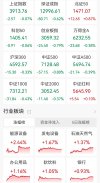
A股主要指数今日小幅走低,截至收盘,沪指跌0.07%报3913点,深证成指跌0.62%,创业板指跌0.79%。全市场成交额1.69万亿元,较前一交易日缩量2024 亿元,超2900股下跌。 | 上证指数 | 深证成指 | 北证5C | | --- | --- | --- | | 3913.76 | 12996.61 | 1471.0 | | -2.57 -0.07% -80.71 -0.62% +12.65 +0 | | | | 科创20 | 创业板指 | 万得全/ | | 1405.41 | 3059.32 | 6232.5 | | -0.91 -0.06% -24.40 -0.79% -23.68 -0 | | | | 沪深300 | 中证500 | 中证A5( | | 4592.57 | 7128.48 | 5494.7 | | -15.30 -0.33% -57.15 -0.80% -21.74 -0 | | | | 中证1000 | 中证2000 | 中证红和 | | 7312.21 | 3052.45 | 5645.9 | | -31.84 -0.43% -11.40 -0.37% +5.54 + ...
地产与石油石化行业领涨,国企共赢ETF(159719)投资机会受关注
Sou Hu Cai Jing· 2025-10-22 05:54
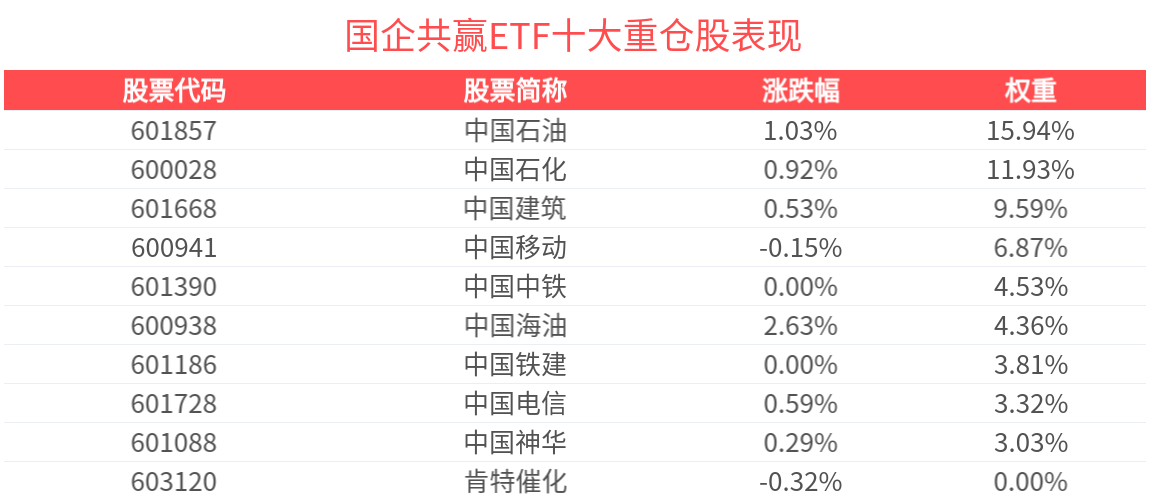
Core Viewpoint - The Guoqi Gongying ETF (159719) has shown a positive performance with a recent increase of 0.44%, marking a three-day consecutive rise, and a weekly gain of 1.08% as of October 21, 2025 [1] Performance Summary - As of October 21, 2025, the Guoqi Gongying ETF has achieved a net value increase of 53.53% over the past three years, ranking 337 out of 1897 in the index stock fund category, placing it in the top 17.76% [1] - The ETF has recorded a maximum monthly return of 14.61% since its inception, with the longest consecutive monthly gain being 7 months and a maximum cumulative increase of 24.70% [1] - The average return in the months of increase is 4.14%, with a total annual profit percentage of 100.00% and a historical three-year holding profit probability of 100.00% [1] - Over the past six months, the ETF has outperformed its benchmark with an annualized excess return of 7.35% [1] Liquidity and Scale - The ETF's latest scale reached 62.51 million yuan, marking a recent one-month high [1] - The trading volume showed a turnover of 4.25% during the session, with a total transaction value of 2.6597 million yuan [1] - The average daily transaction value over the past year was 13.2974 million yuan [1] Fee Structure - The management fee for the Guoqi Gongying ETF is 0.25%, and the custody fee is 0.05%, which are among the lowest in comparable funds [2] Tracking Precision - As of October 21, 2025, the ETF has a tracking error of 0.036% over the past month, indicating the highest tracking precision among comparable funds [3] - The ETF closely tracks the FTSE China State-Owned Enterprises Open Win Index, which reflects the performance of Chinese state-owned enterprises listed in mainland China and Hong Kong, focusing on globalization and sustainable development [3] Top Holdings - The top holdings in the ETF include: - China Petroleum (601857) with a weight of 15.94% and a gain of 1.03% - China Petrochemical (600028) with a weight of 11.93% and a gain of 0.92% - China State Construction (601668) with a weight of 9.59% and a gain of 0.53% [5]
午评:创业板指半日跌近1% 黄金概念股集体下挫
Mei Ri Jing Ji Xin Wen· 2025-10-22 03:43
Market Overview - The market experienced fluctuations, with the Shenzhen Component Index and the ChiNext Index briefly turning positive before declining again [1] - The total trading volume in the Shanghai and Shenzhen markets was 1.1 trillion, a decrease of 53.5 billion compared to the previous trading day [1] Sector Performance - The deep earth economy concept continued to perform strongly, with companies like Shenke Co. and Shihua Machinery achieving three consecutive trading limit increases [1] - The Hubei state-owned assets concept maintained its strength, with stocks such as Wuhan Holdings and Hubei Broadcasting reaching two consecutive trading limit increases [1] - The controllable nuclear fusion concept saw a resurgence, with Antai Technology and Atlantic both hitting the trading limit [1] - Conversely, the gold sector experienced a collective pullback, with Hunan Silver hitting the trading limit down [1] - The natural gas sector weakened, with Guoxin Energy also hitting the trading limit down [1] - Sectors such as engineering machinery, plant-based meat, and wind power showed significant gains, while gold and battery sectors faced notable declines [1] Index Performance - By the end of the trading session, the Shanghai Composite Index fell by 0.44%, the Shenzhen Component Index decreased by 0.81%, and the ChiNext Index dropped by 0.89% [1]
