
战略性新兴产业

Search documents
【有本好书送给你】中国制造业“内卷式”现象是如何形成的?
重阳投资· 2025-12-03 07:33
重阳说 查理·芒格先生有一句广为流传的话:"我这一生当中,未曾见过不读书就智慧满满的人。没有。一个都没 有。沃伦(巴菲特)的阅读量之大可能会让你感到吃惊。我和他一样。我的孩子们打趣我说,我就是一 本长着两条腿的书。" 熟悉重阳的朋友们一定知道,阅读,一直是我们非常推崇的成长路径。 现在,我们希望和你一起,把阅读这件事坚持下去。 每一期专栏,我们依旧聊书,可能是书评、书单或者书摘。 每一期会有一个交流主题,希望你通过留言与我们互动。 我们精选优质好书,根据留言质量不定量送出。 世界莽莽,时间荒荒,阅读生出思考的力量,愿你感受到自己的思想有厚度且有方向,四通八达,尽情 徜徉。 【好书】第311期:《 读懂"十五五":高质量发展新征程 》 张军扩 蔡昉 朱克力 著 中信出版集团 推荐人 编辑 张璇 互动话题: 结合本书, 请就"中国制造业内卷式现象是如何形成"的发表你的看法 。 留言时间:2024年12月3 日 - 2025年 12月10日 (鼓励原创,只要你的内容足够优秀,期期选中也有可能哦) 筛选及书籍(单本)寄送:2025年12月11日后 (选中会收到提交寄送地址的私聊,逾期未提交/信息不全视为放弃,参与期间 ...


《成都因地制宜发展新质生产力的战略和路径研究》成果研讨会成功举办
Zhong Guo Jing Ying Bao· 2025-12-02 14:29
Core Insights - The seminar on "Research on Strategies and Paths for Chengdu to Develop New Quality Productive Forces" highlighted the importance of developing new quality productive forces as a key engine for promoting Chinese-style modernization [1][2] - Chengdu, as a national central city and a core city in the Chengdu-Chongqing economic circle, needs to leverage its resource endowments, industrial foundation, and innovation advantages to explore a high-quality development path with local characteristics [1] Group 1 - The research emphasizes the cultivation of new quality productive forces through technological innovation [1] - It outlines strategies for developing advanced manufacturing clusters that are high-end, intelligent, and green [1] - The report discusses enhancing the stability and competitiveness of key advantageous industrial chains and supply chains [1] Group 2 - Experts agreed that the research framework of "theoretical support - reality assessment - bottleneck analysis - path design" effectively supports Chengdu's urban positioning as "three centers and one base" and the construction of a "Western Science and Technology Innovation Center" [2] - Future research will focus on aligning new quality productive forces with Chengdu's urban functional positioning and deepening the integration of digital and real economies [2] - The study aims to create a replicable and scalable "Chengdu path" to help Chengdu seize opportunities and shape advantages in the national landscape of new quality productive force development [2]
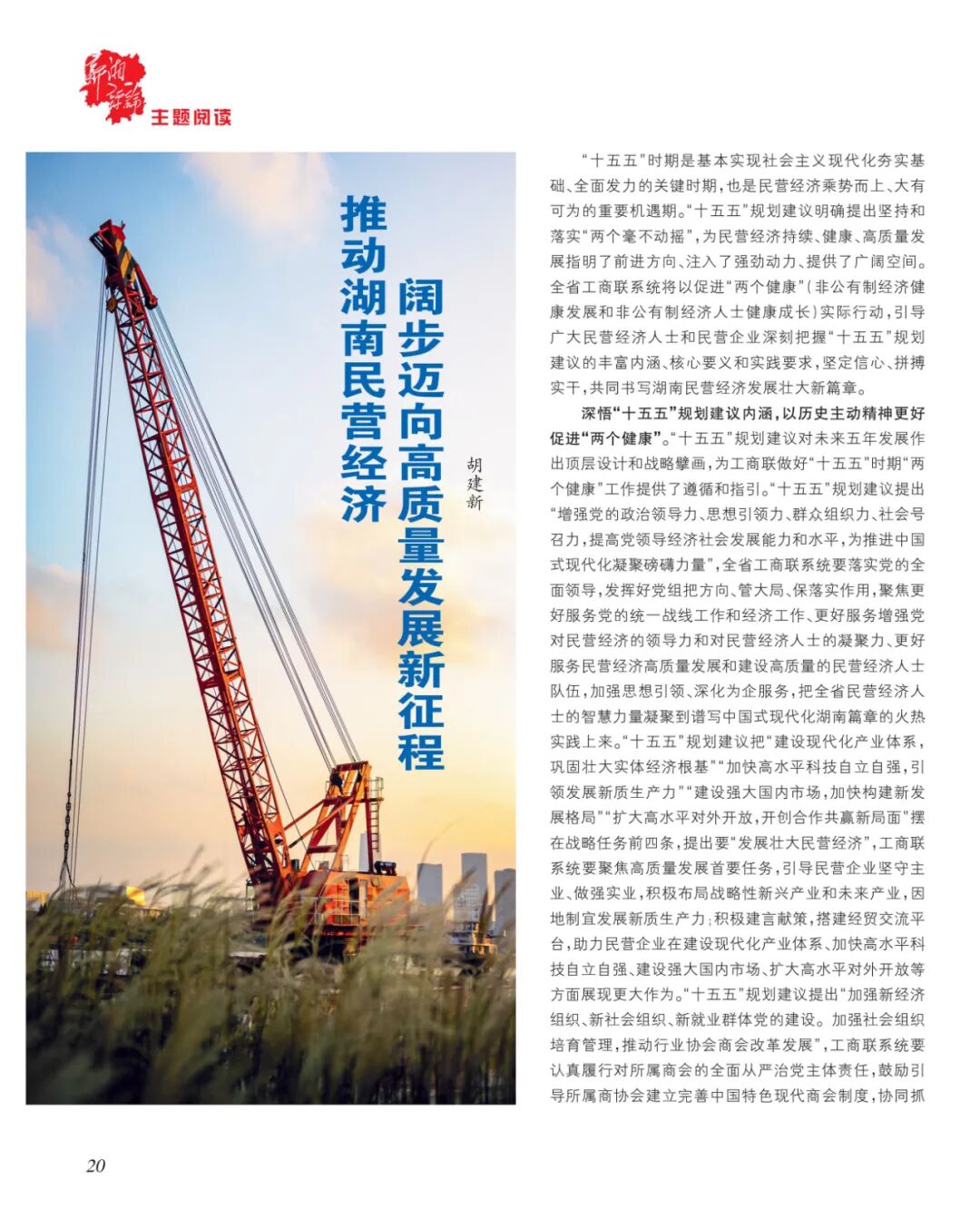
胡建新在《新湘评论》发表署名文章:推动湖南民营经济阔步迈向高质量发展新征程
Xin Lang Cai Jing· 2025-12-02 11:59
(来源:湖南省工商联) 阔步迈向高质量发展新征程 胡建新 "十五五"时期是基本实现社会主义现代化夯实基础、全面发力的关键时期,也是民营经济乘势而上、大有可为的重要机遇期。"十五五"规划建议明确提出 坚持和落实"两个毫不动摇",为民营经济持续、健康、高质量发展指明了前进方向、注入了强劲动力、提供了广阔空间。全省工商联系统将以促进"两个 推动湖南民营经济 健康"(非公有制经济健康发展和非公有制经济人士健康成长)实际行动,引导广大民营经济人士和民营企业深刻把握"十五五"规划建议的丰富内涵、核 心要义和实践要求,坚定信心、拼搏实干,共同书写湖南民营经济发展壮大新篇章。 深悟"十五五"规划建议内涵,以历史主动精神更好促进"两个健康"。"十五五"规划建议对未来五年发展作出顶层设计和战略擘画,为工商联做好"十五 五"时期"两个健康"工作提供了遵循和指引。"十五五"规划建议提出"增强党的政治领导力、思想引领力、群众组织力、社会号召力,提高党领导经济社会 发展能力和水平,为推进中国式现代化凝聚磅礴力量",全省工商联系统要落实党的全面领导,发挥好党组把方向、管大局、保落实作用,聚焦更好服务 党的统一战线工作和经济工作、更好服务增 ...
“十五五”系列谈 | 以扩大有效投资促进区域经济高质量发展
Sou Hu Cai Jing· 2025-12-02 00:51
Core Viewpoint - The article emphasizes that effective investment is a complex system process involving the coupling and collaborative evolution of technological innovation, institutional innovation, and spatial optimization, rather than merely a capital input behavior [1][2]. Group 1: New Requirements and Challenges - The "14th Five-Year Plan" period is crucial for China to advance towards socialist modernization, facing unprecedented challenges and requirements due to profound changes in domestic and international environments [2][4]. - The global landscape is undergoing a new round of technological revolution and industrial transformation, with disruptive technologies reshaping national core competitiveness and increasing the strategic importance of investment [3]. Group 2: Effective Investment and New Quality Productivity - Effective investment is defined as capital formation activities that serve high-quality development goals, focusing on nurturing and expanding new quality productivity [5]. - New quality productivity is characterized by technological innovation as the core driving force, with significant improvements in total factor productivity as a key indicator [6]. Group 3: "Technology-Institution-Space" Analysis Framework - The "Technology-Institution-Space" (TIS) framework illustrates that successful investment activities result from the positive interaction of technology, institutions, and spatial dimensions [7]. - The technology dimension focuses on R&D innovation, digital infrastructure, and high-skilled human capital, which directly determines the height and advancement of new quality productivity [7]. - The institutional dimension emphasizes creating an environment conducive to innovation, including a robust intellectual property protection system and a fair market environment [7]. - The spatial dimension involves optimizing regional functional layouts and constructing modern infrastructure networks to promote the clustering and scaling of new quality productivity [7]. Group 4: Progress and Challenges in Effective Investment - Despite a slowdown in fixed asset investment growth, significant progress has been made in the effectiveness of investment, with a clear trend towards structural optimization [14]. - High-tech industry investment has maintained double-digit growth, significantly outpacing overall fixed asset investment growth, indicating a shift towards new quality productivity core areas [14]. - Challenges remain in aligning technology, institutions, and spatial dimensions, leading to issues such as insufficient basic research investment and a lack of effective technology transfer mechanisms [16][18]. Group 5: Recommendations for a High-Efficiency Investment Ecosystem - To expand effective investment, a shift from "project thinking" to "ecosystem thinking" is necessary, focusing on creating a self-optimizing and virtuous cycle investment ecosystem [21]. - Recommendations include optimizing R&D investment structures, enhancing basic research funding, and establishing market-oriented concept verification centers to bridge the gap between laboratory results and market applications [22][23]. - Institutional reforms should aim to deepen financial supply-side structural reforms and enhance the protection of intellectual property rights to stimulate innovation [24][25]. - Spatial strategies should promote differentiated and specialized investments, avoiding homogeneous competition and ensuring that new infrastructure aligns with local industrial needs [26][27].
安永:A股及港股全年IPO数量和筹资额分别占全球总量的16%和33%
Zhong Guo Jing Ying Bao· 2025-11-28 00:21
Core Insights - The report by Ernst & Young indicates a growth trend in IPO activities in mainland China and Hong Kong, with A-shares and Hong Kong markets accounting for 16% and 33% of global totals respectively in terms of IPO numbers and fundraising amounts [1][2] - In 2025, the A-share IPO market is expected to achieve moderate growth under stable regulation and structural optimization, with a significant increase in fundraising scale compared to the previous year, and an average fundraising amount for IPOs increasing by over 50% [1][2] - The Hong Kong IPO market is projected to recover strongly in 2025, with fundraising surpassing 200 billion HKD for the first time in four years, marking the second-highest peak in five years [2] A-Share Market Insights - The A-share market has shifted from "scale expansion" to "quality priority" over the past five years, with a focus on technology innovation as a core feature of new listings [2] - The average return rate for newly listed stocks remains at 253%, consistent with 2024, and there have been no instances of first-day price drops [1][2] Hong Kong Market Insights - Large IPO projects are key drivers for the resurgence of the Hong Kong market, with over 20 A-share companies expected to list in Hong Kong, raising more than 170 billion HKD collectively [2] - The year 2025 marks the beginning of a new decade for interconnectivity between mainland and Hong Kong capital markets, with expectations for deeper cooperation and enhanced market integration [2] Industry Focus - The top three industries for IPO numbers are industrial, technology, and materials, while the energy sector has risen to the top three in terms of fundraising scale [2] - Active applicants are primarily from strategic emerging industries, including artificial intelligence, robotics, semiconductors, new energy, and biomedicine [2] Recommendations for Companies - Companies are advised to embrace technology and build integrated financial and operational systems, enhancing digital transformation to ensure data consistency and transparency [3]
加快实现高水平科技自立自强
Jing Ji Ri Bao· 2025-11-25 00:42
Core Viewpoint - The article emphasizes the importance of achieving high-level technological self-reliance and strength as a foundation for national prosperity and security, outlining strategic goals, key tasks, and major initiatives for advancing China's technological innovation [1][2]. Strategic Deployment - Since the 18th National Congress, the central government has made significant strategic deployments to enhance technological self-reliance, leading to historic achievements and transformations in China's technology sector [2]. - The goal of building a technology power is clearly defined, with an emphasis on achieving high-level technological self-reliance as essential for national development [2]. New System for National Innovation - A new type of national system is being established to address profound changes in scientific research paradigms, focusing on collaborative innovation and leveraging national strategic technological forces [3]. - The system aims to integrate resources from national laboratories, research institutions, and leading enterprises to tackle major technological challenges [3]. Role of Enterprises in Innovation - Enterprises are recognized as the main body of innovation, with efforts to strengthen their role in integrating innovation elements and transforming technological achievements [4]. - A nurturing environment for technology-driven small and medium enterprises is being developed to enhance their growth and contribution to innovation [4]. Reform of the Technological System - The article highlights the necessity of reforming the technological system to create an efficient, collaborative, and open innovation framework, emphasizing the importance of leadership and coordination in technological tasks [5]. - Reforms include improving evaluation systems and fostering a culture of innovation within research and development [5]. Open Innovation Ecosystem - The importance of an open innovation ecosystem is stressed, with a focus on global collaboration and integration into international innovation networks [6][7]. - China is actively expanding international scientific and technological exchanges and cooperation, establishing key innovation centers [7]. Historical Achievements in Technology - Significant advancements in technology have been made, with China achieving a prominent position in various fields and producing a surge of major innovations [8]. - The country is moving towards becoming an innovative nation, solidifying the material and technological foundation for modernization [8]. Investment in Basic Research - Investment in research and development is increasing, with a projected expenditure of over 3.6 trillion yuan in 2024, marking a nearly 50% increase since 2020 [9]. - The focus on basic research is crucial for achieving breakthroughs and enhancing the foundation for technological self-reliance [9]. Core Technology Autonomy - The article discusses the importance of mastering key core technologies to ensure national economic security, highlighting advancements in various high-tech fields [10]. - Progress in self-developed technologies, such as high-performance chips and advanced equipment, is noted as a significant achievement [10]. Global Technological Competitiveness - China's technological competitiveness is on the rise, with improvements in innovation resource allocation and contributions to global technological innovation [11]. - The country aims to enhance its global innovation index ranking and establish itself as a key player in international innovation networks [11]. Integration of Technology and Industry - The integration of technological innovation and industrial innovation is emphasized as a key strategy for achieving high-level self-reliance [17]. - Efforts are being made to ensure seamless transitions from research to product development, enhancing the overall innovation ecosystem [17]. Reforming the Innovation Ecosystem - Continuous reforms in the technological system are necessary to foster a vibrant innovation ecosystem, focusing on removing barriers to innovation and enhancing collaboration [18]. - The article advocates for a supportive environment for original and disruptive innovations to accelerate the transition from a technological power to a technological strong nation [18].
国资央企“要多用、善用资本市场”有哪些深意
Zheng Quan Ri Bao· 2025-11-23 16:57
Core Viewpoint - The State-owned Assets Supervision and Administration Commission (SASAC) emphasizes the need for state-owned enterprises (SOEs) to enhance their integration capabilities in strategic emerging industries and to effectively utilize capital markets for structural adjustments and industrial upgrades [1] Group 1: Investment and Market Dynamics - Since the beginning of the 14th Five-Year Plan, central enterprises have invested a total of 8.6 trillion yuan in strategic emerging industries, with investments in 2024 expected to exceed 40% of total investments, and revenue from these industries approaching 30% [1] - The capital market is identified as an "accelerator" for SOEs to cultivate strategic emerging industries, providing a full-cycle funding support system through various channels such as IPOs, refinancing, and bond issuance [1] Group 2: Mergers and Acquisitions - The SASAC outlines a new path for mergers and acquisitions, allowing central enterprises to inject non-core but promising strategic emerging businesses into other core enterprises' listed platforms, facilitating mutual benefits [2] - This approach aims to enhance the integration of technology, capacity, and market resources among central enterprises, reducing redundant investments and resource waste [2] Group 3: Valuation Logic Transformation - The injection of strategic emerging industry assets into core enterprises is expected to shift the valuation logic of SOE-controlled listed companies from static asset pricing to dynamic innovation premiums [3] - This policy direction will encourage the market to focus on dynamic indicators such as R&D intensity and technological barriers, addressing the undervaluation of state-owned enterprises and enhancing their competitiveness in key sectors [3]
专家解读深企快速上市核心密钥 全周期培育土壤 最前沿细分行业
Shen Zhen Shang Bao· 2025-11-20 23:27
谈及深圳如何保持这样的上市速度,周军民认为,要优化创新创业政策,鼓励年轻人创业,吸引全国全 球人才创业。同时,加强优质中小企业梯度培育体系,完善"个转企、小升规、规做精、优上市、市做 强"的全周期培育土壤,让企业每一个阶段都有对应政策与资金接力。 近日,深圳一组最新数据引人注目:深圳121家企业成立不到10年就成功上市,其中A股87家、港股34 家。这些企业包括影石科技、越疆科技、云天励飞、奥比中光、大族激光(002008)、速腾聚创等等。 据悉,近年来,深圳全力推动小微工业企业扩大生产、升规纳统。2023年深圳新增1726家工业企业"小 升规",超额完成1500家目标任务,纳统企业数量居全省前列;2024年深圳新增1314家工业企业"小升 规",超额完成1000家目标任务。2019年至2024年,深圳累计培育新增1.1万家规模以上工业企业,新纳 统的"小升规"工业企业对全市工业增速具有明显拉动作用,为全市经济发展积极贡献力量。 为何创立不到10年就能够上市?在中国(深圳)综合开发研究院产业经济研究中心主任周军民看来,这 一方面说明深圳和大湾区创新创业以及上市氛围非常活跃,另一方面说明深圳创业上市的途径明显增 ...
中国制造业“内卷式”现象是如何形成的?
3 6 Ke· 2025-11-19 23:22
中国社会科学院大学经济学院博士研究生 制造业"内卷式"竞争是一种复杂的经济现象。已有的大量研究关注到企业间过度竞争对资源的无效消耗,关注到 供需失衡和产业链重整,关注到中国制造业面临着"创新驱动-效率提升"与"资源错配-内卷加剧"的双重压力,但对 制造业"内卷式"竞争现象的形成机制还缺少一个全面的理论解释框架,特别是缺少将宏观供需失衡、中观产业链 重构与微观企业规模数量变化等各个层面的市场结构变化有机整合的综合理论框架。 黄群慧 中国社会科学院经济研究所研究员、教授 叶其楚 这不仅阻碍了资源的优化配置,还抑制了技术进步和组织效率的提升,使得企业或行业整体无法获得质的突破, 最终陷入"多劳少得"或"多投无果"的困境。更为严重的是,"内卷式"竞争常常伴随着非理性乃至扭曲的企业行 为,催生诸如恶性价格战、排他性协议、滥用市场支配地位、虚假宣传等不正当竞争手段,而这破坏了正常的市 场秩序和资源配置效率。更进一步,行业内的大型企业往往凭借其在技术积累、数据资源、平台控制力、资本运 作等方面的综合优势,形成事实上的市场垄断地位,显著压缩中小企业的生存空间,进而削弱市场的开放性、公 平性和创新活力。 本文基于产业组织理论中 ...

逐绿向新再出发
Jing Ji Ri Bao· 2025-11-19 01:30
Core Insights - Shihezi City is undergoing a transformation in energy structure and industrial form, leading in economic growth within the Xinjiang Production and Construction Corps, but faces challenges such as lagging power grid construction and difficulties in industrial restructuring [1][2] - High-quality transformation requires coordinated efforts in policy guidance, infrastructure development, technological innovation, and talent cultivation [1] Group 1: Energy System Reform - The intermittent and volatile nature of photovoltaic power generation poses significant challenges to grid stability [1] - Shihezi's large photovoltaic bases are mostly located in surrounding counties, with limited existing transmission line capacity and coverage [1] - There is a need to accelerate power grid construction, enhance transmission capacity, upgrade existing transmission lines, and improve line stability [1] - Policies and market mechanisms should be improved to enhance local consumption capacity and encourage enterprises to increase the use of green electricity [1] - Accelerating technological innovation and supporting energy storage facilities are essential for building a more flexible and reliable energy storage system [1] Group 2: Industrial Chain Resilience - Despite having a layout of strategic emerging industries, Shihezi's industrial structure is still heavily weighted and the industrial chain is relatively short [2] - Emphasis should be placed on extending, supplementing, and strengthening the industrial chain through industrial investment and cultivation [2] - Traditional industries should be encouraged to extend upstream and downstream in the industrial chain to enhance product added value [2] - For the new energy industry, precise investment attraction and policy support are needed to introduce key supporting enterprises and technologies [2] - Strengthening overall competitiveness of the industrial chain through technological innovation, brand building, and market expansion is crucial [2] Group 3: Innovation and Talent Development - The fundamental shift towards new industries relies on technological innovation and talent-driven initiatives [2] - Targeted and flexible support policies should be introduced for strategic emerging industries, along with the establishment of more innovation platforms and development funds [2] - A virtuous cycle of "industry attracting talent and talent leading industry" should be constructed, providing guarantees in housing, education, and career development [2] - Collaboration with local universities and research institutions is essential for cultivating high-skilled talent for emerging industries [2] - Joint research and development platforms should be established to promote the local transformation of scientific and technological achievements [2]