金融信息服务

Search documents
国内多家金店金饰价格集体上涨,最高价突破1600元/克
Jing Ji Guan Cha Wang· 2026-01-28 03:31
经济观察网据同花顺(300033)iFinD数据,今日国内黄金珠宝品牌公布的境内足金首饰价格较昨日集 体上涨,最高报1620元/克。 ...
美股ADR与普通股存在哪些区别?
Jin Rong Jie· 2026-01-27 04:51
Core Viewpoint - The article discusses the differences between direct investment in U.S. common stocks and indirect investment through American Depositary Receipts (ADRs), highlighting the significance of understanding these differences for investors. Group 1: Differences in Issuance and Ownership - U.S. common stocks are issued directly by U.S. or foreign companies to investors, representing direct ownership, while ADRs are issued by U.S. depositary banks and represent shares of foreign companies, leading to indirect ownership [1]. - Common stocks are listed on U.S. exchanges like the NYSE or NASDAQ, whereas ADRs are traded on U.S. exchanges but are based on foreign stocks [1]. Group 2: Transaction Costs and Mechanisms - Investors in U.S. common stocks incur standard transaction costs such as commissions and regulatory fees, while ADRs may involve additional fees from depositary banks, including deposit service fees and dividend conversion fees [2]. - ADRs are categorized into different levels (Level 1, Level 2, Level 3), each with varying trading scopes and disclosure requirements, unlike common stocks which do not have such classifications [2]. Group 3: Shareholder Rights - Shareholders of U.S. common stocks can directly exercise their voting and dividend rights, while ADR holders must go through depositary banks to exercise these rights, making the process more complex [2]. Group 4: Regulatory and Disclosure Requirements - U.S. common stocks are subject to strict regulations by the SEC and must disclose financial reports according to GAAP, while ADRs must comply with both U.S. regulations and those of their home countries [3]. - Disclosure requirements for ADRs vary by level, with Level 3 ADRs needing to submit comprehensive reports similar to U.S. companies, while Level 1 ADRs have simplified disclosure requirements [3]. Group 5: Liquidity Performance - The liquidity of U.S. common stocks is determined by their market activity, with larger companies typically having better liquidity [3]. - The liquidity of ADRs depends on the market recognition, size, and trading demand of the corresponding foreign companies, with some leading companies' ADRs having liquidity comparable to common stocks, while smaller companies' ADRs may have lower liquidity [3].
盘中暴跌超35%!知名投顾公司,午后突然跳水!
券商中国· 2026-01-26 08:55
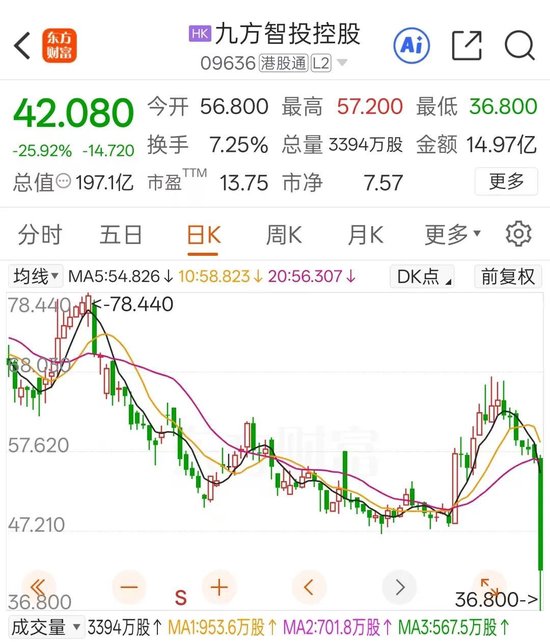
Core Viewpoint - Jiu Fang Zhi Tou Holdings experienced a significant stock price drop, falling over 35% intraday and closing down 25.92% on January 26, 2024, despite no apparent negative news affecting the market [2][6]. Group 1: Stock Performance - From September 2024 to August 2025, Jiu Fang Zhi Tou Holdings' stock price surged from a low of 4.82 HKD per share to a high of 83.54 HKD per share, marking a cumulative increase of over ten times. However, the stock has since declined nearly 50% from its peak [4]. - The company reported a total revenue of 2.1 billion HKD for the first half of 2025, representing a year-on-year growth of 134%. The net profit attributable to shareholders rose from a loss of 174 million HKD in the same period of 2024 to a profit of 865 million HKD [4]. Group 2: Acquisition and Business Expansion - In early January 2026, Jiu Fang Zhi Tou Holdings announced the completion of its acquisition of JF Financial, which includes all equity and core business systems. This acquisition is seen as a strategic move to enhance its overseas business layout [6]. - JF Financial, established in December 2016, operates through licensed entities such as Fang De Securities and Fang De Capital, providing trading services across various financial products [6][7]. Group 3: Regulatory Environment - Since 2025, regulatory scrutiny on third-party investment advisory firms has intensified, with approximately 60 penalties issued against various advisory companies for violations such as unauthorized operations and misleading marketing [9]. - Specific actions taken this year include the suspension of new client acquisitions for three advisory firms due to compliance issues [10].


盘中暴跌超35%!知名投顾公司, 午后突然跳水!
Xin Lang Cai Jing· 2026-01-26 08:55
Core Viewpoint - Jiu Fang Zhi Tou Holdings experienced a significant stock price drop of over 35% in a single trading session, closing down 26.16% without any apparent negative news from the market or company response [4][9]. Company Performance - From September 2024 to August 2025, Jiu Fang Zhi Tou Holdings' stock price surged from a low of 4.82 HKD per share to a high of 83.54 HKD per share, marking a cumulative increase of over ten times. However, the stock has since declined nearly 50% from its peak [3][11]. - For the first half of 2025, the company reported total revenue of 2.1 billion HKD, a year-on-year increase of 134%. The net profit attributable to shareholders rose from a loss of 174 million HKD in the same period of 2024 to a profit of 865 million HKD [3][11]. Strategic Developments - In early January 2026, Jiu Fang Zhi Tou Holdings announced the completion of the acquisition of JF Financial (formerly Yintech Financial), including all its core business systems. This acquisition is viewed as a move to enhance the company's overseas business layout [5][12]. - JF Financial, established in December 2016, operates through licensed entities such as Fang De Securities and Fang De Capital, providing a range of financial services including trading and asset management [5][13]. Product Offerings - The company offers various products, including VIP products, stock learning machines, and the Jiu Fang Zhi Tou App. Notably, certain versions of the stock learning machine have been included in the first batch of the Shanghai 2025 electronic product purchase subsidy list [6][13]. Regulatory Environment - Since 2025, regulatory scrutiny on third-party investment advisory firms has intensified, with approximately 60 penalties issued against various firms for violations such as unlicensed operations and misleading marketing practices [7][14]. - Specific penalties this year include the suspension of new client acquisitions for three advisory firms, indicating a trend towards stricter compliance enforcement in the investment advisory sector [8][15].
知名投顾公司,午后股价跳水
Shang Hai Zheng Quan Bao· 2026-01-26 06:33
| | | 买7 41.680 | 0 (0) | | --- | --- | --- | --- | | | | 买8 41.660 | 0 (0) | | | | 29 41.640 | 0 (0) | | MACD | DIF:0.304 DEA:0.069 M:0.471 | | | | 1.303 | | 分时成交 | | | | | 14:14 41.900 | 5300 | | | | 14:14 41.800V | 100 | | | | 14:14 41.900↑ | 1000 | | -1.890 | | 14:14 41.900 | 200 | | 9:30 | | 16:00 14:14 41.860V | 2200 | 九方智投控股是2C金融信息服务行业龙头。2026年1月初,九方智投控股发布公告宣布已完成对JFFinancial(原名Yintech Financial)全部股权及核心业务系 统的收购。收购完成后,九方智投控股将持有JFFinancial及旗下核心附属公司方德证券、方德资本的全部股权。 | < > 九方智投控股 09636 港股通 ▼ ▼ | | | --- | -- ...
港股九方智投控股午后跳水 一度跌超27%
Xin Lang Cai Jing· 2026-01-26 05:47
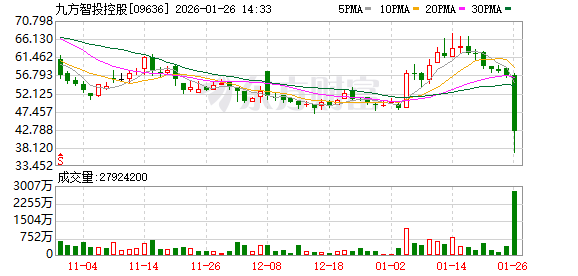
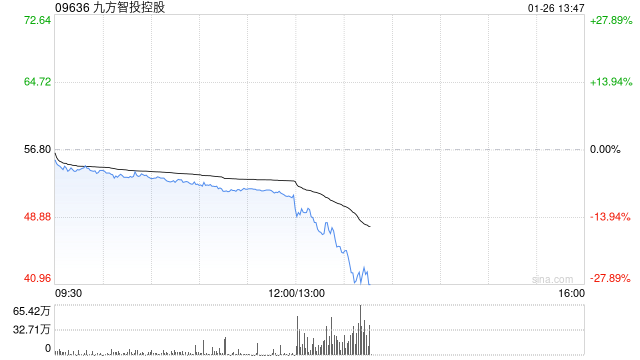
Core Viewpoint - Jiufang Intelligent Investment Holdings (09636) experienced a significant drop in stock price, falling over 27% to a low of 41.02 HKD, with a current price of 41.6 HKD and a trading volume exceeding 700 million HKD [2][6]. Group 1: Stock Performance - The stock price of Jiufang Intelligent Investment Holdings fell to a low of 41.02 HKD, representing a decline of 26.76% from the previous closing price of 56.8 HKD [7]. - The stock's highest price in the past 52 weeks was 83.54 HKD, while the lowest was 20.41 HKD [7]. - The trading volume reached 15.42 million shares, with a total transaction value of approximately 739 million HKD [7]. Group 2: Company Announcements - On January 23, 2026, Jiufang Intelligent Investment Holdings announced the granting of a total of 6.583 million restricted stock units to several employees under the 2025 share incentive plan, pending acceptance by the recipients [4][7].
金融信息服务数据 分类分级规则征求意见
Zhong Guo Zheng Quan Bao· 2026-01-25 23:55
《指南》表示,根据金融信息服务数据在经济社会发展中的重要程度和敏感程度,以及一旦遭到泄露、 篡改、损毁或者非法获取、非法使用、非法共享,对国家安全、经济运行、社会秩序、公共利益、组织 权益、个人权益造成的危害程度,将数据从高到低分为四级,分别为核心数据、重要数据、敏感一般数 据、常规一般数据。 ● 本报记者杨洁 为规范金融信息服务数据处理活动,提升金融信息服务的数据安全水平,国家互联网信息办公室会同有 关部门组织起草了《金融信息服务数据分类分级指南(征求意见稿)》,于1月24日向社会公开征求意 见。 《指南》规定了金融信息服务数据分类分级规则。金融信息服务数据可按照业务属性进行分类。一级分 类分为业务数据、用户数据和企业数据3类,进一步细分为二级分类9类、三级分类66类。 其中,业务数据可细分为金融市场数据、宏观经济数据、行业指标数据、组织机构数据、资讯报告数据 5类(二级分类),进一步细分为股票数据、债券数据、基金数据、理财数据、外汇数据、商品数据等 52类(三级分类)。用户数据分为个人用户数据和机构用户数据2类(二级分类),个人用户数据包括 基本信息、交易数据、生物特征识别信息3类(三级分类),机构用户数 ...
国家网信办:金融信息服务数据分类分级规则征求意见
Zhong Guo Zheng Quan Bao· 2026-01-25 23:31
为规范金融信息服务数据处理活动,提升金融信息服务的数据安全水平,国家互联网信息办公室会同有 关部门组织起草了《金融信息服务数据分类分级指南(征求意见稿)》,于1月24日向社会公开征求意 见。 业内人士表示,金融行业信息敏感度高,做好数据安全防护是确保金融安全的关键,通过分级分类,有 助于金融机构明晰数据安全防护重点,合理分配资源,降低风险,提升安全管理防护水平。 (责任编辑:张紫祎) 《指南》规定了金融信息服务数据分类分级规则。金融信息服务数据可按照业务属性进行分类。一级分 类分为业务数据、用户数据和企业数据3类,进一步细分为二级分类9类、三级分类66类。 《指南》表示,根据金融信息服务数据在经济社会发展中的重要程度和敏感程度,以及一旦遭到泄露、 篡改、损毁或者非法获取、非法使用、非法共享,对国家安全、经济运行、社会秩序、公共利益、组织 权益、个人权益造成的危害程度,将数据从高到低分为四级,分别为核心数据、重要数据、敏感一般数 据、常规一般数据。 根据《指南》,数据级别在分级要素识别、影响对象和影响程度分析的基础上综合确定。影响数据分级 的要素,主要包括数据的覆盖度、时间跨度、精度、公开状态、地域等。数据分级 ...
小盘拥挤度偏高
HTSC· 2026-01-25 10:37
Quantitative Models and Construction Methods 1. Model Name: A-Share Technical Scoring Model - **Model Construction Idea**: The model aims to fully explore technical information to depict market conditions, breaking down the abstract concept of "market state" into five dimensions: price, volume, volatility, trend, and crowding. It generates a comprehensive score ranging from -1 to +1 based on equal-weighted voting of signals from 10 selected indicators across these dimensions[9][14] - **Model Construction Process**: 1. Select 10 effective market observation indicators across the five dimensions[14] 2. Generate long/short timing signals for each indicator individually 3. Aggregate the signals through equal-weighted voting to form a comprehensive score between -1 and +1[9] - **Model Evaluation**: The model provides a straightforward and timely way for investors to observe and understand the market[9] 2. Model Name: Style Timing Model (Small-Cap Crowding) - **Model Construction Idea**: The model uses a crowding-based trend approach to time large-cap and small-cap styles. Crowding is measured by the difference in momentum and trading volume ratios between small-cap and large-cap indices[3][20] - **Model Construction Process**: 1. Calculate the momentum difference between the Wind Micro-Cap Index and the CSI 300 Index across 10/20/30/40/50/60-day windows 2. Compute the trading volume ratio between the two indices over the same windows 3. Derive crowding scores for small-cap and large-cap styles by averaging the highest and lowest quantiles of the above metrics, respectively 4. Combine the momentum and volume scores to obtain the final crowding score. A score above 90% indicates high small-cap crowding, while below 10% indicates high large-cap crowding[25] - **Model Evaluation**: The model effectively captures the dynamics of style crowding and provides actionable insights for timing decisions[20][25] 3. Model Name: Industry Rotation Model (Genetic Programming) - **Model Construction Idea**: The model applies genetic programming to directly extract factors from industry indices' price, volume, and valuation data, without relying on predefined scoring rules. It uses a dual-objective approach to optimize factor monotonicity and top-group performance[28][32][33] - **Model Construction Process**: 1. Use NSGA-II algorithm to optimize two objectives: |IC| (information coefficient) and NDCG@5 (normalized discounted cumulative gain for top 5 groups) 2. Combine weakly collinear factors using a greedy strategy and variance inflation factor to form industry scores 3. Select the top 5 industries with the highest multi-factor scores for equal-weight allocation, rebalancing weekly[32][34] - **Model Evaluation**: The dual-objective genetic programming approach enhances factor diversity and reduces overfitting risks, making it a robust tool for industry rotation[32][34] 4. Model Name: China Domestic All-Weather Enhanced Portfolio - **Model Construction Idea**: The model adopts a macro-factor risk parity framework, emphasizing risk diversification across underlying macro risk sources rather than asset classes. It actively overweights favorable quadrants based on macro momentum[39][42] - **Model Construction Process**: 1. Divide macro risks into four quadrants based on growth and inflation expectations: growth above/below expectations and inflation above/below expectations 2. Construct sub-portfolios within each quadrant using equal-weighted assets, focusing on downside risk 3. Adjust quadrant risk budgets monthly based on macro momentum indicators, which combine buy-side momentum from asset prices and sell-side momentum from economic forecast surprises[42] - **Model Evaluation**: The strategy effectively integrates macroeconomic insights into portfolio construction, achieving enhanced performance through active allocation adjustments[39][42] --- Model Backtesting Results 1. A-Share Technical Scoring Model - Annualized Return: 20.78% - Annualized Volatility: 17.32% - Maximum Drawdown: -23.74% - Sharpe Ratio: 1.20 - Calmar Ratio: 0.88[15] 2. Style Timing Model (Small-Cap Crowding) - Annualized Return: 28.46% - Maximum Drawdown: -32.05% - Sharpe Ratio: 1.19 - Calmar Ratio: 0.89 - YTD Return: 11.85% - Weekly Return: 5.25%[26] 3. Industry Rotation Model (Genetic Programming) - Annualized Return: 32.92% - Annualized Volatility: 17.43% - Maximum Drawdown: -19.63% - Sharpe Ratio: 1.89 - Calmar Ratio: 1.68 - YTD Return: 6.80% - Weekly Return: 3.37%[31] 4. China Domestic All-Weather Enhanced Portfolio - Annualized Return: 11.93% - Annualized Volatility: 6.20% - Maximum Drawdown: -6.30% - Sharpe Ratio: 1.92 - Calmar Ratio: 1.89 - YTD Return: 3.59% - Weekly Return: 1.54%[43] --- Quantitative Factors and Construction Methods 1. Factor Name: Small-Cap Crowding Factor - **Factor Construction Idea**: Measures the crowding level of small-cap style based on momentum and trading volume differences between small-cap and large-cap indices[20][25] - **Factor Construction Process**: 1. Calculate momentum differences and trading volume ratios for multiple time windows 2. Derive crowding scores by averaging the highest and lowest quantiles of these metrics 3. Combine momentum and volume scores to obtain the final crowding score[25] 2. Factor Name: Industry Rotation Factor (Genetic Programming) - **Factor Construction Idea**: Extracts factors from industry indices using genetic programming, optimizing for monotonicity and top-group performance[32][34] - **Factor Construction Process**: 1. Perform cross-sectional regression of standardized daily trading volume against daily price gaps to obtain residuals (Variable A) 2. Identify the trading day with the highest standardized volume in the past 9 days (Variable B) 3. Conduct time-series regression of Variables A and B over the past 50 days to obtain intercepts (Variable C) 4. Compute the covariance of Variable C and standardized monthly opening prices over the past 45 days[38] --- Factor Backtesting Results 1. Small-Cap Crowding Factor - YTD Return: 11.85% - Weekly Return: 5.25%[26] 2. Industry Rotation Factor (Genetic Programming) - Training Set IC: 0.340 - Factor Weight: 18.7% - YTD Return: 6.80% - Weekly Return: 3.37%[31][38]

标普PMI数据显示美国1月商业活动增速放缓
Huan Qiu Wang· 2026-01-25 01:43
【环球网财经综合报道】当地时间本周五,标普全球公布的最新PMI报告显示,美国商业活动在2026年1月虽保持增长态势,但扩张速度较2025年下半年显 著降温。数据显示,尽管制造业增长加快并反超服务业,但受出口下滑拖累,两大行业的新订单增长近期均出现放缓迹象,加之就业增长几近停滞,释放出 美国经济开局动能减弱的信号。 具体数据显示,美国1月标普全球制造业PMI初值录得51.9,略高于12月的51.8但微低于市场预期的52;服务业PMI初值持平于12月的52.5,同样略低于预期 的52.9;综合PMI初值为52.8,虽较上月微升,但亦低于预期的53。 标普报告显示,虽然产出端出现一定韧性,但需求端的疲软引发关注。新订单指数虽从12月的50.8回升至52.2,但整体增速仍处于偏弱水平,出口下滑成为 主要拖累因素。标普全球市场财智首席商业经济学家Chris Williamson分析认为,当前的新增业务增长率令人担忧地偏弱,强化了一季度经济增长可能不及 预期的信号。据调查估算,12月和1月美国的年化GDP增速约为1.5%,低于去年秋季的扩张节奏。 就业市场方面呈现出令人失望的表现。1月就业人数基本保持不变,延续了12月的 ...