生物医药

Search documents
加快布局 提升“五个中心”能级 市政协会议举行大会发言 委员围绕推进高质量发展等议题发表真知灼见
Jie Fang Ri Bao· 2026-02-05 01:52
Group 1: High-Quality Development Goals - Shanghai's primary goal during the "14th Five-Year Plan" is to achieve significant results in high-quality development, focusing on the real economy and effective investment in advanced manufacturing, knowledge-intensive services, and new infrastructure [2][3] - The city aims to enhance new growth drivers by accelerating the construction of a modern industrial system and promoting the transformation of traditional industries through intelligent upgrades [2][3] Group 2: Biopharmaceutical Industry - Shanghai plans to strengthen its core competitiveness in the biopharmaceutical sector by fostering collaboration between enterprises, universities, and research institutions to accelerate the industrialization of innovative drug and medical device research [7][8] - The city will support enterprises in transitioning from cost competition to quality competition through smart manufacturing and technological upgrades [7][8] Group 3: Cultural and Tourism Integration - The integration of culture, tourism, commerce, and exhibitions is seen as a key driver for enhancing consumer capacity and city image, with suggestions for optimizing the commercial value of top-tier IPs and improving both soft and hard infrastructure [5][6] - Shanghai is encouraged to support private enterprises in introducing world-class IP resources and developing a comprehensive consumer experience that includes various cultural and entertainment offerings [6] Group 4: Innovation Ecosystem - The city will continue to promote artificial intelligence innovation and deepen the "Mold Speed Space" initiative, focusing on creating a high-density ecosystem for innovation and encouraging collaboration among leading enterprises [9][10] - Investment in talent development is crucial, with proposals for establishing a research-oriented entrepreneur training mechanism to attract top talent to Shanghai [10] Group 5: Addressing Internal Competition - The issue of "involution" in competition is highlighted, with recommendations for forming cross-regional innovation alliances among leading enterprises to enhance innovation capabilities and shift from homogeneous competition to value-based competition [11][12] Group 6: Supporting Overseas Expansion - Shanghai is advised to accelerate the establishment of headquarters for overseas enterprises, leveraging its financial market and international connections to support businesses in their global expansion efforts [12][13] Group 7: Attracting International Digital Nomads - The emergence of international digital nomads presents an opportunity for Shanghai, which can leverage its advantages to create a conducive environment for remote workers [14][15] - Suggestions include establishing a one-stop service platform for international remote workers and creating a demonstration zone tailored to their needs, enhancing their experience and willingness to stay long-term [15]
住苏州省政协委员积极建言献策
Su Zhou Ri Bao· 2026-02-05 00:49
Group 1 - The provincial political consultative conference highlighted the importance of high-quality development, focusing on practical experiences from Suzhou to address development challenges and enhance growth momentum in Jiangsu during the "14th Five-Year Plan" period [1] - The private economy plays a crucial role in Jiangsu's economic landscape, contributing over 58% of the province's GDP, over 60% of investment and tax revenue, over 80% of new employment, and 90% of business entities [2] - There are 90 companies from Jiangsu in the national top 500 private enterprises, including 11 with revenues exceeding 100 billion yuan, and 3 of the world's top 500 companies are also private enterprises [2] Group 2 - A suggestion was made to transform industrial parks from "space providers" to "industry operators" due to challenges faced by traditional development models, including a national average vacancy rate of 62.8% for industrial parks in 2024 [3] - Recommendations for upgrading industrial parks include targeted investment strategies, focusing on resource endowments, and enhancing service systems to improve collaboration and competitive advantages [3] - Various committee members presented written proposals on topics such as promoting multinational corporate headquarters, integrating manufacturing and service sectors, and accelerating AI applications in manufacturing [4]
解禁大考!港股优质个股更具韧性
证券时报· 2026-02-05 00:07
Core Viewpoint - The Hong Kong capital market is entering a peak period of lock-up stock releases in 2026, primarily driven by a strong recovery in the IPO market in 2025, which saw a total fundraising amount of over 240 billion HKD, leading to a significant increase in the total market value of stocks set to be released in 2026, estimated at 1.72 trillion HKD [1][3]. Group 1: Market Dynamics - The total market value of stocks set to be released in 2026 is significantly higher than the approximately 600 billion HKD in 2025, indicating a substantial increase in liquidity pressure [1]. - In 2026, six months are projected to have a monthly release value exceeding 100 billion HKD, with September leading at 549.7 billion HKD, followed by July at 226.6 billion HKD and December at 203.5 billion HKD [3]. Group 2: Impact on Market - Historically, high release peaks have increased short-term market volatility, with the Hang Seng Index showing an average performance of -0.6% during release months, compared to 2.0% in the previous month [6]. - The impact of stock releases on market performance is often temporary, with the market typically recovering in subsequent months [6][7]. Group 3: Stock Performance - Some newly listed stocks have experienced significant declines post-IPO, with examples showing drops of over 74% within six months [9]. - High-quality companies with solid fundamentals tend to exhibit resilience against release pressures, as seen with companies like Meituan and CATL, where stock releases may present long-term investment opportunities [10].


力争规上工业总产值 突破4200亿元
Mei Ri Shang Bao· 2026-02-04 22:31
Core Insights - The report highlights the achievements during the "14th Five-Year Plan" and outlines the main goals and tasks for the "15th Five-Year Plan" and key work for 2026 [1] Group 1: Economic Performance - The GDP of Qiantang District increased from 109.5 billion in 2020 to 150.1 billion, with an average annual growth rate of 6.5% [1] - The per capita GDP surpassed 25,000 [1] - The total industrial output value of designated enterprises rose from 293.6 billion to 405.8 billion, maintaining a leading position in the province and city [1] Group 2: Industry Development - Qiantang has been recognized for its national-level industrial clusters in biomedicine, integrated circuits, and large aircraft, with five industries selected as provincial-level characteristic industrial clusters [1] - The district aims to achieve an industrial output value of over 420 billion in 2026, focusing on key industrial clusters such as automotive, pharmaceuticals, and semiconductors [2] - The automotive industry targets a scale of 75 billion for complete vehicles and 60 billion for components, fostering a collaborative ecosystem [2] Group 3: Innovation and R&D - Qiantang's R&D expenditure intensity reached 4.91%, ranking second in the province for five consecutive years [1] - The district plans to deepen its "1533" action in artificial intelligence, aiming for core industry revenue to exceed 40 billion by 2026 [3] - The goal is to achieve 121 high-value invention patents per 10,000 people and to add 10 national-level specialized and innovative "little giant" enterprises [3] Group 4: Open Cooperation - Qiantang aims to construct a high-level cooperation center for BRICS countries, targeting over 10% growth in exports to these nations [3] - The district anticipates a growth of over 10% in cross-border e-commerce import and export volume [3] - Efforts will be made to explore new paradigms such as "AI + government services" to enhance integration of domestic and foreign trade [3]
集成式优化发展环境 推动生物医药产业全链开放创新
Xin Hua Ri Bao· 2026-02-04 21:55
Core Viewpoint - The approval of the "Biopharmaceutical Industry Chain Open Innovation Development Plan" by the State Council provides opportunities for Jiangsu Province to strengthen and expand its leading position in the biopharmaceutical industry during the 14th Five-Year Plan period [1] Group 1: Policy Recommendations - Strengthen integrated policy supply and enhance service effectiveness by implementing an "Excellence Cultivation Plan" for innovative pharmaceutical companies and optimizing clinical trial subsidy application processes [1] - Promote an "early intervention, rolling submission" approval pathway for innovative drugs and medical devices, and establish a "one product, one special class" service mechanism [1] - Establish a "white list" system for the import and export of research and development materials in biopharmaceuticals and streamline the approval process for drug marketing licenses and production licenses [1] Group 2: Innovation Ecosystem - Build a comprehensive innovation ecosystem to enhance core industry momentum by attracting national clinical medical research centers and major infrastructure projects to Jiangsu [1] - Accelerate the establishment of provincial smart pharmacy laboratories and leverage national university technology transfer centers to support the establishment of new R&D institutions [1] - Implement a green channel for the listing and coding of innovative medical devices and promote data governance across departments in healthcare [1] Group 3: Talent and Financial Support - Strengthen support for essential resources by establishing a joint recruitment and cross-training mechanism for top talents between research institutions and enterprises [1] - Include AI pharmaceutical algorithm engineers in the provincial key talent cultivation directory and develop a supporting system for high-end talent [1] - Innovate financing products to support the development of customized financial products such as intellectual property pledge loans and establish an international drug registration service center [1]

从“单打独斗”到“万马奔腾”的创新跃升
Xin Hua Ri Bao· 2026-02-04 21:41
Core Insights - The article highlights the recognition of eight innovative companies in Taicang High-tech Zone, referred to as the "Eight Steeds," which span various cutting-edge fields including aerospace materials, medical imaging, and controlled nuclear fusion [1][3]. Group 1: Company Innovations - Huatai Ruixiang has developed the world's first one-piece titanium alloy low-pressure turbine blade, overcoming significant material challenges [2][3]. - Hangchen System's hydraulic actuator has won the first prize in the 2025 China Aerospace Society Science and Technology Progress Award, showcasing superior performance compared to foreign counterparts [2]. - Antong Fusion is the first domestic company focused on commercializing Z-pinch fusion, aiming for commercial power generation by 2040 [3][11]. - YunYao Shenwei utilizes advanced micro-level 3D printing technology to achieve high precision in manufacturing, addressing issues with high-temperature alloy printing [3][4]. Group 2: R&D Investment - The article notes a 45.6% increase in R&D investment in Taicang High-tech Zone during the 14th Five-Year Plan period, indicating a collective commitment to high R&D spending among the "Eight Steeds" [4]. - Yunmu Zhizao has ambitious growth projections, with expected revenue increasing from 4 million in 2024 to over 100 million in 2026, driven by sustained R&D investment [3][4]. Group 3: Industry Ecosystem - The "Eight Steeds" collectively contribute to a robust industrial ecosystem in Taicang, which includes aerospace, new materials, artificial intelligence, and biomedicine [6][7]. - The region has established a collaborative network among companies, enhancing efficiency and innovation through proximity and shared resources [6][7]. - High-level research platforms in the area serve as accelerators for technology transfer, fostering a strong link between academia and industry [6][8]. Group 4: Talent Development - The success of the "Eight Steeds" is attributed to a concentration of top-tier talent, including leading scientists and engineers, which drives innovation [10][11]. - Taicang High-tech Zone has introduced numerous talent projects, significantly boosting the local talent pool and enhancing the overall innovation landscape [10][11]. - Companies emphasize the cultivation of young talent, creating a sustainable talent pipeline that supports long-term growth and innovation [10][11].
火石创造| 31省份“十五五”抢滩新兴产业和未来产业
Sou Hu Cai Jing· 2026-02-04 20:23
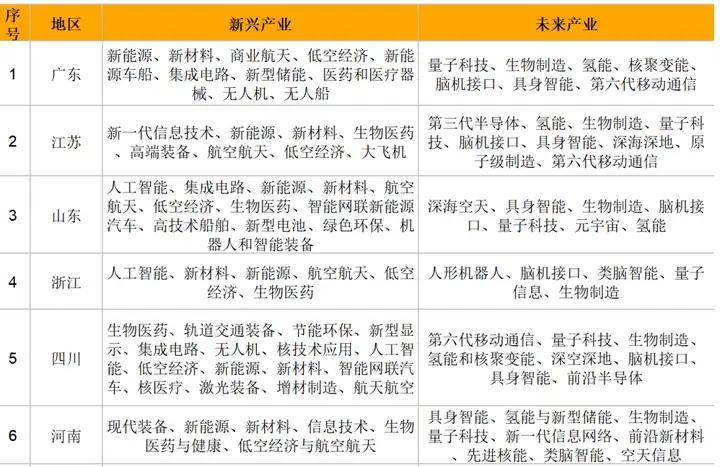
Core Insights - The "14th Five-Year Plan" marks the beginning of a new round of industrial transformation in China, with a clear focus on emerging and future industries across various provinces [1][10] - A comprehensive industrial map has emerged, showcasing strategic competition and collaboration among coastal economic provinces and emerging inland regions [1] Emerging Industries - Low-altitude economy is prioritized by over 28 provinces, making it a nearly universal focus, followed by new materials and new energy, each mentioned by 25 provinces [2] - Biomedicine is highlighted as the most covered future industry, appearing in the plans of 26 provinces, with embodied intelligence and hydrogen energy following closely with 20 and 19 provinces respectively [4] Regional Characteristics - Major economic provinces like Guangdong, Jiangsu, Shandong, and Zhejiang exhibit a comprehensive approach to industrial layout, focusing on both current and future industries [6][7] - Central and western provinces leverage their unique resources to carve out specialized paths, with Sichuan emphasizing nuclear technology and aerospace, while Hubei focuses on optoelectronic information [8] Future Industry Clusters - Six disruptive future industry clusters have been identified: - Intelligent integration cluster focusing on AI and embodied intelligence, with key regions including Zhejiang and Beijing [9] - Quantum information cluster led by Anhui and Beijing, focusing on quantum computing and communication [9] - Future energy cluster targeting hydrogen and nuclear fusion energy, with active participation from Inner Mongolia and Sichuan [9] - Aerospace and deep-sea cluster promoting commercial aerospace and low-altitude economy, with contributions from coastal and inland provinces [9] - Life sciences cluster redefining health and manufacturing, with strengths in Shanghai and Guangdong [9] - Advanced materials cluster providing foundational support for future industries, with significant efforts from Jiangsu and Zhejiang [9] Conclusion - The "14th Five-Year Plan" not only outlines an economic map but also serves as a strategic guide for China to seize opportunities in the global technological revolution and industrial transformation [10]
大创板企业累计融资超140亿元
Xin Lang Cai Jing· 2026-02-04 19:29
Group 1 - The Beijing University Student Entrepreneurship Board (Dachuang Board) held a collective listing ceremony for 53 new companies, marking their official entry into the board, which provides a series of policies and capital market services [1] - Over the past 10 years, the Dachuang Board has accumulated 447 companies with a registered capital exceeding 3.2 billion and total financing exceeding 14 billion, creating over 8,000 jobs [1] - The Dachuang Board, established in 2016, focuses on high-tech industries such as biomedicine, artificial intelligence, and new materials, providing a comprehensive support model for youth entrepreneurship in Beijing [1] Group 2 - One of the newly listed companies, Liu Technology, focuses on industrial network AI, which helps manufacturing companies reduce costs and improve efficiency, and joining the Dachuang Board is expected to attract capital and talent [2] - The Beijing Municipal Human Resources and Social Security Bureau has supported the Dachuang Board with over 20.95 million in funding, making the entire process of getting listed and services free for companies, thus reducing operational costs [3] - A diversified financing system has been established to address the challenges of financing for university student startups, including equity, debt, and special funds, with 136 companies receiving equity financing, and 40 of them exceeding 100 million in financing [3] Group 3 - A 1,100 square meter demonstration service base for the Dachuang Board has been established to incubate and promote university student entrepreneurship, providing full-process services from project cultivation to market connection [4] - The incubation base includes 20 institutions, such as the Beijing University Entrepreneurship Training Camp and Zhongguancun Software Park, to support the development of companies on the Dachuang Board [4]
谢锋大使会见美国药品研究与制造企业协会总裁兼首席执行官尤布尔
Xin Lang Cai Jing· 2026-02-04 18:26
转自:智通财经 【谢锋大使会见美国药品研究与制造企业协会总裁兼首席执行官尤布尔】智通财经2月5日电,据"中国 驻美国大使馆"公众号消息,2026年2月3日,中国驻美国大使谢锋应约会见美国药品研究与制造企业协 会(PhRMA)总裁兼首席执行官尤布尔。双方就中美生物医药行业政策、两国医药合作等议题深入交 换了意见。 ...
激发上海新动能,委员建议成立三大先导产业跨校育人联盟
第一财经· 2026-02-04 15:32
Core Viewpoint - Shanghai should leverage its advantages in new quality productivity, particularly in computing power and data, to support the construction of a modern industrial system characterized by "2+3+6+6" [3] Group 1: Talent and Industry Integration - The integration of the "industry chain-innovation chain-talent chain" is currently insufficient, necessitating the establishment of a new ecosystem for industry-education integration [4] - Recommendations include forming cross-school alliances in leading industries like integrated circuits, biomedicine, and artificial intelligence, along with a unified curriculum and resource-sharing platforms [4] - The need for a dual-recognition mechanism for talent between schools and enterprises is emphasized, allowing for a blend of academic and practical expertise [4][5] Group 2: Financial Capital and Early-Stage Investment - Financial capital is crucial for new quality productivity, with a call for a "cross-border ecological" technology finance model to empower early-stage hard technology transformation [8] - The "dual GP fund" model is highlighted as a successful approach, integrating investment with incubation and industrial implementation [9] - A shift from single investment models to ecological construction models is recommended, encouraging collaboration among funds, bases, and platforms [9] Group 3: Research Credit Innovation - The establishment of a "research credit innovation platform" is proposed, which would create a dynamic evaluation mechanism for the entire process of scientific research and technology commercialization [10] - Suggestions include setting up special funds for research credit and utilizing blockchain technology to create a unified and trustworthy research credit data foundation [10]