私募基金

Search documents
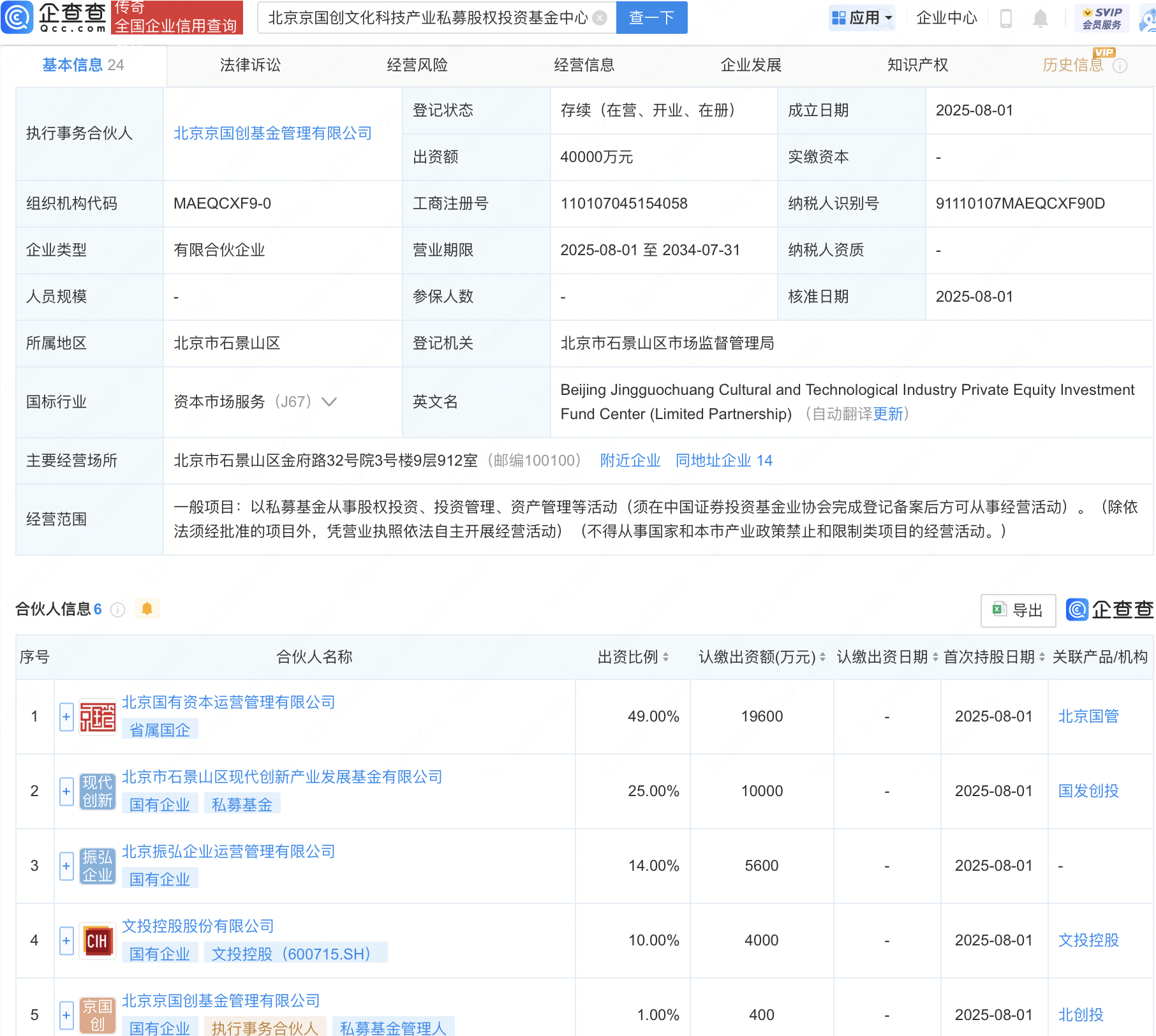
文投控股等新设文化科技产业私募股权投资基金中心
Sou Hu Cai Jing· 2025-08-05 07:12
Group 1 - The Beijing Jingguochuan Cultural Technology Industry Private Equity Investment Fund Center has been established with a capital contribution of 400 million yuan, focusing on private equity investment, investment management, and asset management activities [1][2] - The fund is a limited partnership and is registered in Shijingshan District, Beijing, with a business duration from August 1, 2025, to 2034 [2] - The fund's partners include Beijing State-owned Capital Operation Management Co., Ltd. (49%), Beijing Shijingshan Modern Innovation Industry Development Fund Co., Ltd. (25%), Beijing Zhenhong Enterprise Operation Management Co., Ltd. (14%), and Wen Tou Holdings Co., Ltd. (10%) [3][4] Group 2 - The fund is managed by Beijing Jingguochuan Fund Management Co., Ltd., which serves as the executive partner and private fund manager [4] - The fund's establishment indicates a growing interest in private equity investments within the cultural and technological sectors in Beijing [1][3] - The involvement of state-owned enterprises as major partners highlights the strategic importance of this fund in supporting innovation and development in the region [3][4]


百亿级量化私募首超主观私募
Shen Zhen Shang Bao· 2025-08-04 23:12
Core Insights - Since 2025, the A-share market has shown a structural trend favoring small and mid-cap stocks, leading to impressive performance from quantitative strategy private equity funds, with the best performers achieving a return of 73% [1] - The number of private equity funds with over 10 billion yuan in assets has rapidly expanded, surpassing the number of subjective private equity funds for the first time [2] Group 1: Performance Metrics - As of mid-year, 51 private equity funds with over 10 billion yuan reported an average return of 10.87% in the first half of the year, with 94.12% of these funds achieving positive returns [1] - Among the 48 funds that made profits, 21 had returns within 10%, another 21 had returns between 10% and 19.99%, and 6 funds achieved returns of 20% or more [1] - In the quantitative long strategy category, over 800 private equity products reported positive returns this year, with a success rate of approximately 94% [2] Group 2: Strategy Insights - Quantitative stock selection strategies have shown particularly strong performance, with an average return close to 20%, and the best product exceeding 54% [2] - The average return for quantitative index enhancement strategies is 17%, with 94% of these products achieving positive returns [2] - The growth of quantitative private equity funds is not solely driven by small-cap stocks, but rather reflects a broader strategy that can adapt to various market conditions [3]
期货及衍生品策略10强私募出炉!钧富投资、观理基金、杭州孚盈投资夺冠!百亿私募千象资产上榜!
私募排排网· 2025-08-04 10:00
Core Viewpoint - Since the "9.24 market" last year, the A-share market has shown a structural slow bull trend, with private equity products focusing on stock strategies achieving strong performance in the first half of this year and over the past year. However, over a longer time frame of three to five years, futures and derivatives strategies have shown stronger performance, with significant increases in commodities like gold and lithium carbonate [2][3]. Summary by Category Private Equity Strategy Performance - As of June 30, 2025, there are 593 futures and derivatives strategy products that meet ranking criteria, with average returns of 39.11% over three years and 97.41% over five years, outperforming other strategies [2][3]. - The average returns for various strategies in the first half of the year and over different time frames are as follows: - Stock Strategy: 12.36% (H1), 36.36% (1 year), 35.48% (3 years), 74.97% (5 years) - Futures and Derivatives Strategy: 5.04% (H1), 18.12% (1 year), 39.43% (3 years), 98.23% (5 years) - Multi-Asset Strategy: 8.20% (H1), 25.76% (1 year), 37.34% (3 years), 95.98% (5 years) - Bond Strategy: 5.54% (H1), 13.01% (1 year), 35.14% (3 years), 82.64% (5 years) - Combination Fund: 6.72% (H1), 20.70% (1 year), 15.06% (3 years), 34.10% (5 years) - Overall Average: 10.08% (H1), 30.13% (1 year), 35.81% (3 years), 80.06% (5 years) [3]. Top Performing Private Equity Firms - Among firms with over 20 billion in assets, the top three in futures and derivatives strategy returns over three years are: 1. Junfu Investment 2. Junchen Asset 3. Loshu Investment - The average returns for these firms are not disclosed due to regulatory requirements [4][5]. - Junfu Investment focuses on a diverse range of asset classes, including commodity strategies and various index enhancements, with eight qualifying products showing returns above a certain threshold [6][9]. Mid-Sized Private Equity Firms - For firms with 5-20 billion in assets, the top three in futures and derivatives strategy returns over three years are: 1. Guanzhi Fund 2. Zhemeng Investment 3. Mingrui (Beijing) Private Equity - The average returns for these firms are also not disclosed [10][12]. Small Private Equity Firms - Among firms with 0-5 billion in assets, the top three in futures and derivatives strategy returns over three years are: 1. Fuying Investment 2. Qihe New Asset Management 3. Mufeng Investment - The average returns for these firms exceed a certain threshold, with Fuying Investment's top product showing significant returns [15][16].

最新基金经理主观投资榜揭晓!童驯、徐红兵等夺冠!梁宏、王文、但斌等上榜!
私募排排网· 2025-08-04 07:00
Core Viewpoint - The article discusses the performance of subjective private equity funds in the A-share market, highlighting the advantages of subjective investment strategies over quantitative approaches in capturing structural opportunities and achieving superior returns [2][4]. Group 1: Performance of Subjective Private Equity Funds - As of July 25, 2023, the average return of subjective private equity funds was 5.74%, compared to 4.74% for quantitative funds [2]. - The average return for subjective long-only products in the top tier (over 5 billion) was 11.91%, with 96.30% of products showing positive returns [2][3]. - The top three fund managers in the over 50 billion category were Tong Xun from Tongben Investment, Lu Hang from Fusheng Asset, and Wang Yiping from Evolutionary Asset [2][3]. Group 2: Fund Manager Rankings by Size - In the 20-50 billion category, the average return was 15.32%, with 91.16% of products showing positive returns. The top managers were Xu Hongbing from Shenzhen Dream Factory Investment, Chen Yu from Shennong Investment, and He Xiao from Orange Capital [5][6]. - In the 10-20 billion category, the average return was 27.08%, with all products achieving positive returns. The leading managers were Sun Jie from Nengjing Investment, Zhai Jingyong from Rongshu Investment, and Ding Yushuang from Chenyao Private Fund [8][9]. - In the 5-10 billion category, the average return was 22.88%, with 91.99% of products showing positive returns. The top managers were Liu Xianglong from Fuyuan Capital, Chen Long from Youbo Capital, and Han Yongfeng from Jiu Private Fund [11][12]. - In the 0-5 billion category, the average return was 18.36%, with 90.24% of products showing positive returns. The top managers were Yao Yong from Qinxing Fund, Xian Lisheng from Weifang Fund, and Li Linkai from Xinjing Investment [15][16]. Group 3: Investment Strategies and Market Trends - Tong Xun and Lu Hang successfully captured the "new consumption" trend, leading to their top performance in the market [4]. - Chen Yu from Shennong Investment focused on innovative pharmaceuticals, benefiting from the sector's strong performance this year [7][8]. - Liu Xianglong from Fuyuan Capital emphasized high-growth new consumption companies, indicating a strategic focus on sectors poised for recovery [12][13].

税优保障如何成为私募精英的“隐形铠甲”?
私募排排网· 2025-08-04 03:36
Core Insights - The A-share market showed a trend of fluctuating growth in the first half of 2025, with quantitative private equity becoming a prominent investment force, achieving an average return of 8.32% across all private equity securities products, and 10% for stock strategy private equity [1] - Among 1,243 quantitative long strategy products, 93.32% achieved positive returns, with an average return rate of 15.42%, significantly outperforming other sub-strategies [1] - A wave of dividends emerged in the industry, with 558 private equity products distributing dividends, accounting for 14.09% of the total, amounting to 5.655 billion yuan [1] - High income for private equity managers leads to increased tax burdens, prompting them to seek legal and compliant tax optimization strategies [1] Group 1: Investment Performance - The average return for private equity securities products in the first half of 2025 was 8.32% [1] - Stock strategy private equity led with an average return of 10% [1] - Quantitative long strategy products had a remarkable average return of 15.42%, with 93.32% achieving positive returns [1] Group 2: Dividend Distribution - By the end of June 2025, 558 private equity products had distributed dividends, representing 14.09% of the total products with performance data [1] - The total amount of dividends distributed reached 5.655 billion yuan [1] Group 3: Tax Optimization Strategies - High income levels for private equity managers result in significant tax liabilities, including corporate income tax and value-added tax [1] - The need for tax optimization strategies is emphasized due to the high tax burden faced by managers in the quantitative private equity sector [1] Group 4: Risk Management and Insurance - Private equity managers face core risks including compliance, investment, operational, liquidity, reputation, and ethical risks throughout the fundraising, investment, management, and exit processes [3] - Professional liability insurance is deemed essential for private equity managers to mitigate risks associated with investment decisions and internal management [3][4] - The selection of professional liability insurance should focus on coverage that matches core business risks, including management and professional liability [4] Group 5: Employee Benefits and Insurance - The importance of a comprehensive employee benefits and insurance system is highlighted for attracting and retaining top talent in private equity firms [5] - Group accident insurance and employer liability insurance are included in the core benefits to provide comprehensive protection for employees [5] Group 6: Tax-Advantaged Insurance - The organization considers tax-advantaged insurance options, such as supplementary medical insurance, which can be deducted from total wages within 5% to reduce tax burdens [6] - The focus is on balancing tax compliance, employee needs, and cost-effectiveness when selecting insurance products [6] Group 7: Insurance Configuration Recommendations - Recommendations for insurance configurations for different roles within private equity firms include high-end medical insurance, critical illness insurance, and professional liability insurance [10][12][13][15] - Specific insurance products are suggested based on the unique risks associated with investment research, marketing, and operational roles [10][12][13][15]

量化私募卖得最好,量化产品因何开启财富密码?
Feng Huang Wang· 2025-08-03 22:21
Core Insights - The A-share market experienced significant gains in July, leading to increased issuance of private equity funds, particularly in the quantitative sector, which has shown strong performance this year [1][3][10] Group 1: Quantitative Private Equity Growth - As of July 30, 2023, a total of 3,059 quantitative private equity products have been registered this year, accounting for 45.7% of all registered products [1][4] - The number of newly issued quantitative private equity products increased by 1,129 in just two months, reflecting a substantial rise in both product quantity and market share [1][4] - The number of billion-level quantitative private equity firms reached 41 in July, surpassing subjective private equity firms for the first time [4][10] Group 2: Sales and Marketing Strategies - Companies are adopting innovative sales strategies, including increased roadshow frequency and rapid response times, to enhance sales capabilities [2][8] - The use of AI tools is being integrated into sales processes to improve efficiency and professionalism [2][8] - Effective communication with clients about the nature of quantitative strategies and their inherent risks is emphasized to build trust and understanding [8][9] Group 3: Performance Metrics - The average return for 33 billion-level quantitative private equity firms in the first half of the year was 13.54%, with all firms achieving positive returns [10][11] - In a volatile market, quantitative stock selection strategies have shown significant advantages, with top strategies yielding over 36% returns year-to-date [11][12]
积极参与全球配置87家内地私募获香港9号牌照
Shang Hai Zheng Quan Bao· 2025-08-03 13:34
Group 1 - The core viewpoint of the article highlights the increasing trend of private equity firms in mainland China obtaining Hong Kong's Type 9 license, enabling them to manage USD funds and expand their global investment strategies [1][2] - As of August 1, 2023, 87 mainland private equity firms have received the Type 9 license, with over 40% of these firms managing assets exceeding 5 billion yuan [1][2] - The article emphasizes that leading private equity firms are at the forefront of this trend, with 37 firms managing over 5 billion yuan, representing more than 40% of the licensed firms [2] Group 2 - The article notes that many top private equity firms are also exploring the Singapore market, indicating a broader regional expansion strategy [3][4] - The rising costs of office rentals and talent recruitment in both Hong Kong and Singapore reflect the accelerated pace of private equity firms going global [4] - The concept of "dual-directional engagement" is introduced, where both overseas investors and domestic asset management firms are actively seeking opportunities in each other's markets [5] Group 3 - The article discusses the importance of enhancing comprehensive capabilities for private equity firms as they venture abroad, focusing on compliance systems, risk management, and long-term performance attribution [6][7] - It is suggested that private equity firms should recruit talent with overseas experience and build high-level professional research teams to better understand foreign markets [7] - The need for private equity firms to strengthen their internal governance and investment strategies is emphasized, ensuring they adhere to value and long-term investment principles [7]
量化私募卖得最好!多家销售渠道集中反馈,量化产品因何开启财富密码?
Xin Lang Cai Jing· 2025-08-03 08:24
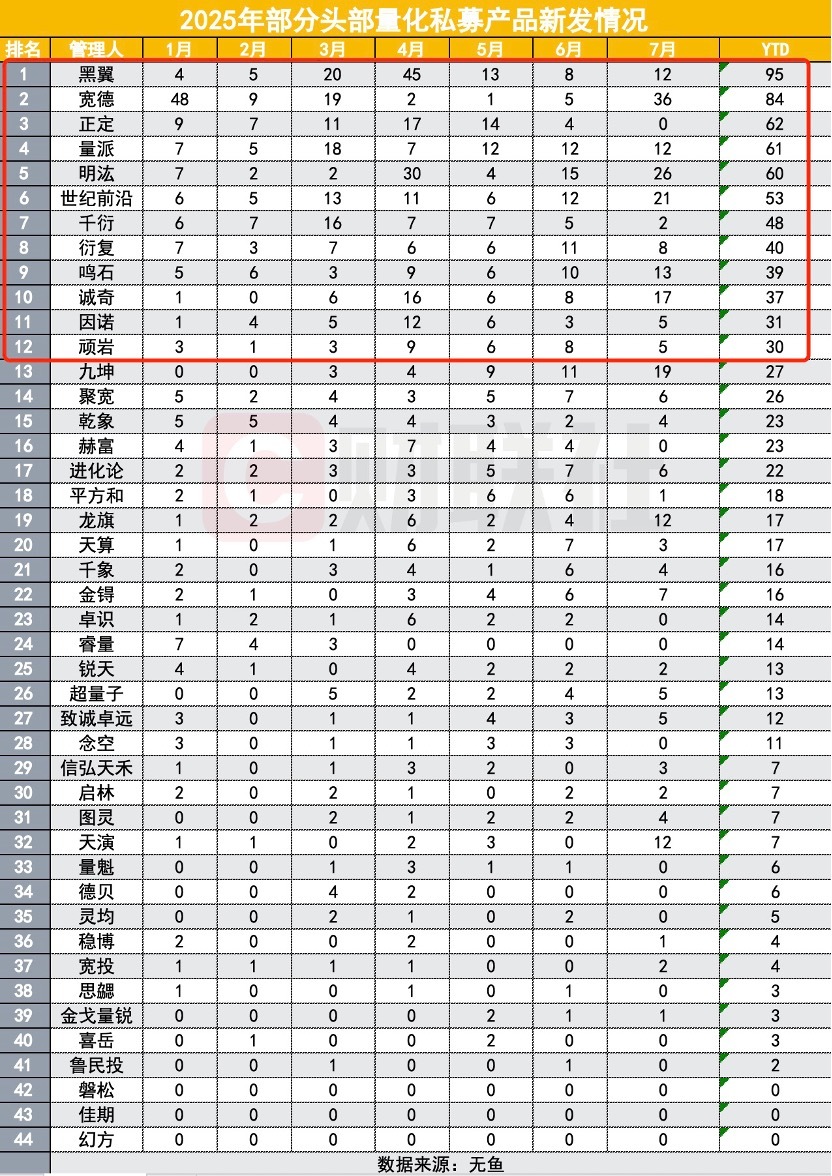
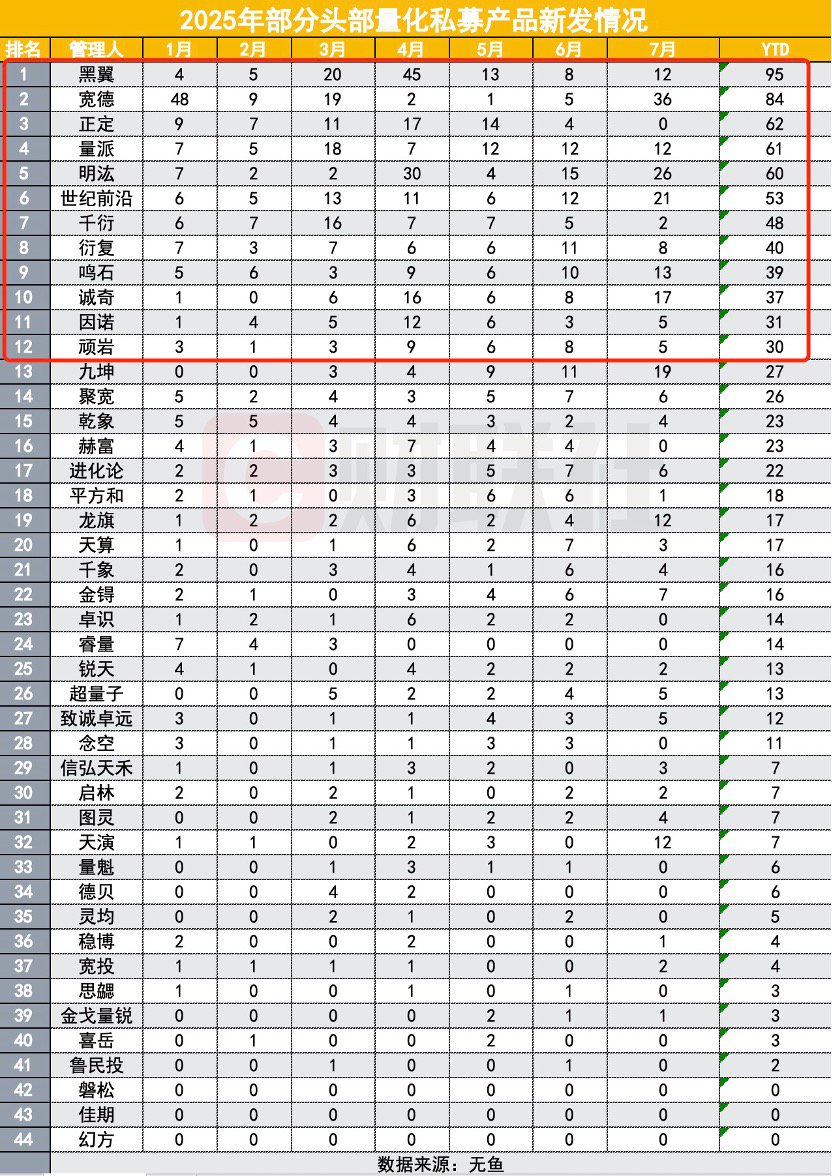
Group 1 - The core viewpoint of the articles highlights the significant growth in the issuance of quantitative private equity funds in the A-share market, driven by strong performance and investor interest [1][3][10] - As of July 30, 2023, a total of 3,059 quantitative private equity products have been registered this year, accounting for 45.7% of all registered products, with a notable increase of 1,129 new products in just two months [1][4] - The average return for quantitative private equity funds with performance data reached 13.54% in the first half of the year, outperforming other strategies [10][11] Group 2 - The number of quantitative private equity firms has increased, with 41 firms now classified as billion-level quantitative private equity, surpassing subjective private equity for the first time [4][5] - Major players in the quantitative private equity space include Heiwing Asset, which has registered 95 products this year, and Wide Investment, which has launched 84 products [5][6] - The industry is experiencing a shift towards high-quality development amid stricter regulations, with a reduction in the number of private equity firms and products, yet an increase in overall fund size by approximately 350 billion yuan [3][4] Group 3 - Sales strategies are evolving, with firms like Lingjun Investment adopting new approaches to enhance sales capabilities, including AI tools and tailored product matching based on client preferences [2][8] - Communication with clients is emphasized as crucial, with firms focusing on transparency and educating clients about the nature of quantitative strategies and their inherent risks [8][9] - The market for quantitative strategies is expected to continue growing, supported by strong performance and improved investor understanding [10][12]
海外资管机构的新选择:借道量化私募产品加仓A股
Jing Ji Guan Cha Wang· 2025-08-02 01:31
Group 1: Investment Trends - A significant improvement in overseas capital's investment sentiment towards China's economy and A-shares has been observed since the beginning of the year, particularly after a series of economic policies were introduced in September 2022 [2][5] - In the first half of the year, foreign investors net increased their holdings in domestic stocks and funds by $10.1 billion, reversing a two-year trend of net reductions [2][5] - The average return of 33 quantitative strategy private equity firms in the first half of the year was 13.54%, outperforming subjective strategy firms which had a return of 5.51% [6] Group 2: Challenges and Opportunities - Domestic quantitative private equity firms face multiple challenges in attracting overseas capital, including limited awareness among foreign brokers about their investment capabilities [8][9] - The investment decision-making cycle varies significantly among different types of overseas asset management institutions, with some requiring up to 1-2 years for decisions [7] - There is a growing trend of domestic quantitative private equity firms actively seeking overseas capital, with approximately 60% of surveyed firms having plans to expand internationally [3][4] Group 3: Market Dynamics - The recent interest from overseas asset management institutions in quantitative private equity products is driven by the underperformance of previously favored subjective strategy products [6][10] - The A-share market is being viewed as a potential alternative to U.S. stocks, with the A-share quantitative dividend strategy being compared to the Nasdaq 100 index due to its upward trend [11][12] - Factors such as low valuations in the A-share market and stronger-than-expected economic growth in China are contributing to the renewed interest from overseas asset managers [12][13]

私募策略也有周期性?股票多头上半年反攻!主观期货领衔近三年!
私募排排网· 2025-08-01 10:00
Core Viewpoint - The article discusses the performance of various private equity strategies in the A-share market amid geopolitical tensions and economic downturns, highlighting the recovery of stock strategies since the "9.24" market event and the strong performance of quantitative long strategies in the first half of 2025 [1][2][4]. Group 1: Private Equity Strategy Performance - As of June 30, 2025, all private equity secondary strategies achieved positive returns in the first half of the year, with quantitative long strategies leading at an average return of 16.31%, followed by subjective long strategies at 10.55% and macro strategies at 9.19% [2][4]. - The total trading volume of the A-share market exceeded 160 trillion yuan in the first half of the year, significantly higher than over 100 trillion yuan in the same period last year, indicating a notable increase in market activity [4]. - The strong performance of quantitative long strategies is attributed to their focus on small-cap stocks, which have performed well, with the CSI 2000 index rising over 15% and the micro-cap stock sector increasing over 40% [4]. Group 2: Top Performing Private Equity Products - As of June 30, 2025, there were 345 quantitative long private equity products with performance data, with the top three products being "Fengshou No. 2," "Liangying Risheng Exclusive No. 1 A Class," and "Baolit Quantitative No. 1," achieving significant excess returns [5][6]. - The top ten quantitative long strategies included products from major firms such as Longqi Technology and Wenbo Investment, with their excess returns also being noteworthy [6][11]. Group 3: Recent Trends in Private Equity Strategies - Over the past year, the top three performing private equity secondary strategies were quantitative long, subjective long, and other derivative strategies, with average returns of 48.32%, 32.00%, and 31.52% respectively [8][10]. - In the last three years, the top three strategies shifted to subjective CTA, other derivative strategies, and bond enhancement, with average returns of 69.36%, 69.29%, and 45.18% respectively, indicating a significant change in market dynamics [12][14].