
保险业

Search documents
资讯早班车-2025-12-02-20251202
Bao Cheng Qi Huo· 2025-12-02 01:58
1. Report Industry Investment Rating No relevant information provided. 2. Core Viewpoints of the Report - In the short - term, supply - demand and prices are the two major economic concerns. The manufacturing industry was in a state of passive de - stocking in November, and the relationship between production and demand improved slightly. However, the sustainability needs to be observed, and the endogenous demand in consumption and real estate needs to be strengthened. The price index has been repaired, with the front - end stronger than the back - end in structure [28]. - After the December Politburo meeting, the general policy direction for 2026 will be set, and the subsequent Central Economic Work Conference will make further deployments. Key areas of focus include monetary policy, fiscal policy, technological self - reliance, etc. The overall environment is favorable for the market [28]. 3. Summary of Each Section 3.1 Macro Data Overview - GDP growth rate in Q3 2025 was 4.8% year - on - year, down from 5.2% in the previous quarter but up from 4.6% in the same period last year [1]. - In November 2025, the manufacturing PMI was 49.2%, slightly up from 49.0% in the previous month but down from 50.3% in the same period last year; the non - manufacturing PMI for business activities was 49.5%, down from 50.1% in the previous month and 50.0% in the same period last year [1]. - In October 2025, the monthly increase in social financing scale was 816.1 billion yuan, significantly lower than 3529.9 billion yuan in the previous month but higher than 1412.0 billion yuan in the same period last year [1]. 3.2 Commodity Investment Reference 3.2.1 Comprehensive - From December 3, 2025, the speculative trading margin standard for the polysilicon futures PS2601 contract will be adjusted to 13%, and the hedging trading margin standard to 12%. The daily opening volume limit for non - futures company members or clients will be 500 lots [2]. - China's S&P manufacturing PMI in November was 49.9, down from 50.6 in the previous month [3]. - On December 1, 36 domestic commodity varieties had positive basis, and 30 had negative basis [3]. - The Bank of Japan Governor signaled a possible interest rate hike [3]. 3.2.2 Metals - Due to supply shortages and expectations of Fed rate cuts, silver prices soared to record highs. On Monday, spot silver reached over $58 per ounce, with a year - to - date increase of over 100% [4]. - On December 1, the price of battery - grade lithium carbonate rose to 94,400 yuan/ton, and the price of lithium hydroxide rose to 82,500 yuan/ton [5]. - As of November 28, lead, aluminum, and nickel inventories decreased, while zinc inventory increased [6]. 3.2.3 Coal, Coking, Steel, and Minerals - The China Iron and Steel Association emphasized accelerating key iron ore projects to enhance the industry's resource security capacity [8]. - Saudi Arabia launched a new round of mineral exploration tenders covering 13,000 square kilometers [8]. - Indonesia set the benchmark prices for different grades of coal for the first half of December [8]. 3.2.4 Energy and Chemicals - Two shale gas industry standards will be implemented on March 28, 2026, to support shale gas development [10]. - On December 1, international oil prices rose due to geopolitical risks and supply - side factors [10]. - Saudi Aramco and Algerian National Oil Company raised LPG prices by 3% - 5% in December [10]. 3.2.5 Agricultural Products - The domestic corn market has been rising strongly, with significant price increases in major ports [11]. - On December 1, the domestic live - hog futures contract 2601 was at a low level, and the spot market prices mostly fell [11]. - The USDA reported weekly export sales data for various agricultural products in the US [11][12]. 3.3 Financial News Compilation 3.3.1 Open Market - On December 1, the central bank conducted 107.6 billion yuan of 7 - day reverse repurchase operations, with a net withdrawal of 231.1 billion yuan [14]. 3.3.2 Key News - French President Macron will visit China from December 3 - 5 [15]. - The CSRC is promoting the pilot of commercial real estate investment trusts (REITs) to support the real estate market [16]. - As of the end of October, the balance of loans in the Yangtze River Delta region showed certain growth trends [17]. - In November, new energy vehicle sales rankings were released, with BYD leading [17]. 3.3.3 Bond Market Summary - The Chinese bond market was mostly strong and volatile. Interest - rate bond yields mostly declined, and treasury - bond futures had mixed performance [21]. - Exchange - traded bonds, especially Vanke bonds, generally declined [21]. - The CSI Convertible Bond Index rose 0.10% [22]. 3.3.4 Foreign Exchange Market - The on - shore RMB against the US dollar rose 69 basis points on December 1 [27]. - The US dollar index fell 0.03% in New York trading [27]. 3.3.5 Research Report Highlights - Huatai Fixed - Income commented on the November official manufacturing PMI, highlighting supply - demand and price concerns [28]. - Guosheng Macro's Xiong Yuan released a report on the possible policy directions after the December Politburo meeting [28]. 3.3.6 Today's Reminders - On December 2, 155 bonds will be listed, 101 bonds will be issued, 54 bonds will be settled, and 135 bonds will pay principal and interest [29][30]. 3.4 Stock Market Key News - A - shares rose unilaterally, with technology themes active. The Shanghai Composite Index rose 0.65%, and the trading volume expanded to 1.89 trillion yuan [31]. - The Hong Kong Hang Seng Index rose 0.67%, and the Southbound funds had a net purchase of HK$2.148 billion [31]. - Shenzhen Stock Exchange will adjust samples of multiple indices on December 15 [31].
债海观潮,大势研判:多空交织,利率低位震荡
Guoxin Securities· 2025-12-01 14:12
Group 1 - The report indicates that in November, most bond varieties experienced a rise in yields, with all interest rate bonds showing a slight increase in yield [2][6] - Long-term low-grade credit bonds saw a decline in yields, with the 5-year AA- credit bond yield decreasing by 16 basis points [17][18] - The report highlights a rebound in default amounts in November, totaling 7.75 billion yuan, which is an increase from the previous month [27] Group 2 - The overseas economic outlook shows a stabilization in US inflation expectations, while economic conditions in Europe and Japan are improving [40][35] - Domestic economic growth in China showed a significant slowdown in October, with GDP growth dropping to 4.2%, down 1.1 percentage points from September [2][56] - The report notes that the high-frequency macro diffusion index for November indicates that domestic economic growth momentum remains weak [74][79] Group 3 - The monetary policy outlook suggests a low probability of interest rate cuts in the fourth quarter, as the central bank has engaged in net absorption in the open market [93][104] - The report emphasizes a shift from "disconnected stock and bond markets" to a scenario where they are more aligned, driven by macroeconomic factors [106][111] - The bond market is expected to experience low-level fluctuations, with a continued decline in government bond financing growth anticipated for the fourth quarter [2][92]
除了12315,还有哪些正规投诉渠道值得一试?
Xin Lang Cai Jing· 2025-12-01 09:21
Core Viewpoint - Consumers have multiple effective channels for complaint beyond the official 12315 hotline, which can enhance the success rate of consumer rights protection [12] Group 1: Official Complaint Channels - The National Financial Supervision Administration (12378 hotline) is a specialized complaint channel for banking services, credit card disputes, insurance claims, and financial products, known for its high efficiency and professionalism [2] - The State Post Bureau's complaint website and WeChat mini-program are effective for issues related to lost, damaged, or delayed deliveries, providing strong constraints on courier companies [3] - The Telecommunications User Complaint Handling Center (12300) is a key regulatory channel for telecom service issues, such as package disputes and signal problems [4] Group 2: Third-Party Social Platforms - Third-party complaint platforms like the Black Cat Complaint platform offer convenience and strong public opinion oversight, serving as important supplements to official channels [5] - The Black Cat Complaint platform features multiple access points, an intelligent processing system, a transparent supervision mechanism, and maintains a neutral stance as a public welfare platform [6] Group 3: Other Notable Complaint Channels - The China Consumers Association and local consumer associations are legally established organizations that protect consumer rights through complaint handling and consumer warnings [7] - E-commerce platforms have their own internal complaint mechanisms that respond quickly, especially when evidence is clear [9] - Quality supervision and inspection channels can be approached for product quality issues, particularly concerning safety standards and quality certification [10] Group 4: Choosing the Right Complaint Channel - Consumers should select complaint channels based on the industry, such as using 12378 for financial issues, the postal bureau for delivery problems, and 12300 for telecom issues [11] - The nature of the complaint should also guide the choice, with 12315 for illegal activities and third-party platforms for quick resolutions [11] - Using multiple channels simultaneously can enhance the effectiveness of complaints, such as combining 12315 with the Black Cat platform for a comprehensive approach [11]
港股收评:恒指涨0.67%、科指涨0.82%,有色金融、航运股走高,加密货币及新消费概念股走低
Sou Hu Cai Jing· 2025-12-01 08:49
Market Overview - The Hong Kong stock market showed a slight upward trend, with the Hang Seng Index rising by 0.67% to close at 26,033.26 points, and the Hang Seng Tech Index increasing by 0.82% to 5,644.76 points [1] - Major technology stocks mostly rose, with Alibaba up 2.24%, Tencent up 1.31%, and JD Group up 0.52%. However, Xiaomi fell by 1.76% and Meituan dropped by 2.88% [1] - The metals sector saw significant gains, with China Nonferrous Mining rising over 13% [1] - Cryptocurrency-related stocks generally declined, with New Fire Technology Holdings down over 9% [1] Company News - Meituan reported Q3 revenue of 95.5 billion yuan, a year-on-year increase of 2%, but its core local business operating profit turned negative, resulting in a loss of 14.1 billion yuan [2] - China Gas reported revenue of 34.481 billion HKD and a profit of 1.334 billion HKD for the six months ending September 30, 2025 [3] - Yingtong Holdings reported a revenue of 1.028 billion RMB, a year-on-year decrease of 3.42%, but net profit increased by 15.4% to 133 million RMB [3] - Jihai Resources reported a revenue of 450 million RMB, a year-on-year increase of 23.41%, with a net profit of 88.127 million RMB, up 2.98% [3] - Yuhua Education reported annual revenue of 2.497 billion RMB, a year-on-year increase of 5.4%, and a net profit of 930 million RMB, up 133.2% [3] - Huitai Textile reported mid-term revenue of 2.524 billion HKD, a year-on-year decrease of 6.72%, and a net profit of 79.322 million HKD, down 25.77% [3] - Huaxin Handbag International reported revenue of 432 million HKD, a year-on-year increase of 22.55%, and a profit of 48.262 million HKD, up 78.88% [4] Institutional Insights - GF Securities noted that the foundation for a bull market in Hong Kong stocks remains intact, but the evolution may present a "volatile upward, gradually rising" characteristic rather than a rapid increase [12] - Dongwu Securities indicated that short-term risk factors in Hong Kong stocks are decreasing, but a catalyst is needed for confirmation of a rebound [12] - Everbright Securities suggested that compared to previous bull markets, there is still significant room for index growth, but the duration of the bull market may be more important than the magnitude of the increase [12] - CICC highlighted that dividends have become a preferred choice in the current market environment, with the banking sector rebounding nearly 10% since the end of September [13]
流动性与机构行为跟踪:基金、券商共振抛券
ZHONGTAI SECURITIES· 2025-12-01 08:38
1. Report Industry Investment Rating No information provided in the content. 2. Core View of the Report This week (from November 24th to November 28th), the capital interest rates were differentiated, the daily average of large - bank lending increased, and funds slightly reduced leverage; the maturity of certificates of deposit decreased, and the yield curve of certificate of deposit maturity steepened; in terms of spot bond transactions, the main buyers were large banks, mainly increasing holdings of 1 - 3Y interest - rate bonds, while funds and securities firms were the main sellers, with funds mainly selling 7 - 10Y and 20 - 30Y interest - rate bonds, and insurance companies continuing to increase allocations to 20 - 30Y ultra - long interest - rate bonds [3]. 3. Summary by Directory 3.1 Currency and Capital Market - A total of 1,676 billion yuan of reverse repurchases matured this week. The central bank cumulatively injected 1,511.8 billion yuan of reverse repurchases from Monday to Friday, injected 1,000 billion yuan of MLF on Tuesday (900 billion yuan of MLF matured on the same day), and 300 billion yuan of outright repurchases matured on Friday. The net liquidity withdrawal for the whole week was 364.2 billion yuan. 1,000 billion yuan of outright repurchases will mature next Friday [7][10]. - As of November 28th, R001, R007, DR001, and DR007 were 1.43%, 1.52%, 1.3%, and 1.47% respectively, with changes of 3.75BP, 2.7BP, - 1.76BP, and 2.6BP compared to November 24th, and were at the 19%, 9%, 11%, and 4% historical quantiles respectively [7][13]. - The daily average of large - bank lending increased slightly. From November 24th to November 28th, the total lending scale of large banks was 19.24 trillion yuan, with a maximum daily lending scale of 4 trillion yuan and a daily average lending scale of 3.8 trillion yuan, an increase of 0.22 trillion yuan compared to the previous week's daily average [7][17]. - The trading volume of pledged repurchase decreased. The daily average trading volume was 7.09 trillion yuan, with a maximum daily volume of 7.56 trillion yuan, a decrease of 2.77% compared to the previous week's daily average. The proportion of overnight repurchase transactions decreased, with a daily average proportion of 86.7% and a maximum daily proportion of 91.1%, a decrease of 2.21 percentage points compared to the previous week's daily average, and was at the 95.4% quantile as of November 28th [7][19]. 3.2 Certificates of Deposit and Bills - The issuance scale of inter - bank certificates of deposit increased this week, and the net financing amount increased. The total issuance volume was 559.25 billion yuan, an increase of 26.22 billion yuan compared to the previous week; the total maturity volume was 802.04 billion yuan, a decrease of 104.99 billion yuan compared to the previous week. The net financing amount was - 242.79 billion yuan, an increase of 130.41 billion yuan compared to the previous week [7][23]. - By bank type, city commercial banks had the highest issuance scale. This week, the issuance scales of inter - bank certificates of deposit by state - owned banks, joint - stock banks, city commercial banks, and rural commercial banks were 115.11 billion yuan, 192.21 billion yuan, 194.55 billion yuan, and 46.38 billion yuan respectively, with changes of 33.46 billion yuan, 18.8 billion yuan, - 22.9 billion yuan, and - 1.08 billion yuan compared to the previous week [23]. - By term type, the 9 - month issuance scale was the highest. The issuance scales of 1 - month, 3 - month, 6 - month, 9 - month, and 1 - year inter - bank certificates of deposit were 48.88 billion yuan, 107.26 billion yuan, 144.51 billion yuan, 153.97 billion yuan, and 104.63 billion yuan respectively, with changes of - 440 million yuan, 90.31 billion yuan, - 32.12 billion yuan, 71.31 billion yuan, and - 102.84 billion yuan compared to the previous week. The 9 - month certificates of deposit accounted for the highest proportion of the total issuance of certificates of deposit by different types of banks, at 27.53%, mainly due to more issuances by state - owned banks; the 6 - month term accounted for 25.84%, mainly due to more issuances by city commercial banks [24]. - The maturity volume of certificates of deposit decreased this week. The total maturity volume was 802.04 billion yuan, a decrease of 104.99 billion yuan compared to the previous week. The certificates of deposit maturing next week (from December 1st to December 5th) will be 448.81 billion yuan [28]. - This week, the issuance interest rates of certificates of deposit of most banks increased, and the issuance interest rates of certificates of deposit of most terms increased. By bank type, as of November 28th, the issuance interest rates of one - year certificates of deposit of joint - stock banks, state - owned banks, city commercial banks, and rural commercial banks changed by 1.04BP, 0BP, - 0.7BP, and 2BP respectively compared to November 21st, and were at the 4%, 5%, 3%, and 7% historical quantiles; by term, as of November 28th, the issuance interest rates of 1 - month, 3 - month, and 6 - month certificates of deposit changed by 4.74BP, 0.68BP, and - 2.9BP respectively compared to November 21st, and were at the 5%, 3%, and 2% historical quantiles [30]. - This week, the Shibor interest - rate curve steepened. As of November 28th, the overnight, 1 - week, 2 - week, 1 - month, and 3 - month Shibor interest rates changed by - 1.9BP, 2BP, 0.7BP, 0.1BP, and 0.2BP respectively compared to November 21st, reaching 1.3%, 1.44%, 1.53%, 1.52%, and 1.58% [32]. - This week, the yield curve of certificate of deposit maturity steepened. As of November 28th, the 1 - month, 3 - month, 6 - month, 9 - month, and 1 - year maturity yields of AAA - rated ChinaBond commercial bank inter - bank certificates of deposit were 1.45%, 1.58%, 1.62%, 1.64%, and 1.64% respectively, with changes of - 4.5BP, 0.15BP, 0.5BP, 0.75BP, and 0.5BP compared to November 21st [7][34]. - This week, the bill interest rates were differentiated. As of November 28th, the 3 - month national - share direct discount rate, 3 - month national - share transfer discount rate, 6 - month national - share direct discount rate, and 6 - month national - share transfer discount rate were 0.75%, 0.42%, 0.87%, and 0.78% respectively, with changes of 3BP, - 21BP, 5BP, and - 4BP compared to November 21st [7][38]. 3.3 Institutional Behavior Tracking - The inter - bank leverage ratio decreased. As of November 28th, the total inter - bank leverage ratio in the bond market decreased by 0.28 percentage points to 105.98% compared to November 21st, and was at the 8.10% historical quantile since 2021 [40]. - The leverage ratio of broad - based funds decreased slightly. As of November 28th, the leverage ratios of banks, securities firms, insurance companies, and broad - based funds were 102.7%, 179.2%, 130.2%, and 104.4% respectively, with changes of - 0.51BP, - 12.87BP, 0.93BP, and - 0.13BP compared to November 21st, and were at the 2%, 0%, 80%, and 7% historical quantiles respectively as of November 28th [7][42]. - The central value of the net - buying duration of funds turned negative, while rural commercial banks and wealth - management products increased their durations. As of November 28th, the weighted average net - buying duration (MA = 10) of funds was - 2.62 years, turning negative compared to 2.56 years on November 21st, and was at the 5% historical quantile; the weighted average net - buying duration (MA = 10) of wealth - management products was 1.54 years, increasing compared to November 21st, and was at the 68% historical quantile; the weighted average net - buying duration (MA = 10) of rural commercial banks was - 0.46 years, increasing compared to November 21st, and was at the 36% historical quantile; the weighted average net - buying duration (MA = 10) of insurance companies was 10.21 years, decreasing compared to November 21st, and was at the 71% historical quantile [7][44]. - The duration of medium - and long - term pure - bond funds decreased this week. As of November 28th, the duration of medium - and long - term pure - bond funds decreased by 0.09 years to 3.33 years compared to November 21st, and was at the 18% historical quantile since this year; the duration of short - term pure - bond funds increased by 0.05 years to 1.45 years compared to November 21st, and was at the 34% historical quantile since this year [48].
金融监管总局:确保香港大埔火灾捐赠资金零延时到账
Bei Ke Cai Jing· 2025-12-01 07:09
Core Points - A significant fire occurred in Hong Kong's Tai Po District, resulting in major casualties and property damage [1] - The National Financial Regulatory Administration issued a special notice to banks and insurance companies to provide financial support for the affected individuals [1] Banking Sector - Chinese banks in Hong Kong are required to enhance financial services to assist affected customers [1] - Banks should consider providing repayment deferrals based on the actual circumstances of affected clients [1] - Support for post-disaster recovery and reconstruction is emphasized, including meeting credit needs for fire prevention, disaster relief, and livelihood security [1] Insurance Sector - Insurance institutions are instructed to proactively provide services and efficiently allocate resources for damage assessment and compensation [1] - The principle of "compensate as much as possible, compensate quickly, and reasonably pre-compensate" is to be followed, with simplified procedures and optimized processes [1] - Timely claims processing is essential to help affected residents resume their lives [1] Online Services - The notice highlights the importance of online banking and remote insurance reporting services to ensure safe and convenient financial services [1] - A green channel for donations is to be established, simplifying the review process for donations while ensuring timely transfer of funds [1]
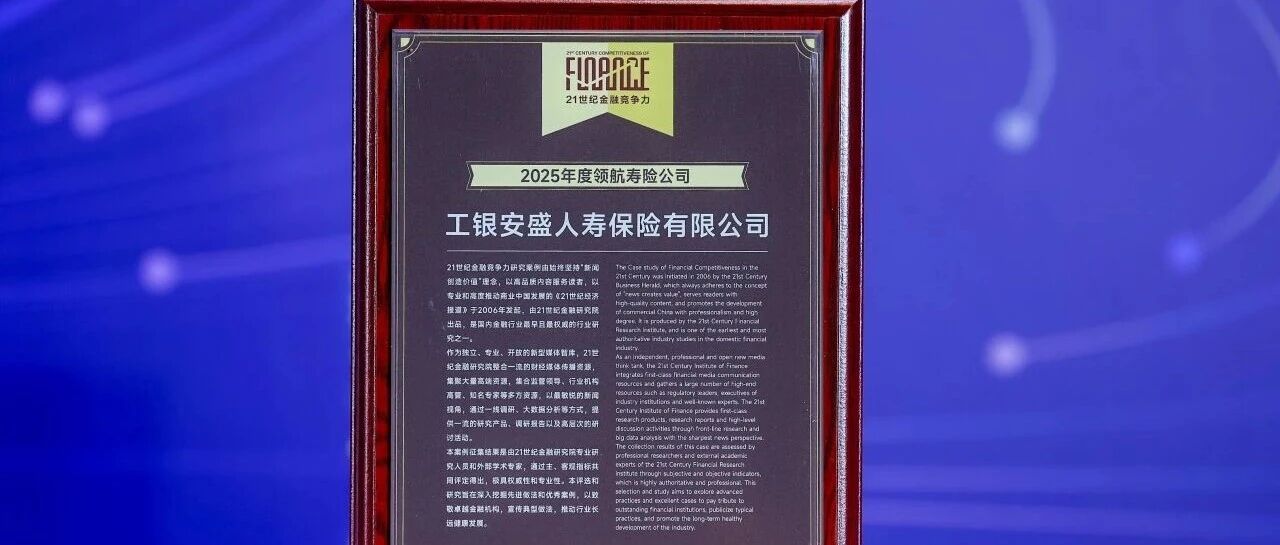
荣获“年度领航寿险公司”,工银安盛人寿如何“领航”?
21世纪经济报道· 2025-12-01 02:07
Core Viewpoint - ICBC-AXA Life Insurance has emerged as a benchmark for high-quality development among joint venture and bank-affiliated insurance companies, recognized for its outstanding performance at the 21st Century Financial Annual Conference [1] Group 1: Business Performance - In the first three quarters of 2025, ten bank-affiliated insurance companies collectively achieved premium income of approximately 456.4 billion yuan, reflecting a year-on-year growth of 16.83% [4] - ICBC-AXA Life Insurance stands out with its total assets and net profit ranking among the top in bank-affiliated insurance companies, leading domestic joint venture life insurance firms [4] - Since its establishment in 2012, the company has expanded its assets at a compound annual growth rate of 32%, with annual premium growth reaching 21%, demonstrating strong operational resilience [4] Group 2: Risk Management and Strategic Alignment - The company emphasizes risk prevention as a core theme of financial work, integrating "risk control foundation" into its "Double Seven Strategy" [5] - In 2024, ICBC-AXA Life Insurance received an AAA rating in risk comprehensive assessment from the National Financial Regulatory Administration, maintaining a "zero bad debt" record [5] - As of the end of Q3 2025, the company's core solvency adequacy ratio was 175%, and the comprehensive solvency adequacy ratio was 243%, indicating solid capital strength [5] Group 3: Investment and Social Responsibility - The company has invested over 190.8 billion yuan in key regions aligned with national strategies, supporting high-quality regional development [6] - ICBC-AXA Life Insurance leverages its insurance funds to support high-end manufacturing and contribute to the transformation of the industry [6] - The company integrates the values of its shareholders to enhance its brand, focusing on diverse and accessible insurance products, and has implemented initiatives like providing exclusive insurance for delivery personnel in collaboration with JD Group [6] Group 4: Future Outlook - ICBC-AXA Life Insurance is committed to advancing its "Double Seven Strategy" and is on a steady path towards high-quality development in the insurance industry [7]

金融助农新模式 信贷嵌入“保险+期货”
Jing Ji Guan Cha Bao· 2025-11-30 09:36
Core Viewpoint - The "Bank + Insurance + Futures" model is emerging as a new breakthrough for banks to increase credit support for agriculture, addressing the challenges faced by farmers in terms of crop yield, market prices, and sales [3][7]. Group 1: Project Overview - The "Yinqi Bao" crop insurance project was launched by the Dalian Commodity Exchange in 2023 to meet the diverse needs of large-scale grain producers, providing both agricultural income insurance and enhanced credit support from banks [2][4]. - As of now, 22 such projects have been established, providing a total of 91 million yuan in loans to 55 cooperatives [2]. Group 2: Challenges and Solutions - The promotion of the "Bank + Insurance + Futures" model faces three main challenges: the need for increased government subsidies for insurance premiums, the integration of various agricultural data to improve loan efficiency, and the provision of personalized financial services for different farmers [3][12]. - Financial institutions are working with experts to encourage policymakers to include this model in official documents as a key strategy for supporting agriculture [3]. Group 3: Financial Mechanism - The "Insurance + Futures" model allows agricultural operators to purchase price or income insurance, which is then hedged in the futures market to mitigate price volatility risks [4][5]. - This model has proven effective in various regions, such as in Guangxi, where pig farmers received over 18 million yuan in insurance payouts due to price fluctuations [5]. Group 4: Impact on Farmers - Farmers participating in the "Yinqi Bao" project can significantly increase their loan limits, with one farmer reporting an increase from 500,000 yuan to over 1 million yuan, allowing for expansion of planting areas and potential income increases of at least 100,000 yuan [6][7]. - The project also includes mechanisms for guaranteed sales through contracts with leading enterprises and a secondary pricing option that allows farmers to benefit from price increases in the futures market [6][7]. Group 5: Data Integration and Customization - Banks are facing challenges in creating a closed-loop system for loans and repayments, as well as in providing customized credit solutions based on the diverse financial situations of farmers [10][12]. - Efforts are being made to integrate various agricultural data to enhance credit assessment and provide higher loan limits, with some banks offering up to 3 million yuan in credit support [12][13]. Group 6: Premium Subsidies - The cost of agricultural income insurance can be significant, with premiums accounting for 5%-6% of the insured amount, leading to financial strain on farmers [14]. - Government and financial institutions are working to increase premium subsidies to alleviate the financial burden on farmers and encourage participation in the "Bank + Insurance + Futures" model [15][17].

新华财经早报:11月30日
Xin Hua Cai Jing· 2025-11-30 01:10
我国将继续坚持对虚拟货币的禁止性政策,持续打击虚拟货币相关非法金融活动 国家航天局设立商业航天司持续推动商业航天高质量发展 数据中心过热致芝商所中断交易超10小时媒体:凸显数字经济时代市场交易平台过度集中存在风险 据中国人民银行29日消息,中国人民银行日前召开打击虚拟货币交易炒作工作协调机制会议。会议强调,虚拟货币不具有与法定货币等同的法律地位,不具 有法偿性,不应且不能作为货币在市场上流通使用,虚拟货币相关业务活动属于非法金融活动。稳定币是虚拟货币的一种形式,目前无法有效满足客户身份 识别、反洗钱等方面的要求,存在被用于洗钱、集资诈骗、违规跨境转移资金等非法活动的风险。会议要求把防控风险作为金融工作的永恒主题,继续坚持 对虚拟货币的禁止性政策,持续打击虚拟货币相关非法金融活动。(新华财经) 国家金融监督管理总局11月29日发布通知,指导银行业保险业全力做好香港大埔火灾的金融保障服务等工作,高效查勘理赔,做好保险保障服务,加强金融 信贷支持,积极助力受灾重建。(新华社) 据应急管理部网站29日消息,日前,国务院安委会印发通知,部署开展高层建筑重大火灾风险隐患排查整治行动,聚焦有人员居住和活动的高层民用建筑 ( ...

金融监管总局:做好大埔火灾金融保障服务,确保捐赠资金零延时到账
Ren Min Ri Bao· 2025-11-29 13:33
Core Viewpoint - The National Financial Regulatory Administration has issued a notification requiring the banking and insurance sectors to enhance financial support services in response to the recent fire disaster in Tai Po, Hong Kong [1] Group 1: Insurance Sector Response - Insurance institutions are required to proactively provide services, allocate resources for damage assessment, and ensure timely compensation for affected clients [1] - The principles of "full compensation, quick compensation, and reasonable pre-compensation" are emphasized to streamline procedures and optimize processes [1] - The focus is on helping disaster-affected residents restore their livelihoods through efficient claims processing [1] Group 2: Banking Sector Support - Chinese banks in Hong Kong are urged to increase financial services to assist affected customers in overcoming difficulties [1] - Banks are encouraged to consider providing repayment deferrals based on the actual circumstances of affected clients [1] - There is a strong emphasis on supporting post-disaster recovery and reconstruction, particularly in meeting credit demands for fire prevention, disaster relief, production, transportation, and livelihood security [1] Group 3: Technological and Operational Enhancements - The notification calls for enhanced technological support, ensuring smooth access to mobile banking, online banking, and remote insurance reporting services [1] - A combination of online and offline services is to be provided to ensure safe and convenient financial services [1] - Establishment of a donation green channel is mandated, simplifying the review process for donations to ensure funds are transferred without delay [1]