贸易

Search documents
中成股份: 中成进出口股份有限公司截至2025年06月30日止前次募集资金使用情况报告
Zheng Quan Zhi Xing· 2025-09-03 16:21
Summary of Key Points Core Viewpoint The report outlines the usage of previously raised funds by Zhongcheng Import and Export Co., Ltd. as of June 30, 2025, detailing the total amount raised, its allocation, and the financial implications of these actions. Group 1: Fundraising Overview - The company raised a total of RMB 244,499,997.12 through a private placement of 41,390,728 shares at a price of RMB 6.04 per share, after deducting underwriting fees [1][2]. - The net amount raised after fees was RMB 243,456,114.36, which was transferred to a designated fund account [1][2]. Group 2: Fund Management - The funds were stored in a dedicated account at the Industrial and Commercial Bank of China, with a balance of RMB 54,765.13 as of August 16, 2021, after the funds were used to repay bank loans and cover issuance costs [1][2]. - The company completed the necessary procedures to close the fund account on August 17, 2021, after all funds were utilized as planned [1][2]. Group 3: Fund Utilization - The funds were used to replace self-raised funds that had been used to repay bank loans totaling RMB 251,544,200 and to cover issuance costs of RMB 1,436,515 [2]. - As of June 30, 2025, there were no changes in the investment projects funded by the previous fundraising, and all funds had been fully utilized [2][3]. Group 4: Economic Benefits - The funds were primarily used for debt repayment, which is expected to optimize the company's financial structure and reduce financial costs, thereby enhancing repayment capacity [2]. - The report indicates that the funds did not generate direct measurable benefits since they were used for debt repayment rather than new investments [2].

中成股份: 中成进出口股份有限公司截至2025年06月30日止前次募集资金使用情况报告的鉴证报告
Zheng Quan Zhi Xing· 2025-09-03 16:21
Group 1 - The report provides a reasonable assurance engagement on the use of previously raised funds by Zhongcheng Import and Export Co., Ltd. as of June 30, 2025 [1][2] - The management of Zhongcheng Import and Export Co., Ltd. is responsible for preparing the report in accordance with the relevant regulations set by the China Securities Regulatory Commission [1][2] - The company raised a total of RMB 244,499,997.12 after deducting underwriting fees, with the funds being deposited into a special account [3][4] Group 2 - The company established a special account for the storage of raised funds, which was verified by an accounting firm [3][4] - As of August 16, 2021, the balance in the raised funds account was RMB 54,765.13, which was subsequently transferred to the company's account [4] - The company used the raised funds to replace self-raised funds for repaying bank loans and covering issuance costs, totaling RMB 25,298.07 million [5]
中成股份: 中成进出口股份有限公司未来三年(2025-2027年)股东回报规划
Zheng Quan Zhi Xing· 2025-09-03 16:21
Group 1 - The company has established a shareholder return plan for the next three years (2025-2027) to ensure a scientific, sustainable, and stable dividend decision-making and supervision mechanism [1][2] - The plan aims to balance reasonable returns for shareholders with the company's sustainable development, considering industry characteristics, development strategy, profitability, and cash flow [1][2] - The company will generally adopt cash dividends, with a minimum of 30% of the average distributable profit over three consecutive years to be distributed in cash, unless specific conditions are met [2][4] Group 2 - The company will differentiate its cash dividend policy based on its development stage and significant capital expenditure arrangements, with minimum cash dividend ratios set at 80%, 40%, and 20% for different scenarios [2][3] - The profit distribution plan will be reviewed every three years to ensure continuity, stability, and scientific basis [4] - The company will engage with shareholders, especially small and medium investors, through various communication channels to gather opinions and concerns regarding profit distribution [4]
中成股份: 中国银河证券股份有限公司关于中成进出口股份有限公司内幕信息知情人登记制度的制定和执行情况的核查意见
Zheng Quan Zhi Xing· 2025-09-03 16:21
Group 1 - The independent financial advisor, China Galaxy Securities, was commissioned by Zhongcheng Import and Export Co., Ltd. to conduct a review of the insider information knowledge person registration system related to the asset acquisition and fundraising transaction [1][2] - The company has established a strict and effective confidentiality system in compliance with relevant laws and regulations, ensuring that sensitive information is disclosed only in accordance with legal requirements [1][2] - The company has taken necessary and sufficient protective measures to limit the knowledge of sensitive information and has adhered to confidentiality obligations prior to the legal disclosure of transaction information [2] Group 2 - The company has signed confidentiality commitment letters with intermediary institutions, clearly defining the scope of confidential information and the responsibilities related to confidentiality [2] - The company's stock will be suspended from trading starting May 16, 2025, following an application to the Shenzhen Stock Exchange [2] - The independent financial advisor confirmed that the company has complied with legal and regulatory requirements in establishing its confidentiality measures [2]

上市公司4亿元资金被占用,存在退市风险,股价6天跌掉29%!大股东变卖优质资产还钱
Mei Ri Jing Ji Xin Wen· 2025-09-03 10:16
Core Viewpoint - The announcement from Xinhua Jin reveals significant fund occupation issues, amounting to 406 million yuan, by its major shareholder, Xinhua Jin Group, raising concerns among over 20,000 shareholders about potential delisting risks if the funds are not recovered in time [1][10]. Fund Occupation Issues - Xinhua Jin Group and its affiliates have occupied 406 million yuan of the company's funds, with the occupation period from January 1, 2025, to June 30, 2025 [3][10]. - As of the half-year report disclosure date, the balance of occupied funds remains at 406 million yuan, indicating a failure to repay [3][10]. - In the first half of 2025, Xinhua Jin Group and its affiliates occupied approximately 801 million yuan, with partial repayments made in April, but funds were subsequently reallocated due to financial pressures from strategic investors [4][6]. Repayment Plans - Xinhua Jin Group intends to use 665 million yuan from the sale of Jimo Yellow Wine to repay the occupied funds, with this receivable already pledged to the company, granting it priority in repayment [2][12]. - The completion of the acquisition of Jimo Yellow Wine by Qingdao Beer is crucial for the repayment, but uncertainties remain regarding the execution of the sale and repayment agreements [14]. Financial Performance - For the first half of 2025, Xinhua Jin reported revenues of approximately 669 million yuan, a year-on-year decline of 24.92%, and a net profit attributable to shareholders of about 12.87 million yuan, down 39.45% [6][9]. - The company's net assets at the end of the reporting period were approximately 1.22 billion yuan, reflecting a slight increase of 0.97% compared to the previous year [9]. Market Reaction - Following the announcement of the fund occupation, Xinhua Jin's stock price fell over 4%, with a total decline of 29.66% over six trading days since the news broke [14].


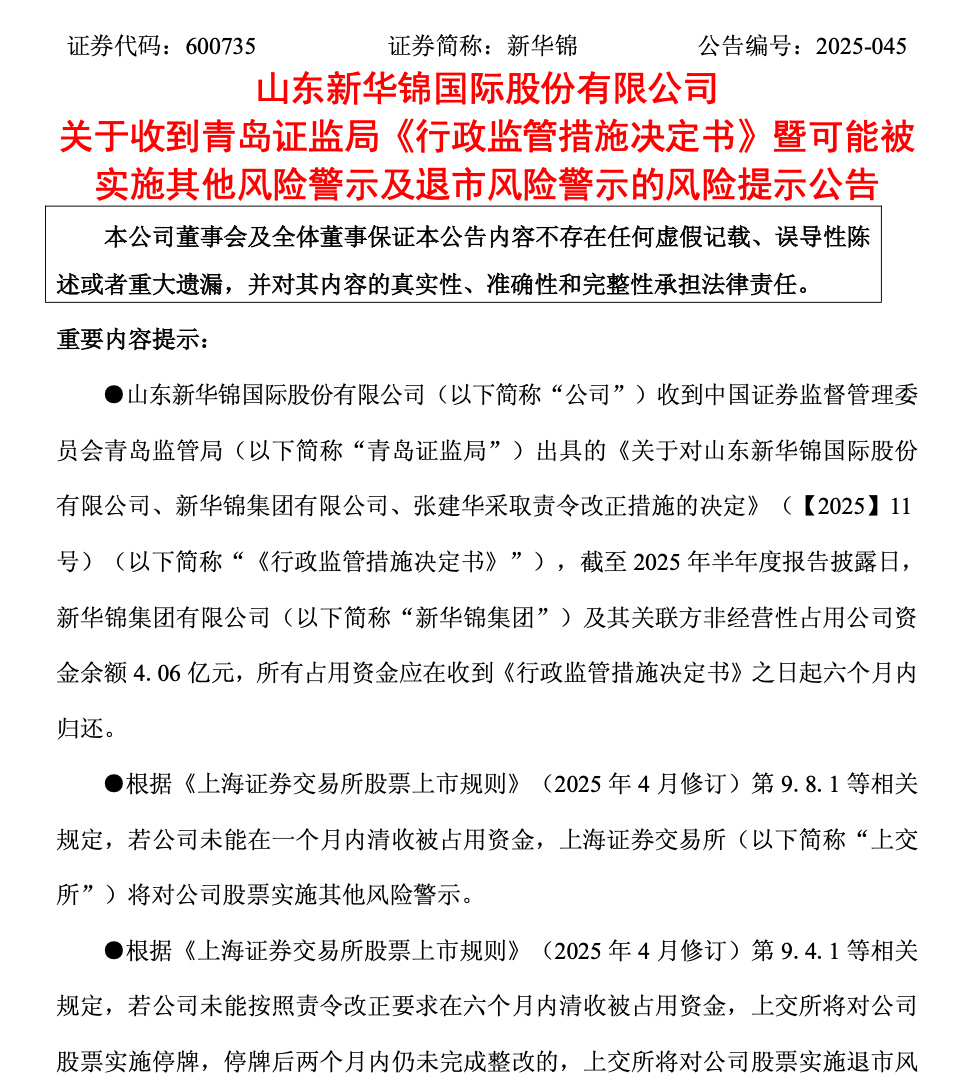
贸易板块9月3日跌1.66%,五矿发展领跌,主力资金净流入1243.3万元
Zheng Xing Xing Ye Ri Bao· 2025-09-03 08:40
Market Performance - On September 3, the trade sector declined by 1.66%, with WISCO leading the drop [1] - The Shanghai Composite Index closed at 3813.56, down 1.16%, while the Shenzhen Component Index closed at 12472.0, down 0.65% [1] Individual Stock Performance - Nanjing Shanglv (600250) saw a significant increase of 6.08%, closing at 13.09 [1] - Other notable movements include: - Yiatong (002183) up by 1.95% to 4.70 - Kairuide (002072) down by 0.84% to 7.12 - Jiangsu Guotai (002091) down by 2.06% to 8.10 [1] Capital Flow Analysis - The trade sector experienced a net inflow of 12.43 million yuan from institutional investors and 23.11 million yuan from retail investors, while individual investors saw a net outflow of 35.55 million yuan [2] - Key stocks in terms of capital flow include: - Yiatong (002183) with a net inflow of 59.47 million yuan from institutional investors [2] - Nanjing Shanglv (600250) with a net inflow of 53.69 million yuan from institutional investors [2] - Kairuide (002072) with a net inflow of 6.95 million yuan from institutional investors [2]

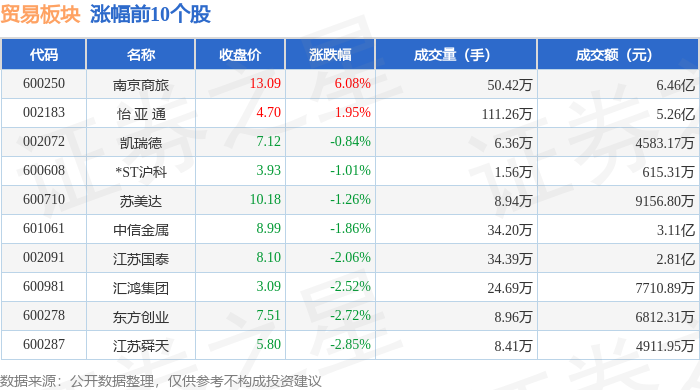
午评:沪指半日跌0.96% 游戏板块领涨
Zhong Guo Jing Ji Wang· 2025-09-03 03:48
Market Overview - The A-share market opened high but closed lower, with the Shanghai Composite Index at 3820.98 points, down 0.96%, and the Shenzhen Component Index at 12474.44 points, down 0.63% [1] - The ChiNext Index remained flat at 2872.12 points [1] Sector Performance Top Performing Sectors - The gaming sector increased by 1.42%, with a total trading volume of 940.11 million hands and a net inflow of 173.66 billion [2] - The film and television sector rose by 1.02%, with a trading volume of 628.13 million hands and a net outflow of 1.36 billion [2] - The electronic chemicals sector saw a gain of 0.89%, with a trading volume of 775.46 million hands and a net inflow of 8.19 billion [2] Underperforming Sectors - The military equipment sector declined by 5.12%, with a trading volume of 1471.68 million hands and a net outflow of 58.26 billion [2] - The military electronics sector fell by 3.59%, with a trading volume of 788.21 million hands and a net outflow of 21.09 billion [2] - The small metals sector decreased by 3.15%, with a trading volume of 1032.60 million hands and a net outflow of 11.76 billion [2]
贸易板块9月2日跌0.07%,江苏舜天领跌,主力资金净流出5036.02万元
Zheng Xing Xing Ye Ri Bao· 2025-09-02 08:59
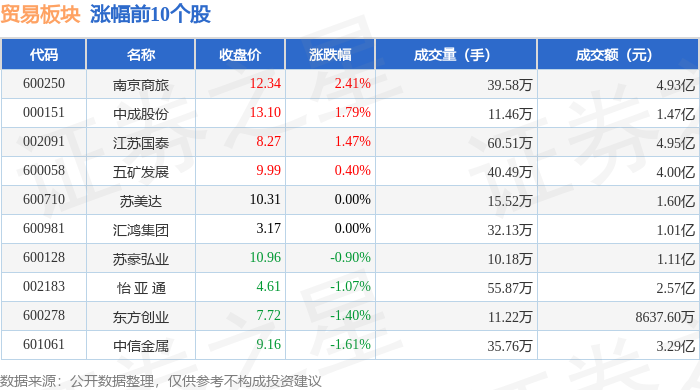
证券之星消息,9月2日贸易板块较上一交易日下跌0.07%,江苏舜天领跌。当日上证指数报收于 3858.13,下跌0.45%。深证成指报收于12553.84,下跌2.14%。贸易板块个股涨跌见下表: | 代码 | 名称 | 收盘价 | 涨跌幅 | 成交量(手) | 成交额(元) | | | --- | --- | --- | --- | --- | --- | --- | | 600250 | 南京商旅 | 12.34 | 2.41% | 39.58万 | | 4.93亿 | | 000151 | 中成股份 | 13.10 | 1.79% | 11.46万 | | 1.47亿 | | 002091 | 江苏国泰 | 8.27 | 1.47% | 1 60.51万 | | 4.95 乙 | | 600058 | 五矿发展 | 66.6 | 0.40% | 40.49万 | | 4.00亿 | | 600710 | 赤美达 | 10.31 | 0.00% | 15.52万 | | 1.60亿 | | 600981 | 汇鸿集团 | 3.17 | 0.00% | 32.13万 | | 1.01亿 | | 600128 ...

欧洲理事会主席喊话美国:欧盟不欢迎关税!美联储9月降息概率89.6%,金银期价齐创历史新高!
Qi Huo Ri Bao· 2025-09-01 23:40
Group 1: Federal Reserve and Interest Rates - The probability of the Federal Reserve maintaining interest rates unchanged in September is 10.4%, while the probability of a 25 basis point cut is 89.6% [1] - In October, the probability of maintaining rates is 4.9%, with a cumulative 25 basis point cut probability of 47.3% and a 50 basis point cut probability of 47.9% [1] Group 2: European Union Trade Relations - The President of the European Council, Costa, stated that the EU does not welcome tariffs and will defend its sovereignty and the interests of its citizens and businesses [2] - Costa acknowledged that many Europeans feel frustrated with the EU's passive stance in trade with the U.S. and the Ukraine issue [2] - The EU is working to establish stronger global trade and industrial partnerships to enhance predictability and resilience, reducing strategic dependencies [2] Group 3: Military and Geopolitical Tensions - German Defense Minister Pistorius refuted EU Commission President von der Leyen's claims about deploying European troops to Ukraine, stating she lacks the authority to discuss such matters [3] - The German government has remained largely silent on discussions regarding sending peacekeeping troops to Ukraine, deeming it "premature" [3] - Venezuelan President Maduro claimed that Venezuela faces the greatest threat in a century from U.S. military presence, with significant naval deployments in the Caribbean [4] Group 4: Precious Metals Market - Gold and silver futures prices reached historical highs, with COMEX gold peaking at $3,557.1 per ounce and silver at $41.64 per ounce [5] - The surge in precious metals prices is driven by expectations of a Federal Reserve rate cut and heightened risk aversion in the market [5][6] - Silver's performance is bolstered by strong industrial demand and a persistent supply deficit, particularly in solar energy and electronics [6][8] Group 5: Economic Indicators and Future Outlook - The core PCE index in the U.S. has shown a continuous rise, and the second-quarter GDP was revised up to 3.3%, indicating persistent inflation risks [7] - The demand for gold remains strong despite increased mining supply, while central banks continue to maintain a steady net purchase of gold [8] - The outlook for precious metals prices remains bullish, with potential further increases if U.S. economic data shows a moderate decline and the Fed proceeds with rate cuts [9]
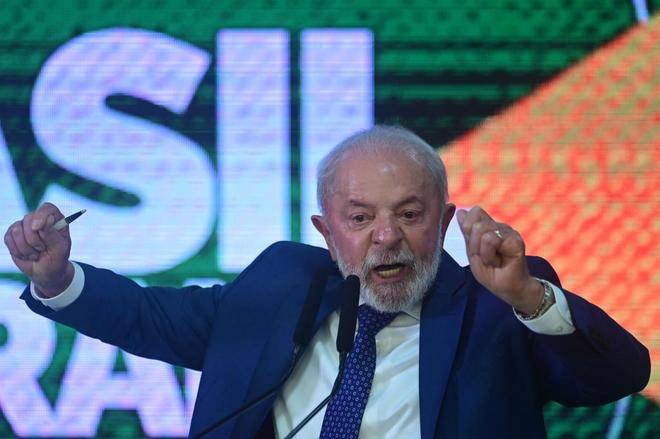
巴西启动反制相关程序,卢拉说仍愿与美国谈判
Sou Hu Cai Jing· 2025-09-01 09:36
Group 1 - The Brazilian government has officially initiated procedures related to the Economic Equivalence Law to respond to high tariffs imposed by the U.S. on Brazilian exports [1] - President Lula expressed that while Brazil is preparing countermeasures, there is no rush to retaliate against the U.S., emphasizing a preference for negotiation to resolve differences [1][3] - The Brazilian government has authorized an investigation into the U.S. unilateral tariff actions, with a technical analysis report expected within 30 days to determine the appropriateness of countermeasures [1][3] Group 2 - The Economic Equivalence Law, passed by the Brazilian Congress in April, allows Brazil to impose countermeasures such as tariffs on imports from countries that negatively impact Brazil's international competitiveness [3] - The U.S. has imposed tariffs of up to 40% on various Brazilian exports, with some products facing tariffs as high as 50%, while certain items like aircraft and nuts are exempt [3] - Brazil's Finance Minister indicated the possibility of legal action in U.S. courts to protect Brazilian interests and seek fair treatment in light of the high tariffs [3] Group 3 - The U.S. Federal Circuit Court ruled that the Trump administration lacked congressional authority to impose certain tariffs, marking a setback for the administration's trade policies [5] - Following the ruling, Trump asserted that all tariffs remain in effect and plans to appeal to the Supreme Court [5]