消费金融

Search documents
“养生游”变诈骗陷阱!官方提醒,银发族守好钱袋子
券商中国· 2025-08-03 06:53
Core Viewpoint - The article emphasizes the increasing prevalence of scams targeting the elderly population in China, particularly as they become more familiar with technology and various investment schemes [3][8]. Group 1: Scam Awareness - The People's Bank of China, Shenzhen Branch, has released information highlighting new scams specifically aimed at the elderly, who are often lured by seemingly attractive offers such as free health tours and expert talks on wellness [3][7]. - The article warns that these offers may disguise investment scams, urging the elderly to be cautious and avoid falling for such traps [3][8]. Group 2: Ongoing Anti-Fraud Campaigns - Since July, a nationwide anti-fraud campaign has been actively promoted, with various financial institutions participating in educational efforts to raise awareness about fraud prevention [7][8]. - The campaign includes the use of diverse media formats, such as short videos and social media, to disseminate financial knowledge and alert the public to potential scams [8][9]. Group 3: Technological Advancements in Fraud Prevention - Financial institutions are increasingly adopting advanced technologies like artificial intelligence and big data to enhance their fraud prevention measures, creating a new paradigm of "intelligent prevention and ecological governance" [8][10]. - The article notes that the complexity of fraud techniques has escalated, necessitating more sophisticated risk identification and analysis capabilities [10][11]. Group 4: Collaborative Efforts in Fraud Prevention - The article discusses the shift in financial institutions from reactive measures to proactive prevention strategies, highlighting the importance of collaboration between banks and law enforcement to quickly respond to fraud cases [9][12]. - There is a growing emphasis on establishing information-sharing mechanisms within the industry to create a more effective anti-fraud ecosystem [12].


天津滨海:以“投”引“资” 锻造发展“硬支撑”
Sou Hu Cai Jing· 2025-08-03 01:21
Economic Performance - Binhai New Area's GDP grew by 5.4% in the first half of the year, maintaining a steady growth trend [1] - Fixed asset investment increased by 9.6%, contributing 73% to the city's growth [1] - General public budget revenue rose by 5.8%, surpassing national and city averages [1] Industrial Development - Binhai New Area focuses on strategic emerging industries such as aerospace, biomedicine, and integrated circuits, driving innovation and forming industry clusters [2][3] - Major projects include investments in JD Consumer Finance and battery recycling, with new retail projects like JD MALL becoming operational [2] Financial Integration - The area promotes financial integration with industry, enhancing support for real economy through green and technology finance [3][6] - A significant investment platform was established with a total investment of 55 billion yuan to enhance effective investment [5] Policy Support - The implementation of 22 specific measures to stabilize foreign trade and investment, including the removal of restrictions on foreign investment in manufacturing [7] - Continuous policy support is driving effective investment and project establishment in Binhai New Area [7] Future Outlook - Binhai New Area aims to strengthen key industries and promote project implementation to sustain economic growth [8] - The area is committed to preventing financial risks while achieving new results in high-quality development [8]
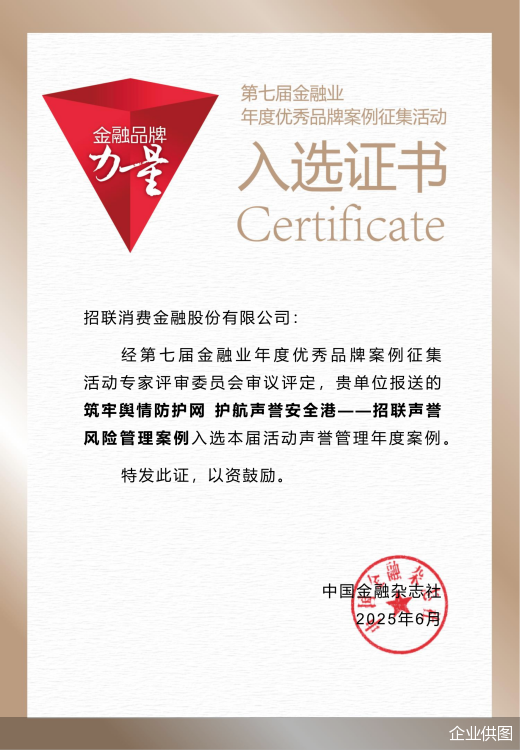
以消保为核心构建声誉护城河 招联三度斩获《中国金融》杂志声誉管理优秀品牌案例
Bei Jing Shang Bao· 2025-08-01 14:14
Core Viewpoint - The article highlights that China UnionPay's consumer finance company, Zhaolian, has been recognized for its reputation risk management practices, winning the "Reputation Management Annual Case" award, marking its third recognition in this area [1][3]. Group 1: Reputation Management - Zhaolian's reputation risk management case, titled "Building a Public Opinion Protection Network, Safeguarding Reputation Safety Harbor," stood out among nearly 400 submissions from 207 financial institutions [1][3]. - The evaluation was conducted by experts from various industry associations and academia, covering multiple dimensions such as brand communication, social responsibility, and corporate culture [3]. Group 2: Consumer Rights Protection - Consumer rights protection is a critical element of Zhaolian's reputation risk management, with the company prioritizing consumer satisfaction and feedback alongside financial performance metrics [4]. - Zhaolian has integrated consumer protection as a core capability, equating "complaint rate" with "bad debt rate," and has utilized AI technology to enhance consumer protection measures [4]. Group 3: Consumer Education and Engagement - Zhaolian actively promotes consumer financial knowledge and risk awareness through various educational materials, reaching nearly 300 million consumers through campaigns aligned with significant consumer rights events [5]. - The company has received recognition for its efforts in enhancing financial literacy among residents in Shenzhen, demonstrating a commitment to consumer education and engagement [5]. Group 4: Future Outlook - Zhaolian aims to continue deepening its reputation management and consumer protection efforts, enhancing its brand image and market competitiveness to contribute to the high-quality development of the financial industry [5].
融慧金科受邀共创蚂蚁数科“金融智能体联盟”
Zhong Guo Chan Ye Jing Ji Xin Xi Wang· 2025-08-01 07:24
Group 1 - The core viewpoint of the news is the establishment of the "Financial Intelligent Agent Application Co-Creation Alliance" initiated by Ant Group's Ant Financial Science and Technology and over ten technology partners, including Ronghui Jinke, to promote industry standards and applications of financial AI [1] - The alliance aims to create an open and win-win collaborative platform to drive industry prosperity through the co-creation of industry standards, exploration of innovative mechanisms for application, and sharing of ecological value [2] - Since its establishment in 2017, Ronghui Jinke has served nearly 200 licensed financial institutions, playing a key role in the digital transformation of the consumer finance industry [2] Group 2 - Ronghui Jinke is entering a "New Ronghui" strategic phase by 2025, focusing on deepening data ecology, breakthrough applications of AI technology, and upgrading its full-link empowerment system [2] - The four innovative advantages of "New Ronghui" include deepening the perspective of clients, building a multi-dimensional data network, driving agile innovation through AI, and upgrading the full-link system to empower financial institutions [2] - Ant Financial's Vice President, Sun Lei, expressed confidence that the collaboration among partners will unleash unprecedented innovative power to promote the inclusive and large-scale application of intelligent agents in the financial industry [2]
百融云-W午后涨超11% 百融云创蝉联“大模型创新应用奖” 机构看好AI+消费金融
Zhi Tong Cai Jing· 2025-08-01 06:40
Group 1 - Bairong Cloud-W (06608) saw an afternoon increase of over 11%, currently up 10.16% at HKD 9.65, with a trading volume of HKD 48.08 million [1] - Bairong Cloud won the "AI Model Innovation Application Award" at the 2025 Innovation Development Forum, marking its second consecutive year receiving this award [1] - According to Guotai Junan Securities, AI is gradually being implemented in various sectors such as securities research, bank credit, marketing channels, insurance agent empowerment, small business marketing, and consumer finance risk control, indicating a broad future potential [1] Group 2 - The report highlights a positive outlook for the consumer finance industry, particularly in intelligent customer service, smart marketing, and intelligent risk control scenarios [1] - Bairong Cloud is recommended as a key player in the rapidly developing consumer finance sector [1]
兴业消费金融股份公司2024年第三期金融债券跟踪评级获“AAA”评级
Sou Hu Cai Jing· 2025-08-01 03:23
2025年7月31日,中诚信国际公布评级报告,兴业消费金融股份公司2024年第三期金融债券跟踪评级 获"AAA"评级。 中诚信国际认为,兴业消费金融股份公司信用水平在未来12~18个月内将保持稳定。 来源:金融界 本次跟踪维持主体及债项上次评级结论,主要基于兴业消费金融股份公司(以下简称"兴业消费金 融"、"公司"或"发行人")强大的股东支持、利润留存不断积累等正面因素对公司整体经营及信用水平 的支撑作用;同时,中诚信国际关注到,政策及竞争环境存在不确定性、宏观经济增速放缓对公司资产 质量的影响以及公司业务发展、升级对人才及技术压力等因素对公司经营及信用状况形成的影响。 ...
金融领域,“国补”来了
财联社· 2025-07-31 16:07
Core Viewpoint - The implementation of personal consumption loan interest subsidy policies and service industry loan interest subsidy policies aims to alleviate credit burdens for residents with genuine consumption needs and to support service-oriented consumption, thereby stimulating market activity and economic growth [1][2][3]. Group 1: Policy Implementation - The State Council's meeting emphasized the importance of fiscal and financial collaboration to boost consumption and activate the market by focusing on both personal consumption and service industry loan demands [1][2]. - The policies are seen as a form of "national subsidy" in the financial sector, aimed at reducing credit costs for residents and financing costs for service industry entities, thus enhancing consumption potential and market vitality [2][3]. Group 2: Financial Institutions' Role - Financial institutions are encouraged to design matching interest-subsidized loan products and ensure compliance in fund usage, with a focus on specific consumption scenarios [4][5]. - Institutions should actively identify financing needs among small and medium-sized enterprises in sectors like catering, housekeeping, and childcare, especially those affected by the pandemic or planning expansion [5]. Group 3: Consumer Financing Products - Financial institutions have accelerated the launch of consumer financing products tailored to consumption upgrades, such as "Consumption Upgrade Loan" and "Green Consumption Loan" [6]. - A roadmap for financial support to boost consumption has been outlined, combining credit support, scenario discounts, and green incentives to lower consumer costs and enhance willingness to spend [6].

乐信上涨2.36%,报6.285美元/股,总市值10.58亿美元
Jin Rong Jie· 2025-07-31 14:27
Core Viewpoint - Lexin (LX) has shown a stock price increase of 2.36% on July 31, reaching $6.285 per share, with a total market capitalization of $1.058 billion [1] Financial Performance - As of March 31, 2025, Lexin reported total revenue of 3.104 billion RMB, a year-on-year decrease of 4.25% [1] - The net profit attributable to shareholders was 430 million RMB, reflecting a significant year-on-year increase of 113.43% [1] Upcoming Events - Lexin is scheduled to disclose its mid-year report for the fiscal year 2025 on August 26, with the actual disclosure date subject to company announcements [2] Company Overview - Lexin Holdings Limited is recognized as a leading new consumption service platform in China, focusing on technological innovation to create new consumption methods [2] - The company has developed a new consumption service ecosystem centered around its installment consumption brand, Fenqile, and membership-based service brand, Lekar [2] - Lexin's main business segments include the quality installment shopping platform Fenqile Mall, membership service platform Lekar APP, financial technology open platform Dingsheng Technology, online lending information intermediary service platform Juzi Finance, and wealth management service brand Lexin Wealth [2]

趣店上涨2.68%,报3.83美元/股,总市值6.32亿美元
Jin Rong Jie· 2025-07-31 13:49
Core Insights - Qudian Inc. (QD) opened with a 2.68% increase, reaching $3.83 per share, with a total market capitalization of $632 million as of July 31 [1] - Financial data indicates that as of March 31, 2025, Qudian's total revenue was 25.789 million RMB, a decrease of 53.82% year-over-year, while net profit attributable to shareholders was 150 million RMB, reflecting a significant increase of 303.92% year-over-year [1] Financial Performance - Total revenue for Qudian as of March 31, 2025, was 25.789 million RMB, down 53.82% compared to the previous year [1] - Net profit attributable to shareholders reached 150 million RMB, showing a year-over-year growth of 303.92% [1] Upcoming Events - Qudian is scheduled to release its mid-year report for the fiscal year 2025 on September 5, with the actual disclosure date subject to company announcements [2] - The company is focused on consumer-oriented technology solutions and is exploring innovative consumer products and services to meet the basic needs of Chinese consumers [2]

从亏3亿到赚1.5亿!中银消金左手甩不良,右手搭合作
Nan Fang Du Shi Bao· 2025-07-31 10:41
近期,中银消费金融三股东上海陆家嘴金融发展有限公司发布了2025年半年报,其中披露了中银消费金 融2025年上半年业绩表现。 据半年报显示,中银消费金融总资产达817.03亿元,较上年末增长2.55%;营业收入达36.81亿元,同比 增长2.8%;净利润扭亏为盈,为1.5亿元,去年同期亏损3.06亿元。 | | | | | | | 甲保:元 巾秤:人民中 | | | --- | --- | --- | --- | --- | --- | --- | --- | | | | 開来会額/ 本期发生額 | | | | 開初会額/ 上開发生額 | | | | 上海中心失腹健设发 | 上海湖东盗景城房 | | 中银消费金融有限公 上海螺塔置业有限 上海中心大厦建设 上海域东嘉里城房 | | 中製消費公體有限 | 上海醒悠置业有限 | | | 展有限公司 | 地产有限公司 | | 52.10 发展有限公司 | 地产机版公司 | 22.70 | 100 | | 境动资产 | 924, 541, 630, 76 | 428, 430, 077. 57 | 79, 226, 745, 527, 70 | 24, 793, 97 ...