
电力

Search documents
官宣!李嘉诚出手,一把套现超千亿
Sou Hu Cai Jing· 2026-02-26 02:45
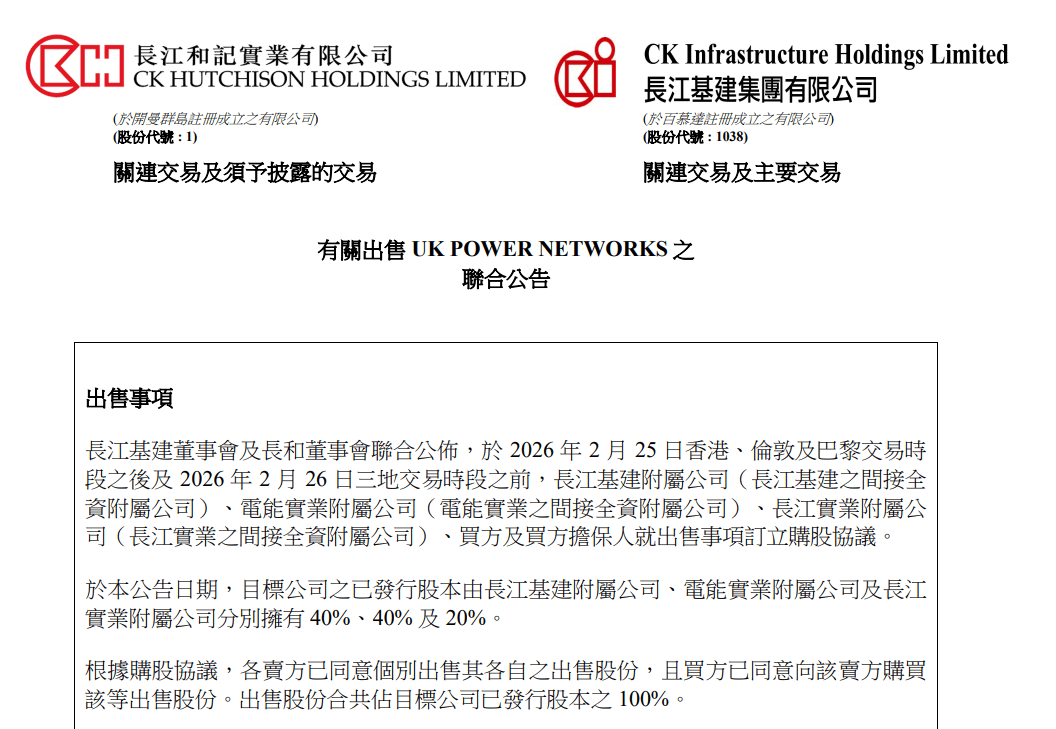
【导读】"长和系"出售英国电网业务,套现超1100亿港元 中国基金报 晨曦 综合整理 李嘉诚旗下"长和系"又有大消息! 2月26日早间,港股长和、长江基建、长实集团、电能实业等纷纷发布公告,对出售UK POWER NETWORKS(以下简称UKPN)一事进行披露。 UKPN已发行股本由长江基建、电能实业及长实集团分别拥有40%、40%及20%。就出售股份及股东债务票据应付长江基建、电能实业、长实集团的代 价分别为42.192亿英镑(约443.016亿港元)、42.192亿英镑(约443.016亿港元)及21.096亿英镑(约221.508亿港元)。根据购股协议,各卖方已同意 出售股份,出售股份合共占UKPN已发行股本的100%。 这笔合计逾1100亿港元的"大买卖",买方及买方担保人由法国公用事业企业Engie直接或间接最终全资拥有。据市场分析,此项交易的企业总值估算高 达168.38亿英镑(约1768亿港元),为近年来全球公用事业领域内规模最大的交易之一。 公告介绍称,Engie为能源转型领域的主要市场参与者,其宗旨为加速转型迈向碳中和经济。Engie集团于30个国家聘用超过90000雇员,涵盖从生产乃 至 ...

创业板跌超1%,锂矿股上演涨停潮,人民币升破6.84关口,恒科指跌近1%,科网股普跌
Hua Er Jie Jian Wen· 2026-02-26 02:07
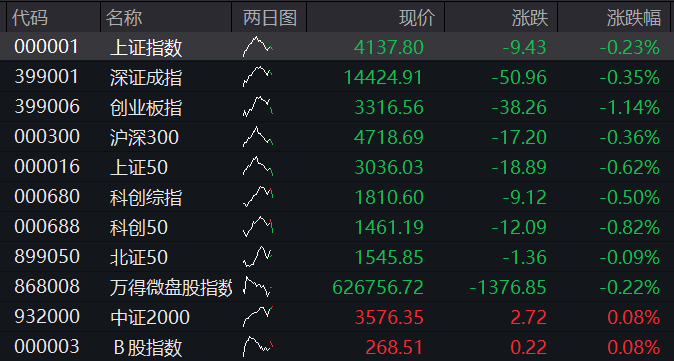
Group 1: Market Overview - The lithium mining sector experienced a surge, with stocks hitting the limit up, following Zimbabwe's Ministry of Mines and Mining Development's emergency statement to suspend all raw mineral and lithium concentrate exports [1] - On February 26, A-shares showed a downward trend, with major indices collectively declining; the ChiNext index fell nearly 1% [1] - The offshore RMB strengthened, surpassing the 6.84 mark, reaching a high of 6.8384 [1][7] Group 2: Stock Performance - Key A-share indices as of the report: Shanghai Composite Index at 4137.80 (-0.23%), Shenzhen Component Index at 14424.91 (-0.35%), and ChiNext Index at 3316.56 (-1.14%) [1] - In the Hong Kong market, the Hang Seng Index fell by 0.08% to 26745.06, while the Hang Seng Tech Index dropped by 0.96% to 5210.13 [2][3] Group 3: Commodity Market - Domestic commodity futures mostly rose, with lithium carbonate increasing by over 5% [4] - Other commodities such as tin, platinum, and fuel oil also saw gains, with tin rising by 4% and platinum, fuel oil, and manganese silicon increasing by over 2% [4] Group 4: Renewable Energy Sector - The renewable energy sector showed activity, with companies like Ganfeng Lithium and Tianqi Lithium experiencing significant stock price increases, reflecting a positive market sentiment towards lithium-related stocks [1][18] - The National Energy Administration's recent report indicated that by 2025, the newly installed capacity for renewable energy generation is expected to reach 452 million kilowatts, a year-on-year increase of 21%, accounting for 83% of the total new power generation capacity [10]

李嘉诚又卖了!长和系三家公司发布联合公告,宣布出售英国电网业务,套现逾1100亿港元
Mei Ri Jing Ji Xin Wen· 2026-02-26 02:00
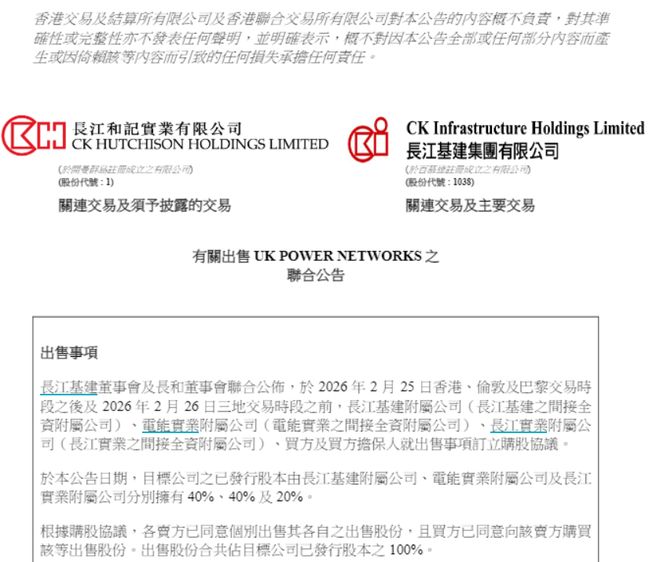
Core Viewpoint - Li Ka-shing's Cheung Kong Group has agreed to sell its 100% stake in UK Power Networks Holdings Limited to Engie UK 2026 Limited for over HKD 110 billion, aiming to realize substantial accounting gains and cash for future investments and acquisitions [1][8]. Group 1: Transaction Details - The three companies involved in the sale are Cheung Kong Infrastructure Group, Power Assets Holdings, and Cheung Kong Holdings, holding 40%, 40%, and 20% stakes in UK Power Networks, respectively [1][5]. - The sale prices for their stakes are HKD 44.3 billion for each of the first two companies and HKD 22.15 billion for the latter [1]. Group 2: Historical Context and Performance - Since acquiring their stakes in 2010, UK Power Networks has transformed into a leading distribution network operator in the UK, providing stable financial contributions to Cheung Kong Infrastructure and Cheung Kong Group [1]. - The family of Li Ka-shing has been a significant investor in the UK, with total investments exceeding RMB 255.5 billion across various sectors, including utilities, telecommunications, and real estate [9][15]. Group 3: Market Position and Future Outlook - Li Ka-shing's family controls approximately 25% of the UK's electricity distribution market, nearly 30% of the gas supply market, and over 40% of the telecommunications market [15]. - The energy infrastructure assets in the UK are considered scarce, providing stable returns and low risk, aligning with the family's investment strategy [15].

南方电网多措并举保障琼州海峡新能源汽车春运过海
Zhong Guo Fa Zhan Wang· 2026-02-26 01:52
Core Insights - The demand for electric vehicles (EVs) crossing the Qiongzhou Strait during the Spring Festival is expected to surge, with projections indicating over 200,000 crossings by 2026, an increase of approximately 80,000 from 2025 [1] - Southern Power Grid Company is implementing multiple strategies to alleviate range anxiety for EV owners, including enhancing charging infrastructure and emergency support services [1][2] Group 1: Emergency Preparedness - Southern Power Grid has established a dual-redundancy support system for charging, combining fixed charging stations with mobile charging units to address the anticipated spike in EV crossings [1] - Three emergency charging vehicles were deployed from Guangzhou and Zhaoqing to support the Qiongzhou Strait during peak travel times, ensuring rapid response capabilities [2] Group 2: Infrastructure and Service Enhancements - A comprehensive inspection of 6,514 charging guns across 652 charging stations in Hainan was conducted to ensure safety and reliability ahead of the Spring Festival [2] - The company has created a "comprehensive service hub" at Haikou Xiuying Port, offering enhanced services such as EV charging consultations and emergency charging guidance [3] Group 3: User Experience and Technology Integration - The "Hainan Charging Pile" app allows users to check the operational status and availability of charging stations in real-time, facilitating better route planning for EV owners [3] - Southern Power Grid's unified charging service platform "Shunyi Charge" provides additional services such as vehicle rentals and on-site delivery of charged vehicles, enhancing convenience for users [3]
2.26犀牛财经早报:公募千亿增量资金即将入市
Xi Niu Cai Jing· 2026-02-26 01:38
Group 1 - Public funds are preparing for a significant market entry with nearly 140 new funds expected to bring in around 100 billion yuan [1] - Fund managers believe that incremental capital, trends in the technology sector, and expectations of interest rate cuts by the Federal Reserve will support the A-share market [1] - Public funds are actively positioning themselves in the Hong Kong stock market, focusing on technology and cyclical sectors [1] Group 2 - Insurance funds are expected to continue increasing their equity market allocations in 2026, with a record high stock allocation reported [2] - A survey of 127 insurance institutions indicates a generally optimistic outlook for the A-share market in 2026, with plans for slight increases in stock allocations [2] - Many insurance institutions plan to maintain their current allocation ratios for bank deposits, bonds, and other financial assets [2] Group 3 - Several domestic and international companies have announced price increases for semiconductor products due to rising raw material costs, with increases starting at 10% [3][4] - The demand for AI is driving a broad price increase for passive components, with major manufacturers discussing price hikes for MLCCs [3][4] Group 4 - Aston Martin is implementing significant measures including a 20% workforce reduction and a permanent sale of its F1 team naming rights due to financial losses [5] - The company reported a 10% decline in wholesale sales and a 21% drop in revenue for the fiscal year 2025 [5] Group 5 - Longfor Group announced the sale of its UK power network business for over 110 billion HKD, aiming to use the proceeds for future investments [5] - The sale involves three companies under the Longfor Group, with significant accounting gains expected from the transaction [5] Group 6 - Nvidia reported fourth-quarter revenue of $68.1 billion, a 73% year-over-year increase, exceeding market expectations [6] - The company anticipates first-quarter revenue between $76.44 billion and $79.56 billion, also above market estimates [6] Group 7 - Transsion Holdings reported a 4.5% decline in revenue for 2025, with net profit down 53.43% due to increased competition and rising supply chain costs [12] - The company's total assets decreased by 1.55% compared to the beginning of the year [12] Group 8 - Ankai Microelectronics reported a revenue increase of 1.87% for 2025, but a net loss of 139 million yuan due to competitive pressures and increased financial costs [11] - The company faced challenges with asset impairment losses and increased R&D expenses impacting profitability [11]


浙能电力2月25日获融资买入5885.11万元,融资余额4.21亿元
Xin Lang Cai Jing· 2026-02-26 01:36
Group 1 - The core viewpoint of the news is that Zhejiang Energy Power Co., Ltd. has shown fluctuations in its stock performance and financial metrics, indicating potential investment opportunities and risks in the energy sector [1][2][3]. Group 2 - As of February 25, Zhejiang Energy Power's stock increased by 0.99%, with a trading volume of 511 million yuan. The financing buy-in amount for the day was 58.85 million yuan, while the financing repayment was 46.61 million yuan, resulting in a net financing buy-in of 12.24 million yuan [1]. - The total financing and securities balance for Zhejiang Energy Power reached 422 million yuan as of February 25, with the financing balance accounting for 0.61% of the circulating market value, which is above the 60th percentile level over the past year [1]. - On the short-selling side, 38,400 shares were repaid, and 10,600 shares were sold on February 25, with a selling amount of 54,100 yuan. The short-selling balance was 1.0047 million yuan, which is below the 10th percentile level over the past year [1]. - As of September 30, the number of shareholders for Zhejiang Energy Power was 155,000, an increase of 10.58% from the previous period, while the average circulating shares per person decreased by 9.56% [2]. - For the period from January to September 2025, Zhejiang Energy Power reported operating revenue of 58.814 billion yuan, a year-on-year decrease of 11.28%, and a net profit attributable to shareholders of 6.230 billion yuan, down 7.02% year-on-year [2]. - The company has distributed a total of 30.473 billion yuan in dividends since its A-share listing, with 7.911 billion yuan distributed in the last three years [3]. - Among the top ten circulating shareholders as of September 30, 2025, Hong Kong Central Clearing Limited held 109 million shares, a decrease of 62.7019 million shares from the previous period, while Huatai-PB CSI 300 ETF held 68.5728 million shares, down by 3.3842 million shares [3].

政策解读|以“五统一、一开放”打造现代电力市场体系标杆
Zhong Guo Dian Li Bao· 2026-02-26 01:35
Core Viewpoint - The State Council's recent "Implementation Opinions" outlines strategic goals for establishing a unified national electricity market system by 2030 and fully developing it by 2035, marking a new phase in China's electricity market reform [1] Group 1: Strategic Goals - By 2030, the goal is to have all types of power sources and electricity users (excluding guaranteed users) directly participate in the electricity market, with market transactions accounting for approximately 70% of total electricity consumption [1] - By 2035, the aim is to form a unified energy market system centered around electricity [1] Group 2: Specific Measures - The "Implementation Opinions" propose measures to optimize resource allocation, enhance market functions, promote equal participation, establish a unified market system, and strengthen policy coordination [1] - The Southern Power Grid Company aims to lead in the construction of the national unified market by adhering to the "five unifications and one openness" principle [2] Group 3: Market Integration and Development - The unified electricity market will transition to a joint trading model, allowing for nationwide supply-demand matching with a single demand proposal [3] - The Southern Power Grid will focus on integrating regional electricity markets and expanding market-based electricity transmission [3] Group 4: Multi-Category Market Construction - The "Implementation Opinions" emphasize the development of various market categories, including spot, medium-to-long-term, ancillary services, green certificates, capacity, and retail markets [4] - This multi-dimensional approach aims to enhance price discovery, supply-demand adjustment, and environmental value realization [4] Group 5: Encouraging Diverse Participation - The document outlines plans to increase participation from various power sources and new market entities, shifting the focus from generation-centric to a collaborative ecosystem involving all stakeholders [5] - The Southern Power Grid will innovate mechanisms for distributed energy sources and virtual power plants to enhance market participation [5] Group 6: Future Directions and Innovations - The "14th Five-Year Plan" period is critical for achieving the "carbon peak by 2030" goal, necessitating efficient resource allocation through the unified electricity market [6] - The Southern Power Grid will implement ten innovative market actions to establish a benchmark for the national unified electricity market [6] Group 7: Regional Market Development - The Southern regional electricity spot market is set to officially operate by 2026, optimizing resource allocation rules and enhancing market efficiency [7] - New mechanisms for cross-grid trading and market participation will be established to promote competition and efficient resource circulation [7] Group 8: New Business Models and International Cooperation - The document encourages the development of new business models, including distributed solar, virtual power plants, and adjustable loads, to support flexible market interactions [8] - It also promotes international cooperation in green energy and the establishment of a unified domestic and cross-border electricity market [8]
电力板块短线拉升,豫能控股涨停
Xin Lang Cai Jing· 2026-02-26 01:35
电力板块短线拉升,豫能控股涨停,永泰能源、华银电力、陕西能源、甘肃能源、深南电A等纷纷走 高。 ...

德国负电价背后的制度韧性
Zhong Guo Dian Li Bao· 2026-02-26 01:35
Core Insights - Negative electricity prices in Germany have evolved from an anomaly to a structural feature due to the high integration of renewable energy sources, with occurrences increasing from 301 hours in 2023 to an expected 459 hours in 2024 and approaching 575 hours by the end of 2025 [1] Group 1: Market Mechanism and Structural Tension - Negative prices arise from the real-time balancing nature of electricity and the priority access granted to renewable energy under the Renewable Energy Act (EEG), leading to traditional power sources paying to maintain generation during low demand periods [2] - The German government maintains the existence of negative prices, viewing them as a necessary market-clearing mechanism that is more efficient than administrative interventions, and as an inevitable phenomenon in the transition to a higher proportion of renewable energy [2] Group 2: Response Strategies - Renewable energy sources are adjusting through a tightening mechanism under EEG, where negative price occurrences lead to zero market premium subsidies for affected power plants after four consecutive hours of negative pricing, with a shift to a "3-hour rule" starting in 2024 to enhance economic incentives for demand management [3] - Demand-side management is transitioning from passive to active collaboration, with policies incentivizing decarbonization investments and providing substantial subsidies to transmission operators, creating a closed-loop incentive system [3] Group 3: Reliability and Safety Mechanisms - Germany's electricity system maintains stability under negative price conditions through a robust rescheduling mechanism that allows for forced adjustments to regional output when market clearing threatens physical safety [4] - The flexibility of traditional power plants has been enhanced through technological upgrades, allowing for reduced minimum output levels, and cross-border transmission capabilities have been improved to mitigate extreme negative pricing impacts [4] - The use of Loss of Load Expectation (LOLE) as a forward-looking safety boundary helps ensure reliable operation during negative price periods, with annual simulations guiding government interventions when necessary [4] Group 4: Micro-Level Execution of Reliability - Smart meter upgrades enable precise management at every physical connection point, with strict monitoring of outage durations ensuring that average outage times remain low, even amidst negative price pressures [5] - Germany's approach illustrates that negative prices and electricity system safety are not mutually exclusive but can be harmonized through institutional innovation that balances price signals with physical safety [5]
坚持电力先行 为能源强国建设和 “十五五”良好开局提供有力支撑
Zhong Guo Dian Li Bao· 2026-02-26 01:30
Core Viewpoint - The 20th Central Committee's Fourth Plenary Session outlines a grand blueprint for economic and social development over the next five years, emphasizing the construction of an energy powerhouse, with a focus on high-quality development in the electricity sector as a key support for this initiative [1] Group 1: Electricity Industry Development - Since the 14th Five-Year Plan, China's electricity industry has maintained healthy and rapid growth, with total installed capacity expected to reach 3.89 billion kilowatts by the end of 2025, and renewable energy capacity exceeding 1.8 billion kilowatts, surpassing thermal power for the first time [2] - The average annual electricity consumption growth rate is projected at 6.6%, supporting a 5.4% growth in the national economy, with total electricity consumption expected to exceed 10 trillion kilowatt-hours by 2025 [2] - The share of non-fossil energy consumption is expected to exceed 20% by 2025, with renewable energy generation accounting for 22.2% of total electricity consumption, up from 9.7% [2] Group 2: New Power System Construction - The construction of a new power system is underway, with significant advancements in various technologies, including nuclear power and coal power upgrades, and the establishment of a unified national electricity market [3] - By mid-century, the electrification rate is expected to exceed 60%, with non-fossil energy consumption surpassing 70%, positioning electricity as the dominant energy carrier [3] - The new power system will be a critical support for the energy powerhouse, emphasizing the need for high-quality development and the integration of renewable energy sources [4] Group 3: Strategic Goals and Implementation - The 15th Five-Year Plan period is crucial for achieving carbon peak goals by 2030 and accelerating the construction of a new power system, focusing on high-quality development and safety [4] - The electricity sector aims to establish a green and low-carbon power supply structure, promoting diverse energy sources and optimizing energy consumption [4] - Key projects and policies will be prioritized, including the construction of high-capacity transmission projects and the implementation of major reforms to ensure stable electricity supply [7][8]