
海洋装备制造

Search documents
獐子岛:拟与海发集团等共同投资设立合资公司
Xin Lang Cai Jing· 2025-07-30 11:24
Core Viewpoint - The company plans to establish a joint venture with three partners, focusing on underwater systems and marine engineering equipment manufacturing and sales [1] Group 1: Joint Venture Details - The joint venture will have a registered capital of 37.5 million yuan [1] - The investment breakdown includes: - Dalian Zhanzidao Ocean Development Group Co., Ltd. contributing 19.125 million yuan for a 51% stake - Zhanzidao contributing 3.375 million yuan for a 9% stake - Dalian Maritime University Investment Management Co., Ltd. contributing 3 million yuan for an 8% stake - Dalian Haifa Zhichuang Technology Development Center (Limited Partnership) contributing 12 million yuan for a 32% stake [1] Group 2: Business Scope - The joint venture will operate in the following areas: - Manufacturing and sales of underwater systems and operational equipment - Sales and manufacturing of marine engineering equipment - Manufacturing of diving and salvage equipment [1]

10万亿海洋经济崛起!硬科技注入产业发展澎湃动力
Zheng Quan Shi Bao Wang· 2025-07-30 01:17
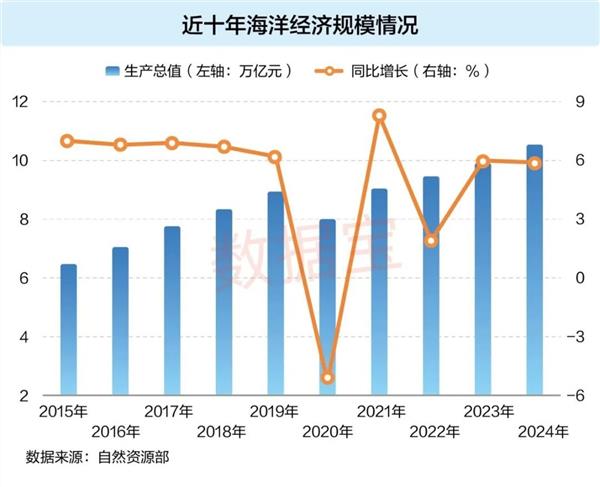
Economic Overview - The scale of China's marine economy is steadily growing, with a historic breakthrough of over 10 trillion yuan expected in 2024, accounting for approximately one-third of global shipping volume and container throughput [1][2] - From 2020 to 2024, the marine economy's scale increased from 8 trillion yuan to 10.54 trillion yuan, indicating a growth rate higher than many traditional industries [2][4] Strategic Importance - The marine economy is positioned as a crucial strategic element in China's modernization efforts, emphasizing high-quality development and exploration of marine resources [2][6] - The marine economy's contribution to GDP is rising, projected to reach 7.81% in 2024, marking a new high since 2020 [4] Technological Innovation - Technological innovation is a key driver for the growth of the marine economy, with emerging industries showing a 7.2% increase in added value in 2024, outpacing the overall marine GDP growth [7][9] - Significant advancements include the establishment of a marine microbial genome database and the development of new marine pharmaceuticals [9] Industry Structure - The marine economy's industrial structure is evolving, with the secondary industry contributing 3.77 trillion yuan in 2024, representing 35.8% of the total, indicating a strong performance since 2019 [10] - Companies like China Shipbuilding are enhancing their capabilities in deep-sea equipment and fostering a cycle of innovation and industry demand [11] Global Competitiveness - China leads globally in several marine sectors, with 69.4% of new marine engineering equipment orders in 2024, maintaining its position for seven consecutive years [12][13] - The country is also a dominant player in offshore wind energy, holding a significant share of the global market and continuing to expand its capacity [13] Future Outlook - The rise of the 10 trillion yuan marine economy is not only a response to economic needs but also a vital part of national strategy, with expectations for further breakthroughs supported by technological advancements [14]

碧海扬帆立潮头 “蓝色粮仓”绘新篇 广东湛江探索海洋经济与金融融合新模式
Jin Rong Shi Bao· 2025-07-29 05:31
Core Insights - Zhanjiang is emerging as a national model for blue economy and financial innovation, with marine production value projected to account for 33% of the city's GDP by 2024 and marine-related loans exceeding 20 billion yuan [1][2] Policy and Institutional Innovation - In May 2024, the People's Bank of China Zhanjiang Branch issued the first local-level blue finance guidance document, establishing a dual-driven system of "policy guidance + industry navigation" to support blue finance development [2] - A strategic cooperation agreement was signed between Zhanjiang government and 11 banks, with a total investment intention of 2.1 trillion yuan focusing on "green steel, green petrochemicals, green energy, green food, and blue marine economy" [2] Financial Innovation and Solutions - Zhanjiang is implementing a "credit reconstruction" model in its national marine ranch demonstration area, introducing "credit + marine" service models to enhance financing for marine economies [3] - Various banks have developed tailored financial products, such as "marine ranch loans" and "golden pomfret industry chain loans," to address financing challenges in the marine sector [3] - As of now, 11 credit marine ranches have received a total credit limit of 1.47 billion yuan [3] Technological Empowerment - Zhanjiang has launched a comprehensive marine financial service platform, facilitating 1,365 financing transactions with a total credit amount exceeding 9.34 billion yuan [4] - Digital technologies are reshaping financial risk assessment, with banks collaborating with industry leaders to create integrated platforms that enhance visibility and traceability in marine transactions [4] Ecological Development and Synergy - The blue finance innovation is fostering a collaborative ecosystem, with banks supporting small and micro enterprises in the blue industry chain through various partnership models [5] - Insurance products are evolving from single-point coverage to regional protection, enhancing risk management in marine aquaculture [5] Performance Metrics - In 2024, Zhanjiang issued 1,636 marine industry financing loans totaling 11.98 billion yuan, with blue industry chain loans amounting to 120 million yuan [6] - The marine equipment manufacturing sector's output surpassed 5 billion yuan, showcasing the effectiveness of blue finance initiatives [6] - Zhanjiang is leading in establishing blue finance standards, creating comprehensive financial service models, and developing a digitalized marine finance system [6]
10万亿海洋经济崛起硬科技注入产业发展澎湃动力
Zheng Quan Shi Bao· 2025-07-28 17:59
Group 1 - The core viewpoint of the articles emphasizes the significant growth and strategic importance of China's marine economy, which is projected to exceed 10 trillion yuan in 2024, marking a historic milestone [1][2][8] - The marine economy is defined as economic activities centered around the development and utilization of marine resources, encompassing various sectors such as marine energy, fisheries, shipping, tourism, equipment manufacturing, biomedicine, and environmental technology [2][8] - The marine economy's contribution to China's GDP is increasing, with projections indicating it will account for 7.81% of GDP in 2024, the highest since 2020 [3][8] Group 2 - The marine economy's total output value has grown from 8 trillion yuan in 2020 to 10.54 trillion yuan in 2024, reflecting a growth rate that surpasses many traditional industries [2][3] - In the first quarter of 2025, the marine economy maintained a positive growth trend, with a preliminary marine production value of 2.5 trillion yuan, representing a year-on-year increase of 5.7% [3] Group 3 - Technological innovation is a key driver of growth in the marine economy, with emerging industries in this sector seeing an increase in added value of 7.2% in 2024, outpacing the overall marine production value growth [4] - The marine economy's industrial structure is being optimized, with the second industry's production value reaching 3.77 trillion yuan in 2024, accounting for 35.8% of the total [4] Group 4 - China has established a leading position in various marine sectors, with the country securing 69.4% of the global market share for newly contracted marine engineering equipment in 2024 [6][7] - The shipbuilding industry continues to dominate globally, with China maintaining the top position in shipbuilding completion, new orders, and hand-held orders for 15 consecutive years [6][7] Group 5 - The marine economy is not only a response to economic development needs but also a crucial component of national strategy, leveraging China's rich marine resources and technological capabilities for further breakthroughs [8]
发展海洋经济 鼓足“蓝色动能”(议政)
Ren Min Ri Bao· 2025-07-23 22:11
Core Viewpoint - The article emphasizes the importance of promoting high-quality development of the marine economy in China, highlighting the need for top-level design, technological innovation, and ecological protection to support the country's goal of becoming a maritime power [6][7]. Policy Support and Economic Growth - The Shanghai Marine Industry Development Plan (2025-2035) aims for steady growth in marine production value and enhanced technological innovation by 2030 [7]. - Zhejiang's implementation of the marine economy doubling plan is accelerating the establishment of a modern marine industry system [7]. - There is a call for increased policy support and a multi-level financing mechanism to attract social capital into emerging marine sectors such as high-end marine equipment manufacturing and deep-sea resource development [8]. Technological Innovation and Industry Development - The marine economy is transitioning from resource dependence to innovation-driven development, with a focus on establishing a blue industry guidance fund to support technological innovation [8]. - The article discusses the significance of marine negative emissions technologies, including seawater alkalization and marine ranching, as key areas for international standardization and market development [8][9]. - The marine new industry added value is projected to grow by 7.2% in 2024, with breakthroughs in key technologies and equipment [9]. Strategic Development and Integration - Strengthening marine strategic scientific capabilities is crucial for the development of marine industries, with an emphasis on integrating modern technologies into traditional marine sectors [10][11]. - The article advocates for a comprehensive approach to marine spatial planning that considers environmental protection and resource optimization [12]. Ecological Protection and Carbon Sequestration - The article highlights ongoing marine ecological protection projects, which have restored approximately 400 kilometers of coastline and 31,000 hectares of coastal wetlands [12]. - There is a focus on enhancing marine carbon sequestration capabilities through targeted implementation strategies and research on marine negative emissions processes [12][13]. - Recommendations include establishing a marine carbon sequestration special fund and developing a unified carbon trading market to support marine carbon projects [13].
东营|东营:绿蓝交响 向海图强
Da Zhong Ri Bao· 2025-07-10 01:14
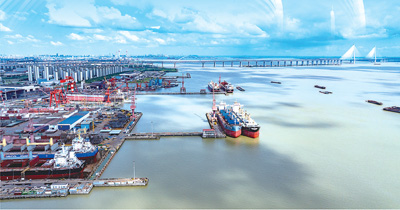
Core Viewpoint - Dongying is committed to high-quality and high-standard development of its marine economy, leveraging its natural advantages and focusing on ecological protection and restoration while promoting industrial transformation and upgrading [2][4][5]. Marine Economic Development - Dongying has over 460 kilometers of coastline and more than 6,000 square kilometers of marine area, rich in oil, gas, rock salt, and fishery resources, providing a natural advantage for marine economic development [2]. - The marine economy has become a strong "blue engine" for regional high-quality development, with ongoing actions to enhance the marine industry and build a modern marine industrial system [2][5]. Ecological Protection and Restoration - The city has initiated ecological water replenishment in the Yellow River Delta Nature Reserve, with a planned total replenishment volume of 150 million cubic meters [3]. - Since the 14th Five-Year Plan, Dongying has restored 4,537 hectares of coastal wetlands and implemented strict management of marine fishery resources, including a total of 6 billion aquatic seedlings released during this period [3][4]. Industrial Transformation and Upgrading - Dongying aims to accelerate the transformation of traditional marine industries and promote modern fishing practices, with a focus on ecological and sustainable development [7]. - The city is fostering new marine industries, including marine pharmaceuticals and bio-products, leveraging its rich marine biological resources [7]. Port Development and Logistics - Dongying Port has seen a significant reduction in average waiting time for vessels from 40.6 hours to 19.5 hours, enhancing operational efficiency [8]. - In 2024, the port's cargo throughput reached 91.15 million tons, a year-on-year increase of 26.4%, with ongoing efforts to develop a deep-water port and improve logistics infrastructure [9].
深海科技:海洋强国战略的关键支柱
2025-07-09 02:40
Summary of Deep Sea Technology and Marine Economy Conference Call Industry Overview - The deep sea technology and marine economy are recognized as key pillars in the national strategy, with the national marine production value expected to exceed 10 trillion yuan in 2024, accounting for 7.8% of GDP and contributing 11.5% to GDP growth [1][3][4]. Core Insights and Arguments - The government has placed significant emphasis on deep sea technology, highlighting its importance alongside commercial aerospace and low-altitude economy in the work report, indicating a period of rapid development supported by policy [1][3][5]. - Deep sea technology encompasses three main areas: deep sea material research and development, deep sea equipment manufacturing, and deep sea tool application, with structural and buoyancy materials being critical [1][6]. - The marine equipment manufacturing sector is experiencing new opportunities, particularly in underwater detection technology, underwater construction technology, and oil and gas production equipment, with significant growth potential in underwater robots and related fields [1][7][8]. - The shipbuilding industry is at a peak due to the shipping cycle, with shipbuilding completion volume expected to grow by 13.8% year-on-year in 2024, and new orders increasing by 58.8% [6][8][10]. Investment Opportunities - Investment opportunities exist in deep sea technology, particularly in high-performance steel, alloy materials, and composite materials that are resistant to corrosion and high pressure [6]. - Companies such as Baotai Co., Baose Co., and Steel Research High-Tech are noted for their competitive edge in these segments [6]. - The marine equipment manufacturing industry is poised for growth, with a focus on underwater exploration and military equipment, supported by a favorable policy environment [9][10]. Additional Important Insights - The development of offshore wind power is currently concentrated in nearshore areas, but there is significant potential for growth in deep offshore wind power, which will increase demand for submarine cables and related infrastructure [11][12]. - The trend towards digitalization and intelligence in deep sea technology is accelerating, with the construction of underwater data centers addressing cooling and land cost issues while ensuring data security and compliance [2][13][14]. - Marine communication, particularly its integration with AI, is identified as a promising direction for future development in deep sea technology [15].
海洋经济,再迎重磅政策利好
第一财经· 2025-07-03 05:51
Core Viewpoint - The article highlights the significant policy support for China's marine economy, which is expected to enter a new phase of growth, emphasizing innovation, high-quality development, and collaboration across various coastal provinces [1][2]. Group 1: Policy and Development Plans - The Central Financial Committee's recent meeting focused on advancing the marine economy's high-quality development, stressing innovation, efficient collaboration, and industry upgrades [1]. - Shanghai's marine industry development plan (2025-2035) aims to establish a marine industry development fund and create a world-class shipbuilding and marine engineering equipment cluster [1][9]. - Coastal provinces like Jiangsu, Zhejiang, Guangdong, Fujian, and Shandong are actively promoting policies and legislative measures to enhance marine economic development [1]. Group 2: Economic Performance and Projections - The marine production value in China surpassed 10 trillion yuan in 2024, reaching 10,543.8 billion yuan, with a year-on-year growth of 5.9%, outpacing the national GDP growth by 0.9 percentage points [4]. - The marine economy is projected to become a new engine for national economic growth, with significant potential for job creation and value addition by 2030 [3][2]. Group 3: Industry Structure and Trends - China's marine economy is characterized by a high proportion of traditional industries, with marine fisheries, coastal tourism, and marine transportation accounting for nearly 90% of the marine economy [5]. - Emerging marine industries, such as marine biomedicine and marine engineering equipment, currently represent less than 10% of the total, indicating a need for deep transformation and upgrading [5][6]. - The marine new industries' added value grew by 7.2% year-on-year, with marine manufacturing contributing over 30% to the marine production value [5]. Group 4: Regional Developments - Shanghai's marine production value reached 1,138.7 billion yuan in 2024, growing by 11.2% and accounting for 21.1% of the city's total production value [8]. - Zhejiang aims for over 220 billion yuan in marine economic project investments this year, with marine fisheries expected to exceed 100 billion yuan in output [9][10]. - Shandong is focusing on reform and innovation to enhance its marine economy, exploring new management models for marine resources and developing marine financial products [11].
三叔的海洋经济生意经
格隆汇APP· 2025-07-02 11:18
Core Viewpoint - The article highlights the rapid development of China's deep-sea economy, projecting a national marine production value to exceed 10 trillion yuan in 2024, accounting for 7.8% of GDP, with a growth rate surpassing GDP by 0.9 percentage points [1][6]. Group 1: National Strategy and Policy Support - Deep-sea technology has been recognized as a strategic emerging industry, included in the 2025 government work report alongside commercial aerospace and low-altitude economy as new economic engines [3]. - The State Council issued a supplementary document for the "14th Five-Year" marine economic development plan, allocating significant funding to support deep-sea technology industrialization [6]. - Various coastal provinces have introduced policies to support marine economic development, indicating a regional competition to advance into the deep sea [6][7]. Group 2: Market Potential and Industry Growth - By 2030, the market size of core deep-sea technology segments is expected to reach 921.2 billion yuan, with potential for auxiliary maintenance services to push it into the trillion-yuan club [12]. - The global deep-sea mining market is projected to exceed 30 billion USD by 2030, with China holding a technological advantage and the most international exploration contracts [12]. - The deep-sea equipment manufacturing sector is anticipated to see an annual growth rate exceeding 12%, driven by the extreme conditions of deep-sea environments [12]. Group 3: Technological Advancements - China's deep-sea technology has reached the international first tier, with successful trials of the new generation of manned submersibles [9]. - The domestic production rate of high-end components for deep-sea equipment is currently below 65%, indicating significant opportunities for domestic manufacturers [9]. - Innovations in cross-disciplinary fields, such as underwater data centers and AI monitoring systems, are emerging as key areas of growth [9][14]. Group 4: Investment Trends and Capital Flow - The current stage of the deep-sea industry resembles the early days of the new energy sector, characterized by clear policies, technological breakthroughs, and defined application scenarios [16]. - Major investment firms are establishing specialized funds to capitalize on deep-sea projects, indicating a surge in interest and competition among investors [8][16]. - The valuation of companies with full deep-sea operational capabilities is rising, with significant interest from private equity in "hidden champions" within the sector [16].
耕海牧渔,建设“蓝色粮仓”(美丽中国)
Ren Min Ri Bao· 2025-07-01 22:19
Core Viewpoint - Shandong Rizhao is transforming its marine economy from traditional fishing to sustainable modern fisheries, focusing on marine ecological restoration and the development of marine ranching, which has led to increased income for fishermen and enhanced efficiency in the fishing industry [1][2]. Group 1: Marine Ranching Development - Rizhao has established 8 national-level marine ranching demonstration zones and 14 provincial-level projects, with over 1,000 deep-water anti-wind net cages and 2 large intelligent truss net cages, aiming for marine production value to exceed 30% of the regional GDP by 2024 [1][2]. - The introduction of artificial reefs, such as a 3-meter long, 10-ton hollow concrete cube, has facilitated the growth of algae, attracting fish and promoting the recovery of marine biological resources [2][3]. Group 2: Ecological Restoration and Sustainable Practices - The local government has implemented measures like bottom sowing and releasing fish to gradually restore the marine ecological environment, resulting in a resurgence of fish species such as blackhead fish and sea bass [3][4]. - The practice of multi-species aquaculture has been adopted, allowing for year-round sales of various products and creating a beneficial cycle that reduces water eutrophication [3][4]. Group 3: Integration of Tourism and Fishing - The local community is capitalizing on the improved marine resources by developing marine tourism, including sea fishing experiences, which has led to an annual income exceeding 200 million yuan from the sea fishing industry [4][5]. - The establishment of accommodations and dining options related to fishing culture has transformed the area into a comprehensive coastal tourism destination [5]. Group 4: Technological Advancements in Aquaculture - The introduction of advanced aquaculture technologies, such as the "Blue Granary" project for salmon farming, is expected to yield 900 tons of salmon, showcasing the shift towards modern, technology-driven aquaculture practices [6][7]. - Smart systems are being utilized to monitor environmental conditions in real-time, enhancing the efficiency and sustainability of fish farming operations [6][7]. Group 5: Future Prospects and Industry Growth - The collaboration with research institutions has led to successful breeding and industrialization of species like the swollen-belly seahorse, with a survival rate of over 90% for seedlings, indicating a promising future for marine resource enhancement [7]. - The local government aims to leverage marine ranching to protect marine resources and promote economic development, with a target of producing 3.5 tons of dried seahorse and 20.758 million live seahorses by 2024 [7].