
肉类加工

Search documents
双汇转型突围:传统巨头能否在消费变局中再造“新双汇”?
Sou Hu Cai Jing· 2025-11-27 13:10
Core Insights - The company is facing significant challenges in its traditional meat processing business, particularly with a 9.04% year-on-year decline in packaged meat product sales and a revenue drop to 11.2 billion [3][4] - In response to these challenges, the company is diversifying its operations by investing in the pet food sector and launching a new health-focused brand, "Jiansong" [1][6] Group 1: Traditional Business Challenges - The company's core meat processing segment has seen a revenue decline, with a total revenue of 28.4 billion, reflecting only a slight increase of 2.97% year-on-year, while net profit grew by 1.17% to 2.3 billion [3] - Increased competition from traditional rivals and new entrants has contributed to the company's struggles, with innovative products targeting younger consumers [4] - Internal issues, including family disputes and a significant drop in stock price from 48.61 to around 25, have further exacerbated the company's challenges, leading to a market value loss of over 110 billion [5] Group 2: Strategic Initiatives - The company has made a strategic investment of 1 billion in the local pet food company Zhongyu Pet Food, aiming to tap into the rapidly growing pet food market, which has surpassed 100 billion and is experiencing double-digit growth [7] - The launch of the "Jiansong" brand focuses on health-conscious products, including salad chicken breast and low-fat luncheon meat, targeting fitness enthusiasts and urban professionals [8] - The company is also expanding its restaurant business with a dual approach of central kitchens and ready-to-eat meals, introducing popular products like "Eight Dishes" and family gift boxes [10] Group 3: Ongoing Concerns - Despite the new initiatives, the company faces a short-term funding gap of 3.8 billion, which may limit its ability to invest in innovation due to a high dividend payout ratio exceeding 97% from 2019 to mid-2025 [12] - The competition in the pet food market is intensifying, with established international brands and emerging domestic players already holding significant market share [13] - The company's ability to connect with younger consumers is crucial for its transformation from a traditional meat manufacturer to a provider of healthy lifestyle products, necessitating a rethinking of product development and marketing strategies [14]



Meatpacker JBS agrees to merge its leather assets with the ones from Viva
Reuters· 2025-11-25 22:19
Core Insights - Brazilian meatpacker JBS has signed a binding memorandum of understanding with the shareholders of Viva to combine their assets related to leather production and commercialization [1] Company Summary - JBS is actively expanding its operations in the leather sector through this strategic partnership with Viva [1] - The collaboration aims to enhance the efficiency and market reach of both companies in the leather industry [1] Industry Summary - The leather production and commercialization sector is witnessing consolidation as companies seek to leverage synergies and improve competitiveness [1] - This move reflects a broader trend in the industry towards strategic alliances to optimize resources and expand market presence [1]

挑起贸易战损人也伤己 美国自己也开始疼了
Ren Min Ri Bao Hai Wai Ban· 2025-11-24 04:09
Group 1: Tariff Increase and Industry Impact - The U.S. government is considering raising tariffs on $200 billion worth of Chinese imports from 10% to 25%, with public commentary extended to September 5 [1] - The technology and chemical industries are shocked by the proposed tariff increase, with the Information Technology Industry Council calling it "irresponsible and counterproductive" [2] - The American Retail Federation expressed anger, stating that the new tariffs are a reckless bet on a trade policy that is already causing harm [2] Group 2: Agricultural Sector Struggles - The trade war has led to a significant decrease in demand for U.S. meat products, resulting in a backlog of nearly 1.2 billion kilograms of meat in warehouses [2] - U.S. soybean prices have dropped approximately 15% due to trade concerns, impacting farmers' profits by 8% to 10% [2] - Goldman Sachs warned that the trade war could reduce earnings for several U.S. companies by 15% due to decreased export revenues and increased costs [2] Group 3: Consumer Impact and Price Increases - Tariffs are expected to raise costs for manufacturers, which will ultimately be passed on to consumers, leading to increased prices for various goods [4] - Companies like Polaris Industries have already raised prices to offset anticipated tariff costs, indicating a direct impact on consumer prices [5] - Analysts predict that the trade conflict could lead to a loss of 250,000 jobs and an average increase of $210 in expenses for American households [5] Group 4: Economic Outlook and Political Implications - Concerns are growing about the potential economic slowdown due to the trade war, which could pose a political challenge for the Republican Party ahead of the midterm elections [6][7] - Predictions indicate that a 10% increase in tariffs could result in a 2.5% decrease in U.S. GDP over three years, with a full-blown trade war potentially doubling this impact [7] - The ongoing trade tensions are disrupting global supply chains and increasing uncertainty, which could push the economy towards recession [7][8]
泰森食品:关闭内布拉斯加工厂,牛肉业务亏4.26亿美元
Sou Hu Cai Jing· 2025-11-22 18:21
Core Points - Tyson Foods is closing a major beef processing plant in Lexington, Nebraska, and scaling down operations at a Texas facility due to losses in its beef processing business [1][2] - The Nebraska plant processes approximately 5,000 cattle daily, accounting for 4.8% of the U.S. daily beef slaughter volume, while the Texas facility has a daily capacity of about 6,000 cattle [1][2] - The company's latest financial report indicates that the beef processing segment is the only loss-making division for the fiscal year 2025, with an adjusted operating loss of $426 million [1][2] Company Actions - Closure of the Nebraska beef processing plant and reduction of production at the Texas facility [1][2] - Tyson Foods is the first among the top four meat processing companies in the U.S. to close a major beef processing plant [1][2] Financial Impact - The beef processing division reported an adjusted operating loss of $426 million for the fiscal year 2025 [1][2]

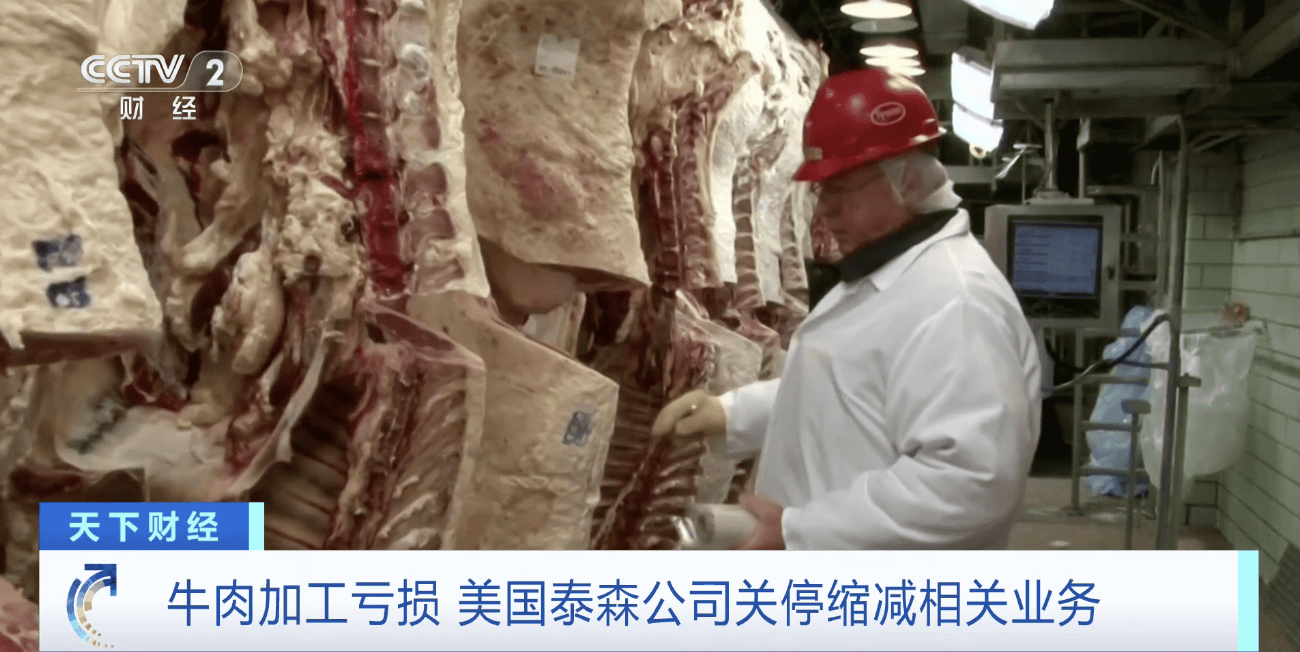
牛肉加工亏损 美国泰森公司关停缩减相关业务
Sou Hu Cai Jing· 2025-11-22 13:23
Core Viewpoint - Tyson Foods announced the closure of a major beef processing plant in Nebraska and plans to scale down operations at another facility in Texas due to losses in its beef processing segment, which is the only loss-making division in its latest financial report [1][3]. Group 1: Company Actions - The plant being closed is located in Lexington, Nebraska, with a daily capacity to process approximately 5,000 cattle, accounting for about 4.8% of the U.S. daily beef slaughter [3]. - The Texas facility, which will see a reduction in production, has a daily capacity of around 6,000 cattle [3]. - The adjustments will impact approximately 5,000 jobs across the two facilities [3]. Group 2: Financial Performance - In the latest financial report, Tyson Foods reported an adjusted operating loss of $426 million for its beef processing segment for the fiscal year 2025 [3]. - The beef processing division is the only segment showing losses, highlighting significant challenges within this area of the business [3]. Group 3: Industry Context - Nebraska has a strong cattle industry, ranking second in the U.S. for cattle herd size, following Texas [5]. - The local cattle industry is facing survival challenges due to prolonged drought and rising feed costs, leading to a decline in the cattle herd to a 75-year low [5].
牛肉业务面临巨额亏损 泰森食品(TSN.US)关闭旗下最大牛肉加工厂
智通财经网· 2025-11-22 04:46
Core Insights - Tyson Foods is closing its beef processing plant in Lexington, Nebraska, to adjust the scale of its beef business and lay the foundation for long-term success [1] - The company is shifting its Amarillo, Texas plant to single-shift full production and increasing output at other facilities to optimize production capacity across its network [1] - The beef sector is facing significant challenges due to rising feed costs, drought, and supply chain issues, leading to a historic shortage of cattle in the U.S. and soaring beef prices [1] Financial Impact - The CFO forecasts that the adjustments in the beef department will result in losses between $400 million and $600 million, with annual cattle costs increasing by $2 billion as of September [2] - Beef prices have surged by 45% since mid-2024, although they have slightly decreased from last year's peak, remaining nearly double the levels seen during the pandemic [1] Market Conditions - The beef supply is at a historical low due to drought, potential cattle herd rebuilding, and issues related to the New World screw-worm fly in Mexico, creating headwinds for the market [1] - The Trump administration is attempting to alleviate consumer pressure by proposing the removal of a 40% tariff on Brazilian beef imports and investigating potential price manipulation in the meatpacking industry [2]
巴西副总统:仍有部分出口商品被美征收高额关税
Yang Shi Xin Wen Ke Hu Duan· 2025-11-21 20:01
Core Insights - The United States has announced the cancellation of a 40% additional tariff on certain Brazilian products, including coffee, meat, and fruits, marking a significant development in bilateral negotiations [1] - Approximately 22% of Brazilian exports to the U.S. will still be affected by tariffs, indicating that challenges remain in the trade relationship [1] - Brazilian Vice President Alckmin expressed optimism regarding the ongoing negotiations, highlighting the tariff reduction as the "greatest progress" in discussions between the two countries [1]
计量监管不松懈 额敏县市场监督管理局为风干肉特色消费公平“护航”
Zhong Guo Shi Pin Wang· 2025-11-20 06:55
Core Viewpoint - The article highlights the efforts of the E'min County Market Supervision Administration to regulate the dried meat market by conducting a special inspection of measuring instruments to protect consumer rights and prevent measurement fraud [1][2]. Group 1: Inspection Actions - The inspection focused on over 20 dried meat vendors, checking electronic scales for compliance with mandatory testing and validity of certification [1]. - During the inspection, two measuring instruments were found nearing the end of their certification period, prompting immediate reminders for timely re-testing [1]. Group 2: Education and Guidance - Inspectors provided legal education to vendors, clarifying the responsibilities and deadlines for mandatory testing of measuring instruments [1]. - The administration assisted 13 vendors in navigating the Xinjiang Measurement Smart Management System, enhancing their ability to manage and certify measuring instruments [1]. Group 3: Future Measures - The E'min County Market Supervision Administration plans to establish a long-term measurement supervision mechanism, including regular inspections and reminders for upcoming certifications [2]. - The administration emphasizes a zero-tolerance policy towards measurement violations, aiming to ensure fair practices in the market and promote healthy development [2].
光明肉业:11月17日召开董事会会议
Mei Ri Jing Ji Xin Wen· 2025-11-17 09:38
Group 1 - The core viewpoint of the article is that Guangming Meat Industry has announced the convening of its 10th fourth board meeting via telecommunication, where it will discuss the proposal for the third extraordinary shareholders' meeting of 2025 [1] - For the fiscal year 2024, Guangming Meat Industry's revenue composition is as follows: 76.5% from meat products, 14.65% from brand distribution, and 8.84% from other sources [1] - As of the time of reporting, Guangming Meat Industry has a market capitalization of 6.6 billion yuan [1]

光明肉业:拟按持股比例向子公司提供1.02亿元财务资助
Xin Lang Cai Jing· 2025-11-17 09:26
光明肉业公告称,为满足子公司光明农牧资金需求,拟与益民食品集团向其提供2.0亿元财务资助,公 司按持股比例提供1.02亿元,期限一年,利率2.20%。本次交易构成关联交易,尚需股东会审议,不构 成重大资产重组。截至2025年9月30日,光明农牧资产26.19亿元,负债31.13亿元,1-9月营收11.96亿 元,净利润-4.87亿元。本次资助后,公司资助余额1.02亿元,占最近一期经审计净资产的4.13%,无逾 期未收回金额。 ...