食品生产

Search documents
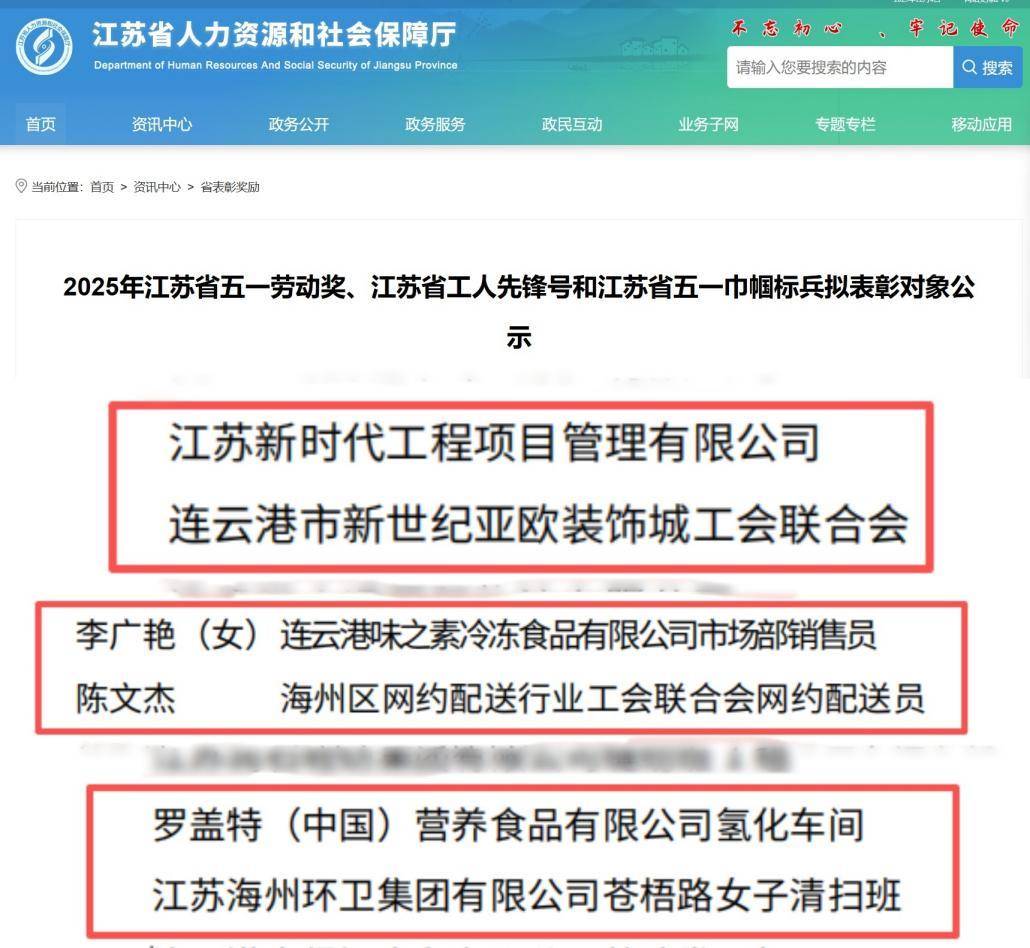
连云港海州4家单位2名个人 入围2025年江苏省五一劳动奖等拟表彰名单
Yang Zi Wan Bao Wang· 2025-12-08 02:52
Group 1 - Jiangsu Province has announced the candidates for the 2025 Labor Day Awards, highlighting four advanced units and two outstanding individuals from Lianyungang City, showcasing their dedication across various sectors including sanitation, engineering management, and industrial production [1][9] - The four recognized units exemplify industry leadership through professional capabilities and dedication, with the Jiangsu Haizhou Sanitation Group's women's cleaning team maintaining a 16-hour daily cleaning schedule for over 20 years, demonstrating commitment even in adverse weather conditions [2][3] - Jiangsu New Era Engineering Project Management Co., Ltd. has been active in the engineering consulting field for 18 years, focusing on a full lifecycle service system and promoting digital transformation through innovative technologies [3] Group 2 - Two individuals recognized for their contributions include delivery worker Chen Wenjie, who has completed 17,948 deliveries since joining in 2021, achieving a customer satisfaction rate of 100% and actively participating in emergency delivery efforts during the pandemic [8] - Li Guangyan, a workshop team leader with over 20 years in the company, has developed standardized manuals to address cultural differences among employees, leading to a 24.6% increase in production efficiency in 2022 compared to 2020 [8] - The recognition of these units and individuals serves as an affirmation of the achievements of grassroots workers in Haizhou and reflects the effectiveness of cultivating a labor spirit in the region [9]


广州市市场监督管理局公布2025民生领域案件查办“铁拳”行动第四批典型案例
Zhong Guo Zhi Liang Xin Wen Wang· 2025-12-05 09:12
Group 1 - Guangzhou market regulatory authorities are focusing on service development and public welfare by launching the "Iron Fist" action in the field of people's livelihood for 2025, announcing the fourth batch of typical cases [2] - A hospital in Guangzhou was penalized for false advertising and violating pricing regulations, resulting in a confiscation of illegal gains amounting to 308,719.28 yuan and a fine of 1,200,000 yuan [2][3] - A food company in Guangzhou was fined 75,000 yuan for engaging in improper pricing practices during a live-streaming sales event, misleading consumers with false promotional claims [4] Group 2 - A restaurant management company in Guangzhou was fined 110,000 yuan and had illegal gains of 9,394 yuan confiscated for operating without a food business license and selling food with pathogenic microorganisms exceeding safety standards [5][6] - A business in Baiyun District was penalized for producing and selling food without proper licensing and for adding medicinal ingredients to food products, resulting in a fine of 20,000 yuan [6][7] - A clothing company in Guangzhou was fined 75,000 yuan for selling products that infringed on registered trademarks, with a total of 438 items confiscated [8][9] Group 3 - A biotechnology company in Guangzhou was reported to the police for illegally adding substances to food products, violating food safety laws [11] - A maintenance company was fined 38,000 yuan for failing to maintain elevators according to safety standards, highlighting the importance of compliance in safety management [12][13] - A medical beauty clinic was fined 60,000 yuan for publishing medical advertisements without proper approval, emphasizing the need for regulatory compliance in the medical advertising sector [14] Group 4 - A trading company was fined 50,000 yuan for selling electric tricycles without mandatory certification, with illegal gains of 13,869.91 yuan confiscated [15][16] - An environmental technology company was fined 10,000 yuan for issuing reports without proper accreditation, which could impact environmental protection efforts [17][18] - A children's products company was fined 40,000 yuan for selling substandard children's shoes, with illegal gains of 6,581.64 yuan confiscated [18][19] Group 5 - A trading company was fined 9,000 yuan for engaging in measurement violations related to imported candy products, highlighting the importance of accurate labeling and compliance with measurement regulations [20][21]
市场监管总局:严厉打击持证食品企业为无证主体“贴牌”“背书”等违法行为
Yang Guang Wang· 2025-12-02 03:33
Core Viewpoint - The State Administration for Market Regulation (SAMR) is intensifying efforts to enforce food safety regulations across the entire supply chain, focusing on illegal activities such as the addition of harmful substances and the misuse of food production licenses [1] Group 1: Enforcement Actions - From March to October, SAMR collaborated with local market regulation departments in Guangdong, Zhejiang, Henan, and Hunan to investigate cases involving illegal food production and distribution [1] - The agency has taken actions against companies involved in illegal practices, including revoking food production licenses and dismantling illegal production networks [1] - Criminal evidence related to these cases has been forwarded to law enforcement agencies for further action [1] Group 2: Legal Framework and Compliance - SAMR has emphasized strict legal repercussions for licensed food producers who knowingly assist unlicensed entities by providing production license information or inspection reports [1] - This initiative aligns with the "four strictest" principles in food safety enforcement, aiming to enhance the effectiveness of regulatory measures [1] Group 3: Future Directions - SAMR will guide local authorities to increase the crackdown on collusion in illegal food production practices [1] - The agency encourages food producers to adhere strictly to food safety laws and invites the public to report violations, fostering a collaborative regulatory environment [1]
滕州市自由树食品有限公司成立 注册资本5万人民币
Sou Hu Cai Jing· 2025-12-02 02:25
天眼查App显示,近日,滕州市自由树食品有限公司成立,法定代表人为刘旭,注册资本5万人民币, 经营范围为许可项目:食品生产;餐饮服务;食品销售。(依法须经批准的项目,经相关部门批准后方 可开展经营活动,具体经营项目以相关部门批准文件或许可证件为准)一般项目:餐饮管理;食用农产 品初加工;农副产品销售;食用农产品零售;技术服务、技术开发、技术咨询、技术交流、技术转让、 技术推广;日用百货销售;食用农产品批发;食品添加剂销售;日用品销售;食品互联网销售(仅销售 预包装食品);包装服务;新鲜水果零售;外卖递送服务;新鲜水果批发;食品销售(仅销售预包装食 品);互联网销售(除销售需要许可的商品);礼品花卉销售。(除依法须经批准的项目外,凭营业执 照依法自主开展经营活动)。 ...
全链条抽检守护“舌尖安全”
Jing Ji Ri Bao· 2025-12-02 02:02
Core Insights - Food safety inspections are crucial for identifying issues and mitigating risks in the food supply chain, with a total of 5.7 million batches inspected and a non-compliance rate of 2.74% as of mid-November this year [1] Group 1: Inspection Coverage and Effectiveness - The food safety inspection system has expanded its reach from production to consumption, covering various sales channels and food types, resulting in a nearly 50% decrease in the number of companies with multiple non-compliance cases since 2020 [2] - The inspection has encompassed 39 categories of food and 2066 testing indicators, ensuring comprehensive coverage of daily consumer food [2] Group 2: Collaborative Regulatory Efforts - Multiple government departments, including the Market Supervision Administration and the Ministry of Agriculture, have collaborated to enhance inspection efforts, leading to over 60,000 batches of non-compliant food identified this year [3] Group 3: Targeted Risk Focus - Inspections are strategically focused on vulnerable groups and high-risk areas, such as infant formula and school food services, with 100% coverage of infant formula production enterprises and bi-weekly inspections of school canteens [4] Group 4: Agricultural Product Monitoring - The Ministry of Agriculture conducts quarterly risk monitoring of key agricultural products, ensuring comprehensive coverage across various production and distribution points [5] Group 5: Technological Advancements in Inspections - The regulatory body has developed 106 supplementary testing methods to address food adulteration issues, significantly enhancing detection capabilities [7] - A total of 1725 national standards have been established to support the inspection process, ensuring that regulations are based on solid benchmarks [7]
截至11月中旬,完成抽检570万批次——全链条抽检守护“舌尖安全”
Xin Hua Wang· 2025-12-01 23:41
Core Insights - Food safety inspections are crucial for identifying issues and mitigating risks in the food supply chain, with a total of 5.7 million batches inspected and a non-compliance rate of 2.74% as of mid-November 2023 [1] Group 1: Inspection Coverage and Effectiveness - The food safety inspection system has expanded its reach from production to consumption, covering various sales channels and food types, resulting in a nearly 50% decrease in the number of non-compliant enterprises since 2020, with a 57.47% year-on-year decline in the first three quarters of 2023 [2] - Inspections now encompass 39 categories of food, including fruits, vegetables, and processed products, with 2,066 testing indicators to ensure accurate and reliable results [2] Group 2: Collaborative Regulatory Efforts - Multiple government departments, including the Market Regulation Administration and the Ministry of Agriculture, are collaborating to enhance inspection efforts, particularly for bulk food and school canteen products, leading to over 60,000 batches of non-compliant food identified this year [3] Group 3: Targeted Risk Focus - Inspections are strategically focused on high-risk areas, such as infant formula and school food services, with 100% coverage of production enterprises for infant formula and bi-weekly inspections of school canteens [4] - The inspection strategy also targets previously high non-compliance food categories and responds to public complaints and concerns [4] Group 4: Quality Control and Monitoring - The Ministry of Agriculture conducts quarterly risk monitoring in key regions and products, ensuring comprehensive coverage of production bases and markets, with adjustments made based on social concerns and actual production practices [5] Group 5: Technological Advancements in Inspections - The regulatory body is addressing challenges in food safety inspections by developing 106 supplementary testing methods to detect adulteration in various food categories, significantly enhancing detection capabilities [7] - A total of 1,725 national standards have been established to support the inspection process, ensuring that regulations are based on solid guidelines [7]
截至11月中旬 完成抽检570万批次——全链条抽检守护“舌尖安全”
Jing Ji Ri Bao· 2025-12-01 22:17
Core Insights - Food safety inspections are crucial for identifying issues and mitigating risks in the food supply chain, with a total of 5.7026 million batches inspected and a non-compliance rate of 2.74% as of mid-November this year [1] - The number of non-compliant enterprises has significantly decreased, with a nearly 50% reduction expected in 2024 compared to 2020, and a 57.47% decrease in the first three quarters of this year [2] - The regulatory framework has expanded to cover all aspects of food production and sales, including traditional and online platforms, ensuring comprehensive oversight [2][3] Inspection Coverage - Inspections now encompass 39 categories of food, including various agricultural products and processed foods, achieving near-total coverage of daily consumer food items [2] - The inspection process includes 2,066 indicators related to pesticides, veterinary drugs, microorganisms, and food additives, ensuring reliable and precise results [2] Collaborative Efforts - The State Administration for Market Regulation collaborates with multiple departments to enhance inspection efforts for key products, resulting in over 60,000 batches of non-compliant food identified this year [3] Targeted Risk Focus - Inspections are strategically focused on vulnerable groups and high-risk areas, such as infant formula and school canteen food, with 100% coverage of production enterprises for infant formula [4] - Specific attention is given to problematic food categories and previous high non-compliance rates, with increased inspection frequency for these items [4] Agricultural Monitoring - The Ministry of Agriculture conducts quarterly risk monitoring in key regions, ensuring comprehensive coverage of production bases and markets for various agricultural products [5] Technological Advancements - The regulatory body is addressing challenges in food safety inspections through technological innovations, including the development of 106 supplementary testing methods for detecting adulteration [7] - A total of 67 rapid testing methods have been introduced to enhance efficiency in identifying issues in key locations like markets and school canteens [7] Standardization and Innovation - A robust standard system has been established, with 1,725 national standards published to support inspection and regulation processes [7] - The "reveal and take charge" model has been adopted to leverage societal research capabilities for breakthroughs in detection technology [8]
市场监管总局:严打为无证食品生产“贴牌”“背书”等违法行为
Yang Shi Wang· 2025-12-01 12:44
在查办案件的基础上,为进一步筑牢食品安全防线,严厉打击持证企业为牟取不当利益而为无证主 体"贴牌""背书"等违法行为,近日,市场监管总局在答复此类违法行为法律适用问题的复函中进一步强 调,食品生产者明知他人未依法取得食品生产许可,仍向其提供食品生产许可证信息或出具出厂检验报 告的,依照《中华人民共和国食品安全法》第一百二十二条规定严厉查处。此举显示市场监管部门在食 品安全执法中始终贯彻"四个最严"要求,综合运用市场监管执法手段,切实加大对违法行为的打击力 度,有力保障人民群众"舌尖上的安全"。 央视网消息:据"市说新语"微信公众号消息,近年来,市场监管总局持续推进食品安全全链条执法。今 年3月至10月,市场监管总局组织广东、浙江、河南、湖南等地市场监管部门,查办了食品中非法添加 有毒有害物质、声称功效、虚构进口等系列案,对非法生产经营企业进行联合打击,吊销涉案企业的食 品生产许可证,铲除非法生产链条和窝点,并将涉嫌犯罪线索移送公安机关。 市场监管总局将指导各地持续加大对此类勾连违法行为的查处力度。同时,提醒广大食品生产经营者, 要严格遵守食品安全法律法规,鼓励社会各界通过投诉举报渠道提供违法线索,积极构建政府 ...
市场监管总局:严打持证企业为无证主体“贴牌”等违法行为
Yang Shi Xin Wen· 2025-12-01 12:03
近年来,市场监管总局持续推进食品安全全链条执法。今年3月至10月,市场监管总局组织广东、浙 江、河南、湖南等地市场监管部门,查办了食品中非法添加有毒有害物质、声称功效、虚构进口等系列 案,对非法生产经营企业进行联合打击,吊销涉案企业的食品生产许可证,铲除非法生产链条和窝点, 并将涉嫌犯罪线索移送公安机关。 (文章来源:央视新闻) 市场监管总局将指导各地持续加大对此类勾连违法行为的查处力度。同时,提醒广大食品生产经营者, 要严格遵守食品安全法律法规,鼓励社会各界通过投诉举报渠道提供违法线索,积极构建政府监管、行 业自律、社会监督的社会共治格局。 在查办案件的基础上,为进一步筑牢食品安全防线,严厉打击持证企业为谋取不当利益而为无证主 体"贴牌""背书"等违法行为。近日,市场监管总局在答复此类违法行为法律适用问题的复函中进一步强 调,食品生产者明知他人未依法取得食品生产许可,仍向其提供食品生产许可证信息或出具出厂检验报 告的,依照《中华人民共和国食品安全法》第一百二十二条规定严厉查处。 ...
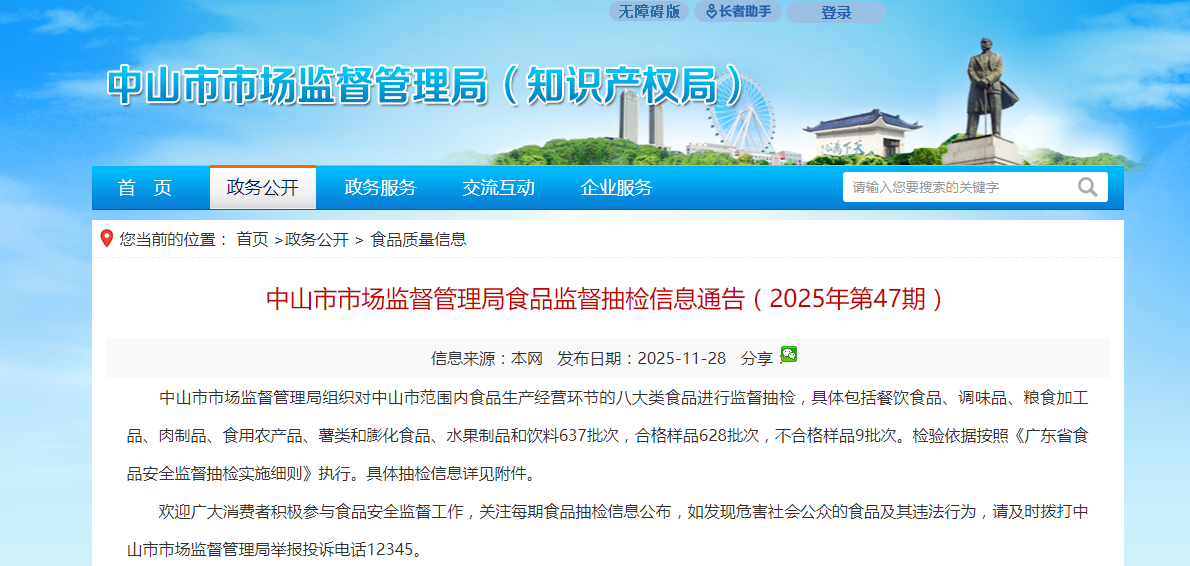
广东省中山市市场监督管理局食品监督抽检信息通告(2025年第47期)
Zhong Guo Zhi Liang Xin Wen Wang· 2025-12-01 08:39
Core Points - The Zhongshan Market Supervision Administration conducted a food safety inspection across eight categories of food, testing a total of 637 samples, with 628 passing and 9 failing the safety standards [2][3]. Group 1: Inspection Results - A total of 637 food samples were tested, with 628 samples deemed qualified, resulting in a pass rate of approximately 98.6% [2]. - The categories of food inspected included catering food, condiments, grain products, meat products, edible agricultural products, potato and puffed foods, fruit products, and beverages [2][3]. Group 2: Non-compliance Details - Among the 9 non-compliant samples, specific issues included the presence of prohibited substances such as dehydroacetic acid and its sodium salt, as well as excessive levels of anionic synthetic detergents [2][3]. - The inspection results are made public to encourage consumer participation in food safety oversight, with a hotline provided for reporting unsafe food practices [2].