鸡仔饼

Search documents
浓浓“慈孝情”
Xin Lang Cai Jing· 2026-02-22 06:37
Group 1 - The article highlights the importance of family gatherings during the Spring Festival, emphasizing the significance of traditional customs and the emotional connections between generations [1][2][3] - The preparation of traditional dishes and the selection of authentic ingredients are seen as essential for maintaining the cultural essence of the festival, reflecting the deep-rooted values of family and heritage [1][2] - The narrative illustrates the role of younger generations in honoring their elders through thoughtful gifts and acts of care, showcasing a blend of modern lifestyles with traditional values [2][3] Group 2 - The article discusses the impact of aging on family dynamics, particularly focusing on the challenges faced by elderly family members, such as Alzheimer's disease, and the efforts made by younger family members to engage and connect with them [3] - The emotional weight of farewells during the festival is portrayed, highlighting the bittersweet nature of family reunions and the lasting memories created during these gatherings [3]
年轻人春节回家账单:花销超2万,机票占一半
凤凰网财经· 2026-02-16 10:48
Core Viewpoint - The article highlights the financial burden young people face during the Chinese New Year, with many spending a significant portion of their monthly salary on travel, gifts, and red envelopes for family members, leading to a phenomenon referred to as "Spring Robbery" [3][5]. Group 1: Travel Expenses - The cost of round-trip tickets for travel during the New Year can reach nearly 5000 yuan, consuming a large part of a young worker's salary [3]. - Travel expenses for returning home can vary widely, with estimates ranging from 6000 to 20000 yuan depending on individual circumstances [5][11]. Group 2: Gift and Red Envelope Spending - Young individuals report spending between 6000 to 20000 yuan on gifts and red envelopes for family members, which can include significant amounts for parents and children [5][11][21]. - Specific examples include spending 6800 yuan on gifts for parents and 4600 yuan on red envelopes for grandparents and children, totaling around 12000 yuan for one couple [22]. Group 3: Cost-Saving Strategies - Some individuals have turned to digital platforms and AI-driven apps to save money during the New Year, participating in activities that allow them to earn cash or discounts [9][10]. - Families are collaborating to maximize savings through these platforms, with one family reportedly saving around 2000 yuan through collective efforts [10]. Group 4: Cultural Significance - Despite the financial strain, many young people express that the experience of returning home and spending time with family is invaluable, emphasizing the emotional and cultural importance of the New Year celebrations [5][22][23]. - The article illustrates that the joy of family reunions and traditional customs outweighs the financial costs incurred during this festive period [22][23].


蛋卷、无人机、小米汽车同台——什么才是今年最潮“广货”?
Nan Fang Du Shi Bao· 2026-01-30 12:57
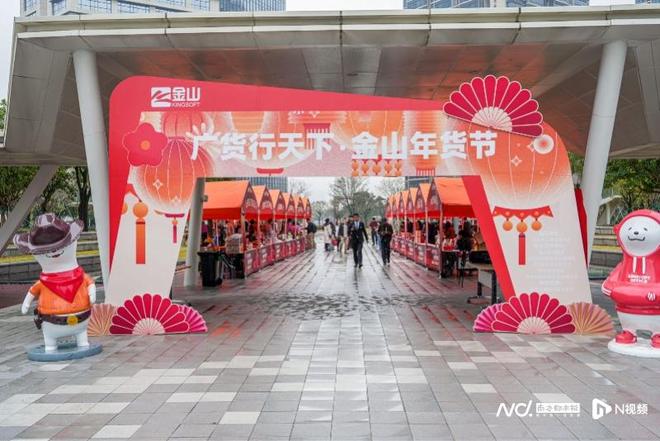
Core Viewpoint - The "Guanghuo Goes Global · Jingshan New Year Goods Festival" was launched in Zhuhai High-tech Zone, featuring nearly 40 enterprises and around 200 selected products, aiming to provide a high-quality one-stop shopping experience for the New Year [1][3][5]. Group 1: Event Overview - The event is guided by multiple local government bodies and organized by Kingsoft Group in collaboration with various associations, responding to the provincial initiative "Guanghuo Goes Global" [3]. - The festival showcases a variety of products, including traditional foods and innovative tech items, emphasizing quality and local specialties [5][10]. Group 2: Product Highlights - Featured products include traditional delicacies such as Doumen pig's feet ginger and handmade pastries, aimed at promoting local brands to a broader market [7][9]. - The event also includes modern tech displays, such as Xiaomi cars and racing drones, integrating traditional New Year shopping with contemporary technology [9][10]. Group 3: Community and Economic Impact - The festival serves as a platform for local farmers and businesses to increase revenue and enhance regional brand recognition [7]. - Kingsoft Group is actively participating by purchasing local products for internal distribution, promoting a cycle of support for local goods [10]. Group 4: Event Logistics - The festival runs until January 31, with extended free parking for visitors on the last day, facilitating easy access for the community [10].

体验“成为中国人”?老广:先从叹茶开始|广货行天下
Nan Fang Nong Cun Bao· 2026-01-27 20:33
Core Viewpoint - The article explores the concept of "Becoming Chinese" through the lens of daily life in Guangdong, emphasizing the cultural significance of tea and its integration into various aspects of life [2][3][38]. Group 1: Tea Culture in Guangdong - Tea in Guangdong is not merely a beverage but a vital part of daily rituals, reflecting a lifestyle that values leisure and enjoyment [4][10]. - The experience of drinking tea, such as "一盅两件," is characterized by a relaxed atmosphere, where various types of tea and dim sum are enjoyed together [8][12]. Group 2: Culinary Pairings and Health Benefits - After a hearty meal, tea is consumed to aid digestion, with options like Phoenix Dan Cong and aged Pu-erh being highlighted for their rich flavors and health benefits [16][19]. - Traditional snacks like green bean cakes and fermented bean curd biscuits complement the tea, enhancing the overall tasting experience [17][20]. Group 3: Modern Tea Trends - The afternoon tea culture in Guangdong has evolved, with younger generations embracing new tea drinks, showcasing innovation and creativity in the beverage industry [22][24]. - The fusion of Eastern and Western tea traditions is evident in experiences like "British afternoon tea," which incorporates local delicacies and porcelain, reflecting Guangdong's historical trade connections [26][34]. Group 4: Cultural Significance - The article emphasizes that tea culture in Guangdong transcends regional boundaries, serving as a cultural bridge between local and global communities [36][38].

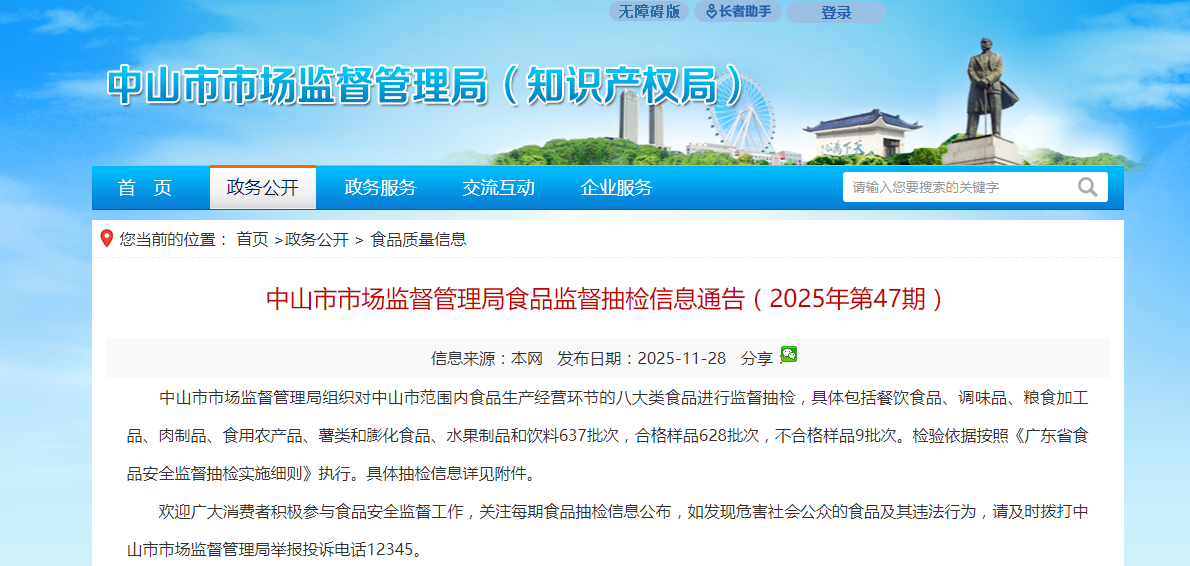
广东省中山市市场监督管理局食品监督抽检信息通告(2025年第47期)
Zhong Guo Zhi Liang Xin Wen Wang· 2025-12-01 08:39
Core Points - The Zhongshan Market Supervision Administration conducted a food safety inspection across eight categories of food, testing a total of 637 samples, with 628 passing and 9 failing the safety standards [2][3]. Group 1: Inspection Results - A total of 637 food samples were tested, with 628 samples deemed qualified, resulting in a pass rate of approximately 98.6% [2]. - The categories of food inspected included catering food, condiments, grain products, meat products, edible agricultural products, potato and puffed foods, fruit products, and beverages [2][3]. Group 2: Non-compliance Details - Among the 9 non-compliant samples, specific issues included the presence of prohibited substances such as dehydroacetic acid and its sodium salt, as well as excessive levels of anionic synthetic detergents [2][3]. - The inspection results are made public to encourage consumer participation in food safety oversight, with a hotline provided for reporting unsafe food practices [2].
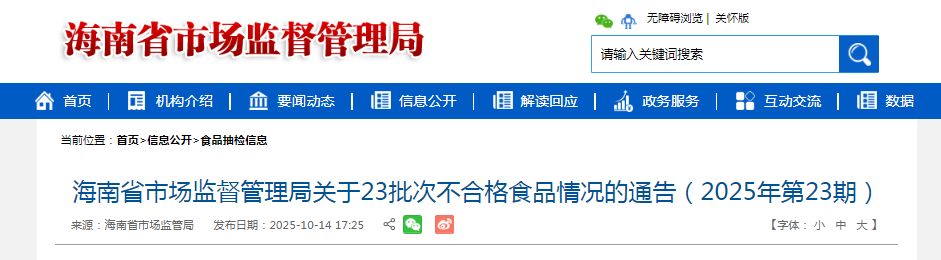
海南省市场监督管理局关于23批次不合格食品情况的通告(2025年第23期)
Zhong Guo Zhi Liang Xin Wen Wang· 2025-10-15 06:37
Core Points - The Hainan Provincial Market Supervision Administration reported that 23 batches of food products were found to be non-compliant with safety standards during a recent inspection of 1,112 batches [2][3][4]. Summary by Categories Food Additives - Non-compliance was noted in products such as mung bean cakes and homemade pastries, where the levels of dehydroacetic acid and its sodium salt exceeded national food safety standards [2][3]. Pesticide Residues - Several vegetable samples, including snow peas and scallions, showed pesticide residues above the permissible limits, specifically with substances like procymidone and acetamiprid [4][5]. Veterinary Drug Residues - Issues were identified in pork and shrimp products, with residues of chloramphenicol and enrofloxacin exceeding safety standards [5][6]. Heavy Metal Contamination - A seafood sample (scallops) was found to have cadmium levels that did not meet safety standards [7]. Microbial Contamination - Reusable dining utensils from a restaurant were found to have unacceptable levels of coliform bacteria, indicating poor sanitation practices [8].