
食用油

Search documents
为什么你的好产品卖不动?从金丝猴奶糖的‘上海迁徙’看消费者信任的底层逻辑”
Sou Hu Cai Jing· 2025-08-07 03:56
Core Insights - The article discusses the concept of "trust image" in consumer perception, highlighting how it influences brand positioning and market success in the Chinese candy market and other sectors [1][2][9] Group 1: Trust Image Concept - The "trust image" is a critical factor in consumer decision-making, often overshadowing product quality and marketing efforts [1] - The case of Jin Si Hou milk candy illustrates how regional biases can limit market penetration, necessitating a shift in brand perception through strategic relocation and branding [1][2] Group 2: Strategies for Building Trust - Companies can break through cognitive barriers by redefining key value dimensions of their products, as seen with Jin Si Hou and Chang An Hua canola oil [2] - Visualizing value is essential; for instance, the development of Chen Pi series by Pi Zai Huang transforms traditional craftsmanship into relatable consumer experiences [3] Group 3: Systematic Empowerment - Successful implementation of trust images involves reconstructing sales narratives and adapting channel strategies, emphasizing the importance of integrating trust into every sales interaction [4] - Many brands mistakenly equate capturing a positioning word with establishing trust, neglecting the essence of trust images as consumer perceptions of products [5] Group 4: Category-Specific Trust Points - Different product categories have unique trust anchors, such as the "Shanghai gene" in the candy industry and "raw material worship" in the cooking oil sector [6] - The introduction of new product lines, like Jin Si Hou's foray into snacks, reflects the need for ongoing adaptation to changing consumer behaviors [7] Group 5: Simplifying Consumer Decisions - In an era of information overload, the essence of trust images is to simplify decision-making for consumers, guiding them through their cognitive blind spots [9] - Brands that evoke professional associations in consumers' minds can naturally enhance their pricing power, leading to increased market success [9]


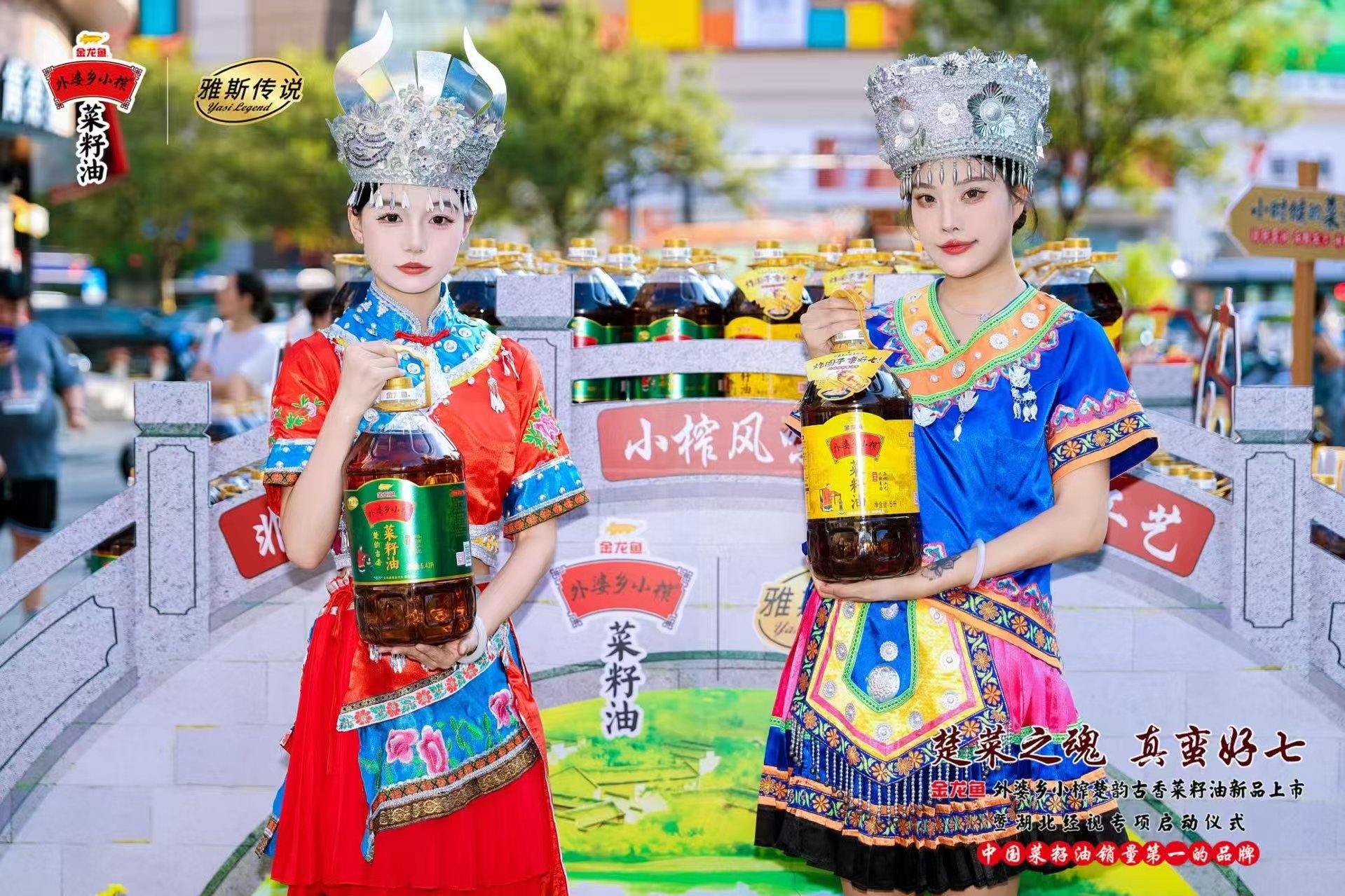
楚菜之魂真蛮好七丨金龙鱼外婆乡小榨菜籽油携手湖北经视带您寻味小时候的菜油香
Xin Lang Cai Jing· 2025-08-06 06:10
Core Viewpoint - The launch event for Yihai Kerry's new product, "Chuyun Guxiang" rapeseed oil, emphasizes the connection between traditional Hubei cuisine and high-quality cooking oil, aiming to enhance the culinary experience for local consumers [1][3]. Group 1: Product Launch and Features - Yihai Kerry's "Chuyun Guxiang" rapeseed oil is tailored specifically for Hubei consumers, utilizing high-quality rapeseed and traditional small-scale pressing techniques to preserve flavor and nutritional value [3][5]. - The product aims to evoke nostalgic flavors associated with Hubei's culinary heritage, as demonstrated by a cooking demonstration featuring traditional dishes [3][10]. Group 2: Strategic Partnerships and Marketing - The launch event was held in collaboration with Yasi Supermarket, marking a strategic partnership to enhance distribution and sales channels for the new product across Hubei [5][7]. - Yihai Kerry plans to conduct promotional activities in seven cities, including Wuhan and Yichang, utilizing various marketing strategies such as tastings and giveaways to increase product visibility [7][8]. Group 3: Quality Assurance - The production facility, Yihai Kerry (Wuhan) Grain and Oil Industrial Co., has achieved multiple quality management certifications, ensuring high standards for the "Chuyun Guxiang" rapeseed oil [5].
楚菜之魂 真蛮好七丨金龙鱼外婆乡小榨菜籽油携手湖北经视带您寻味小时候的菜油香
Zhong Guo Zhi Liang Xin Wen Wang· 2025-08-06 05:13
Core Viewpoint - The launch event of Jinlongyu's new product, "Xiaozha Chuyun Guxiang Canola Oil," aims to bring traditional and authentic canola oil products to the people of Hubei, emphasizing the connection between local cuisine and the product's unique flavor [1][4]. Group 1: Product Launch and Features - Jinlongyu's "Xiaozha Chuyun Guxiang Canola Oil" is designed specifically for Hubei consumers, combining traditional craftsmanship with patented technology to enhance the flavor of local dishes [4][6]. - The product is made from high-quality canola seeds and follows a meticulous small-batch production process to preserve its rich aroma and nutritional value [4][6]. - The oil is positioned as a nostalgic product, evoking memories of the "oil fragrance" from childhood, which resonates with local consumers [3][10]. Group 2: Marketing and Sales Strategy - The launch event was held in collaboration with Yasi Supermarket, establishing a strategic partnership to enhance sales channels and boost market presence in Hubei [6][7]. - Jinlongyu plans to conduct promotional activities across seven cities in Hubei, including Wuhan and Yichang, to engage consumers through tastings and interactive events [7][8]. - The company will also implement online and offline promotional campaigns leading up to the Mid-Autumn Festival, offering over 100,000 bottles for free sampling or at discounted prices [8][10]. Group 3: Quality Assurance and Consumer Engagement - The production facility has received multiple quality management certifications, ensuring the safety and health of the products offered to consumers [6]. - Jinlongyu emphasizes the importance of consumer feedback and oversight in the Hubei market, aiming to maintain high product quality and customer satisfaction [10].
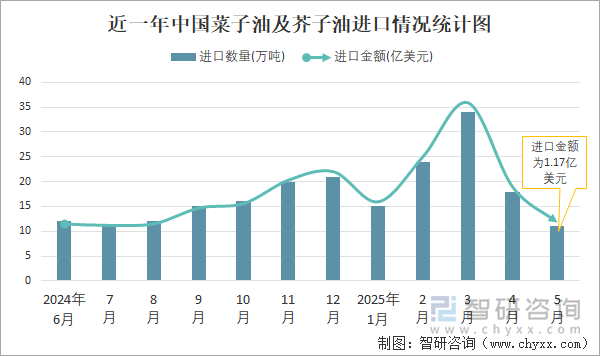
2025年5月中国菜子油及芥子油进口数量和进口金额分别为11万吨和1.17亿美元
Chan Ye Xin Xi Wang· 2025-08-06 03:07
Group 1 - The core viewpoint indicates a significant decline in China's imports of rapeseed oil and mustard oil in May 2025, with a total import volume of 110,000 tons, representing a year-on-year decrease of 20.3% [1] - The import value for the same period is reported at $11.7 million, which reflects a year-on-year decline of 13.1% [1] - The data is sourced from Chinese customs and organized by Zhiyan Consulting, highlighting the importance of reliable data in industry analysis [3]
道道全股价微跌0.61% 上半年净利润同比增长563%
Jin Rong Jie· 2025-08-04 19:20
Core Viewpoint - The stock price of Daodaquan has decreased by 0.61% to 11.38 yuan as of August 4, 2025, with significant trading volume and a notable increase in net profit for the first half of 2025 [1] Company Performance - Daodaquan reported a revenue of 2.792 billion yuan for the first half of 2025, reflecting a year-on-year growth of 1.16% [1] - The net profit for the same period reached 181 million yuan, showing a substantial year-on-year increase of 563.15% [1] - The decline in raw material costs has contributed to the recovery of profitability, and the effectiveness of channel expansion has been significant [1] Shareholder and Market Activity - As of July 31, 2025, the number of shareholders decreased by 7.72%, indicating an increase in share concentration [1] - On August 4, 2025, the net outflow of main funds was 12.508 million yuan, accounting for 0.39% of the circulating market value [1] - Over the past five trading days, the cumulative net inflow of main funds was 41.6043 million yuan, representing 1.28% of the circulating market value [1]
西南证券:给予道道全买入评级
Zheng Quan Zhi Xing· 2025-08-04 12:40
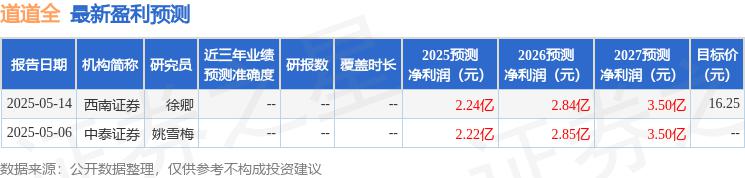
Core Viewpoint - The report highlights the steady growth of Daodaoquan's core business and the effectiveness of its channel expansion, leading to a "buy" rating from Southwest Securities [1]. Financial Performance - In the first half of 2025, Daodaoquan achieved revenue of 2.792 billion yuan, a year-on-year increase of 1.16% - The net profit attributable to shareholders reached 181 million yuan, up 563.15% - The net profit after deducting non-recurring items was 157 million yuan, an increase of 428.51% [1][2]. Cost Management and Profitability - The company benefited from a decline in raw material costs, significantly restoring profitability - The overall gross margin improved by 2.32 percentage points to 11.65% - The gross margin for the core product, packaging oil, increased by 0.89 percentage points to 15.67%, while the gross margin for meal products rose by 1.23 percentage points to 5.40% [1][2]. Core Business Growth - The packaging oil business, which is the main source of revenue and profit, generated 1.751 billion yuan, a year-on-year increase of 20.53% - Sales volume in the food processing segment reached 170,900 tons, up 24.19%, indicating strong market demand and brand recognition - The number of distributors increased by 92 to 1,397, and online direct sales revenue for packaging oil grew by 23.64% [2]. Capacity Expansion - Daodaoquan plans to invest 1 billion yuan in a 1 million tons/year edible oil processing project in Weinan, Shaanxi, to capture opportunities in the Northwest market - The company is also advancing the construction of the "Daodaoquan Changsha Headquarters Base" with an investment of 45 million yuan during the reporting period, totaling 228 million yuan [2]. Earnings Forecast - The expected EPS for 2025, 2026, and 2027 are 0.7 yuan, 0.83 yuan, and 1.02 yuan, respectively - The corresponding dynamic PE ratios for 2025-2027 are projected to be 16, 14, and 11 times [3].

2025年中国甘油二酯食用油(二酯油)发展历程、发展背景、产业链图谱、市场规模、竞争格局及发展趋势研判:中老年消费者占比超80%[图]
Chan Ye Xin Xi Wang· 2025-08-04 07:12
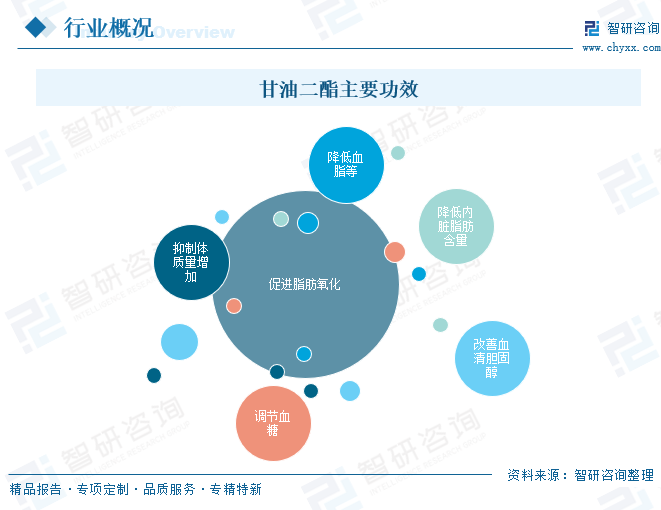
Overview - China is the world's largest consumer of edible oil, with a daily per capita intake far exceeding recommended levels, leading to a growing demand for healthy cooking oils due to increasing rates of chronic diseases such as hypertension, diabetes, and obesity [1][15] - The market for glycerol diester oil (diester oil) is projected to reach 17.977 billion yuan in 2024, reflecting a year-on-year growth of 0.21% [1][15] Development Background - Rising living standards have enhanced consumer willingness to pay for high-end, healthy oils, with glycerol diester oil gaining market share as a functional oil [8] - The Chinese population's daily cooking oil consumption significantly exceeds WHO recommendations, contributing to a high prevalence of chronic diseases, thus increasing the urgency for healthy oil options [8] Industry Chain - The upstream of the glycerol diester oil industry includes suppliers of soybean oil, rapeseed oil, peanut oil, corn oil, and other raw materials, as well as suppliers of fat enzyme preparations, water, glycerol, and production equipment [10] - The midstream consists of glycerol diester oil production companies, while the downstream includes various sales channels such as supermarkets, convenience stores, and e-commerce platforms [10] Consumer Demographics - The primary consumers of glycerol diester oil include health-conscious elderly individuals, those with chronic diseases, weight loss seekers, and young people pursuing a healthy lifestyle, with the elderly demographic accounting for over 80% of the market [13] Competitive Landscape - The glycerol diester oil industry in China has relatively few companies compared to mainstream oils, resulting in moderate competition. Key players include Changshouhua Food Co., Ltd., Zhidai Technology (Beijing) Co., Ltd., and Yihai Kerry Arawana Holdings Co., Ltd. [17][19] - Changshouhua Food Co., Ltd. is recognized as a leader in the industrialization of glycerol diester oil, having established the world's first large-scale production line for this oil [19] Industry Trends - The demand for healthy cooking oils is expected to continue rising as consumer health awareness increases, with glycerol diester oil being recognized for its fat-reducing and blood lipid-regulating properties [23] - Companies are likely to enhance market promotion and education efforts, developing differentiated products targeting various consumer groups, such as high-purity options for the elderly and affordable, convenient packaging for younger consumers [23]
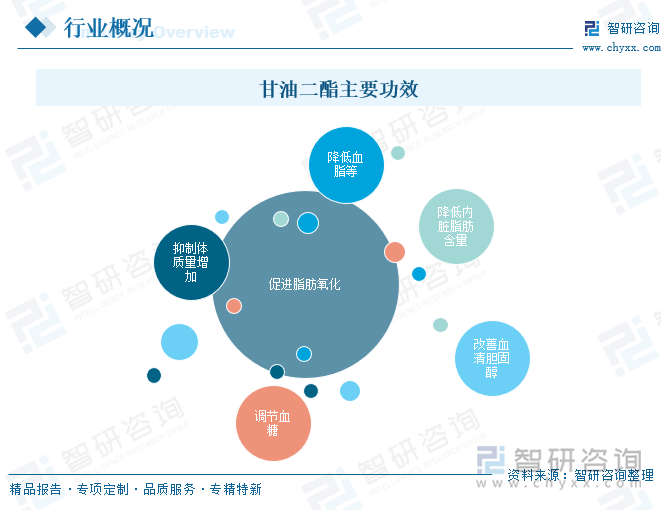
研判2025!中国氯化钙行业产量、价格及进出口分析:2025上半年氯化钙产量同比增9.94%,基础设施需求激增成主要驱动力[图]
Chan Ye Xin Xi Wang· 2025-08-04 03:41
Overview - China is the world's largest consumer of edible oil, with a daily per capita intake far exceeding recommended levels, leading to a growing demand for healthy cooking oils due to increasing rates of chronic diseases such as hypertension, diabetes, and obesity [1][15] - The market for glycerol diester oil (DAG oil) is expanding, with a projected market size of 17.977 billion yuan in 2024, reflecting a year-on-year growth of 0.21% [1][15] Development Background - Rising living standards have increased consumer willingness to pay higher prices for high-end, healthy oils, with DAG oil gaining market share as a functional oil [8] - The Chinese population's high daily cooking oil consumption and the prevalence of chronic diseases have intensified the demand for healthy oils [8] Industry Chain - The upstream of the DAG oil industry includes suppliers of soybean oil, rapeseed oil, peanut oil, corn oil, and other raw materials, as well as suppliers of fat enzyme preparations, water, glycerol, and production equipment [10] - The midstream consists of DAG oil production companies, while the downstream includes supermarkets, convenience stores, specialty oil shops, and e-commerce platforms [10] Consumer Demographics - The primary consumers of DAG oil include health-conscious elderly individuals, those with chronic diseases, weight loss seekers, and young people pursuing a healthy lifestyle, with the elderly demographic accounting for over 80% of the consumer base [13] Competitive Landscape - The DAG oil industry in China has relatively few companies compared to mainstream oils, leading to moderate competition [17] - Key players include Changshouhua Food Co., Ltd., Zhidai Technology (Beijing) Co., Ltd., Guangzhou Shanbainian Food Technology Co., Ltd., and Yihai Kerry Arawana Holdings Co., Ltd., among others [17][19] Industry Trends - The demand for healthy cooking oils is expected to continue increasing, with DAG oil being recognized for its fat-reducing and blood lipid-regulating properties [23] - Companies are likely to enhance market promotion and education efforts, developing differentiated products targeting various consumer groups, including high-purity products for the elderly and affordable options for younger consumers [23]

道道全半年赚1.81亿超2024全年 成本改善毛利率升至11.65%
Chang Jiang Shang Bao· 2025-08-03 23:33
Core Viewpoint - The company Daodaoquan (002852.SZ) reported strong performance in the first half of 2025, with significant increases in both revenue and net profit, driven by higher sales volume and lower raw material costs [1][3][4]. Financial Performance - In the first half of 2025, Daodaoquan achieved operating revenue of 2.792 billion yuan, a year-on-year increase of 1.16% [1][3]. - The net profit attributable to shareholders reached 181 million yuan, a remarkable year-on-year growth of 563.15% [1][3]. - The net profit after deducting non-recurring gains and losses was 157 million yuan, up 428.51% year-on-year [1][3]. - The gross profit margin for the first half of 2025 was 11.65%, the highest for the same period in seven years [1][4]. Cost Management - The company reported a 42.34% reduction in total expenses, with total expenses amounting to 112 million yuan in the first half of 2025, down from 194 million yuan in the same period of 2024 [5]. - Sales expenses decreased by 27.26% to 61.56 million yuan, while R&D and financial expenses also saw declines [5]. Market Performance - Since the beginning of 2025, Daodaoquan's stock price has increased by 40.84%, rising from 8.13 yuan per share to 11.45 yuan per share by the end of July [2][5]. Dividend Distribution - The company plans to distribute a mid-term cash dividend of 1.76 yuan per 10 shares, totaling approximately 60.54 million yuan [6].
破发股道道全跌5.61% 2017年上市两次募资共19.7亿元
Zhong Guo Jing Ji Wang· 2025-08-01 08:28
Group 1 - The core point of the news is that Daodaoquan's stock is currently trading at 11.45 yuan, reflecting a decline of 5.61%, and the company is in a state of share price below its initial public offering (IPO) price [1] - Daodaoquan was listed on the Shenzhen Stock Exchange on March 10, 2017, with an issuance of 25 million shares at an IPO price of 47.30 yuan per share, raising a total of 118.25 million yuan [1] - The net proceeds from the IPO, after deducting issuance costs of 6.586 million yuan, amounted to 111.664 million yuan, which were allocated to various projects including an edible oil processing project in Yueyang and a refining project in Chongqing [1] Group 2 - In November 2021, Daodaoquan conducted a non-public offering of 70 million shares at a price of 11.31 yuan per share, raising a total of approximately 791.7 million yuan [2] - After deducting underwriting and advisory fees of approximately 10.1 million yuan and other expenses of about 1.68 million yuan, the actual net proceeds from this offering were approximately 779.92 million yuan [2] - The total amount raised from both the IPO and the subsequent non-public offering is approximately 197.42 million yuan [3] Group 3 - Daodaoquan has a history of profit distribution, having announced cash dividends of 2.30 yuan per 10 shares for the 2017 annual profit distribution and 4.10 yuan per 10 shares for the 2017 semi-annual profit distribution [3] - The company also executed a capital reserve conversion, issuing 7 additional shares for every 10 shares held during both profit distributions [3]