制造业

Search documents
2025全年全国规模以上工业增加值比上年增长5.9%
Yang Shi Xin Wen Ke Hu Duan· 2026-01-19 02:27
Core Insights - The industrial production in China showed rapid growth, with the total industrial value-added increasing by 5.9% year-on-year [1] Group 1: Industrial Growth - The mining sector's value-added increased by 5.6%, while the manufacturing sector grew by 6.4%, and the electricity, heat, gas, and water production and supply sector grew by 2.3% [1] - The equipment manufacturing industry saw a value-added growth of 9.2%, and the high-tech manufacturing industry experienced a 9.4% increase, both outpacing the overall industrial growth by 3.3 and 3.5 percentage points respectively [1] Group 2: Economic Types - State-owned enterprises reported a value-added growth of 4.6%, while joint-stock enterprises grew by 6.3%, foreign and Hong Kong, Macao, and Taiwan-invested enterprises increased by 3.9%, and private enterprises saw a growth of 5.3% [1] Group 3: Product Performance - The production of 3D printing equipment, industrial robots, and new energy vehicles increased significantly, with growth rates of 52.5%, 28.0%, and 25.1% respectively [1] Group 4: December Performance - In December, the industrial value-added increased by 5.2% year-on-year and 0.49% month-on-month [1] - The manufacturing purchasing managers' index (PMI) was at 50.1, rising by 0.9 percentage points from the previous month, while the business activity expectation index increased to 55.5, up by 2.4 percentage points [1] Group 5: Profitability - From January to November, the total profit of large-scale industrial enterprises reached 66,269 billion yuan, reflecting a year-on-year growth of 0.1% [1]
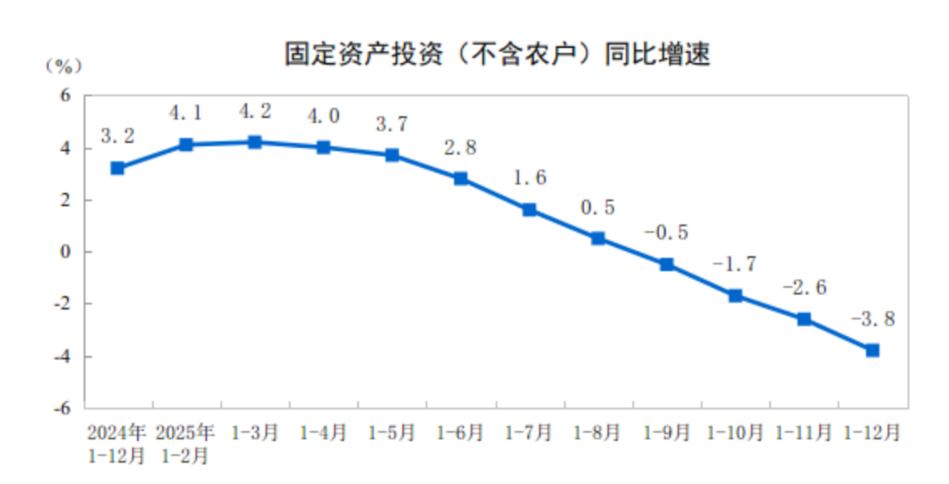
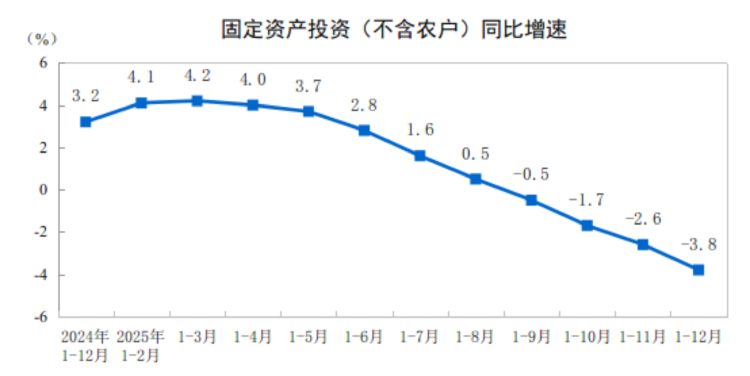
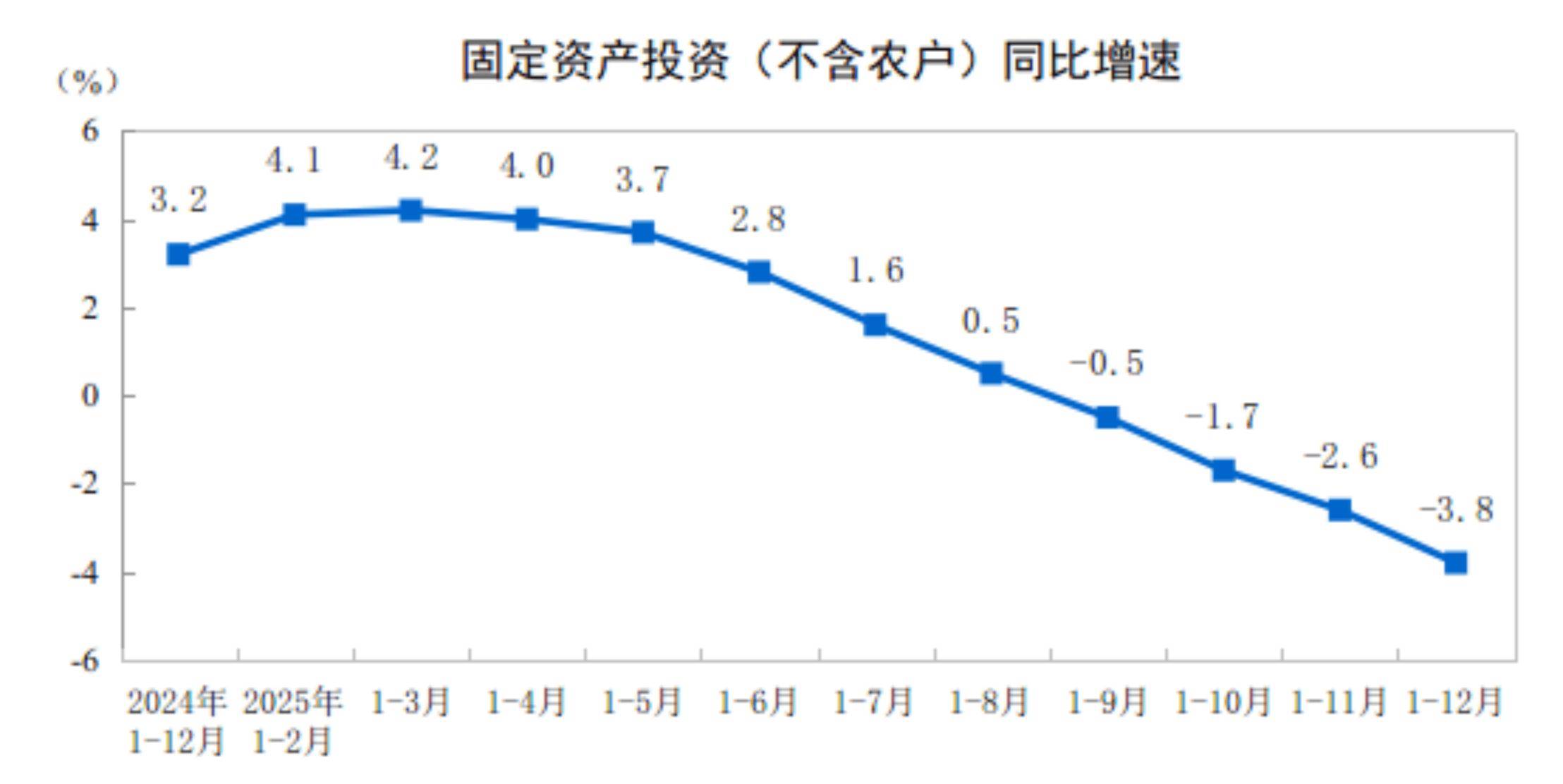
国家统计局:2025年全国固定资产投资485186亿元 比上年下降3.8%
智通财经网· 2026-01-19 02:25
分产业看,第一产业投资9570亿元,比上年增长2.3%;第二产业投资177368亿元,增长2.5%;第三产业投资298248亿元,下降7.4%。 第二产业中,工业投资比上年增长2.6%。其中,采矿业投资增长2.5%,制造业投资增长0.6%,电力、热力、燃气及水生产和供应业投 资增长9.1%。 第三产业中,基础设施投资(不含电力、热力、燃气及水生产和供应业)比上年下降2.2%。其中,管道运输业投资增长36.0%,多式联运 和运输代理业投资增长22.9%,水上运输业投资增长7.7%。 分地区看,东部地区投资比上年下降8.4%,中部地区投资下降2.7%,西部地区投资下降1.3%,东北地区投资下降15.5%。 智通财经APP获悉,1月19日,国家统计局发布2025年全国固定资产投资基本情况。2025年,全国固定资产投资(不含农户)485186亿 元,比上年下降3.8%(按可比口径计算)。其中,民间固定资产投资比上年下降6.4%。从环比看,12月份固定资产投资(不含农户)下降 1.13%。分产业看,第一产业投资9570亿元,比上年增长2.3%;第二产业投资177368亿元,增长2.5%;第三产业投资298248亿元,下 ...

国家统计局:2025年我国国内生产总值突破140万亿元 增长5.0%
Jing Ji Guan Cha Bao· 2026-01-19 02:25
Economic Overview - In 2025, China's GDP reached 1401879 billion yuan, growing by 5.0% year-on-year, with the first, second, and third industries growing by 3.9%, 4.5%, and 5.4% respectively [1] - Quarterly GDP growth rates were 5.4% in Q1, 5.2% in Q2, 4.8% in Q3, and 4.5% in Q4, with a 1.2% increase in Q4 on a quarter-on-quarter basis [1] Agriculture - National grain production totaled 71488 million tons, an increase of 838 million tons or 1.2% from the previous year [2] - Livestock production reached 10072 million tons, a 4.2% increase, with pork production at 5938 million tons, growing by 4.1% [2] Industrial Production - Industrial value-added for large enterprises grew by 5.9%, with manufacturing increasing by 6.4% and high-tech manufacturing by 9.4% [3] - The production of 3D printing equipment, industrial robots, and new energy vehicles saw significant increases of 52.5%, 28.0%, and 25.1% respectively [3] Services Sector - The service sector's value-added grew by 5.4%, with information transmission and software services increasing by 11.1% [4] - The service industry business activity index was at 49.7 in December, indicating stable growth [4] Retail and Consumption - Total retail sales of consumer goods reached 501202 billion yuan, growing by 3.7%, with online retail sales increasing by 8.6% [5] - The retail sales of essential and upgraded goods showed strong growth, with communication equipment sales up by 20.9% [5] Investment Trends - Fixed asset investment decreased by 3.8% to 485186 billion yuan, with manufacturing investment growing by 0.6% [6] - High-tech industries, particularly information services and aerospace manufacturing, saw investment growth of 28.4% and 16.9% respectively [6] Trade Performance - Total goods import and export value reached 454687 billion yuan, a 3.8% increase, with exports growing by 6.1% [7] - Private enterprises accounted for 57.3% of total trade, reflecting a 1.8 percentage point increase from the previous year [7] Price Stability - The Consumer Price Index (CPI) remained stable year-on-year, with food prices decreasing by 0.7% [8] - Core CPI, excluding food and energy, rose by 0.7%, indicating mild inflationary pressure [8] Employment and Income - The urban unemployment rate averaged 5.2% for the year, with a slight decrease to 5.1% in December [9] - Per capita disposable income reached 43377 yuan, with rural income growth outpacing urban income growth [11] Demographic Changes - The total population decreased by 3.39 million to 140489 million, with an urbanization rate of 67.89%, up by 0.89 percentage points [12] Economic Outlook - The economy is expected to face challenges from external changes and domestic supply-demand imbalances, necessitating proactive macroeconomic policies [13]
2025年经济发展向新向优
Guo Jia Tong Ji Ju· 2026-01-19 02:25
Economic Overview - In 2025, China's GDP reached 14,018.79 billion yuan, growing by 5.0% year-on-year at constant prices [1] - The GDP growth rates by quarter were 5.4% in Q1, 5.2% in Q2, 4.8% in Q3, and 4.5% in Q4 [1] Agriculture - The total grain production was 71,488 million tons, an increase of 1.2% from the previous year [2] - Meat production reached 10,072 million tons, marking a 4.2% increase, with pork production at 5,938 million tons, up by 4.1% [2] Industrial Production - The industrial added value for large-scale enterprises grew by 5.9% year-on-year [3] - High-tech manufacturing and equipment manufacturing saw growth rates of 9.4% and 9.2%, respectively, outpacing overall industrial growth [3] Services Sector - The service sector's added value increased by 5.4% year-on-year [4] - Key service industries such as information transmission and software services grew by 11.1% [4] Retail and Consumption - Total retail sales of consumer goods reached 501,202 billion yuan, growing by 3.7% year-on-year [5] - Online retail sales amounted to 159,722 billion yuan, a year-on-year increase of 8.6% [5] Investment - Fixed asset investment (excluding rural households) decreased by 3.8% to 485,186 billion yuan [6] - Manufacturing investment grew by 0.6%, while real estate investment fell by 17.2% [6] Trade - Total goods import and export value was 454,687 billion yuan, up by 3.8% year-on-year [7] - Exports increased by 6.1% to 269,892 billion yuan, while imports rose by 0.5% [7] Employment - The urban surveyed unemployment rate averaged 5.2% for the year, with a December rate of 5.1% [9] - The total number of migrant workers reached 30,115 million, a 0.5% increase from the previous year [9] Income - The per capita disposable income for residents was 43,377 yuan, reflecting a nominal growth of 5.0% [10] - Rural residents' income growth outpaced that of urban residents, with rural income increasing by 5.8% [10] Population - The total population decreased by 3.39 million to 1,404.89 million by the end of the year [11] - The urbanization rate reached 67.89%, an increase of 0.89 percentage points from the previous year [11]

2025年我国固定资产投资同比下降3.8%
Sou Hu Cai Jing· 2026-01-19 02:24
Core Insights - In 2025, China's fixed asset investment (excluding rural households) reached 48,518.6 billion yuan, representing a decline of 3.8% compared to the previous year [1] - Private fixed asset investment decreased by 6.4% year-on-year [1] - Month-on-month, fixed asset investment fell by 1.13% in December [1] Investment by Industry - Primary industry investment was 957 billion yuan, showing a growth of 2.3% year-on-year [3] - Secondary industry investment totaled 177,368 billion yuan, with a growth of 2.5% [3] - Tertiary industry investment was 298,248 billion yuan, experiencing a decline of 7.4% [3] - Within the secondary industry, industrial investment grew by 2.6%, with mining investment up by 2.5%, manufacturing investment up by 0.6%, and investment in electricity, heat, gas, and water production and supply up by 9.1% [3] - In the tertiary industry, infrastructure investment (excluding electricity, heat, gas, and water production and supply) decreased by 2.2% [3] - Notable growth in specific sectors included pipeline transportation investment up by 36.0%, multimodal transport and logistics investment up by 22.9%, and water transportation investment up by 7.7% [3] Investment by Region - Investment in the eastern region declined by 8.4% year-on-year [3] - The central region saw a decrease of 2.7% in investment [3] - Investment in the western region fell by 1.3% [3] - The northeastern region experienced the most significant decline, with a drop of 15.5% [3] Investment by Registration Type - Domestic enterprises' fixed asset investment decreased by 3.8% year-on-year [4] - Investment from Hong Kong, Macau, and Taiwan enterprises fell by 2.2% [4] - Foreign enterprises' fixed asset investment saw a significant decline of 13.8% [4]
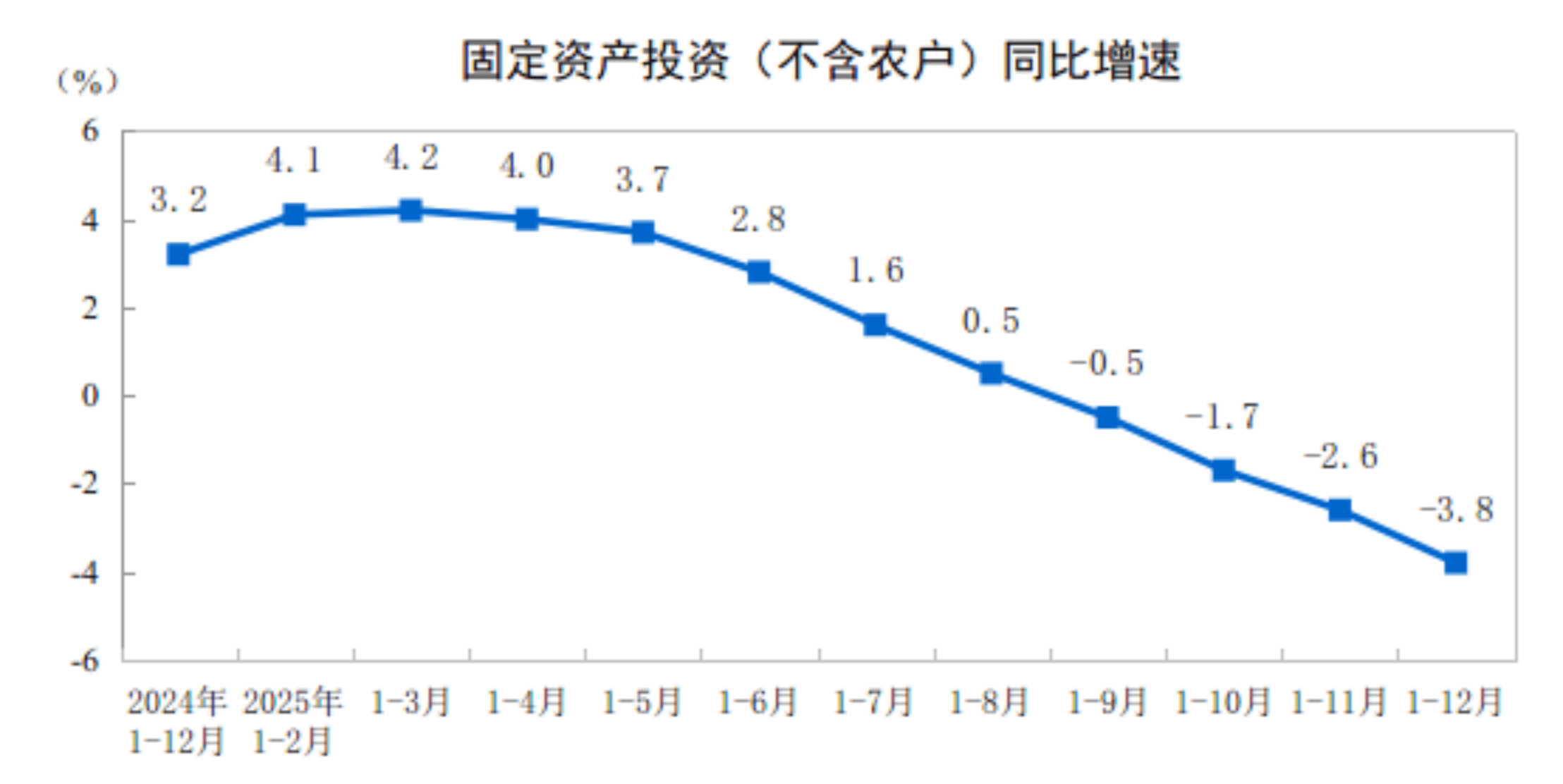
中国2025年固定资产投资同比下降3.8%,采矿业投资增长2.5%、制造业增长0.6%
Hua Er Jie Jian Wen· 2026-01-19 02:21
Core Insights - In 2025, China's total fixed asset investment (excluding rural households) reached 48,518.6 billion yuan, representing a decline of 3.8% compared to the previous year [1][3] - Private fixed asset investment decreased by 6.4% year-on-year, indicating a significant contraction in private sector investment [1][4] - The industrial investment within the secondary sector grew by 2.6% year-on-year, with mining investment increasing by 2.5% and manufacturing investment rising by 0.6% [1][3] Investment by Sector - Primary sector investment amounted to 957 billion yuan, showing a growth of 2.3% year-on-year [3] - Secondary sector investment totaled 177,368 billion yuan, reflecting a growth of 2.5% [3] - Tertiary sector investment was 298,248 billion yuan, which saw a decline of 7.4% [3] Regional Investment Trends - Investment in the eastern region decreased by 8.4% year-on-year, while the central region saw a decline of 2.7% [3] - The western region experienced a decrease of 1.3%, and the northeastern region faced a significant drop of 15.5% [3] Investment by Registration Type - Domestic enterprises' fixed asset investment fell by 3.8% year-on-year [4] - Investment from Hong Kong, Macau, and Taiwan enterprises decreased by 2.2% [4] - Foreign enterprises' fixed asset investment saw a substantial decline of 13.8% [4]
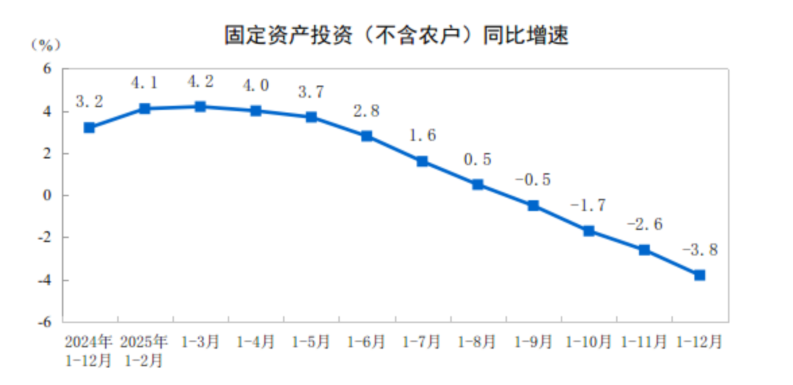
2025年全国固定资产投资485186亿元,比上年下降3.8%
Guo Jia Tong Ji Ju· 2026-01-19 02:19
Core Viewpoint - In 2025, China's fixed asset investment (excluding rural households) is projected to be 48,518.6 billion yuan, representing a decline of 3.8% compared to the previous year [1][4]. Investment by Sector - Investment in the primary industry reached 957 billion yuan, showing a growth of 2.3% year-on-year [3][4]. - Investment in the secondary industry totaled 177,368 billion yuan, with a growth of 2.5% [3][4]. - Investment in the tertiary industry was 298,248 billion yuan, reflecting a decline of 7.4% [3][4]. Secondary Industry Breakdown - Industrial investment in the secondary industry increased by 2.6% year-on-year [3]. - Mining investment grew by 2.5%, while manufacturing investment saw a modest increase of 0.6% [3]. - Investment in the electricity, heat, gas, and water production and supply industry surged by 9.1% [3]. Tertiary Industry Breakdown - Infrastructure investment (excluding electricity, heat, gas, and water production and supply) decreased by 2.2% [3]. - Notable growth was observed in pipeline transportation (36.0%), multimodal transport and agency services (22.9%), and water transportation (7.7%) [3]. Regional Investment Trends - Investment in the eastern region declined by 8.4% year-on-year [3]. - The central region experienced a decrease of 2.7%, while the western region saw a decline of 1.3% [3]. - The northeastern region faced the most significant drop at 15.5% [3]. Investment by Registration Type - Domestic enterprises' fixed asset investment fell by 3.8% [4]. - Investment from Hong Kong, Macau, and Taiwan enterprises decreased by 2.2% [4]. - Foreign enterprises experienced a substantial decline of 13.8% in fixed asset investment [4].
国家统计局:2025年全国固定资产投资485186亿元,比上年下降3.8%
Sou Hu Cai Jing· 2026-01-19 02:19
Investment Overview - Fixed asset investment (excluding rural households) reached 1,000,186 billion yuan, with a year-on-year growth of 2.0% [2][4] - Investment in the primary industry was 957 billion yuan, increasing by 2.3% compared to the previous year [2] - Investment in the secondary industry totaled 177,368 billion yuan, growing by 2.5% [2] - Investment in the tertiary industry was 298,248 billion yuan, showing a decline of 7.4% [2] Sector Analysis - In the secondary industry, industrial investment grew by 2.6%, with mining investment increasing by 2.5%, manufacturing investment rising by 0.6%, and investment in electricity, heat, gas, and water production and supply increasing by 9.1% [2] - Within the tertiary industry, infrastructure investment (excluding electricity, heat, gas, and water production and supply) decreased by 2.2%, while pipeline transportation investment surged by 36.0%, multimodal transport and agency services increased by 22.9%, and water transport investment rose by 7.7% [2] Regional Investment Trends - Investment in the eastern region declined by 8.4%, the central region saw a decrease of 2.7%, the western region experienced a drop of 1.3%, and the northeastern region faced a significant decline of 15.5% [2] Investment by Ownership Type - Domestic enterprises' fixed asset investment fell by 3.8%, investment from Hong Kong, Macau, and Taiwan enterprises decreased by 2.2%, and foreign enterprises' fixed asset investment dropped by 13.8% [2][4]
国家统计局:2025年全年国内生产总值1401879亿元 比上年增长5.0%
智通财经网· 2026-01-19 02:18
智通财经APP获悉,1月19日,国家统计局发文称,初步核算,全年国内生产总值1401879亿元,按不变 价格计算,比上年增长5.0%。分产业看,第一产业增加值93347亿元,比上年增长3.9%;第二产业增加 值499653亿元,增长4.5%;第三产业增加值808879亿元,增长5.4%。总的来看,2025年国民经济顶住 多重压力保持稳中有进发展态势,高质量发展取得新成效。但也要看到,外部环境变化影响加深,国内 供强需弱矛盾突出,经济发展中老问题、新挑战仍然不少。 原文如下: 2025年经济发展向新向优 预期目标圆满实现 2025年,面对国内外经济环境的复杂变化,在以习近平同志为核心的党中央坚强领导下,各地区各部门 深入贯彻落实党中央、国务院决策部署,坚定不移贯彻新发展理念、推动高质量发展,统筹国内国际两 个大局,统筹发展和安全,实施更加积极有为的宏观政策,纵深推进全国统一大市场建设,国民经济运 行顶压前行、向新向优,高质量发展取得新成效,经济社会发展主要目标任务圆满实现,"十四五"胜利 收官。 全年社会消费品零售总额501202亿元,比上年增长3.7%。按经营单位所在地分,城镇消费品零售额 432972亿元, ...
5.0%!突破140万亿元!2025年GDP出炉
证券时报· 2026-01-19 02:13
2025年GDP数据出炉。 据国家统计局数据,2025年全年国内生产总值1401879亿元,按不变价格计算,比上年增长5.0%。分产业看,第一产业增加值93347亿元,比 上年增长3.9%;第二产业增加值499653亿元,增长4.5%;第三产业增加值808879亿元,增长5.4%。分季度看,一季度国内生产总值同比增长 5.4%,二季度增长5.2%,三季度增长4.8%,四季度增长4.5%。从环比看,四季度国内生产总值增长1.2%。 一、粮食增产丰收,畜牧业稳定增长 全年全国粮食总产量71488万吨,比上年增加838万吨,增长1.2%。其中,夏粮产量14975万吨,下降0.1%;早稻产量2851万吨,增长1.2%;秋 粮产量53662万吨,增长1.5%。分品种看,小麦产量14007万吨,基本持平;玉米产量30124万吨,增长2.1%;稻谷产量20904万吨,增长 0.7%;大豆产量2091万吨,增长1.3%。全年猪牛羊禽肉产量10072万吨,比上年增长4.2%,首次超过1亿吨。其中,猪肉产量5938万吨,增长 4.1%;牛肉产量801万吨,增长2.8%;羊肉产量496万吨,下降4.2%;禽肉产量2837万吨,增长 ...