
小金属

Search documents
历史第二!两市成交额再上3万亿,沪指逼近3900点
Guan Cha Zhe Wang· 2025-08-25 07:27
Market Performance - The A-share market experienced a significant upward trend on August 25, with the Shanghai Composite Index approaching the 3900-point mark, closing up by 1.51% at 3883.56 [1] - The Shenzhen Component Index rose by 2.26%, closing at 12441.07, while the ChiNext Index increased by 3%, ending at 2762.99 [1] - A total of 3351 stocks in the market rose, while 1898 stocks fell, with 92 stocks hitting the daily limit up and 8 stocks hitting the limit down [1] Trading Volume - The total trading volume of the Shanghai and Shenzhen stock exchanges exceeded 3 trillion yuan, marking a new high for the year and the first time in 217 trading days that it surpassed this threshold [2] - This trading volume exceeded the previous second-highest record of 2.942678 trillion yuan set on October 9, 2024, and is only behind the historical record of 3.454933 trillion yuan achieved on October 8, 2024 [2] Sector Performance - Sectors such as CPO, non-ferrous metals (tungsten), refrigerants, precious metals, minor metals, and other non-ferrous metals showed significant gains [2] - Conversely, sectors including fentanyl, industrial gases, telecommunications, and beauty care experienced notable declines [2]

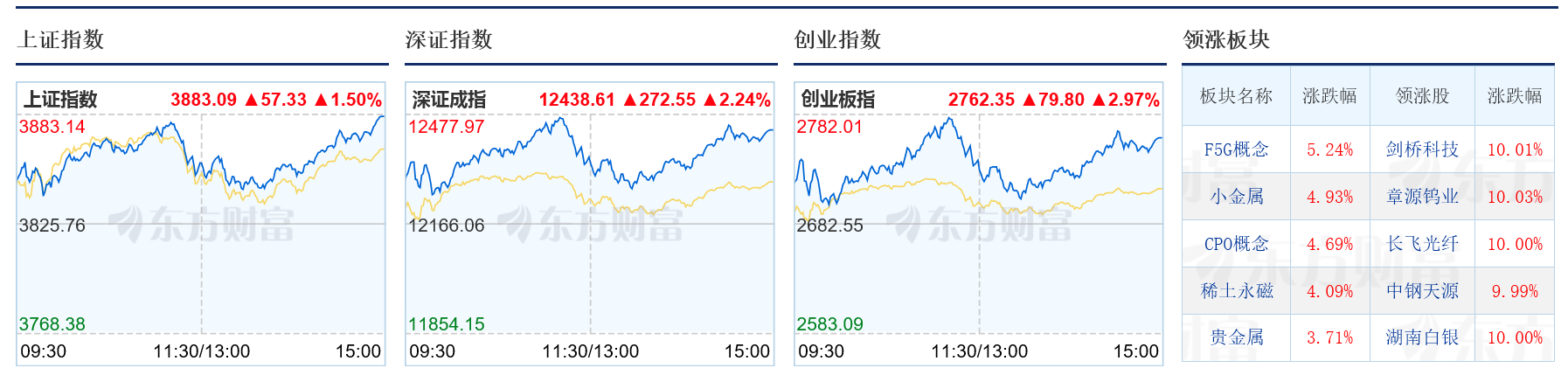
8月25日上证指数收盘上涨1.51%,创业板指上涨3.0%,成交额史上第二次突破三万亿,小金属、贵金属涨幅居前
Sou Hu Cai Jing· 2025-08-25 07:16
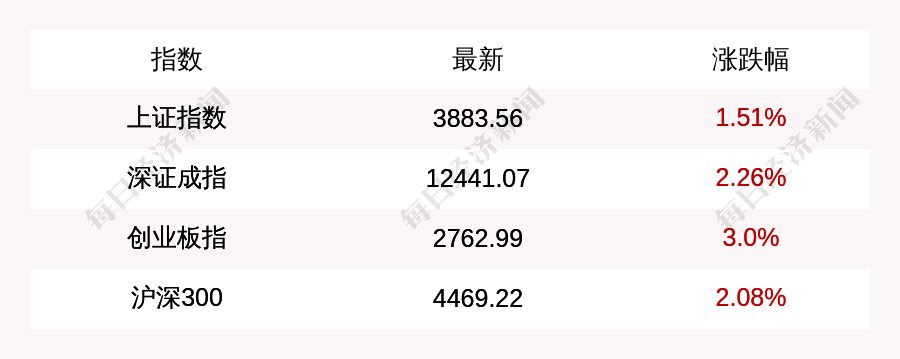
Market Performance - The Shanghai Composite Index closed at 3883.56 points, up 57.8 points, with a gain of 1.51% [1] - The Shenzhen Component Index closed at 12441.07 points, up 275.01 points, with a gain of 2.26% [1] - The ChiNext Index closed at 2762.99 points, up 80.44 points, with a gain of 3.0% [1] - The CSI 300 Index closed at 4469.22 points, up 91.22 points, with a gain of 2.08% [1] Trading Volume - The total trading volume of the Shanghai and Shenzhen markets exceeded 30 trillion yuan, marking the second occurrence in A-share history to surpass this threshold [1] Sector Performance - The top five performing sectors included: - Small Metals: up 4.94% - Precious Metals: up 3.73% - Communication Equipment: up 3.15% - Beverage Industry: up 2.93% - Wind Power Equipment: up 2.25% [1] - The bottom five performing sectors included: - Electronic Chemicals: down 0.33% - Automotive Manufacturing: down 0.19% - Beauty and Personal Care: down 0.13% [1]

行业轮动ETF策略周报(20250818-20250824)-20250825
Hengtai Securities· 2025-08-25 07:12
Report Summary 1. Report Industry Investment Rating No relevant content provided. 2. Core Viewpoints - The strategy based on industry and theme ETFs constructed by Hengtai Securities Research Institute has achieved certain results. From August 18 - 22, 2025, the strategy's cumulative net return was about 6.08%, and the excess return relative to the CSI 300 ETF was about 1.79%. From October 14, 2024, to the present, the out - of - sample cumulative return of the strategy was about 15.90%, and the cumulative excess relative to the CSI 300 ETF was about 0.76% [3]. - For the week of August 25 - 29, 2025, the model recommends allocating sectors such as communication equipment, industrial metals, and batteries. The strategy will newly hold products like Battery ETF, Science and Technology Innovation Semiconductor ETF, and Industrial Mother Machine ETF, and continue to hold products such as Communication Equipment ETF, Industrial Non - ferrous Metals ETF, and Satellite ETF [12]. 3. Summary by Related Catalogs 3.1 Strategy Portfolio Construction - Hengtai Securities Research Institute constructed a strategy portfolio based on industry and theme ETFs according to the strategy reports "Strategy Portfolio Report under Industry Rotation: Quantitative Analysis from the Perspective of Industry Style Continuity and Switching" (20241007) and "Research on the Overview and Allocation Methods of the Stock - type ETF Market: Taking the ETF Portfolio Based on the Industry Rotation Strategy as an Example" (20241013) [2]. 3.2 ETF Portfolio Information | Fund Code | ETF Name | ETF Market Value (billion yuan) | Holding Status | Heavy - held Shenwan Industry and Weight | Weekly Timing Signal | Daily Timing Signal | | --- | --- | --- | --- | --- | --- | --- | | 159583 | Communication Equipment ETF | 2.68 | Continue to hold | Communication equipment (73.61%) | 1 | 1 | | 560860 | Industrial Non - ferrous Metals ETF | 18.08 | Continue to hold | Industrial metals (54.97%) | 1 | 1 | | 159755 | Battery ETF | 48.90 | Add to portfolio | Battery (60.37%) | 1 | 1 | | 588170 | Science and Technology Innovation Semiconductor ETF | 4.09 | Add to portfolio | Semiconductor (87.1%) | 1 | 1 | | 159667 | Industrial Mother Machine ETF | 6.53 | Add to portfolio | Automation equipment (45.3%) | - 1 | 1 | | 159206 | Satellite ETF | 2.05 | Continue to hold | Military electronics (34.22%) | 1 | 1 | | 516150 | Rare Earth ETF Harvest | 58.89 | Add to portfolio | Minor metals (34.67%) | 1 | 1 | | 560170 | Central State - owned Enterprises Science and Technology ETF | 14.17 | Add to portfolio | Aviation equipment (22.35%) | 1 | 1 | | 588830 | Science and Technology Innovation New Energy ETF | 5.73 | Add to portfolio | Photovoltaic equipment (47.93%) | 1 | 1 | | 159698 | Grain ETF | 2.06 | Add to portfolio | Planting industry (48.33%) | 1 | 1 | [3] 3.3 Performance Tracking - From August 18 - 22, 2025, the strategy's cumulative net return was about 6.08%, and the excess return relative to the CSI 300 ETF was about 1.79%. From October 14, 2024, to the present, the out - of - sample cumulative return of the strategy was about 15.90%, and the cumulative excess relative to the CSI 300 ETF was about 0.76% [3]. 3.4 Portfolio Adjustment - In the week of August 25, 2025, products such as Battery ETF, Science and Technology Innovation Semiconductor ETF, and Industrial Mother Machine ETF will be newly held, while products like Gold Stock ETF, Game ETF, and Innovation Drug ETF will be removed from the portfolio [3][12].
中矿资源(002738):铜冶炼厂拖累公司业绩,铯铷业务构筑业绩支撑
GOLDEN SUN SECURITIES· 2025-08-25 06:52
Investment Rating - The report maintains a rating of "Buy" for the company [6]. Core Views - The company's performance in the first half of 2025 was impacted by losses in copper smelting, while the cesium and rubidium business provided a performance cushion [1]. - The lithium salt business saw a decline in profitability due to falling prices, but there are expectations for improvement in the second half of 2025 [3]. - The company is expected to achieve significant growth in net profit from 2025 to 2027, with projections of 6.4 billion, 14.6 billion, and 22.7 billion yuan respectively [3]. Summary by Sections Financial Performance - In the first half of 2025, the company achieved revenue of 3.27 billion yuan, a year-on-year increase of 35%, but the net profit attributable to shareholders was only 90 million yuan, a decrease of 81% [1]. - The gross profit margin for the first half of 2025 was 18%, with a significant drop in lithium salt gross profit by 75% year-on-year [2]. - The cesium and rubidium business saw a gross profit of 510 million yuan, up 50% year-on-year, which helped offset losses from other segments [1]. Business Segments - The lithium salt segment sold 18,000 tons in the first half of 2025, a year-on-year increase of 6.4%, but the average price fell by 13% in Q2 2025 [2]. - The copper smelting business is expected to incur a net loss of approximately 200 million yuan in the first half of 2025 due to tight global copper concentrate supply [2]. - The cesium and rubidium business showed strong growth, with Q2 2025 gross profit reaching approximately 280 million yuan, a quarter-on-quarter increase of 22% [1]. Future Outlook - The company anticipates improved profitability in the lithium salt business in the second half of 2025, driven by rising lithium prices and cost reduction measures [3]. - The cesium and rubidium business is expected to continue supporting the company's earnings during the transition period [3]. - The company plans to expand its copper production capacity to over 100,000 tons within five years, with the Kitumba copper mine expected to reach production by 2026 [3].

中国稀土涨2.89%,成交额5.31亿元,主力资金净流入1930.94万元
Xin Lang Cai Jing· 2025-08-25 05:35
Core Viewpoint - China's rare earth stocks have shown significant growth in 2023, with a year-to-date increase of 74.15% and notable recent trading activity indicating strong investor interest [2][3]. Company Overview - China Rare Earth Group Resources Technology Co., Ltd. was established on June 17, 1998, and listed on September 11, 1998. The company is located in Jiangxi Province and specializes in rare earth smelting, separation, and technology research and services [2]. - The company's main revenue sources are rare earth oxides (59.95%), rare earth metals (38.19%), with minor contributions from other services [2]. Financial Performance - For the first quarter of 2025, the company reported a revenue of 728 million yuan, representing a year-on-year growth of 141.32%. The net profit attributable to shareholders was 72.62 million yuan, up 125.15% year-on-year [3]. - Cumulative cash dividends since the company's A-share listing amount to 346 million yuan, with 124 million yuan distributed over the past three years [4]. Stock Market Activity - As of August 25, the stock price of China Rare Earth reached 48.85 yuan per share, with a trading volume of 531 million yuan and a market capitalization of 51.84 billion yuan [1]. - The stock has seen significant trading activity, with a net inflow of 19.31 million yuan from main funds and notable buying from large orders [1]. Shareholder Information - As of August 8, the number of shareholders increased to 185,300, with an average of 5,727 shares held per shareholder, a decrease of 13.54% from the previous period [3]. - Major shareholders include Hong Kong Central Clearing Limited and Southern CSI 500 ETF, with some reductions in their holdings [4].

有色金属周报:美联储放鸽,看好贵金属表现-20250825
Tebon Securities· 2025-08-25 05:18
Investment Rating - The report maintains an "Outperform" rating for the non-ferrous metals industry [2]. Core Viewpoints - The report expresses optimism for precious metals due to the dovish stance of the Federal Reserve, which is expected to lower interest rates as early as September. This is seen as a strong signal for gold prices to rise, supported by a weakening dollar and increasing gold-silver ratios [4][5]. - Industrial metal prices show mixed performance, with copper, aluminum, lead, zinc, tin, and nickel experiencing slight declines. However, significant infrastructure projects in Tibet are anticipated to boost overall demand and metal prices [5]. - The report highlights a positive outlook for small metals, particularly rare earths and tungsten, driven by a recovery in manufacturing demand [5]. - Energy metals, particularly lithium, are also noted for price increases, with a focus on future demand growth [5]. Summary by Sections 1. Industry Data Review 1.1 Precious Metals - The report indicates a favorable outlook for precious metals, particularly gold, in light of the Federal Reserve's potential interest rate cuts [4]. 1.2 Industrial Metals - Prices for industrial metals have varied, with copper at 78,690 CNY/ton (-0.3%), aluminum at 20,630 CNY/ton (-0.4%), and nickel at 119,610 CNY/ton (-1.3%). The report notes a general decline in prices but anticipates demand recovery from infrastructure projects [27][28]. 1.3 Small Metals - Prices for rare earths, particularly praseodymium-neodymium oxides, have increased significantly, with a weekly rise of 15.6% [29]. Tungsten prices are also on the rise, reflecting increased demand in manufacturing [32]. 1.4 Energy Metals - Lithium prices have increased, with lithium concentrate priced at 7,155 CNY/ton. The report emphasizes the importance of monitoring future demand for energy metals [35]. 2. Market Data - The report notes that the non-ferrous metals sector has seen a 1.33% increase, with specific segments like small metals rising by 10.53% [36]. 3. Key Events Review - The report highlights a significant dovish signal from Federal Reserve Chairman Powell, indicating potential interest rate cuts, which could positively impact precious metals [42].
创业板指冲高回落涨2.22% CPO、制冷剂、稀土永磁概念走强
Qi Huo Ri Bao Wang· 2025-08-25 05:11
Market Overview - The market experienced a morning surge followed by a pullback, with the ChiNext Index leading the gains [1] - The total trading volume in the Shanghai and Shenzhen markets reached 2.08 trillion yuan, an increase of 567.8 billion yuan compared to the previous trading day [1] - Over 2800 stocks in the market saw an increase, indicating a broad-based rally [1] Sector Performance - The sectors that performed well included CPO, refrigerants, rare earth permanent magnets, precious metals, non-ferrous metals, and small metals [1] - Conversely, sectors that faced declines included telecommunications operations, outdoor camping, fentanyl, electronic chemicals, and beauty care [1] Index Performance - By the end of the trading session, the Shanghai Composite Index rose by 0.86%, the Shenzhen Component Index increased by 1.61%, and the ChiNext Index gained 2.22% [1]
开评:三大指数集体高开 AI芯片概念开盘活跃
Zheng Quan Shi Bao Wang· 2025-08-25 02:10
Core Viewpoint - On August 25, the three major indices opened collectively higher, indicating a positive market sentiment at the start of the trading day [1] Market Performance - The Shanghai Composite Index opened up by 0.59% - The Shenzhen Component Index opened up by 1.03% - The ChiNext Index opened up by 1.41% [1] Sector Performance - Active sectors at the opening included small metals, semiconductors, securities, education, and AI chip concepts - Declining sectors included banks, traditional Chinese medicine, food and beverage, and CRO concepts [1]
小金属的大时代——动态更新及后市展望
2025-08-24 14:47
Summary of Key Points from Conference Call Records Industry Overview - The small metals industry is facing increasing resource scarcity, with China having rich reserves but experiencing resource depletion due to long-term high-intensity mining and stricter environmental standards, which limit supply growth [1][3][4] - Global supply of small metals is tight due to dispersed overseas resources and high development costs, exacerbating the supply-demand imbalance [1][4] Core Insights and Arguments - **Demand Growth**: The demand for small metals is rapidly increasing, driven by emerging industries such as electric vehicles and photovoltaics, as well as high-end equipment manufacturing. The demand for high-end rare earth permanent magnet materials is particularly notable, with projected CAGR from 2023 to 2027 reaching 16%, 59%, 63%, and 21% for various applications [1][4] - **Supply Tightness**: The domestic rare earth market is experiencing tight supply, with limited increases in imports from Myanmar and other sources. This is expected to lead to further price increases for neodymium oxide in the short term [1][9][10] - **Policy Changes**: Recent adjustments in the rare earth industry policies by the Ministry of Industry and Information Technology (MIIT) have changed the management of total quantity control, affecting how production indicators are assigned and reported [1][5][6] Seasonal Trends - The demand for neodymium-iron-boron materials exhibits seasonal patterns, with the second half of the year typically being a peak production and sales season. Historical data shows that neodymium oxide prices tend to rise during this period [7][8] Market Conditions - The current domestic rare earth market is tight, with a significant drop in imports from Myanmar and a halt in exports from the U.S. due to MP Company's cessation of shipments. This has led to a decrease in overall supply of neodymium-iron-boron materials [9][10] Price Expectations - Short-term expectations indicate that neodymium oxide prices may continue to rise due to sustained demand and limited supply increases. As of August 22, the average price was 624,500 RMB per ton, up 17% from the beginning of the year [10][11] Investment Recommendations - Investors are advised to focus on companies with strong resource attributes and growth potential, such as Northern Rare Earth and Guangxi Rare Earth, as well as related companies in the supply chain. In the overseas market, attention should be given to MP Company and USA Rare Earth [12][19] Specific Metal Insights - **Antimony**: The domestic antimony industry is in a situation where prices are likely to rise due to tight supply and potential recovery in exports. The global supply of antimony is significantly constrained, with a reduction of nearly 20% this year [13][14][15] - **Germanium**: The market for germanium is experiencing slight price declines due to increased supply from by-products, but future demand from defense spending and satellite applications is expected to drive prices up [16][17] - **Tungsten**: The tungsten market is characterized by rising prices and tightening supply, with China's production expected to face pressure in the coming years due to policy restrictions and declining ore grades [18][20][21] Global Supply Outlook - The global supply of small metals is expected to remain tight in the long term, with limited increases from major projects and ongoing environmental restrictions. The supply gap is projected to widen from 2025 to 2028 [25][26] Conclusion - The small metals industry is at a critical juncture, with significant demand growth driven by technological advancements and geopolitical factors, while supply constraints and policy changes create a complex investment landscape. Investors should remain vigilant and consider both domestic and international opportunities in this sector.
有色金属行业跟踪周报:鲍威尔释放“鸽派”信号,有色金属价格预期走强-20250824
Soochow Securities· 2025-08-24 10:22
Investment Rating - The report maintains an "Overweight" rating for the non-ferrous metals sector [1] Core Views - The non-ferrous metals prices are expected to strengthen due to dovish signals from Powell, with a focus on employment data and potential interest rate cuts [1][4][28] Summary by Sections Market Review - The non-ferrous metals sector rose by 1.33% from August 18 to August 22, ranking 26th among 31 sectors [15] - The small metals sector increased by 10.53%, while industrial metals fell by 1.16% during the same period [15] Industrial Metals - **Copper**: As of August 22, LME copper closed at $9,797/ton, up 0.37% week-on-week, while SHFE copper was at ¥78,690/ton, down 0.47% [32] - **Aluminum**: LME aluminum closed at $2,622/ton, up 0.73%, and SHFE aluminum at ¥20,630/ton, down 0.67% [37] - **Zinc**: LME zinc price was $2,806/ton, up 0.32%, while SHFE zinc was ¥22,275/ton, down 1.02% [39] - **Tin**: LME tin closed at $33,845/ton, up 0.70%, and SHFE tin at ¥265,930/ton, down 0.33% [46] Precious Metals - **Gold**: COMEX gold closed at $3,417.20/oz, up 1.05%, while SHFE gold was at ¥773.40/g, down 0.31% [52] - The report indicates that precious metals are expected to strengthen following Powell's dovish remarks [4][47]