医疗器械

Search documents
昊海生物科技股东减持计划引关注,股价短期承压
Jing Ji Guan Cha Wang· 2026-02-14 05:43
Core Viewpoint - The recent focus on Haohai Biological Technology is the shareholder's plan to reduce holdings, which may exert short-term pressure on market sentiment but aligns with previous commitments made by the shareholder [1] Stock Performance - Haohai Biological Technology's A-shares (688366.SH) have shown weak performance, closing at 45.91 yuan on February 13, 2026, down 1.21% for the day and a cumulative decline of 2.28% over the past five days; meanwhile, the Hong Kong shares (06826.HK) closed at 26.72 HKD, up 2.06% for the day but with a volatility of 4.55% over the same period [2] - On February 13, 2026, net outflow of approximately 1 million yuan was observed in A-shares, indicating short-term pressure on capital [2] - The A-share price has fallen below the 5-day moving average (46.22 yuan), with a MACD indicator showing a death cross signal; the Hong Kong stock is near the middle band of the Bollinger Bands (26.034 HKD), with the KDJ indicator showing a J line at 78.96, indicating short-term overbought conditions [2] Financial Report Analysis - In Q3 2025, the company experienced a decline in performance, with quarterly revenue decreasing by 11.29% to 595 million yuan and net profit attributable to shareholders dropping by 11.39% to 93.58 million yuan; cumulative revenue for the first three quarters fell by 8.47%, and net profit decreased by 10.63% [3] - The gross margin remained at 70.39%, but the non-recurring net profit saw a significant decline of 44.54%, primarily due to increased sales expenses and market environment impacts [3] Institutional Perspectives - Institutions maintain a long-term focus on Haohai Biological Technology's fundamentals, with two institutions issuing buy or hold ratings for the Hong Kong shares in February 2026, targeting an average price of 56.65 HKD, indicating potential upside compared to the current stock price [4] - Institutions are particularly attentive to the company's progress in exporting medical devices and high-end product lines, although the short-term reduction in holdings may suppress valuation recovery [4]
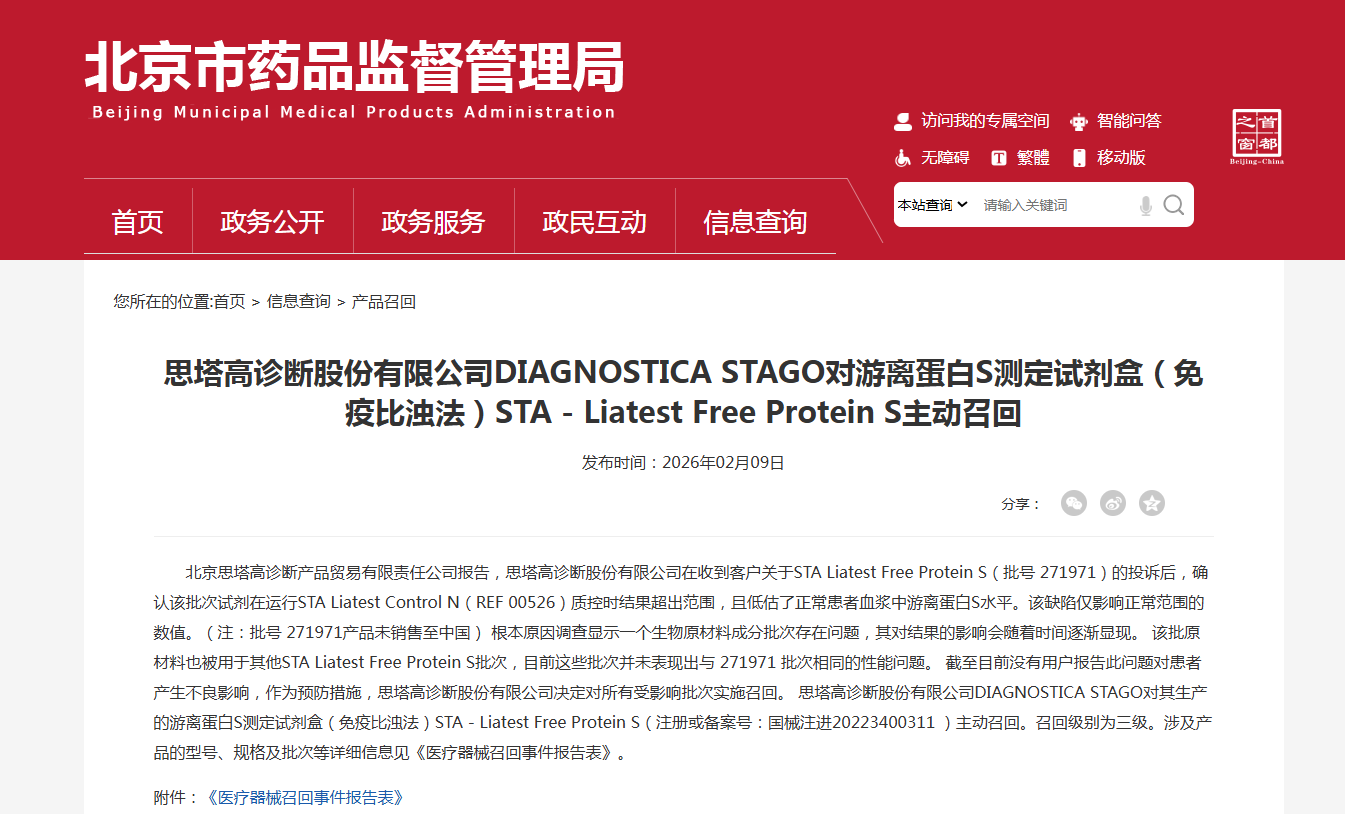
思塔高诊断股份有限公司DIAGNOSTICA STAGO对游离蛋白S测定试剂盒(免疫比浊法)STA - Liatest Free Protein S主动召回
Xin Lang Cai Jing· 2026-02-14 05:05
北京思塔高诊断产品贸易有限责任公司报告,思塔高诊断股份有限公司在收到客户关于STA Liatest Free Protein S(批号 271971)的投诉后,确认该批次试 剂在运行STA Liatest Control N(REF 00526)质控时结果超出范围,且低估了正常患者血浆中游离蛋白S水平。该缺陷仅影响正常范围的数值。(注:批号 271971产品未销售至中国) 根本原因调查显示一个生物原材料成分批次存在问题,其对结果的影响会随着时间逐渐显现。 该批原材料也被用于其他STA Liatest Free Protein S批次,目前这些批次并未表现出与 271971 批次相同的性能问题。 截至目前没有用户报告此问题对患者产生不良影响,作为预防措施, 思塔高诊断股份有限公司决定对所有受影响批次实施召回。 思塔高诊断股份有限公司DIAGNOSTICA STAGO对其生产的游离蛋白S测定试剂盒(免疫比浊 法)STA - Liatest Free Protein S(注册或备案号:国械注进20223400311 )主动召回。召回级别为三级。涉及产品的型号、规格及批次等详细信息见《医疗 器械召回事件报告表》。 ...

1月IPO报告:3个项目,账面退出回报超700亿
投中网· 2026-02-14 04:02
Core Findings - In January 2026, a total of 22 Chinese companies successfully completed IPOs across A-shares, Hong Kong, and US markets, raising a total of 42.839 billion yuan, with A-share IPO numbers halving compared to the previous month [7][8] - The number of IPOs decreased by 26.67% year-on-year and by 50% month-on-month, while the total amount raised increased by 2.17 times year-on-year but decreased by 21% month-on-month [8] - The Hong Kong Stock Exchange led in both the number of IPOs (12 companies) and the amount raised (33.717 billion yuan) [8] A-share Market Analysis - In January 2026, 9 Chinese companies went public in the A-share market, with a 25% year-on-year decrease and a 50% month-on-month decrease in IPO numbers [16] - The total amount raised in the A-share market was 9.053 billion yuan, reflecting a 27.47% year-on-year increase but a 71.18% month-on-month decrease [16] - The highest fundraising in the A-share market was achieved by Zhenstone Co., Ltd., which raised 2.919 billion yuan [16] Hong Kong Market Analysis - The Hong Kong market saw 12 IPOs in January 2026, with a 50% year-on-year increase but a 52% month-on-month decrease [18] - The total amount raised in Hong Kong was 33.717 billion yuan, marking a 5.62 times year-on-year increase and a 48.49% month-on-month increase [18] - The presence of AI-related companies in the IPOs indicates a significant investment interest from VC/PE institutions in the sector [18] US Market Analysis - Only 1 Chinese company completed an IPO in the US market in January 2026, representing a 90% year-on-year decrease [21] - The amount raised in the US was 0.07 billion yuan, a 94.71% year-on-year decrease [21] - Recent SEC policy changes are expected to further impact small companies' ability to go public in the US [21] VC/PE Exit Analysis - In January 2026, 13 companies with VC/PE backing went public, a 13.33% year-on-year decrease and a 62.86% month-on-month decrease [26] - The total exit return for VC/PE institutions was 109.455 billion yuan, a 15.3 times year-on-year increase [26] - The electronic information sector had the highest exit returns, with notable contributions from companies like Zhiyuan and Biran Technology [26] Industry and Regional Analysis - The electronic information sector led in both the number of IPOs and the amount raised, with 7 companies raising a total of 26.595 billion yuan [34] - Shanghai had the highest number of IPOs (5 companies) and the highest amount raised (18.384 billion yuan) [40] - The fundraising amount from Shanghai increased by 165.61 billion yuan year-on-year, the largest increase among regions [40] Key IPO Cases - The top fundraising companies included Biran Technology (5.017 billion yuan), MiniMax (4.318 billion yuan), and Haowei Group (4.297 billion yuan) [48] - The highest market capitalization on the first day was recorded by Haowei Group at 150.833 billion yuan [49]

浩欧博与罗氏诊断合作推进,前三季度营收净利双降
Jing Ji Guan Cha Wang· 2026-02-14 03:57
Business Developments - In October 2025, the company signed a cooperation framework agreement with Roche Diagnostics to collaborate in the field of chemiluminescent self-antibody detection products [1] - In December 2025, the company's wholly-owned subsidiary obtained a medical device registration certificate for the "Immunoglobulin G4 (IgG4) Testing Kit" [1] - In January 2026, the company's "Nabok" chemiluminescent platform received a medical device registration certificate for new mixed allergen screening and ragweed detection projects, indicating ongoing R&D and market expansion in the in vitro diagnostics sector [1] Financial Performance - For the first nine months of 2025, the company reported revenue of 292 million yuan, a year-on-year decrease of 4.84% [2] - The net profit attributable to the parent company was 26.19 million yuan, down 1.41% year-on-year [2] - The gross profit margin stood at 59.17%, with a debt ratio of 14.11% [2] Stock Performance - As of February 10, 2026, the company's stock price was 145.25 yuan per share, reflecting a year-to-date decline of 5.56% and a 20-day decline of 7.66% [3] - On that day, the net outflow of main capital was 1.9648 million yuan, with a turnover rate of 0.56% [3] - No specific future events have been disclosed for February 14, 2026, or beyond, regarding financial report dates or shareholder meetings, with regular announcements to be made by the company [3]

乐心医疗AI大模型应用上线,股价区间波动资金现分歧
Jing Ji Guan Cha Wang· 2026-02-14 02:31
Group 1 - The core viewpoint of the news is that Lexin Medical (300562) has officially launched its large model application focused on cardiovascular and cerebrovascular disease risk assessment, with successful pilot results [1] - The company emphasizes that it cannot predict the specific impact of this business on future performance and advises investors to be cautious of risks [1] - This development reflects the company's innovative layout in the field of AI digital chronic disease management, which may positively influence market sentiment [1] Group 2 - In the recent stock performance, Lexin Medical's stock price showed noticeable fluctuations over the past seven trading days, closing at 14.65 yuan on February 13, a slight increase of 0.21% from 14.62 yuan on February 6 [2] - The stock experienced a volatility of 5.75% during this period, with a peak price of 15.03 yuan on February 11 [2] - In terms of capital flow, on February 11, there was a net outflow of 4.4588 million yuan from main funds, while speculative funds saw a net inflow of 4.9387 million yuan, indicating short-term capital divergence [2]

惠泰医疗拟回购股份提振信心,机构看好其新品放量
Jing Ji Guan Cha Wang· 2026-02-14 01:11
Group 1 - The company plans to repurchase shares using its own funds, with an amount between 150 million to 200 million yuan, aimed at employee incentives and enhancing investor confidence [1] - The first repurchase was executed on February 11, 2026, with 77,000 shares bought back at a total cost of approximately 18.61 million yuan [1] - The recent opening of the national drug procurement may have indirect effects on the medical device industry, although the company's core business focuses on electrophysiology and interventional devices [1] Group 2 - Huayuan Securities initiated coverage on the company on February 13, 2026, giving it a "buy" rating, with expected compound annual growth rates for revenue and net profit exceeding 24% from 2025 to 2027 [2] - In the past 90 days, four institutions have rated the company, with three giving a "buy" and one an "overweight" rating, indicating positive expectations from analysts [2]

医药行业专题报告:25Q4持仓调整筑底,2026年医药板块有望迎来修复性机会
Guoxin Securities· 2026-02-14 00:45
Investment Rating - The investment rating for the pharmaceutical and biotechnology sector is "Outperform the Market" (maintained) [2] Core Insights - The pharmaceutical sector underperformed the market in Q4 2025, with the overall sector down by 9.3% compared to a slight decline of 0.2% in the CSI 300 index. Notably, the pharmaceutical commercial segment showed a positive performance with a 5.3% increase, while other segments like medical services and biological products experienced significant declines [4][8] - The total net asset value of pharmaceutical funds decreased to 358.4 billion yuan, a 9.0% decline quarter-on-quarter. This marks the first time since 2019 that passive pharmaceutical funds (181.8 billion yuan) surpassed active funds (176.5 billion yuan) [4][14] - The overall pharmaceutical holdings across all funds dropped to 7.97%, a decrease of 1.71 percentage points. Active pharmaceutical funds maintained a high concentration with a holding ratio of 97.45% [23] Summary by Sections 1. Market Review - In Q4 2025, the pharmaceutical and biotechnology sector lagged behind the CSI 300 index, with a decline of 9.3%. The chemical pharmaceuticals segment fell by 9.6%, biological products by 12.4%, and medical devices by 10.6% [8] 2. Pharmaceutical Fund Size - As of Q4 2025, the net asset value of pharmaceutical funds was 358.4 billion yuan, down 9.0% from the previous quarter. Active funds accounted for 176.5 billion yuan, a 14.6% decrease, while passive funds reached 181.8 billion yuan, down 2.8% [14] 3. Pharmaceutical Holdings Ratio - The pharmaceutical holdings ratio for all funds was 7.97%, down 1.71 percentage points. Active pharmaceutical funds had a holding ratio of 97.08%, while passive funds had 97.83% [23] 4. Holdings Structure Analysis - The highest sub-sector holding in Q4 2025 was chemical preparations at 37.5%, followed by other biological products at 20.8%. The largest increases in holdings were seen in traditional Chinese medicine (+0.98 percentage points) and chemical preparations (+0.62 percentage points) [29] 5. Additions and Reductions in Holdings - The top three pharmaceutical stocks by the number of funds holding them were Heng Rui Medicine (498 funds), WuXi AppTec (408 funds), and Mindray Medical (204 funds). Notably, Heng Rui Medicine saw a reduction of 236 funds, while Ying En Biological-B experienced an increase of 47 funds [84][88]
A股股票回购一览:5家公司披露回购进展
Xin Lang Cai Jing· 2026-02-14 00:18
Summary of Key Points Core Viewpoint - On February 14, five companies announced progress related to stock buybacks, with one company disclosing implementation progress and four companies completing their buyback plans [1] Group 1: Stock Buyback Progress - One company, Hengyi Petrochemical, reported the highest buyback amount of 77.8271 million yuan [1] - A total of five stock buyback announcements were made by the five companies on this date [1] Group 2: Completed Buybacks - Four companies completed their buybacks, with total amounts exceeding 10 million yuan [1] - Sanofi Biologics, Hualing Steel, and Newpoint Software reported the highest completed buyback amounts of 300 million yuan, 279 million yuan, and 49.3567 million yuan, respectively [1]
诺令生物递表港交所 为全球少数能够实现NO全链路技术自主可控的企业之一
Zhi Tong Cai Jing· 2026-02-13 23:28
Core Viewpoint - Nanjing Noling Biotechnology Co., Ltd. has submitted its listing application to the Hong Kong Stock Exchange, focusing on the research and commercialization of inhaled nitric oxide (iNO) therapy, with a comprehensive technology platform covering the entire chain of nitric oxide (NO) generation, transmission, detection, storage, and clinical application [1][3]. Company Overview - Noling Biotechnology has five approved products and four candidates in development, targeting critical care, ward, outpatient, and home disease management in the cardiopulmonary field [3]. - The core product, iNOwill, received approval from the National Medical Products Administration in 2022 and is expected to gain EU CE certification in 2025, primarily for use in acute critical care for severe cardiopulmonary diseases [3][4]. - Noling is one of the few companies globally capable of achieving autonomous control over the entire NO technology chain and is the only company with a comprehensive product line covering both NO treatment and diagnostic applications [1][3]. Product Pipeline - The iNOwill device is a portable iNO treatment system that generates medical-grade NO on-site and integrates NO generation, delivery, and real-time monitoring into a single system [4]. - NovaPulse IABP, another key product, is designed for cardiovascular and perioperative care, registered as a Class III medical device in China since September 2025 [4][6]. Financial Information - For the fiscal year ending December 31, 2024, the company reported revenues of approximately RMB 45.547 million, with a gross profit margin of 59.3% [7][10]. - The company incurred a loss of approximately RMB 86.246 million for the same period, with a significant portion attributed to research and development expenses [9][10]. Market Overview - The global iNO therapy market is transitioning from cylinder delivery to real-time generation systems, with the latter expected to grow from approximately USD 100 million in 2024 to USD 550 million by 2030, reflecting a compound annual growth rate (CAGR) of 32.8% [11][12]. - The IABP market in China is projected to expand rapidly, from RMB 313.1 million in 2020 to RMB 641.4 million in 2024, with a CAGR of 19.6% [12][13].
关税威胁真解除了?印度炼厂急躲俄油,就为保住那18%税率!
Sou Hu Cai Jing· 2026-02-13 23:04
Core Viewpoint - The recent trade agreement between the US and India marks a significant reduction in tariffs, facilitating deeper economic cooperation and market access for both nations [1][2][3]. Group 1: Tariff Adjustments - The US has implemented an 18% "reciprocal tariff rate" on Indian-origin goods, a substantial decrease from previous rates that could reach 50% or more [3][21]. - India has committed to significantly lowering tariffs on a range of US industrial and agricultural products, including specific items that benefit US agricultural states and manufacturing hubs [4][5][6]. Group 2: Non-Tariff Barriers - India has agreed to address long-standing non-tariff barriers that have hindered US companies, including the import licensing process for medical devices and market access restrictions for ICT products [7][8]. - The agreement includes a commitment from India to evaluate the adoption of US standards or international testing requirements within six months of the agreement's effectiveness [9]. Group 3: Strategic Goals - The US aims to expand exports, deepen market access, and strengthen regulatory frameworks, seeking not only to sell more products but also to lower entry barriers for US workers and producers in India [13][14][15]. - The agreement reflects a broader strategy where both countries are positioning themselves for future economic and technological collaboration, moving beyond mere tariff reductions [12][32]. Group 4: Procurement Commitments - A notable aspect of the agreement is the procurement commitment of $500 billion over five years, which includes high-value items such as energy, aircraft parts, and technology products [26][27]. - This procurement list is seen as a means to translate political agreements into tangible business contracts, particularly in the technology sector [28][29]. Group 5: Energy and Geopolitical Considerations - The agreement subtly ties tariff reductions to India's commitment to reduce imports of Russian oil, indicating a complex geopolitical exchange [35][37]. - India is gradually diversifying its oil supply sources, reflecting a strategic approach to balance its energy needs while maintaining relations with both the US and Russia [41][53]. Group 6: Future Cooperation and Challenges - The agreement is viewed as a first step towards a more comprehensive bilateral trade deal, with mechanisms in place to adjust commitments if either party alters its tariff arrangements [49][66]. - The real test will be whether the commitments translate into effective execution, particularly in areas like non-tariff barriers and digital trade rules [64][65].