
社交媒体

Search documents
竟然全是假的!马斯克揭开美国遮羞布,外媒:真相远比这更恶劣!
Sou Hu Cai Jing· 2025-07-31 11:26
Group 1: Government Efficiency and Infrastructure - Elon Musk's resignation from the "Government Efficiency Department" highlights inefficiencies and waste within the U.S. government, which he claims is plagued by bureaucracy and collusion with interest groups [1] - Musk's experience in trying to implement efficient practices from Silicon Valley into the bureaucratic system resulted in significant delays, exemplified by the stalled Hyperloop project compared to China's rapid high-speed rail expansion [1] - The average time for U.S. infrastructure projects to complete environmental assessments and permitting is 7 to 10 years, indicating systemic inefficiencies [1] Group 2: Military Aid and Defense Industry - U.S. military aid to Ukraine has not translated into timely equipment delivery, with reports of missing arms and equipment, raising concerns about the accountability of defense spending [3][5] - The Pentagon's "loss rate" theory has been criticized for justifying the continuous supply of weapons while obscuring the actual waste and mismanagement of funds [5] Group 3: Economic Inequality and Labor Issues - Musk criticized the disparity in wages between American workers and high-level executives, revealing a significant wealth gap where the top 1% holds 40% of the nation's wealth [7] - The phenomenon of "working poverty" persists despite a low unemployment rate, as many workers struggle with stagnant wages and rising living costs [7] Group 4: Healthcare and Education - The privatized healthcare system in the U.S. leaves 28 million people uninsured, contributing to a lower life expectancy compared to other countries [10] - Rising college tuition has led to significant student debt burdens for families, exacerbating economic inequality [10] Group 5: Systemic Issues and Calls for Reform - Musk's revelations point to deeper systemic issues in the U.S., where public resources are controlled by interest groups, and labor rights are undermined by capital [15] - The need for a fundamental restructuring of the system is emphasized, as current policies favor a small elite at the expense of the broader population [15]



美国银行将Meta Platforms目标价从775美元上调至900美元。
news flash· 2025-07-31 10:53
美国银行将Meta Platforms目标价从775美元上调至900美元。 ...
美股异动|Meta盘前大涨超12%势创新高 Q2业绩超预期+营收指引强劲
Ge Long Hui A P P· 2025-07-31 08:25
消息面上,Meta Q2营收同比增长22%至475.2亿美元,高于分析师预期的448.3亿美元;每股收益为7.14 美元,远超分析师预期的5.89美元。展望第三季度,Meta预计营收将介于475亿至505亿美元之间,区间 中值高于分析师预期的462亿美元。 另外,Meta上调2025年全年支出至660亿-720亿美元,之前预测为640亿-720亿美元。Meta CEO扎克伯 格表示,Meta能够依赖其稳定的广告业务为扩大AI市场份额提供充足资金支持。同时,AI也在提振公 司的广告业务。(格隆汇) 格隆汇7月31日|Meta(META.US)盘前大涨超12%,报778.87美元,开盘后势创历史新高,总市值将逼 近2万亿美元。 ...
Meta电话会:AI显著提升用户活跃度,明年资本支出继续“狂飙”,人才算力两手抓,配备AI眼镜是趋势
硬AI· 2025-07-31 07:00
Core Viewpoint - Meta's AI technology has significantly enhanced advertising economic benefits and improved user engagement and content quality, becoming a major growth engine for the overall business. Zuckerberg stated that Meta is now equipped to achieve "super intelligence," with substantial capital expenditure growth expected in 2026 [1][2][3]. Financial Performance - In Q2, Meta reported revenue of $47.52 billion, exceeding analyst expectations of $44.83 billion, with advertising revenue of $46.5 billion also surpassing forecasts. The Reality Labs division incurred a loss of $4.5 billion, which was better than market expectations. The company raised its 2025 capital expenditure lower limit from $64 billion to $66 billion, leading to a 10% increase in stock price post-announcement [2][3][4]. - The operating profit margin for the quarter was 43%, with a net income of $18.3 billion, translating to earnings per share of $7.14. Total expenses for the quarter were $27.1 billion, a 12% year-over-year increase [24][25]. AI Monetization and User Engagement - AI has become the core driver of Meta's current business growth, with a significant efficiency boost in the advertising system. The new AI-driven advertising recommendation model improved ad conversion rates by approximately 5% on Instagram and 3% on Facebook. The use of generative AI creative tools has also expanded, particularly among small advertisers with limited budgets [3][4][21]. - User engagement metrics improved, with Facebook's user time increasing by 5% and Instagram's by 6%. Video engagement saw a year-over-year increase of over 20% [4][28]. Investment in AI and Infrastructure - Meta plans to continue investing heavily in computing power and talent resources, establishing the "Meta Super Intelligence Lab" to develop next-generation models. The company is building multiple gigawatt-level computing clusters to provide "personal super intelligence" for billions of users [3][6][12]. - Capital expenditures for 2025 are projected to be between $66 billion and $72 billion, with expectations for significant growth in 2026 as well. The CFO emphasized that infrastructure costs will be the primary driver of expense growth in 2026, including depreciation and operational costs [5][6][38]. Talent Acquisition and Team Structure - The company is focusing on building a "small but elite" team of top talent in AI, with a particular emphasis on recruiting industry-leading experts. The structure of the team is designed to facilitate cutting-edge research in super intelligence [9][10][11]. - Employee compensation is expected to be the second-largest driver of expense growth in 2026, primarily due to investments in technical talent [11][36]. Future Outlook and Strategic Focus - Meta's future strategy includes enhancing the freshness of original content and improving the recommendation system to better match user interests. The company aims to leverage AI advancements to further improve user engagement and monetization efficiency [4][28][49]. - The company is optimistic about the long-term potential of AI technologies and their ability to reshape its systems and operations, with a focus on self-improvement capabilities in AI [42][48].

微软 meta 双双大超预期
小熊跑的快· 2025-07-31 00:09
Group 1: Microsoft Performance - Microsoft reported Azure cloud revenue growth of 39%, exceeding previous guidance of 34-35% and market expectations of 37% [1] - Total revenue for FY2532 reached $76.44 billion, a year-over-year increase of 18%, slightly above market expectations of $73.8 billion [1] - Net profit was $27.23 billion, up 24% year-over-year, surpassing the expected $25.2 billion [1] Group 2: Microsoft Business Segments - Intelligent Cloud segment generated $29.88 billion in revenue, a 26% year-over-year increase, exceeding expectations of $29.1 billion [1] - Productivity and Business Processes revenue was $33.11 billion, up 16% year-over-year, driven by an 18% increase in Microsoft 365 commercial cloud revenue [1] - Personal Computing revenue reached $13.5 billion, a 9% year-over-year increase, higher than the expected $12.6 billion [1] Group 3: Capital Expenditure and Future Guidance - Capital expenditure for the quarter was $24.2 billion, with over 50% allocated to long-term assets like data centers [2] - FY26 Q1 guidance includes revenue expectations of $32.2-32.5 billion for Productivity and Business Processes and $30.1-30.4 billion for Intelligent Cloud [2] - FY26 full-year revenue is expected to achieve double-digit growth [2] Group 4: AI Impact on Performance - Cloud business growth is driven by AI, with Azure revenue exceeding $75 billion, a 34% increase [2] - Monthly active users of Copilot applications surpassed 100 million, indicating significant user acceptance [2] - AI infrastructure expansion includes an additional 2 GW of data center capacity to support Azure AI and OpenAI demands [3] Group 5: Meta Performance - Meta reported total revenue of $47.516 billion for Q2, a 22% year-over-year increase, exceeding guidance and market expectations [4] - Net profit reached $18.337 billion, up 36.18% year-over-year, surpassing the expected $15.166 billion [4] - Capital expenditure was $17 billion, primarily for server and data center investments, exceeding expectations [4] Group 6: Meta Advertising and User Engagement - Meta's applications achieved over 3.4 billion daily active users, with total revenue of $47.1 billion, a 22% year-over-year increase [5] - Advertising revenue grew by 21%, with online retail being the fastest-growing sector [5] - Average ad prices increased by 9%, driven by improved ad effectiveness [5] Group 7: Meta's Future Guidance - Meta expects total revenue for Q3 to be between $47.5 billion and $50.5 billion, with a positive impact from foreign exchange [6] - The company raised its full-year capital expenditure guidance to between $66 billion and $72 billion to meet AI and business needs [6]


Meta业绩超预期、指引强劲,上调全年资本支出下限,盘后大涨10%
美股IPO· 2025-07-30 23:54
Core Insights - Meta's Q2 revenue reached $47.52 billion, significantly exceeding market expectations, with earnings per share at $7.14, also above forecasts [1][4][5] - Strong advertising revenue and lower-than-expected losses in Reality Labs contributed to a projected Q3 revenue of $47.5 to $50.5 billion, higher than analyst estimates [1][3][5] - The company raised its 2025 capital expenditure lower limit from $64 billion to $66 billion, indicating confidence in its advertising business to support aggressive AI investments [1][7][8] Financial Performance - Revenue: Q2 revenue was $47.52 billion, surpassing analyst expectations of $44.83 billion [4] - Earnings per Share: Q2 EPS was $7.14, significantly higher than the expected $5.89 [5] - Advertising Revenue: Q2 advertising revenue was $46.5 billion, exceeding the forecast of $44.07 billion [5] - Reality Labs Losses: Q2 losses for Reality Labs were $4.5 billion, better than the anticipated $4.8 billion loss [5] Business Outlook - Revenue Guidance: Meta expects Q3 revenue to be between $47.5 billion and $50.5 billion, with a midpoint above analyst estimates of $46.2 billion [5] - Capital Expenditure: Projected 2025 capital expenditures are now estimated to be between $66 billion and $72 billion [7][8] AI Investment Strategy - Increased Spending: Meta plans to further increase capital expenditures next year, driven by investments in talent, infrastructure, data centers, and energy to compete in the evolving AI landscape [7][8] - Infrastructure Costs: The primary driver of spending growth will be infrastructure costs, including accelerated depreciation and increased operational costs [8] - Talent Acquisition: Meta is aggressively recruiting top AI researchers with substantial compensation packages, including offers reaching up to $1 billion [11][12] AI Development Challenges - Internal Challenges: The development of advanced AI faces challenges such as employee turnover and frequent organizational restructuring [9] - Competitive Landscape: Competitors are also increasing spending to capture market share as AI usage becomes more prevalent among consumers and businesses [12][13] Product Development - Smart Glasses: Meta is actively entering the smart glasses market, launching products like Ray-Ban Meta and Oakley Meta glasses, as part of its "personal superintelligence" strategy [14] - Reality Labs Losses: Reality Labs has incurred cumulative losses nearing $70 billion since late 2020, with Q1 losses reported at $4.2 billion [14][15]

盘后大涨12%!MetaQ2业绩超预期、指引强劲,上调全年资本支出下限
Hua Er Jie Jian Wen· 2025-07-30 23:46
Core Insights - Meta Platforms reported strong Q2 earnings, exceeding revenue expectations and providing robust guidance for Q3, leading to a post-market stock surge of 12% [1][2] - The company continues to invest heavily in AI, supported by its stable advertising revenue, indicating confidence in future growth [4][8] Financial Performance - Q2 Revenue: $47.516 billion, surpassing analyst expectations of $44.83 billion [1] - Q2 Earnings Per Share: $7.14, significantly above the expected $5.89 [1] - Family of Apps Revenue: $47.15 billion, exceeding market expectations of $44.403 billion [1] - Reality Labs Revenue: $370 million, slightly below the market expectation of $383 million [1] - Daily Active Users (DAUs): 3.48 billion, a 6% year-over-year increase [1] Guidance and Capital Expenditure - Q3 Revenue Guidance: Expected between $47 billion and $50.5 billion, with the midpoint above analyst estimates of $46.2 billion [2] - 2025 Capital Expenditure Guidance: Expected to be between $66 billion and $72 billion, up from a previous lower estimate of $64 billion [2][4] Investment in AI - Meta is increasing capital expenditures primarily for infrastructure, talent acquisition, and operational costs related to AI [5][6] - The company is restructuring its AI division into "Meta Superintelligence Labs" to enhance its AI capabilities [8] - Significant recruitment efforts are underway, with offers reaching up to $1 billion for top AI talent [8][9] Market Position and Competition - Meta's competitors, including Alphabet, are also increasing their capital expenditures to capture market share in the AI space [9][10] - The AI competition is characterized by rapid advancements and significant capital investment, likened to past technology races [10] Product Development - Meta is actively developing smart glasses and other AI-related products as part of its "personal superintelligence" strategy [10][11] - The company has reported a significant increase in sales for its Ray-Ban Meta smart glasses, with a threefold increase expected by mid-2025 [11]
脸书母公司Meta第二季度净利润增长36% 股价大涨9%
Feng Huang Wang· 2025-07-30 23:31
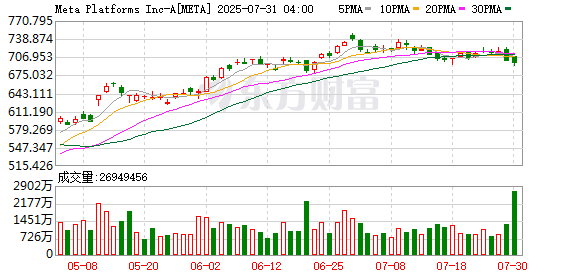
凤凰网科技讯 北京时间7月31日,脸书母公司Meta(NASDAQ: META)今天发布了截至6月30日的2025财 年第二季度财报。财报显示,Meta第二季度总营收为475.16亿美元,较上年同期的390.71亿美元增长 22%;净利润为183.37亿美元,较上年同期的134.65亿美元增长36%,其中元宇宙业务营业亏损45.30亿 美元。 股价表现: Meta第二季度营收和每股收益均超出分析师预期,对于第三季度的营收展望也超出预期,推动股价在 盘后上涨近9%。 Meta周三在纳斯达克交易所的开盘价为708.09美元。截至周三收盘,Meta股价下跌4.79美元,报收于 695.21美元,跌幅为0.68%。截至发稿,Meta股价在盘后交易中上涨62.05美元至757.27美元,涨幅为 8.93%。过去52周,Meta股价最高为747.90美元,最低为450.80美元。 第二季度运营要点: ——2025年6月,应用家族日活跃用户(DAP)平均值为34.8亿人,同比增长6%; ——应用家族上的广告展现量同比增长11%,每条广告的平均价格同比增长9%。 第二季度财务业绩: ——总营收为475.16亿美元,较上年同期 ...
Meta Platforms的CEO扎克伯格:人工智能(AI)正提振公司的广告业务。
news flash· 2025-07-30 21:26
Core Insights - Meta Platforms' CEO Mark Zuckerberg stated that artificial intelligence (AI) is boosting the company's advertising business [1] Group 1 - The integration of AI technologies is enhancing the effectiveness of Meta's advertising strategies [1] - Increased AI capabilities are expected to drive higher engagement and conversion rates for advertisers [1] - The positive impact of AI on advertising revenue is a key focus for Meta's future growth [1]