电池

Search documents
中原证券:光伏电池行业领涨 A股震荡上行
Xin Lang Cai Jing· 2026-01-25 06:25
Market Overview - The A-share market experienced slight fluctuations and upward movement on Friday, January 23, with the Shanghai Composite Index facing resistance around 4143 points during the day [1][2][4] - Industries such as photovoltaic equipment, energy metals, batteries, and aerospace performed well, while sectors like airports, insurance, banking, and shipbuilding showed weaker performance [1][2][4] Future Market Outlook and Investment Recommendations - The average price-to-earnings ratios for the Shanghai Composite Index and the ChiNext Index are 16.88 times and 53.36 times, respectively, indicating they are above the median levels of the past three years, suggesting a suitable environment for medium to long-term investments [2][5] - The total trading volume on Friday was 31,184 billion yuan, which is above the median trading volume of the past three years [2][5] - The central bank has indicated that there is still room for further interest rate cuts and reserve requirement ratio reductions to support economic transformation and boost market confidence [2][5] - Regulatory measures are being implemented to encourage long-term capital inflow while maintaining market stability through adjustments in margin trading and transaction regulations [2][5] - The market is expected to focus on performance and industry trends for the next phase, with a likelihood of the Shanghai Composite Index maintaining slight upward movement [2][5][6] - Short-term investment opportunities are recommended in the photovoltaic equipment, energy metals, batteries, and aerospace sectors [2][6]

邀请函:2026(第二届)起点锂电圆柱电池技术论坛暨圆柱电池20强排行榜发布会4月10日深圳举办!
起点锂电· 2026-01-24 11:10
Group 1 - The core viewpoint of the article highlights the explosive growth of the large cylindrical battery and all-tab technology market, with a projected increase of over 15% in China's cylindrical battery shipments by 2025, and a growth rate exceeding 40% for large cylindrical batteries [3] - Major companies in the large cylindrical battery sector, such as EVE Energy, Molicel, and others, are expected to face supply shortages due to high demand, indicating a robust market outlook for 2026 [3] - The article emphasizes the rapid adoption of large cylindrical battery products in various applications, including lightweight power, electric two- and three-wheelers, portable and home energy storage, and automotive power [3] Group 2 - The event will feature the release of the 2026 China Cylindrical Battery Comprehensive Competitiveness Ranking, providing authoritative references for procurement in the industry [3] - The forum will include discussions on cutting-edge technologies, processes, and materials related to cylindrical batteries, fostering innovation and collaboration among industry leaders [3][6] - The agenda includes specialized sessions on high-power cylindrical battery technology, innovations in household and portable energy storage, and the development trends of automotive-grade large cylindrical batteries [7][8] Group 3 - The event is organized by Qidian Lithium Battery and Qidian Research Institute (SPIR), with an expected attendance of over 600 participants [6] - Notable companies invited to participate include EVE Energy, CATL, BYD, and various others from the cylindrical battery supply chain, indicating a strong industry interest [10] - The forum will also address the challenges and advancements in the industrialization of all-tab large cylindrical batteries, including their applications in emerging fields like robotics and drones [8]


纳电商业化加速
Jing Ji Guan Cha Wang· 2026-01-24 07:23
Core Insights - CATL has launched a new series of sodium-ion batteries, including the industry's first mass-produced sodium-ion battery for low-temperature applications, achieving an energy density of 175Wh/kg and operational capability at -30°C [2] - Jiangsu Zhongna Energy has commenced production at its 10,000-ton sodium iron sulfate cathode material base, reducing the cost of sodium-ion battery cells to approximately 0.45 yuan/Wh, marking a significant step towards commercial viability [4][5] - The sodium-ion battery industry is transitioning from concept validation to large-scale delivery, with projections indicating a production increase to 3.45GWh by 2025, nearly doubling from 2024 [3] Industry Developments - Major international players, including LG Energy, are planning to establish pilot production lines for sodium-ion batteries in Nanjing, leveraging China's mature supply chain to accelerate commercialization [3] - The sodium-ion battery sector is gaining traction independent of lithium price fluctuations, with recent industry activities indicating a robust growth trajectory [3][6] - The cost of sodium-ion battery cells is expected to decrease further, potentially reaching below 0.4 yuan/Wh by 2026, enhancing their competitiveness against lithium-ion batteries [5] Market Opportunities - Sodium-ion batteries are finding unique applications in extreme temperature environments, such as commercial vehicles in cold regions and high-temperature conditions, where they outperform traditional lead-acid batteries [12][14] - The batteries are also being considered for two-wheeler battery swap markets, where their longer cycle life can reduce operational costs compared to lead-acid batteries [16] - In the energy storage sector, sodium-ion batteries are moving towards system integration, with hybrid solutions combining lithium and sodium technologies to enhance efficiency [17][18] Challenges and Solutions - Despite cost reductions, manufacturing challenges persist, particularly in maintaining material consistency during large-scale production [7][9] - The mismatch between lithium-ion production lines and sodium-ion battery requirements poses operational hurdles, necessitating specialized production environments [9][10] - The industry is shifting towards a focus on unique market segments where sodium-ion batteries can excel, rather than competing directly with lithium-ion batteries in mainstream applications [21][22] Future Outlook - The sodium-ion battery market is expected to evolve with increased participation from major players, leading to a more competitive landscape [19] - By 2025, the majority of sodium-ion battery production is projected to utilize stable, long-cycle life cathode materials, indicating a strategic shift in technology focus [20] - The integration of state-owned enterprises in funding and supporting sodium-ion projects is likely to drive further development and market penetration [22]


巨头新品发布、核心材料量产,钠电池商业化按下“加速键”
经济观察报· 2026-01-24 05:06
Core Viewpoint - The sodium battery industry is transitioning from concept validation to large-scale delivery, with significant advancements in production and cost reduction, positioning itself as a viable alternative in scenarios where lithium batteries are less effective [2][4][21]. Industry Developments - CATL launched a new series of sodium-ion batteries, including the industry's first mass-produced low-temperature version, achieving an energy density of 175Wh/kg [2]. - Jiangsu Zhongna Energy's sodium iron sulfate cathode material production facility has begun mass production, reducing the cost of sodium battery cells to approximately 0.45 yuan/Wh [5][6]. - By 2025, China's sodium-ion battery production is expected to reach 3.45GWh, nearly doubling from 2024 [4]. Cost and Economic Viability - The cost of sodium battery cells is projected to decrease further, potentially falling below 0.4 yuan/Wh by 2026, making them increasingly competitive with lithium batteries [6][7]. - Despite the cost reductions, challenges remain in achieving consistent material quality and production efficiency, particularly when scaling from laboratory to industrial production [8][9]. Unique Market Opportunities - Sodium batteries are finding unique applications in extreme temperature environments, such as low-temperature commercial vehicles and high-temperature conditions in regions like Saudi Arabia [13][14]. - In the two-wheeler battery swap market, sodium batteries offer longer cycle life compared to lead-acid batteries, leading to lower operational costs over time [16]. - The integration of sodium batteries in energy storage systems is evolving, with hybrid solutions combining lithium and sodium technologies to enhance efficiency [18][19]. Strategic Industry Positioning - The sodium battery sector is increasingly recognized as a strategic backup for energy security, with major players entering the market to leverage their supply chain capabilities [7][21]. - The industry is shifting towards a focus on long-life, lower-cost materials, with a significant portion of production expected to utilize stable, low-energy-density cathode materials by 2025 [22][24]. - The market is evolving to accept sodium batteries as a distinct product category rather than merely a cheaper alternative to lithium batteries, emphasizing their unique advantages in specific applications [10][11][24].
固态电池量产窗口期临近,久功科技凭技术突围抢占赛道先机
Xin Lang Cai Jing· 2026-01-24 04:12
随着全球脱碳进程提速与新能源产业升级,固态电池作为破解传统锂电池安全性与能量密度瓶颈的核心 技术,正从实验室走向产业化临界点。随着中国新能源重卡等细分市场的爆发式增长,这一赛道逐渐成 为资本与企业角逐的焦点,据中信证券测算,2030年全球固态电池总出货量将超700GWh,其中全固态 电池超200GWh。在此背景下,成立仅三年的浙江久功新能源科技有限公司,凭借无锂负极硫化物全固 态技术路线的精准卡位与产业化的快速推进,从众多参与者中脱颖而出,成为赛道核心玩家。 行业红利集中释放,固态电池迎来量产"临界点" 固态电池被业内视为新能源领域的"下一代核心技术",其以固态电解质替代传统液态电解液,不仅显著 降低热失控风险,更能通过体系升级将比能量和能量密度同时提升至400Wh/kg和1000Wh/L以上,远超 当前主流锂电池水平。当前,政策支持与市场需求形成双重推力,行业正迈入量产前夜。 政策层面,随着"十五五"规划框架明确,多地结合区域产业优势,将固态电池纳入"新赛道"布局。其中 浙江省明确支持高能量密度固态电池研发与产业化,通过浙江省级企业研究院认定等政策,为久功科技 等企业提供全方位支持。 市场需求端更是呈现爆发 ...
公司互动丨这些公司披露在电池等方面最新情况
Di Yi Cai Jing· 2026-01-23 14:24
Battery - Wanrun Co., Ltd. has achieved supply of perovskite photovoltaic materials, theoretically applicable to space perovskite solar flip batteries [1] - Yiwei Lithium Energy has established partnerships with leading companies in the commercial rocket and satellite sectors to provide aerospace battery products and solutions [1] Photovoltaics - Zhonglai Co., Ltd. is actively promoting the development of products suitable for diverse applications, including space, as part of an industry trend towards expanding photovoltaic product applications [1] Other - Aerospace Power's current aerospace components business is limited to mechanical processing [1] - Chujian New Materials' subsidiaries, Tian Niao High-tech and Dingli Technology, are partners with China's aerospace industry [1] - Aofei Entertainment holds approximately 5.12% equity in Beijing Noyteng Technology Co., Ltd. [1] - Tuori New Energy's crystalline silicon batteries have previously supplied commercial satellites, but no new orders have been signed recently [1] - Tianjian Technology's microwave front-end industrial base has commenced production [1] - Nanfeng Co., Ltd.'s subsidiary is diversifying market expansion in 3D printing [1] - Ankai Micro's products have undergone price adjustments [1] - Beidou Star's revenue directly from rockets and satellites accounts for less than 0.1% [1]
亿纬锂能:目前已与多家头部商业火箭公司和商业卫星公司合作
Mei Ri Jing Ji Xin Wen· 2026-01-23 13:35
Core Viewpoint - The company has been actively developing lithium battery solutions for commercial aerospace applications, focusing on high performance, reliability, and cost-effectiveness [2]. Group 1 - The company has been providing all-scenario lithium battery solutions, indicating a broad approach to battery technology [2]. - Two years ago, the company began to layout commercial aerospace lithium battery products, showing a proactive strategy in this emerging market [2]. - The company has established partnerships with several leading commercial rocket and satellite companies, highlighting its competitive position in the aerospace sector [2].

亿纬锂能:公司已与多家商业火箭、商业卫星头部企业达成合作
Zheng Quan Ri Bao Wang· 2026-01-23 13:19
Core Viewpoint - The company emphasizes its commitment to providing comprehensive lithium battery solutions, particularly for the aerospace sector, highlighting its proactive approach in establishing relevant business operations two years ago [1] Group 1: Business Strategy - The company has strategically positioned itself in the aerospace industry by developing high-performance, reliable, and cost-effective battery products tailored for extreme environments [1] - Collaborations have been established with leading companies in the commercial rocket and satellite sectors to supply these specialized battery solutions [1]
锂电产业链周记 | 红旗全固态电池首台样车下线 容百科技涉嫌误导性陈述被立案
Xin Lang Cai Jing· 2026-01-23 13:11
Group 1 - The Portuguese government announced a €350 million subsidy for the lithium battery factory project by China Innovation Aviation, which has a total investment of €3.077 billion and is expected to create 1,800 jobs [1] - The factory, located in Sintra, Portugal, will have a production capacity of 15 GWh and is set to be fully operational by 2028 [1] Group 2 - BYD's 500 MWh independent battery energy storage system project in Bulgaria has officially commenced operations, marking it as one of the largest independent storage projects in Eastern Europe [2] - This project is a strategic collaboration between BYD Energy and ContourGlobal [2] Group 3 - The first prototype of the Hongqi all-solid-state battery has been successfully produced by China FAW, achieving significant breakthroughs in high-pressure module packaging and system lightweight integration [4] - The all-solid-state battery features a 66Ah cell that has passed extreme heat abuse tests at 200°C, with ionic conductivity exceeding 10 mS/cm [4] - China FAW began research on all-solid-state batteries in 2014 and developed the industry's first solid-state battery VDA size standard module in 2019 [4]


固态电池又“量产”了?这可能是一个芬兰公司的拙劣骗局
3 6 Ke· 2026-01-23 12:37
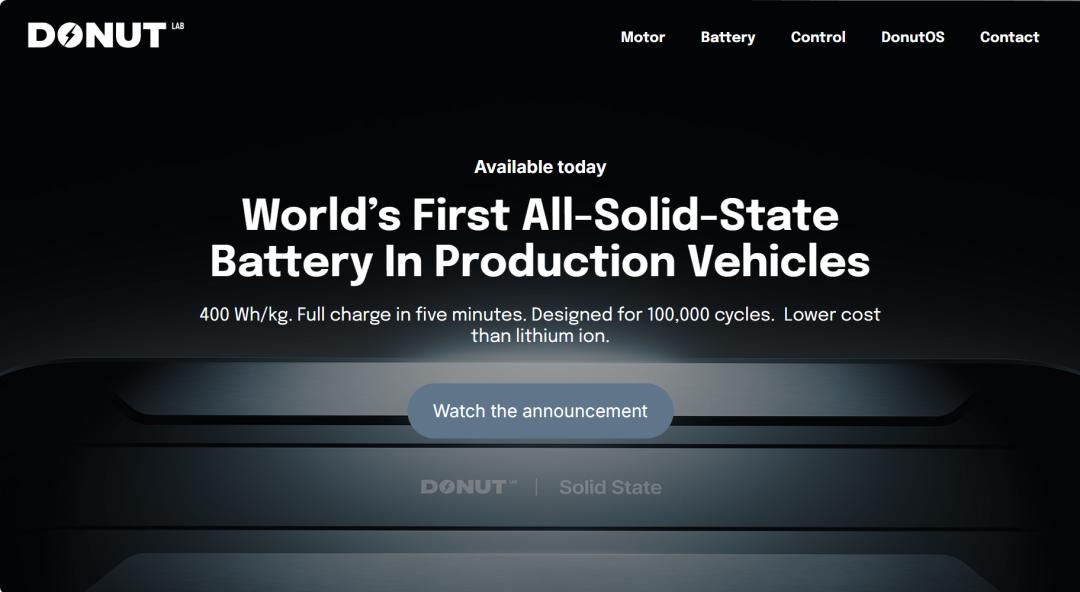
Core Viewpoint - Donut Lab claims to have developed the world's first mass-produced all-solid-state battery, boasting impressive specifications, but faces skepticism from industry experts regarding the feasibility of its claims [1][2][5]. Group 1: Battery Specifications and Industry Reactions - The solid-state battery features an energy density of 400Wh/kg, a charging time of 5 minutes, and a cycle life of up to 100,000 times, which has attracted significant attention but also controversy [2][5]. - Experts from Finnish universities and industry leaders, such as Yang Hongxin from Honeycomb Energy, have expressed doubts, labeling the company as a fraud if the specifications are accurate [3][5]. - Current solid-state batteries typically have a cycle life ranging from 1,000 to 4,000 times, while mainstream lithium-ion batteries exceed 2,000 cycles, making Donut Lab's claims appear highly ambitious [8][9]. Group 2: Manufacturing and Material Concerns - Donut Lab has not disclosed the core materials or manufacturing processes of its battery, stating it does not contain rare earth elements or lithium, which raises questions about the battery's technological advancements [11][12]. - The emphasis on not using rare earth elements is seen as lacking significance, as these materials are not commonly used in current battery technologies [12]. - The claim of not using lithium is particularly controversial, as lithium is essential for high-performance solid-state batteries, leading to skepticism about the battery's viability [12][13][14]. Group 3: Market Application and Commercial Viability - Donut Lab plans to integrate its solid-state battery into a production electric motorcycle named Verge, set for delivery in Q1 2026, which is viewed as a questionable market strategy given the motorcycle market's smaller scale compared to the automotive market [21][23]. - The commercial logic of deploying such advanced technology in a less lucrative market raises concerns about the company's motives, suggesting either a strong hidden profitability or potential deception [23][28]. - There is speculation that solid-state batteries may first find applications in robotics and eVTOL (electric vertical takeoff and landing) industries, where the demand for high energy density is greater than in traditional electric vehicles [24][28].