调味品

Search documents
华莱士、好利来供应商冲刺北交所IPO,上半年净赚逾1.5亿
Xin Jing Bao· 2025-09-26 14:52
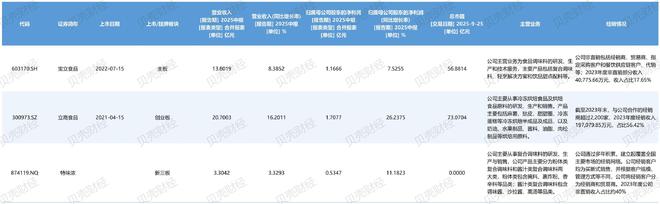
Industry Overview - The seasoning industry is experiencing a wave of interest in capital markets, with several companies planning to list on the New Third Board and the Beijing Stock Exchange [1] - Notable companies in this trend include "the first stock of pepper oil" Yao Mazi and Taihefang, which aims to be the "first stock of winter adjustment" on the Beijing Stock Exchange [1] Company Profile: Baili Food - Baili Food, established in 2012 and headquartered in Dongguan, Guangdong, positions itself as a "high-cost performance Western food material provider" [2] - The company offers a comprehensive range of products including salad dressings, flavored sauces, seasoning powders, breadcrumbs, and ketchup, integrating R&D, production, and sales [2] Financial Performance - For the fiscal years 2022, 2023, and the first seven months of 2024, Baili Food's largest customers were Wallace and Tastin, with sales of 48.82 million yuan, 51.24 million yuan, and 64.99 million yuan respectively, accounting for 3.87%, 3.19%, and 5.90% of total revenue [2] - As of June 2025, Baili Food achieved approximately 1.039 billion yuan in revenue, a year-on-year increase of 9.34%, and a net profit of about 155 million yuan, up 11.26% [2] - The company's R&D expenses were approximately 7.99 million yuan, representing about 0.77% of total revenue [2] Market Comparison - Baili Food's gross margin is slightly below the average of comparable companies, attributed to differences in business segments, customer structures, product types, and business scales [4] - In the first seven months of 2024, Baili Food's gross margin was 30.47%, compared to 32.07% for Baoli Food, 32.60% for Lihigh Food, and 31.03% for Tewenong, with an average of 31.90% for comparable companies [5] Ownership Structure - As of June 2025, Xu Weihong and Lu Lianfu collectively hold 65% of Baili Food's shares, with Xu serving as the chairman and head of R&D, while Lu is the vice chairman [4]

海天味业:董事兼总裁管江华出任公司新任法定代表人
Bei Jing Shang Bao· 2025-09-26 12:40
Core Viewpoint - Hai Tian Flavoring Industry recently announced the appointment of Guan Jianghua as the new legal representative of the company, following a decision made during the sixth board of directors' ninth meeting [1] Group 1: Management Changes - Guan Jianghua, born in January 1974, holds a bachelor's degree and is a senior economist [1] - He joined the company in 1998 and has held various positions including manager of the sales department, vice president of marketing, general manager of operations, assistant president, and vice president [1] - The change in legal representation has not yet completed the industrial and commercial registration process, and the registration still shows Cheng Xue as the legal representative [1]

涪陵榨菜(002507.SZ):拟向全体股东每10股派发现金股利2元中期分红
Ge Long Hui A P P· 2025-09-26 10:30
Core Viewpoint - Fuling Zhacai (002507.SZ) announced a profit distribution plan for the first half of 2025, proposing a cash dividend of RMB 2.00 per 10 shares based on the total share capital as of June 30, 2025, amounting to a total cash dividend of RMB 230,783,805.60 [1] Group 1 - The total share capital of the company as of June 30, 2025, is 1,153,919,028 shares [1] - The cash dividend will be distributed to all shareholders from the undistributed profits [1] - The company will not issue bonus shares or convert reserves into share capital [1]

涪陵榨菜董事、总经理赵平离任,高翔接任
Xin Lang Cai Jing· 2025-09-26 09:41
Core Points - Zhao Ping, the director and general manager of Fuling Zhacai Group, resigned due to work adjustments, effective from the date of delivery to the board [1] - After his resignation, Zhao Ping will serve as a senior manager and holds 2,210,335 shares in the company, adhering to share lock-up and reduction regulations [1] - The board of directors remains compliant with the legal requirement, consisting of 9 members after Zhao Ping's departure [1] - The company appointed Gao Xiang as the new general manager, with a term consistent with the fifth board of directors [1]
白酒关注中秋国庆动销,大众品把握结构性机会
Dongguan Securities· 2025-09-26 09:40
Investment Rating - The report maintains an "Overweight" rating for the food and beverage industry, expecting the industry index to outperform the market index by over 10% in the next six months [53]. Core Viewpoints - The report highlights the focus on liquor sales during the Mid-Autumn Festival and National Day, suggesting that consumer demand remains under pressure, particularly for high-end liquor brands like Kweichow Moutai [4][48]. - The report indicates a structural opportunity in mass-market products, with varying performance across different sub-sectors, emphasizing the importance of monitoring demand and cost indicators in the beer sector and consumption recovery in the condiment sector [4][48]. Summary by Sections Market Review - From September 12 to September 25, 2025, the SW food and beverage industry index fell by 5.76%, underperforming the CSI 300 index by approximately 6.76 percentage points [11]. - All sub-sectors underperformed the CSI 300 index during this period, with the baking sector experiencing the largest decline at -7.80% [13][14]. - Approximately 7% of stocks in the industry recorded positive returns, with notable gainers including Qianwei Yangchu (+21.90%) and Yangyuan Beverage (+16.80%) [15] . Industry Important Data Tracking Liquor Sector - As of September 25, 2025, the price of Feitian Moutai decreased to 1,765 RMB per bottle, while the price of Guojiao 1573 increased to 840 RMB per bottle [22]. Condiment Sector - As of September 25, 2025, the price of soybean meal was 2,988 RMB per ton, down 72 RMB from September 11, while the price of white sugar was 5,780 RMB per ton, down 110 RMB [25]. Beer Sector - As of September 25, 2025, the average price of barley was 2,230 RMB per ton, while the price of aluminum ingots was 20,710 RMB per ton, down 100 RMB [30]. Dairy Sector - The average price of fresh milk remained stable at 3.03 RMB per kilogram as of September 19, 2025 [37]. Meat Products Sector - The average wholesale price of pork was 19.44 RMB per kilogram as of September 25, 2025, down 0.49 RMB from September 11 [39]. Industry News - The report notes a slight decline in the national liquor price index in early September 2025, indicating ongoing market adjustments [41]. - The number of registered beer-related enterprises increased by 10.83% year-on-year from January to August 2025, reflecting a growing market [42]. Weekly Industry Perspective - The report emphasizes the importance of monitoring liquor sales during the upcoming holidays and suggests focusing on high-certainty liquor brands and mass-market products that benefit from policy catalysts [48].




涪陵榨菜(002507) - 002507涪陵榨菜投资者关系管理信息20250926
2025-09-26 08:30
Group 1: Financial Performance and Shareholder Returns - The company has maintained a cash flow of approximately 2.8 billion CNY annually, with 4.2 billion CNY allocated for financial management, yielding a return rate of only 2% [2][6]. - The sales net profit margin has consistently exceeded 30% over the past two years, while the net asset return rate has been impacted by a significant increase in net assets due to non-public fundraising in 2021 [19][32]. - The company has been increasing dividend payouts annually to provide stable returns to shareholders, while share buybacks are considered based on various factors [1][6]. Group 2: Market Strategy and Product Development - The company is focusing on expanding its product categories and channels, with a strategy to develop new products that meet consumer demands and to penetrate new markets [7][10]. - Recent innovations include the introduction of snack products like "Little Crunchy" and "Only Wujang," aimed at the snack food segment [2][10]. - The company is actively exploring the customization of products for B2B clients and has established a large customer operations center to facilitate direct service [5][10]. Group 3: Management and Operational Efficiency - The management team is subject to annual performance evaluations, and measures are in place to address underperformance [4][6]. - The company has implemented robotic applications in production processes to enhance efficiency and standardization [8][26]. - The company is committed to maintaining a focus on its core business of pickled vegetables while exploring strategic acquisitions to expand its product matrix [11][30]. Group 4: Market Challenges and Consumer Trends - The company acknowledges the challenges posed by market fluctuations, macroeconomic factors, and competition from alternative products [6][23]. - There is a noted shift in consumer preferences towards a wider variety of snack options, prompting the company to adapt its product offerings accordingly [23][24]. - The company is also exploring overseas markets and has established a dedicated subsidiary for export business, although specific revenue targets for the next three years have not yet been set [20][30].
兰州市市场监督管理局2025年食品安全专项抽检信息通告 兰市监通告〔2025〕6号
Zhong Guo Zhi Liang Xin Wen Wang· 2025-09-26 08:08
Core Points - The Lanzhou Market Supervision Administration conducted a food safety inspection from July to August 2025, focusing on various food categories including restaurant food, condiments, alcoholic beverages, grain products, meat products, snacks, convenience foods, beverages, and edible agricultural products [2][3][4] - A total of 58 batches of ordinary food were found to be non-compliant during the inspections, prompting regulatory actions such as halting production and sales, product recalls, and legal penalties against violators [2][3][4] Summary by Category Inspection Overview - The inspections were carried out in accordance with the Food Safety Law of the People's Republic of China and the Gansu Province food safety supervision and sampling plan [2] - The aim was to enhance food safety and protect consumer health [2] Non-compliance Findings - 58 batches of food products were identified as non-compliant during the inspection period [2][3] - The non-compliant products included various categories such as cakes, rice noodles, and condiments, with specific violations related to food safety standards [3][4] Regulatory Actions - The Market Supervision Administration has taken measures to control risks associated with the non-compliant products, including stopping production, removing products from shelves, and initiating recalls [2][3] - Consumers are encouraged to report any food safety issues by calling the complaint hotline 12315 [2]
光明乳业,如何保卫上海市场?丨消费参考
2 1 Shi Ji Jing Ji Bao Dao· 2025-09-26 05:05
Core Viewpoint - Bright Dairy is experiencing a decline in revenue and profit, particularly in its home market of Shanghai, amid a broader contraction in the dairy industry [1][2][3]. Financial Performance - In the first half of 2025, Bright Dairy's revenue decreased by 1.9% year-on-year to 12.47 billion yuan, while net profit attributable to shareholders fell by 22.5% to 220 million yuan [1]. - Revenue from liquid milk, other dairy products, and livestock products was 6.61 billion yuan, 4.45 billion yuan, and 520 million yuan, with year-on-year growth rates of -8.6%, +8.8%, and -13.8% respectively [1]. - Regionally, revenue in Shanghai, other regions, and overseas was 3.49 billion yuan, 4.99 billion yuan, and 3.94 billion yuan, with year-on-year growth rates of -6.9%, -1.5%, and +1.9% respectively [1]. Industry Context - The overall demand for dairy products is shrinking, with Nielsen IQ reporting a 9.6% year-on-year decline in dairy sales across all channels as of June 2025 [3]. - Competitors like Mengniu and Yili also reported revenue declines, with Mengniu's revenue down 6.9% to 41.57 billion yuan and Yili's liquid milk revenue down 2.1% to 36.13 billion yuan in the first half of 2025 [3]. Competitive Landscape - Bright Dairy is intensifying efforts to defend its market share in Shanghai by launching new products and enhancing its distribution channels [5][6]. - New Dairy, a competitor, reported a revenue increase of 3.01% to 5.526 billion yuan in the first half of 2025, indicating a more proactive approach in its core markets [4].

从茶叶到新茶饮 京城老字号多举措贴近年轻人
Bei Jing Shang Bao· 2025-09-25 16:55
Core Insights - A number of time-honored brands are revitalizing their operations, with 京华茶业 launching a new tea beverage brand "京华飘雪" in the Forbidden City, offering a range of tea products and ice cream [1][3] - 京华茶业, a subsidiary of 北京首农食品集团, has a history dating back to 1950 and operates a full industry chain from tea cultivation to sales, with partnerships across 18 provinces in China [3] - 六必居 is innovating by collaborating with 三元食品 to create new products and expanding its digital sales channels, achieving a threefold increase in e-commerce sales since 2020 [4][5] - 王致和 has introduced a low-salt fermented bean curd product, reducing salt content by over 40%, while also exploring new markets through smart manufacturing [4] - 白玉 is expanding its product lines and sales channels, achieving significant sales growth in premium supermarkets and online platforms, with a 150% increase in online sales in 2022 [5] Company Strategies - 京华茶业 is focusing on optimizing offline outlets and building a comprehensive marketing network across various regions in China [1] - 六必居 is enhancing its digital presence and has established a sales network covering major online platforms, while also opening innovative physical stores [4] - 王致和 is pursuing innovation through product development and technological upgrades to address industry challenges [4] - 白玉 is diversifying its product offerings to meet modern consumer demands and expanding its distribution channels to include premium supermarkets and online platforms [5] Cultural and Market Trends - The cultural heritage of these time-honored brands serves as a foundation for their innovation, with products being reinterpreted for modern consumers [6] - The transformation of traditional products into contemporary offerings is a key strategy for engaging younger consumers [6] - The ongoing journey of innovation for these brands is aimed at transitioning from "old classics" to "new classics" [6]

从茶叶到新茶饮 从市场到连锁商超 老字号多举措贴近年轻消费者
Bei Jing Shang Bao· 2025-09-25 13:51
Group 1: Company Innovations - The traditional brand Jinghua Tea has launched a new tea beverage brand "Jinghua Piaoxue" in the Forbidden City, offering tea drinks, tea-flavored ice cream, and ready-to-drink tea products, while optimizing its offline network and expanding franchise development [1] - Liu Biju has collaborated with Sanyuan Foods to create co-branded products like "Erba Sauce Milk Tea" and "Erba Sauce Yogurt Shake," and has expanded the application of its sauce into snacks, baking, and tea drinks [2][5] - Wang Zhihuo has introduced a low-salt fermented bean curd series with over 40% less salt than traditional products, while also exploring the "food and medicine integration" market and upgrading through smart manufacturing [5] - Baiyu has developed new product lines such as hand-pulled tofu and new-style fresh bean curd, and has collaborated with Liu Biju to launch cross-border products, achieving sales of over 4 million yuan for certain items [5][6] Group 2: Market Expansion and Sales Channels - Liu Biju has accelerated its digital transformation, achieving a threefold increase in e-commerce sales since 2020, and has opened an innovative store in Harbin in partnership with JD Seven Fresh [5] - Baiyu has expanded its sales channels from traditional markets to premium supermarkets, with sales in 7FRESH being three times that of ordinary brands, and has opened 60 new specialty stores in Beijing [6] - Baiyu's online sales have seen a 150% year-on-year increase in 2022, supported by a logistics system covering over 2,500 points in the Beijing-Tianjin-Hebei region [6] Group 3: Cultural Heritage and Consumer Engagement - The innovation of traditional brands is rooted in cultural heritage, with products like low-salt pickles and ready-to-eat bean curd being reinterpreted for modern consumers [6] - The transformation of traditional brands involves a comprehensive channel strategy, connecting deeply with consumers, especially younger demographics, through both offline experiences and online platforms [6] - The commitment to cultural transmission, product innovation, and channel transformation is seen as a continuous journey for traditional brands, aiming to evolve from "old classics" to "new classics" [6]