玩具

Search documents
湾财周报 人物 宗馥莉回应风波;实控人前妻手撕新董秘
Nan Fang Du Shi Bao· 2025-08-31 14:06
Group 1 - The core viewpoint of the article revolves around the ongoing controversies surrounding Wahaha and its chairperson, Zong Fuli, who stated that she will not change direction due to the current turmoil [4][5][6] - Zong Fuli addressed issues related to family inheritance disputes and the optimization of distributors during a recent interview, emphasizing her business philosophy and understanding of commerce [4][6] - The internal conflict at Reliable Co. has intensified, with the founder's ex-wife publicly criticizing the new secretary and the company's management decisions [6][7] Group 2 - Huawei's rotating chairman, Xu Zhijun, announced significant progress in the HarmonyOS ecosystem, highlighting advancements in application adaptation, technological innovation, and industry applications [8] - Lantu Automotive is set to go public in Hong Kong, reflecting market confidence, with over 200,000 users gained in the past period [8] - The restaurant industry is experiencing a normalization phase with declining same-store sales, but the chairman of Xiaocaiyuan expressed confidence in the business model, noting a quick return on investment for new locations [8]




一周新消费NO.324|Babycare官宣郭碧婷成为全新品牌代言人;喜茶上新网纹瓜瓜冰浆
新消费智库· 2025-08-31 13:04
Group 1 - The core viewpoint of the article highlights the recent product launches in the food and beverage industry, showcasing innovation and market expansion strategies by various brands [4][6][19]. Group 2 - Mixue Ice City has launched a new "Lemon Milk" series, which includes Lemon Milk Coffee and Snow King Lemon Milk, emphasizing rich and refreshing flavors [4][24]. - Want Power, a brand under Wangwang, introduced a new product "Berry Care," featuring five core ingredients aimed at health-conscious consumers [4]. - Joyoung has released a new fig and flaxseed soy milk powder, targeting female consumers with high protein and fiber content [4]. - Kirin Beverage has launched a roasted tea latte, designed for various consumption scenarios such as studying and working [5]. - Yili's Ikahuo has introduced a new health drink made from iron skin dendrobium and western ginseng, utilizing advanced preservation techniques [6]. - Menglong Ice Cream has unveiled a new glowing ice pop, appealing to health-conscious consumers with its low-calorie content [7]. - Heytea has launched a new ice drink made from a specific type of melon, highlighting unique production techniques [7]. - Nongfu Spring has introduced a new series of bottled water sourced from various locations across China [7]. - Sanofi Group has launched a new herbal tea product, focusing on light health benefits [7]. Group 3 - Babycare has announced actress Guo Biting as its new brand ambassador, launching a themed short film [8]. - Mengniu has appointed a new CFO, indicating a shift in its executive leadership [8]. - KFC has opened its first KPRO restaurant in Henan, focusing on balanced meal options [10]. - Lucky Coffee has opened its first overseas store in Malaysia, marking its global expansion [10]. Group 4 - Shibeikang has completed a nearly 100 million RMB Series B financing round, aimed at accelerating its drug development pipeline [14]. - Pure Fitness has secured $50 million in funding, indicating strong investor interest in the fitness sector [16]. - Sleep.ai has raised $5.5 million in funding, transitioning to a focus on commercialization and partnerships [17]. - Anta has announced an investment in the Korean fashion group MUSINSA, establishing a joint venture in China [17]. Group 5 - Coca-Cola has launched customized snack products for bulk retail, expanding its product offerings [19]. - Kangshifu has undergone significant management changes, indicating a strategic shift within the company [19]. - Nayuki has collaborated with a brand to launch a new beverage line, enhancing its product diversity [19]. - Ganyuan Food has introduced a new rice cake series with various flavors, focusing on quality ingredients and innovative cooking methods [19].






布鲁可(0325.HK):IP更加均衡发展 2025H1海外收入大幅增长
Ge Long Hui· 2025-08-30 19:04
Core Viewpoint - The company reported a significant increase in revenue and adjusted net profit for the first half of 2025, driven by strong sales in character building toys and a focus on expanding its IP portfolio [1][4]. Financial Performance - In H1 2025, the company achieved revenue of 1.338 billion yuan, a year-over-year increase of 27.9%, and a net profit of 297 million yuan, compared to a loss of 258 million yuan in H1 2024 [1]. - The adjusted net profit for H1 2025 was 320 million yuan, reflecting a 9.6% increase year-over-year [1]. - The gross margin for H1 2025 was 48.39%, down 4.5 percentage points year-over-year, attributed to rising costs from increased sales volume and new SKU demands [1]. Product and IP Development - Revenue from character building toys reached 1.33 billion yuan in H1 2025, accounting for 99.1% of total revenue, with a gross margin of 48.52% [1][2]. - The company launched 243 new SKUs in H1 2025, bringing the total to 925 SKUs by the end of the period [1]. - The company is expanding its user demographic, with products for ages 6-16 and above accounting for 82.6% and 14.8% of revenue, respectively [2]. Market Expansion - Online sales revenue increased to 108 million yuan in H1 2025, a 44.6% year-over-year growth, while offline sales reached 1.23 billion yuan, up 26.6% [3]. - Overseas sales surged to 111 million yuan, marking an 898.56% increase, primarily driven by markets in North America and Asia [3]. Future Outlook - The company forecasts revenues of 3.418 billion yuan, 4.716 billion yuan, and 5.725 billion yuan for 2025-2027, with adjusted net profits of 844 million yuan, 1.174 billion yuan, and 1.430 billion yuan, respectively [4]. - The company maintains a "buy" rating based on its strong competitive position in the character building toy market and the potential for market share growth [4].
高乐股份(002348.SZ):上半年净亏损2795.16万元
Ge Long Hui A P P· 2025-08-30 16:41
Core Viewpoint - The company reported a significant increase in revenue for the first half of 2025, but it also faced substantial net losses [1] Financial Performance - The company achieved an operating revenue of 131 million yuan, representing a year-on-year growth of 35.93% [1] - The net profit attributable to shareholders was a loss of 27.95 million yuan [1] - The net profit attributable to shareholders after deducting non-recurring gains and losses was a loss of 30.26 million yuan [1] - The basic earnings per share were -0.0295 yuan [1]

华尔街见闻早餐FM-Radio|2025年8月30日
Sou Hu Cai Jing· 2025-08-30 16:33
华见早安之声 市场概述 科技股抛售潮打压美股周五收跌,市场带着谨慎心态,为9月潜在的季节性挑战做好准备。8月纳指跑输小盘股、标普累涨1.91%。特斯拉下挫3.50%、领跌 美股科技七巨头。 芯片股普跌,英伟达跌超3.3%。甲骨文跌5.9%。 中概股指数收涨1.55%,8月累计涨超6%、 连涨四个月。 阿里巴巴大涨13%,创2023年3月以来最佳单日表现。 美债涨跌不一,10年期收益率涨2.3基点。 8月降息预期升温下,2年期收益率累跌33个基点。 美元指数先涨后跌、较日高跌0.29%。 比特币下挫逾3.3%、跌破10.9万美元关口。 黄金四连涨,较日低一度涨1.46%。美油跌近0.5%。内盘期货夜市收盘涨跌各异,纯碱夜盘收跌2.08%,烧碱涨1.24%。 亚洲时段,AH股8月收官,创业板大涨超24%,恒指稳居25000点,新"股王"寒武纪翻倍,工业富联市值破万亿。 要闻 证监会: 持续巩固资本市场回稳向好势头,加快推进新一轮资本市场改革开放。 国家发改委: 发展"人工智能+"坚决避免无序竞争和一拥而上,未来1-2年是人工智能落地的关键窗口期。 美国上诉法庭裁定, 特朗普大部分全球关税违法,但在官司未完结之际仍 ...

华尔街见闻早餐FM-Radio | 2025年8月30日
Hua Er Jie Jian Wen· 2025-08-29 23:26
Market Overview - Technology stocks faced a sell-off, leading to a decline in U.S. markets, with the Nasdaq underperforming small-cap stocks and the S&P 500 gaining 1.91% in August [2] - Tesla dropped 3.50%, leading the decline among major tech stocks, while Nvidia fell over 3.3% and Oracle dropped 5.9% [2] - Chinese concept stocks rose 1.55%, with Alibaba surging 13%, marking its best single-day performance since March 2023 [2] - U.S. Treasury yields showed mixed results, with the 10-year yield rising by 2.3 basis points and the 2-year yield falling by 33 basis points amid increasing rate cut expectations [2] - Bitcoin fell over 3.3%, dropping below $109,000, while gold prices increased for four consecutive days [2] Key News - The China Securities Regulatory Commission (CSRC) aims to consolidate the positive momentum in the capital market and accelerate the next round of reforms and opening-up [3][13] - The National Development and Reform Commission (NDRC) emphasizes the importance of avoiding disorderly competition in the "Artificial Intelligence +" sector, identifying the next 1-2 years as a critical window for AI implementation [3][13] - Alibaba reported a 18% year-on-year decline in Q2 Non-GAAP net profit, while cloud business revenue grew by 26% [6][15][20] - Huawei's revenue for the first half of the year reached 427 billion yuan, a 3.94% increase year-on-year, but net profit fell by 32% [6][15] - BYD's revenue surpassed Tesla for the first time, with a 13.79% year-on-year increase in net profit [7][15] - Foxconn predicts sovereign AI investments could reach $1 trillion over the next five years, becoming a new growth point in the computing power market [7][16] Company Performance - Alibaba's Q2 revenue grew by 2%, with net profit increasing by 76% to 42.4 billion yuan [20] - Lenovo Holdings reported a 144% increase in net profit and a 20.67% rise in revenue for the first half of the year [21] - Bank of China saw a 3.61% increase in revenue year-on-year, with non-interest income rising by 26.43% [22] - China National Offshore Oil Corporation (CNOOC) reported a 14.86% increase in net profit for the first half of the year, achieving record highs in both revenue and net profit [24] - China Shenhua's revenue reached 138.1 billion yuan, with a significant 7.7% decrease in self-produced coal costs [25]

星辉娱乐上半年扭亏背后:靠“西甲扑救王”解约
Guo Ji Jin Rong Bao· 2025-08-29 14:04
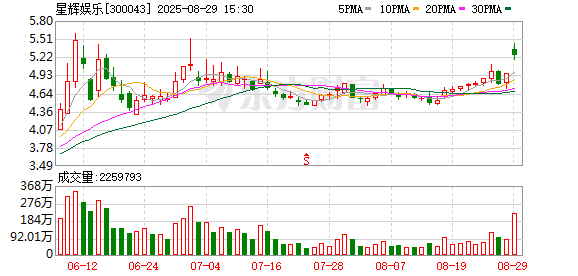
Core Viewpoint - Xinghui Entertainment reported significant growth in revenue and profitability for the first half of 2025, primarily driven by player transfer income and increased broadcasting rights revenue from its football club operations [2][3]. Financial Performance - The company achieved a revenue of 1.135 billion yuan, representing a year-on-year increase of 84.58% [2]. - The net profit attributable to shareholders turned positive, reaching 155 million yuan [2]. - The net cash flow from operating activities surged by 737.97% to 374 million yuan [2]. Business Segments - The revenue breakdown shows that the football club business generated 502 million yuan, accounting for 44.23% of total revenue, with player transfer income contributing 217 million yuan and broadcasting rights income 172 million yuan [3]. - The football club segment achieved a net profit of 106 million yuan, marking a turnaround from previous losses [3]. Strategic Moves - Xinghui Entertainment is in the process of divesting its football club business, planning to transfer 99.66% of its stake in the Spanish club to Velocity Sports Ltd [3]. - The completion of this transaction is pending approval from the Spanish Sports Council, introducing uncertainty regarding the deal [3]. Other Business Segments - The gaming segment generated 406 million yuan in revenue, a year-on-year increase of 43.19%, but still recorded a net loss of 913.3 million yuan [4][5]. - The toy business achieved a revenue of 201 million yuan, growing by 8.46%, but net profit decreased to 33.01 million yuan from 35.97 million yuan in the previous year [6].

群兴玩具:算力跨界首获突破反亏更多,AI重组引牛散扎堆入驻|看财报
Tai Mei Ti A P P· 2025-08-29 10:08
Core Viewpoint - The company, Qunxing Toys, reported a revenue of 175.53 million yuan for the first half of the year, a year-on-year increase of 38.4%, but faced a net loss of 17.06 million yuan, a decline of 158.6% compared to the previous year, indicating a significant disparity between revenue growth and profitability [1][4]. Revenue and Profitability - The main revenue driver for the company is liquor sales, which accounted for over 80% of total revenue in the first half of the year, but with a low gross margin of only 2.32% [1][5]. - The newly launched computing power business generated 18.11 million yuan in revenue, representing 10.32% of total revenue, but is currently operating at a loss with a gross margin of -88.66% [2][4]. Business Expansion and Challenges - The company is attempting to enter the AI sector through a planned acquisition of Hangzhou Tiankuan Technology, but this initiative has seen no substantial progress in over six months [5][9]. - Despite the challenges, the company has secured a significant contract worth 113 million yuan with Tencent for computing power services, effective from April 2025 [6]. Shareholder Dynamics - The shareholder structure has changed, with an increase in individual shareholders, including notable investors who have recently entered the top ten shareholders list [7][9]. - The stock price has declined approximately 30% since the announcement of the acquisition plan, reflecting market skepticism about the company's future prospects [10].


海外IP潮玩跟踪系列:乐高:产品组合创新推动需求增长双位数,持续扩张全球产能
Guoxin Securities· 2025-08-29 09:12
Investment Rating - The investment rating for the industry is "Outperform the Market" (maintained) [2][3]. Core Insights - The report highlights that LEGO Group achieved a revenue growth of 12%, reaching 34.6 billion Danish Krone (approximately 38.6 billion RMB), marking a historical high. Operating profit increased by 10% to 9 billion Danish Krone (approximately 10 billion RMB), and net profit also grew by 10% to 6.5 billion Danish Krone (approximately 7.3 billion RMB) [4][6]. - The continuous double-digit growth in LEGO's performance is attributed to product innovation, global expansion, and strategic collaborations with leading IPs [5][11]. Summary by Relevant Sections Product Innovation - In the first half of 2025, LEGO launched a record 314 new product sets, catering to diverse consumer needs, including a new flower series popular during Valentine's Day and Mother's Day, and a collaboration with Formula 1 [9]. - The company initiated the "She Built That" campaign to encourage girls to express their creativity as builders, and plans to launch LEGO® Pokémon in 2026 [9]. Global Supply Chain Expansion - LEGO is expanding its global footprint with a new factory in Vietnam and ongoing expansions in Mexico and Hungary. The new regional distribution centers in Belgium and Vietnam are set to enhance supply chain flexibility [9]. - An investment of over 1.5 billion USD is planned for a new factory and an 185,000 square meter regional distribution center in Virginia, USA, expected to be operational by 2027 [9]. Retail Experience Innovation - In the first half of 2025, LEGO opened 24 new brand retail stores, bringing the total to 1,079 stores across 54 markets. The company is investing in new technologies to enhance brand experiences for children, consumers, and retail partners [10].
1933年以来最狠关税!美国家庭一年多掏2400刀
Sou Hu Cai Jing· 2025-08-29 09:07
Group 1: Tariff Impact Overview - The latest round of tariffs in the U.S. took effect on August 7, raising the average tariff rate to 18.6%, the highest since 1933, resulting in an estimated annual increase of $2,400 in household spending [1] Group 2: Price Increases by Product Category - **Electronics**: Computer prices rose nearly 5% year-on-year as of June, with short-term price increases projected at 18.2% and long-term at 7.7% [2] - **Clothing and Leather Goods**: Prices are expected to rise nearly 20% even after supply chain adjustments [4] - **Footwear**: Nike announced price increases for certain shoe models, with specific increases varying by style, as they plan to pass on tariff costs to consumers [6] - **Toys**: Prices increased by 3.2% in Q2, with over 75% of toys relying on Chinese production, making it difficult to shift production locations [9] - **Home Appliances and Household Goods**: Major retailers like Walmart and Costco have begun raising prices on appliances and kitchen products, though specific increases are not yet disclosed [11] - **Consumer Goods**: Procter & Gamble plans to raise prices on products like Tide and Pampers by an average of 2.5% to offset approximately $1 billion in tariff costs [13] - **Food and Agricultural Products**: Overall food prices are expected to rise by over 3%, with fresh produce potentially increasing by 7% [15] - **Coffee**: Tariffs on Brazilian coffee are as high as 50%, leading to significant retail price increases [17] - **Alcohol**: Tariffs on imported wines and spirits from the EU will rise from 10% to 15%, affecting retail prices [19] - **Automobiles**: Average vehicle prices are expected to rise by 12% (approximately $6,000), with specific increases for Japanese and Mexican assembled models [24] - **Watches**: Swiss watch exports to the U.S. will face a tariff increase to 39%, leading to expected retail price hikes [23]