储能

Search documents
储能最后拼图补齐-全国容量电价政策解读
2026-02-02 02:22
Summary of Key Points from the Conference Call Industry Overview - The conference call discusses the national capacity pricing policy for energy storage in China, which aims to unify local capacity compensation policies into a national standard, benefiting most provinces and promoting new energy storage development towards 4-hour continuous discharge [1][9]. Core Insights and Arguments - **National Capacity Pricing Policy**: The policy is designed to address stability issues in the power system due to rapid growth in wind and solar energy, ensuring that regulating power sources can achieve economic viability through fixed compensation [2][4]. - **Long-term Stability Mechanism**: The national capacity pricing is viewed as a long-term stable mechanism, providing a predictable development environment that attracts more investment into the new energy storage sector [10][12]. - **Investment Trends**: By early 2025, state-owned enterprises (SOEs) were initially cautious about new energy storage but gradually recognized its importance, leading to a consensus by the end of the year to accelerate investments in energy storage projects [13][14]. - **Economic Viability of New Energy Storage**: New energy storage has become highly competitive due to significant cost reductions, with installed capacity expected to exceed pumped storage by 2024, reaching over 70 million kW [5]. - **Pumped Storage Challenges**: While still important, pumped storage faces competition from emerging storage technologies. The new policy allows for compensation based on average prices over 3-5 years to stabilize investments [6][7]. - **Coal Power Decline**: The competitiveness of coal power is decreasing due to reduced operating hours, necessitating fixed subsidies to maintain viability [8]. Important but Overlooked Content - **Regional Policy Variations**: Different provinces have implemented varying capacity compensation policies, with some offering higher rates than others. For instance, Gansu's compensation is around 100 yuan per kW annually, while Shandong's is about 46 yuan, reflecting local market conditions [19][20]. - **Impact of Capacity Pricing on Investment Expectations**: The capacity pricing policy provides SOEs with a stable income source, which is crucial for large-scale investments, as they prioritize stability over high returns [12][28]. - **Future Market Dynamics**: The peak-valley price difference is expected to narrow, influencing market dynamics in the coming years, particularly in regions with varying energy resource availability [15]. - **Investment Directions for SOEs**: The most promising investment areas for power generation SOEs include wind energy, new energy storage, pumped storage, and green electricity desulfurization projects, with new energy storage being prioritized due to lower costs [18]. Conclusion - The national capacity pricing policy represents a significant shift in China's energy landscape, providing a framework that supports the growth of new energy storage while addressing the challenges faced by traditional energy sources. The emphasis on stability and predictability in investment returns is likely to shape the future of energy investments in the country.
储能容量电价政策解读
2026-02-02 02:22
Summary of Key Points from the Conference Call Industry and Company Involved - The discussion revolves around the **energy storage capacity pricing policy** in China, particularly its implications for **energy storage**, **pumped storage**, and **thermal power** industries. Core Insights and Arguments 1. **Capacity Pricing Policy Impact** The capacity pricing policy is a positive signal for energy storage, but its effectiveness will depend on the implementation details set by each province. Provinces with high renewable energy or lacking regulatory power may set higher benchmarks, while those with sufficient regulatory power may implement changes more slowly [1][2] 2. **Pumped Storage and Thermal Power** The new policy has a moderate impact on pumped storage, ensuring cost control for projects at average levels, while high-cost projects face risks. For thermal power, the removal of a 20% lower limit and the relaxation of long-term contract signing ratios will help stabilize revenues and enhance overall profitability [1][5] 3. **Market Mechanism and Stability** The capacity pricing policy aims to stabilize coal power revenues through market mechanisms, which is significant for the coal power industry in the long term. However, coal price fluctuations in 2026 pose risks, especially with substantial price drops in some provinces in 2025 [1][8] 4. **Energy Storage Project Viability** Current policies support energy storage projects for up to 6 hours, with longer projects being economically unfeasible due to potential upper limits on capacity pricing calculations. Provinces may adjust their policies based on local conditions, but significant changes are unlikely [1][9] 5. **Investment Climate** Despite rising lithium carbonate prices increasing project costs, investment enthusiasm remains strong. The establishment of a capacity pricing mechanism provides stable expectations for investors, which is crucial for long-term investment [3][17] 6. **Implementation of Capacity Pricing** The capacity pricing for energy storage is calculated based on local coal power capacity prices, adjusted by specific ratios. For example, if the coal power capacity price is 165 RMB/kW-year, the energy storage capacity price would be calculated based on the duration of full power discharge relative to the peak load duration [4] 7. **Future of Energy Market** The new policy aligns with previous expectations and will have varying impacts on different stakeholders. The overall measures aim to enhance revenue stability and address challenges posed by declining utilization hours in the energy market [6][7] 8. **Regional Policy Variations** Provinces like Gansu and Ningxia are advancing in establishing unified capacity mechanisms, while others may follow suit but with different timelines and specifics. The second phase of the reliable capacity compensation mechanism will integrate thermal power and energy storage into a unified calculation formula [13][25] 9. **Dynamic Balance of Energy Sources** The growth of renewable energy sources like wind and solar must be balanced with energy storage to ensure system stability. The rapid increase in energy storage capacity will significantly enhance reliable capacity, but if not managed, it could lead to reduced unit capacity prices [26][27] 10. **Investment Strategies and Market Adjustments** Provinces will tailor policies to attract investment based on local demand for services like frequency regulation. However, if installed capacity grows too quickly, it could lead to oversupply and reduced profitability, necessitating careful policy adjustments [24] Other Important but Potentially Overlooked Content - The approval process for new energy storage projects is simplified, which could lead to rapid growth but also requires cautious management to avoid increased social costs [11] - The current energy market primarily focuses on energy quantity, with auxiliary services still underutilized. New models are being tested, but challenges remain in accurately predicting storage states [20][21] - The potential for simultaneous revenue generation from energy and frequency regulation services exists but is not yet widely adopted in China [22] This summary encapsulates the critical insights from the conference call regarding the energy storage capacity pricing policy and its implications for various stakeholders in the energy sector.
全国统一容量电价机制如期落地
2026-02-02 02:22
Summary of Conference Call Notes Industry Overview - The conference call discusses the implementation of a national unified capacity pricing mechanism in the energy sector, aimed at improving the electricity market mechanism and ensuring long-term investment returns for the energy storage industry [1][5]. Key Points and Arguments - **Capacity Pricing Policy**: The policy addresses issues related to peak-valley arbitrage and time-of-use pricing, which cannot fully recover project costs. It aims to attract more investments in the energy storage sector and mitigate short-term policy adjustment impacts [1][3]. - **Impact on Energy Storage Demand**: The domestic capacity pricing policy and the high growth in overseas household energy storage demand are expected to accelerate the release of energy storage demand. The decline in lithium carbonate price volatility alleviates concerns about suppressed terminal demand, presenting a significant opportunity for the lithium-ion sector [1][6]. - **Short-term Production Outlook**: A production decline is anticipated in February due to the Spring Festival, but a production peak is expected in March. Raw material price increases have gradually been passed down to downstream sectors, with leading companies experiencing minimal profit impact due to stronger bargaining power [1][7]. - **Ningde Times' Growth Forecast**: Ningde Times is projected to maintain growth in shipments through 2026, benefiting from increased market share in domestic energy storage and high growth in the European market. The company is expected to maintain stable profitability through improved raw material layout and cost transmission mechanisms [1][8]. - **Policy Focus on Independent Energy Storage**: The policy explicitly targets independent energy storage, excluding renewable energy storage, to promote the development of electrochemical energy storage installations by 2025 and beyond. This policy integrates results from multiple provincial pilot programs [1][9]. Additional Important Content - **Investment in Power Grid Equipment**: The total investment in domestic power grid equipment is projected to reach 4 trillion yuan, with an expected actual investment of over 720 billion yuan by 2026, reflecting a double-digit growth rate year-on-year. The Chinese power equipment industry is expected to benefit from a global investment cycle in power grids [3][19]. - **Household Energy Storage Demand**: The household energy storage sector is experiencing strong demand, with positive shipment performance in the first quarter, driven by subsidy policy changes in Australia and domestic export tax rebates. The Australian market's budget for household energy storage is set to triple, significantly boosting demand [1][15]. - **European Market Developments**: The European market is witnessing changes in storage application scenarios and profit models, with policies promoting diverse revenue streams. The market is expanding from residential to commercial and industrial applications [1][16][17]. - **Impact of Raw Material Prices**: The rise in raw material prices poses some pressure on first-tier equipment manufacturers, but the overall impact is manageable due to hedging mechanisms and pricing strategies [1][21]. Conclusion - The conference call highlights the strategic importance of the capacity pricing policy in fostering long-term investment in the energy storage sector, the anticipated growth of key players like Ningde Times, and the broader implications for the power grid and household energy storage markets. The insights provided indicate a positive outlook for the energy storage industry, driven by supportive policies and market dynamics.

安踏成彪马最大股东,速卖通跻身美国增速TOP10丨出海周报
2 1 Shi Ji Jing Ji Bao Dao· 2026-02-02 02:07
Industry Overview - The Ministry of Commerce will launch a national-level overseas comprehensive service platform to streamline services related to foreign affairs, legal, financial, and logistics, aiming to reduce cross-border compliance costs and improve decision-making efficiency for enterprises [3] - China's foreign trade continues to grow, with the total import and export value expected to reach 45.47 trillion yuan by 2025, a year-on-year increase of 3.8%. The number of provinces with foreign trade exceeding one trillion yuan has expanded to nine [4] - The current trend in China's energy storage sector is shifting from scale expansion to value cultivation, with renewed interest in overseas factory construction [5] Company Dynamics - AliExpress has seen a significant increase in website traffic in developed markets, with a year-on-year growth of 18.7% in the U.S. for 2025, making it one of the fastest-growing platforms [7] - Anta Sports announced the acquisition of a 29.06% stake in PUMA for 1.506 billion euros, positioning itself as the largest shareholder and aiming to enhance its global brand and channel presence [8] - Kimi reported that its overseas revenue has surpassed domestic revenue, with a fourfold increase in global paid users following the launch of its K2.5 model [10] - Caocao Travel has expanded its ride-hailing services to approximately 16,000 cities across 42 countries, providing a comprehensive international travel service network [11] - BYD is collaborating with Kim Long Motor to build a $130 million battery factory in Vietnam, highlighting a shift towards local manufacturing and technical support [12] - Qatar Investment Authority (QIA) led a $150 million cornerstone investment in Dongpeng Beverage's Hong Kong IPO, marking its first significant investment in a Chinese consumer company [13] - Titanium Technology announced a strategic partnership with Silicon Valley's DeepLumen to develop an AI-driven marketing infrastructure [14]


未知机构:电新周观点更新好看太空光伏储能锂钠电锂电全国容量电价-20260202
未知机构· 2026-02-02 02:00
Industry and Company Summary Industry: Lithium Battery and Energy Storage Key Points - **National Capacity Pricing Policy**: The introduction of the national capacity pricing policy is expected to increase the Internal Rate of Return (IRR) for energy storage by over 3%, with more provinces expected to adopt energy storage solutions by 2026 [1] - **Lithium Battery Production**: In February, lithium battery production is projected to decrease by over 10%, indicating that the production season is not as weak as anticipated [1] - **Sodium Battery Testing**: Ningde has initiated winter testing for multiple automotive companies regarding sodium batteries, with expectations for mass shipments in Q2 [1] - **Investment Focus**: The preferred investment hierarchy is as follows: energy storage cells (Penghui) > lithium iron phosphate cathodes > energy storage integration (Haibo) > separators (Enjie), copper and aluminum foils (Nord and Dingsheng) [1] Industry: Sodium Battery and Lithium Carbonate Key Points - **Lithium Carbonate Price Adjustment**: Following a price adjustment, there is a strong expectation for a new upward trend in lithium carbonate prices, with downstream procurement becoming more active after recent price drops [2] - **Wind Power Sector Performance**: The wind power sector has seen numerous earnings forecasts that fell short of expectations due to a decline in Q4 shipment volumes and year-end impairments, indicating a confirmed bottom for the main engine sector [2] - **Investment Recommendations**: Recommended stocks include Jinlei Co., Daikin Heavy Industries, and major turbine manufacturers (Goldwind, SANY, Yunda, Mingyang) [2] Industry: Photovoltaics Key Points - **Space Photovoltaics**: SpaceX's application to deploy 1 million satellites to create a space data center reinforces the logic behind space photovoltaics [3] - **Cost Reduction in Battery Production**: The high price of silver and technological breakthroughs have led to an average cost reduction of over 0.15 CNY/W in copper-based batteries, indicating a potential explosion in the no-silver production sector [3] - **Investment Focus in Photovoltaics**: The preferred investment hierarchy includes equipment manufacturers (Liancheng, Lap, Maiwei, Yujing) and battery and auxiliary material producers (Bojian, Foster, Kaisheng, Juhua, Dike, Risheng, Junda) [3] Industry: AIDC (Artificial Intelligence Data Center) Key Points - **New Bidding Round**: The domestic supply chain is entering a new round of bidding, with ByteDance shifting its bidding focus to high-voltage direct current solutions [3] - **NVIDIA Certification**: NVIDIA's GB300 liquid cooling certification is tightening, which may lead future investments to focus on core components and ASIC overflow [3] - **Increased Production Capacity**: The production capacity of Yingweike's QD is expected to increase by 20 times in Q1, strengthening ties with the NVIDIA ecosystem [3]


寒冬中逆势盈利9-11亿,阿特斯以战略韧性引领价值重估
Cai Fu Zai Xian· 2026-02-02 01:49
Core Insights - The photovoltaic industry is showing signs of recovery from a challenging period, with over half of the 24 companies that disclosed their 2025 performance forecasts reporting reduced losses [2] - The overall industry remains at the bottom of the cycle, with major companies expected to incur significant losses, but there is a consensus among industry leaders about a potential turning point in 2026 [3] Group 1: Industry Trends - The photovoltaic sector is transitioning from chaotic expansion to rational development, aided by "anti-involution" policies that promote self-discipline among companies [2] - Major companies are setting ambitious profit targets for 2026, indicating a collective belief in an upcoming industry turnaround [3] Group 2: Company Resilience - Canadian Solar (阿特斯) is demonstrating unique resilience through its "photovoltaic + energy storage" dual-drive strategy, which is crucial for navigating the industry's downturn [4] - The company's energy storage segment has a substantial order backlog of $3.1 billion, providing strong future revenue certainty [4] Group 3: Financial Strength - Canadian Solar reported a significant increase in operating cash flow, reaching 5.47 billion yuan, a 120.9% year-on-year growth, while capital expenditures decreased by 19.5% [5] - The company's global strategy has shown flexibility, with a recent restructuring of its U.S. operations to secure long-term benefits while complying with local regulations [5] Group 4: Value Transformation - The industry is shifting focus from scale competition to quality and technology, with companies needing to adhere to self-discipline and production based on sales [7] - Canadian Solar's dual-drive model provides a unique risk-hedging capability, allowing it to maintain performance even amid fluctuations in the photovoltaic sector [7]

容量电价破局,储能发展的春天来了?
Guo Ji Jin Rong Bao· 2026-02-02 00:47
Core Viewpoint - The issuance of Document No. 114 marks a significant policy breakthrough for the new energy storage industry in China, establishing the capacity value of new energy storage from a national institutional level and promoting the development of a new power system [1][2][3] Group 1: Policy Implications - Document No. 114 introduces a new pricing mechanism for independent energy storage, recognizing its capacity value and aiming to enhance power supply security and support the consumption of renewable energy [1][2] - The document addresses structural contradictions in the existing capacity pricing mechanism, such as declining utilization hours for coal power and the lack of cost recovery channels for pumped storage projects [2][3] - The policy aims to create a fair competitive environment and clarify the market positioning and revenue mechanisms for energy storage, which has historically been marginalized [2][3] Group 2: Industry Impact - The new policy is expected to elevate the technical threshold for independent energy storage, favoring companies with peak capacity capabilities and thus enhancing their eligibility for government subsidies [2][3] - The document signals a shift in the profitability model for energy storage, moving from a single revenue stream to a multi-dimensional revenue model that includes capacity, energy, and ancillary service revenues [4][5] - Companies like Sungrow and Haibo Shichuang are adapting their strategies to align with the new policy, focusing on integrated solutions and exploring new revenue models [6][7] Group 3: Market Dynamics - The policy encourages the development of flexible consumption capabilities among end-users, which is essential for maximizing the utilization of renewable energy [9] - The document emphasizes the importance of energy storage as a stabilizer and regulator within the power system, with significant peak discharge capabilities highlighted [9] - The ongoing reforms in the electricity market, including the establishment of a unified national market, are designed to enhance the flexibility of the new power system and meet market demands [3][4]

电力设备行业跟踪周报:容量电价政策出台,储能锂电优质龙头利好-20260202
Soochow Securities· 2026-02-02 00:45
Investment Rating - The report maintains an "Accumulate" rating for the power equipment industry [1] Core Insights - The introduction of a national capacity pricing policy for energy storage is expected to benefit leading lithium battery companies significantly [1] - The report highlights a strong growth forecast for energy storage, with an expected increase of over 60% in 2026, driven by robust demand in emerging markets and data center storage [4][8] - The report emphasizes the potential of solid-state batteries and the space photovoltaic sector, indicating a promising outlook for these technologies [4][8] Industry Overview - The energy storage sector is experiencing a surge, with the National Energy Administration reporting an addition of 62.24 GW/183 GWh of new energy storage capacity by 2025 [4] - The report notes a decline in various sectors, including photovoltaic and lithium batteries, with significant price adjustments observed in raw materials [4] - The report discusses the global energy storage market, predicting a compound annual growth rate of 30-50% over the next three years [4] Company Performance - Companies like Ningde Times and BYD are highlighted for their strong market positions and growth potential, with Ningde Times being a global leader in power and energy storage batteries [7] - The report provides earnings forecasts for various companies, indicating a recovery in profitability for several firms, including Ganfeng Lithium and Enjie [4][7] - Specific companies are recommended for investment based on their growth trajectories and market positions, including Ningde Times, Sunshine Power, and others [7][8] Investment Strategy - The report suggests a strong push for energy storage and lithium battery sectors, with a focus on companies that are expected to benefit from the new capacity pricing policy [4][8] - It also highlights the importance of solid-state battery technology and the anticipated growth in the humanoid robotics sector, with Tesla leading the charge [4][8] - The report recommends a diversified investment approach across various segments, including energy storage, lithium batteries, and robotics, to capitalize on emerging opportunities [4][8]


电力设备行业跟踪周报:容量电价政策出台,储能锂电优质龙头利好
Soochow Securities· 2026-02-02 00:24
Investment Rating - The report maintains an "Accumulate" rating for the power equipment industry [1] Core Viewpoints - The introduction of a national capacity pricing policy for energy storage is expected to benefit leading lithium battery companies significantly [4] - The report highlights a strong growth forecast for energy storage, with an expected increase of over 60% in 2026, driven by high demand and supportive policies [4][8] - The report emphasizes the potential of solid-state batteries and the space photovoltaic sector, indicating a promising outlook for these technologies [4][8] Industry Trends - Energy Storage: The national capacity pricing mechanism has been released, marking a significant policy shift. The National Energy Administration has reported an addition of 62.24 GW/183 GWh of new energy storage capacity by 2025 [4] - Electric Vehicles: The report anticipates a recovery in electric vehicle sales, with a projected increase of 5-10% in domestic sales for 2026 [4] - Lithium Battery Market: The report notes a significant increase in lithium battery shipments, with a forecast of 1100 GWh globally in 2026, representing a 72% year-on-year growth [4] Company Insights - CATL (宁德时代) is highlighted as a global leader in power and energy storage batteries, with a low valuation and confirmed growth trajectory [7] - Other companies such as 阳光电源 (Sungrow Power Supply), 固德威 (GoodWe), and 比亚迪 (BYD) are also recommended for their strong market positions and growth potential [7] - The report mentions specific financial forecasts for various companies, indicating expected profitability improvements and revenue growth in the coming years [4][7] Investment Strategy - The report suggests a strong push for large-scale energy storage and lithium battery sectors, with a focus on leading companies that are expected to benefit from policy changes and market demand [4][8] - It recommends investing in companies with strong technological advantages and overseas market expansion capabilities, particularly in the robotics and automation sectors [4][8]
传闻华为将分拆数字能源?千亿资产待价而沽,谁将接盘?
3 6 Ke· 2026-02-02 00:22
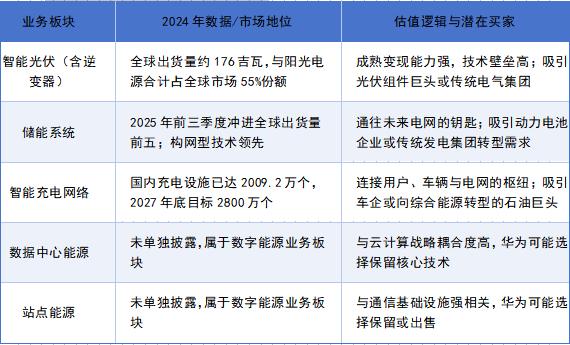
Core Insights - Huawei is reportedly seeking a buyer for its digital energy business, which generated revenue of 68.678 billion yuan in 2024, marking a 24.4% year-on-year growth and becoming the company's third-largest revenue source [1][2] - The global photovoltaic inverter market is experiencing a cyclical adjustment, with expected shipment declines from 589 GW in 2024 to 523 GW in 2026, while the energy storage sector is transitioning from scale expansion to value enhancement [2][3] - The potential valuation of Huawei's digital energy business could reach up to 400 billion yuan, making it a complex asset that may deter single buyers and attract regulatory scrutiny [4][5] Market Signals - The decision to consider splitting the digital energy business aligns with significant structural changes in the global energy market, driven by uncertainties in major markets like China, Europe, and the U.S. [2][3] - The energy storage market is projected to exceed 100 GW of installed capacity in 2025, with market drivers shifting from policy incentives to more complex mechanisms and revenue models [2] Business Breakdown - The digital energy business comprises several segments, including smart photovoltaics (55% global market share), energy storage systems, smart charging networks, data center energy, and site energy [5] - Potential buyers for these segments may include traditional electric groups, battery manufacturers, and automotive companies transitioning to integrated energy solutions [5] Strategic Implications - If the split occurs, it represents a long-term strategic decision for Huawei, allowing the company to reallocate resources and focus on core areas such as AI chips, digital twins, and 5G [6][8] - The complexity of the split is heightened by the interconnections between digital energy and Huawei's other services, such as cloud solutions and smart automotive offerings [6][7] Challenges for Buyers - Buyers will face challenges in maintaining the competitive advantages associated with the Huawei brand, as the brand's value is tied to its overall technology ecosystem [7][8] - The potential acquisition could lead to one of the largest transactions in China's renewable energy sector, with Huawei poised to reinvest the proceeds into critical technology battles [8]