
软件

Search documents
华尔街预测“今年美股牛市”:不再局限于科技股,将“多点开花”
Feng Huang Wang· 2026-01-19 01:49
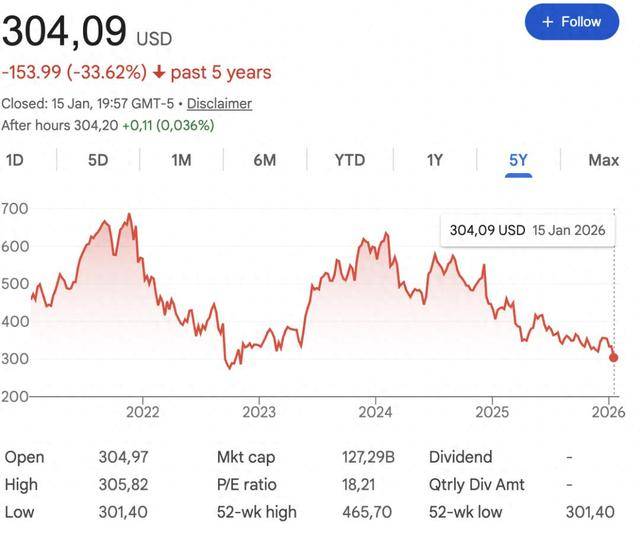
投资者对人工智能(AI)前景的热情预计今年将继续推动大型科技股的上涨,但与此同时,华尔街也 预计美股牛市今年将"多点开花"。 过去两周,工业、材料、能源和必需消费品板块的表现均优于大盘,这些板块的涨幅均达到5.5%或更 多。即使是小盘股罗素2000指数自年初以来也上涨了8%,超过了同期上涨超过1%的标准普尔500指 数。 奥本海默首席投资策略师John Stoltzfus在接受采访时说道:"这是一个不断扩大的牛市。" 据悉,Stoltzfus今年对标普500指数给出的目标价为8100点,这意味着该指数将较当前水平上涨大约 17%,是华尔街最乐观的预测。而其他大多数分析师则预计该基准指数将实现两位数百分比的增长,目 标价为7500点或7600点。 巴克莱银行美国股票策略主管Venu Krishna表示:"在我们等待事态发展的同时,我认为科技,尤其是大 型科技公司和人工智能,是这个市场的核心。我们坚信,即使人工智能受到的审查力度明显加大,它今 年仍将保持强劲势头。" 这场考验将在于,面临人工智能颠覆的软件股能否站稳脚跟。自年初以来,微软、Salesforce 和 ServiceNow等公司的股价均有所下跌,投资者 ...
茶颜悦色回应外拓传闻;马斯克向OpenAI微软索赔千亿美元
Sou Hu Cai Jing· 2026-01-19 01:17
Monetary Policy - The People's Bank of China has decided to lower the re-lending and re-discount rates by 0.25 percentage points, effective from January 19, 2026. The new rates for agricultural and small business re-lending will be 0.95%, 1.15%, and 1.25% for 3-month, 6-month, and 1-year terms respectively, while the re-discount rate will be 1.5% and the mortgage supplementary loan rate will be 1.75% [2] Trade Relations - Several EU countries are considering imposing tariffs on goods worth €93 billion imported from the US as a countermeasure against tariffs imposed by the US on eight European countries. If no agreement is reached, retaliatory tariffs will automatically take effect from February 6 [3] AI Industry - Elon Musk predicts that China will dominate AI computing power due to its significant electricity supply advantages, potentially tripling its power generation compared to the US by 2026, which will support high-energy data centers [4][5] - OpenAI plans to test targeted advertising within the ChatGPT application to diversify revenue streams ahead of a potential IPO, targeting free users and a new low-cost subscription model [5] - Anthropic is seeking to raise $25 billion or more, with Sequoia Capital participating in the funding round, aiming for a valuation of $350 billion [7] Automotive Industry - Bosch, the world's largest automotive supplier, is facing significant financial pressure, projecting a profit margin below 2% for 2025, primarily due to restructuring costs of €3.1 billion [19] - Porsche's global sales are expected to decline by 10% in 2025, with a notable 26% drop in the Chinese market, reflecting a nearly 60% decrease from its peak in 2021 [20]





华泰证券:港股斜率放缓,空间仍在
Jin Rong Jie· 2026-01-19 00:44
Market Overview - The Hong Kong stock market experienced fluctuations last week, rebounding significantly in the first half due to expectations around AI applications, easing overseas monetary policy, and short covering, but cooling down in the latter half, showing relative resilience [1] - Key factors driving the market rebound in Q1 remain unchanged, including overall loose financial conditions, foreign capital and southbound capital returning, upward revisions in profit expectations, and the attractiveness of Hong Kong stocks compared to A-shares [1] - The market sentiment has improved, with fear indicators moving out of panic zones and a notable decline in short positions, indicating a potential right-side harvesting period for the market [1] Earnings and Revenue Forecasts - Non-financial earnings and revenue forecasts have been revised upwards, with the most significant increases seen in the metals and electric new energy sectors [2] - Over the past four weeks, the consensus forecast for non-financial earnings has been revised up by 0.2%, while revenue forecasts have been slightly adjusted down by 0.1% [2] - The sectors with the largest upward revisions in earnings forecasts include metals (5.5%), electric new energy (2.8%), and light industry (2.1%) [2] Capital Flow and Liquidity - There has been a significant inflow of foreign capital, with net inflows into Hong Kong stocks reaching $2.82 billion, compared to $1.54 billion the previous week [3] - Active foreign capital has turned into net inflows, with the largest weekly net inflow since September 2024, while passive foreign capital inflows have also increased [3] - Southbound capital inflows have slowed, with approximately HKD 10.05 billion net inflow last week, primarily into media, computing, and retail sectors [3] Market Sentiment - The sentiment index for Hong Kong stocks has improved, reaching a reading of 33.7, indicating a recovery from panic levels [3] - Historical data suggests that entering the "panic zone" has led to a 100% success rate for Hong Kong stocks over the following month since the end of 2023 [3] - The current market environment is seen as a favorable time for positioning, with reduced short selling pressure and a shift towards a right-side harvesting phase [3] Investment Recommendations - Short-term focus should be on sectors related to the AI chain (semiconductors, software) and innovative pharmaceuticals, with a gradual accumulation strategy for high-quality new consumer stocks [4] - Mid-term recommendations include overweighting upstream sectors in the power chain (electric equipment and metals like copper and aluminum), insurance, and local real estate in Hong Kong [4] - Upcoming economic indicators to watch include GDP, industrial output, and retail sales figures [4]

开年最惨!美国软件股崩了,因为Claude Code太火了
Hua Er Jie Jian Wen· 2026-01-19 00:23
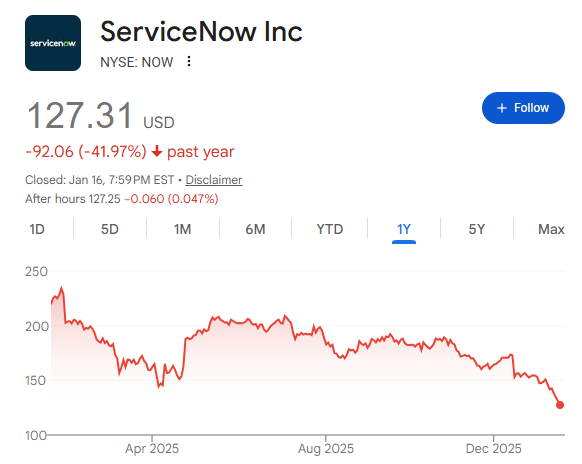
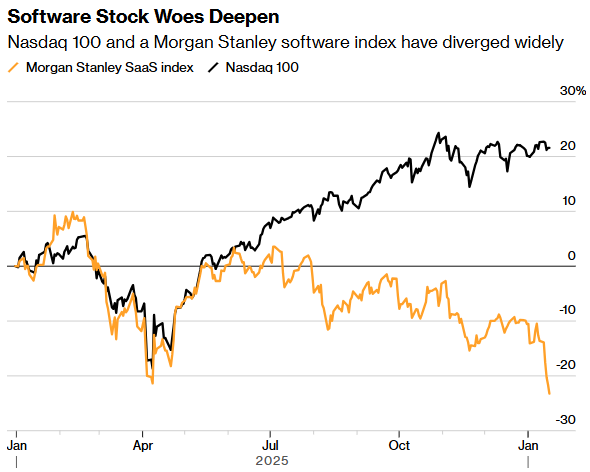
Core Viewpoint - The release of Claude Code has reignited concerns about the disruption of the software industry by AI, leading to a significant decline in U.S. software stocks, marking one of the worst starts to the year in recent history [1][5]. Group 1: Market Performance - Since the beginning of the year, a basket of SaaS stocks tracked by Morgan Stanley has dropped by 15%, following an 11% decline in 2025, marking the worst opening performance since 2022 [1]. - Software stocks are currently trading at a record low valuation of 18 times expected earnings for the next 12 months, significantly below the past decade's average of over 55 times [1]. - Companies like ServiceNow Inc. have seen their stock prices fall to multi-year lows, while Intuit Inc. experienced a 16% drop, the largest weekly decline since 2022 [2]. Group 2: Investor Sentiment - Many buy-side institutions believe there is "no reason to hold" software stocks amid the disruptive uncertainty brought by AI, with no visible catalysts for valuation recovery in the short term [4][6]. - The release of the "Claude Cowork" service by Anthropic has intensified fears among investors regarding the future growth prospects of software companies [5][6]. Group 3: AI Integration Challenges - Most software manufacturers have not demonstrated significant appeal in their AI products, with Salesforce and Adobe struggling to show revenue impact from their AI initiatives [7]. - Existing software companies need to exhibit accelerated growth to drive stock price rebounds, which appears unlikely in the short term [7]. - In contrast, other tech sectors, particularly semiconductor companies, are expected to see substantial profit growth, with projections of nearly 45% profit growth in 2025 and 59% in 2026 [7][8]. Group 4: Valuation Discrepancies - Despite low valuations, there remains a divide in market sentiment regarding the future of software stocks, with some analysts optimistic about a rebound by 2026 due to stable customer spending and attractive valuations [8]. - Barclays and Goldman Sachs predict that rising AI adoption will expand the total addressable market for software companies, potentially benefiting them in the long run [8]. - Wealthspire's chief market strategist notes that while the sector is not yet a clear buy opportunity, it is approaching a more attractive point for investment [9].


本周市场迎三大主线:特朗普亮相达沃斯、美联储主席悬念、奈飞(NFLX.US)、英特尔(INTC.US)引领财报季高潮
智通财经网· 2026-01-19 00:11
Group 1 - Major US stock indices remained nearly flat last week as the fourth quarter earnings season approaches, hovering near historical highs [1] - The Russell 2000 index, representing small-cap stocks, reached new closing highs in the last three trading days, while the Dow Jones Industrial Average led the major indices, influenced less by tech giants and the AI theme [1] - The S&P 500 index remained flat for the week, and the Nasdaq Composite index declined by approximately 0.4% [1] Group 2 - Geopolitical issues and domestic policy proposals, including credit card fee caps and housing assistance plans, are expected to be key discussion topics during Trump's upcoming appearance at the World Economic Forum [2] - The fourth quarter earnings releases are accelerating, with notable attention on Netflix and Intel's performance [2] - Netflix is attempting to acquire Warner Bros. Discovery while fending off a competing bid from Paramount Global, with plans to increase its offer to a cash acquisition [2] Group 3 - The Russell 2000 index is trading at historical highs, indicating a positive outlook for the US economy, as these companies typically derive more revenue from domestic customers compared to S&P 500 constituents [3] - The equal-weighted S&P 500 index reached a record high on January 13, while software stocks have seen significant declines, with companies like Intuit and Adobe dropping over 12% year-to-date [3] - The Russell 2000 index has risen approximately 20% over the past six months, compared to a 10% increase in the S&P 500 index [3] Group 4 - The current market rally is driven by the AI theme, with stocks across various sectors, including energy and defense, participating in the uptrend [4] - Companies like Bloom Energy and Kratos Defense have seen substantial stock price increases, driven by demand for AI data centers and rising gold prices benefiting mining companies [4] - Leading stocks in the S&P 500 this year include those associated with AI investments, such as Sandisk and Intel, which are primarily hardware-focused [4] Group 5 - The market's bullish sentiment is reinforced by strong rotations into new derivative areas under the same AI investment theme as it enters its fourth year [5]


机构称“没有理由持有”!美股软件股陷入“AI焦虑”,板块估值跌至多年低位
智通财经网· 2026-01-19 00:04
Core Viewpoint - The software sector in the U.S. stock market is experiencing its worst start in years, with a 15% decline in software-as-a-service stocks tracked by Morgan Stanley, contrary to earlier expectations of a 11% drop by 2025 [1][4]. Group 1: Market Performance - The stock prices of major software companies like Intuit, Adobe, and Salesforce have seen significant declines, with Intuit dropping 16%, Adobe and Salesforce both falling over 11% [1]. - Despite the Nasdaq 100 index nearing historical highs, companies like ServiceNow have reached multi-year lows, indicating a disconnect between overall market performance and software stock valuations [5]. Group 2: AI Innovations and Concerns - Anthropic's launch of the Claude Cowork service has raised concerns about disruptive innovations in AI, which could further impact software manufacturers' growth prospects [4]. - The rapid development of AI tools has created unprecedented uncertainty regarding future growth, as highlighted by investment managers [4]. Group 3: Earnings and Valuation Trends - Earnings growth for software and service companies in the S&P 500 is expected to slow to 14% in 2026, down from an anticipated 19% in 2025, contrasting with more optimistic fundamentals in other tech sectors [6]. - The price-to-earnings ratio for Morgan Stanley's software company portfolio has dropped to 18 times expected earnings, a historical low compared to an average of over 55 times in the past decade [6][7]. Group 4: Future Outlook - Some analysts believe that the current low valuations of software stocks could lead to a rebound by 2026, driven by stable customer spending and the potential benefits of AI [7][8]. - There is a cautious optimism about the software sector's attractiveness, although it is not yet deemed a definitive buy opportunity [8].
半导体相关ETF上涨 行业ETF“吸金”
Zhong Guo Zheng Quan Bao· 2026-01-18 20:45
Group 1: ETF Performance - Semiconductor-related ETFs led the market with weekly gains exceeding 10%, particularly the Penghua Sci-Tech Semiconductor ETF and the Sci-Tech Semiconductor ETF [1] - Aerospace-related ETFs experienced significant declines, with several products, including the Aerospace ETF and the Aerospace ETF Tianhong, dropping over 6% [2] - The top 10 ETFs by net inflow during January 12-16 were predominantly industry ETFs, including software, non-ferrous metals, and media [2] Group 2: Trading Activity - Broad-based ETFs saw active trading, with those tracking the CSI A500 and CSI 300 indices leading in transaction volume [3] - The Huatai-PineBridge CSI 300 ETF recorded a transaction volume of 745.58 billion, while the CSI 500 ETF reached 637.92 billion [3] Group 3: Market Outlook - Morgan Asset Management anticipates that the attractiveness of the A-share market will increase due to a friendly domestic policy environment and a recovery in corporate profits [3] - Guotai Fund suggests that the "anti-involution + technology" theme will continue to dominate, with policies supporting market competition and encouraging R&D investments [4] - Huaxia Fund recommends focusing on high-growth sectors such as AI, gaming, media, software, and chips, while advising caution on previously popular sectors like commercial aerospace [5]
东莞市华立实业股份有限公司关于收到上海证券交易所问询函的公告
Xin Lang Cai Jing· 2026-01-18 19:30
Core Viewpoint - Dongguan Huali Industrial Co., Ltd. has received an inquiry letter from the Shanghai Stock Exchange regarding its proposed acquisition of a 19% stake in Shenghui Clean Group Holdings Limited for HKD 47.5 million, raising questions about the rationale and implications of this cross-industry investment [1][2]. Group 1: Transaction Purpose - The company has shifted its focus from decorative composite materials to water services and membrane filtration materials since November 2024, and previously attempted to acquire a 51% stake in Beijing Zhongke Huilian Technology Co., Ltd. but terminated the deal due to a lack of consensus on key terms [2]. - The proposed acquisition aims to make the company the second-largest shareholder in Shenghui Clean, which specializes in property cleaning and public space cleaning services [2]. - The company's net cash flow from operating activities was negative at CNY 90 million for the first nine months of 2025, a significant decline from the positive cash flow in the same period of 2024 [2]. Group 2: Inquiry on Transaction Details - The acquisition price is set at HKD 0.128 per share, with the target company's stock price having increased by 179% over the last 60 trading days and 253% over the last 120 trading days [4]. - The target company reported a 10.14% increase in revenue for the first half of 2025, but its net profit decreased by 21.78% [4]. - The target company had a workforce of 8,160 employees, generating an average revenue of CNY 82,500 per employee, and its accounts receivable increased by 15.40% to CNY 268 million by the end of 2024 [4]. Group 3: Additional Information Requested - The company is required to disclose the decision-making process and rationale behind the acquisition, especially in light of the previous failed acquisition of Zhongke Huilian [3]. - The inquiry also seeks clarification on the necessity of the investment given the significant cash flow issues and whether it aligns with the company's strategic development plan [3]. - The company must explain the rationale for acquiring a stake in a business that differs significantly from its core operations and how it plans to achieve business synergy and resource sharing [3].

四大投行齐看空!Adobe股价狂跌45%,AI让专业设计门槛“大跳水”
Sou Hu Cai Jing· 2026-01-18 15:19
Core Viewpoint - Adobe is facing significant challenges as major investment banks have downgraded its ratings, leading to a nearly 8% drop in its stock price and a market value decline of almost 50% since the end of 2023, contrasting sharply with the rising Nasdaq index and software sector ETFs [1][3] Group 1: Market Reaction and Ratings Downgrade - Multiple investment banks, including Goldman Sachs and Oppenheimer, have downgraded Adobe's ratings, citing a slowdown in its growth engine primarily due to the impact of AI technology [3] - The consensus rating for Adobe has fallen to its lowest level in a decade, reminiscent of its previous crisis when it transitioned from selling software on discs to a subscription model [5] Group 2: AI Impact on Creative Workflows - The emergence of generative AI has drastically lowered the barriers to creating professional-quality content, allowing users to generate images and videos with simple language prompts, which undermines Adobe's traditional value proposition [7][8] - Competing tools like Midjourney and Runway, as well as established rivals like Canva and Figma, are integrating AI to offer user-friendly solutions at lower prices, further challenging Adobe's market position [10] Group 3: Adobe's Response and Challenges - Adobe is actively developing its own generative AI models, such as Firefly, and integrating them into its flagship products like Photoshop, but these efforts have not yet translated into significant revenue growth [12] - The shift in user habits towards simpler, cheaper AI tools poses a long-term threat to Adobe, as new creators may prefer these alternatives over Adobe's complex software suite [14] Group 4: Industry Implications - Adobe's situation illustrates a broader trend where technology is democratizing professional skills, challenging traditional business models based on the scarcity of specialized tools [16] - The company's future hinges on finding a balance between maintaining professional depth and embracing the accessibility brought by AI, as the industry adapts to these technological shifts [16]
ETF市场扫描与策略跟踪:沪深300,ETF合计净流出超千亿元
Western Securities· 2026-01-18 11:37
Global and A-share Market Overview - The A-share market showed mixed performance last week, with the Sci-Tech 50 Index recording the highest increase of 2.58%. The Hong Kong market also saw an uptick, with the Hang Seng Index rising by 2.34%. The top-performing ETFs primarily tracked TMT sector indices [1][11][14]. ETF New Issuance Statistics - Last week, 10 stock ETFs were reported in the A-share market, including 2 focused on non-ferrous metals. A total of 8 new stock ETFs were established. In the US market, 8 equity ETFs were newly established [1][16][18]. Fund Flows in A-share Market - The top 10 ETFs with net inflows were predominantly from the TMT sector, while the top 10 with net outflows were mainly from the CSI 300 Index ETFs. The ETF tracking the Sci-Tech 100 Index had the highest net inflow, while the CSI 300 Index ETF had the highest net outflow [2][25][27]. - In the A-share market, the net inflow for the top 10 broad-based indices included the Sci-Tech 100 with 9.59 billion yuan, while the CSI 300 saw a net outflow of 1,034.75 billion yuan [28][32]. Industry ETF Fund Flows - The TMT sector led the A-share market with a net inflow of 465.84 billion yuan, followed by upstream and materials with 216.32 billion yuan. Other sectors like new energy and consumption also saw positive inflows, while sectors such as low-carbon environmental and agriculture experienced outflows [33][35].