
渔业

Search documents
杭企探路“智慧渔业”新赛道
Mei Ri Shang Bao· 2025-09-11 22:18
Core Viewpoint - The article highlights the transformation of Zhejiang Shangda Public Group Co., Ltd. from traditional aquaculture to smart aquaculture, emphasizing the use of Recirculating Aquaculture Systems (RAS) to enhance fish quality while reducing resource consumption [1][2]. Group 1: Company Overview - Zhejiang Shangda Public Group was established in 2000 and has shifted its focus from environmental governance to smart aquaculture [1]. - The company utilizes RAS technology, achieving over 95% water recycling efficiency, which allows fish to grow in a stable and high-quality water environment [1]. Group 2: Technological Innovations - The company integrates artificial intelligence, food technology, biotechnology, and information technology to improve fish quality [1]. - It has developed a fully automated, sterile workshop that ensures antibiotic-free fish farming through real-time water quality monitoring and automated feeding [2]. Group 3: Product Characteristics - The fish produced by the company are characterized by being delicious, safe, and nutritious, with a focus on health-oriented functional feeds [2]. - The use of functional tea polyphenol feed enhances the taste and nutritional balance of the fish [2]. Group 4: Future Projects - The company plans to commence construction of the Smart Fish Valley project in Qiandao Lake by the end of September, which is expected to produce 18,000 tons of fish annually [2]. - The project will utilize "water diversion aquaculture," purifying lake water through the RAS system and promoting resource recycling [2]. Group 5: Societal Impact - The Smart Fish Valley project aims to promote low-carbon aquaculture technology and is expected to create 1,000 jobs, contributing to local economic development [2].
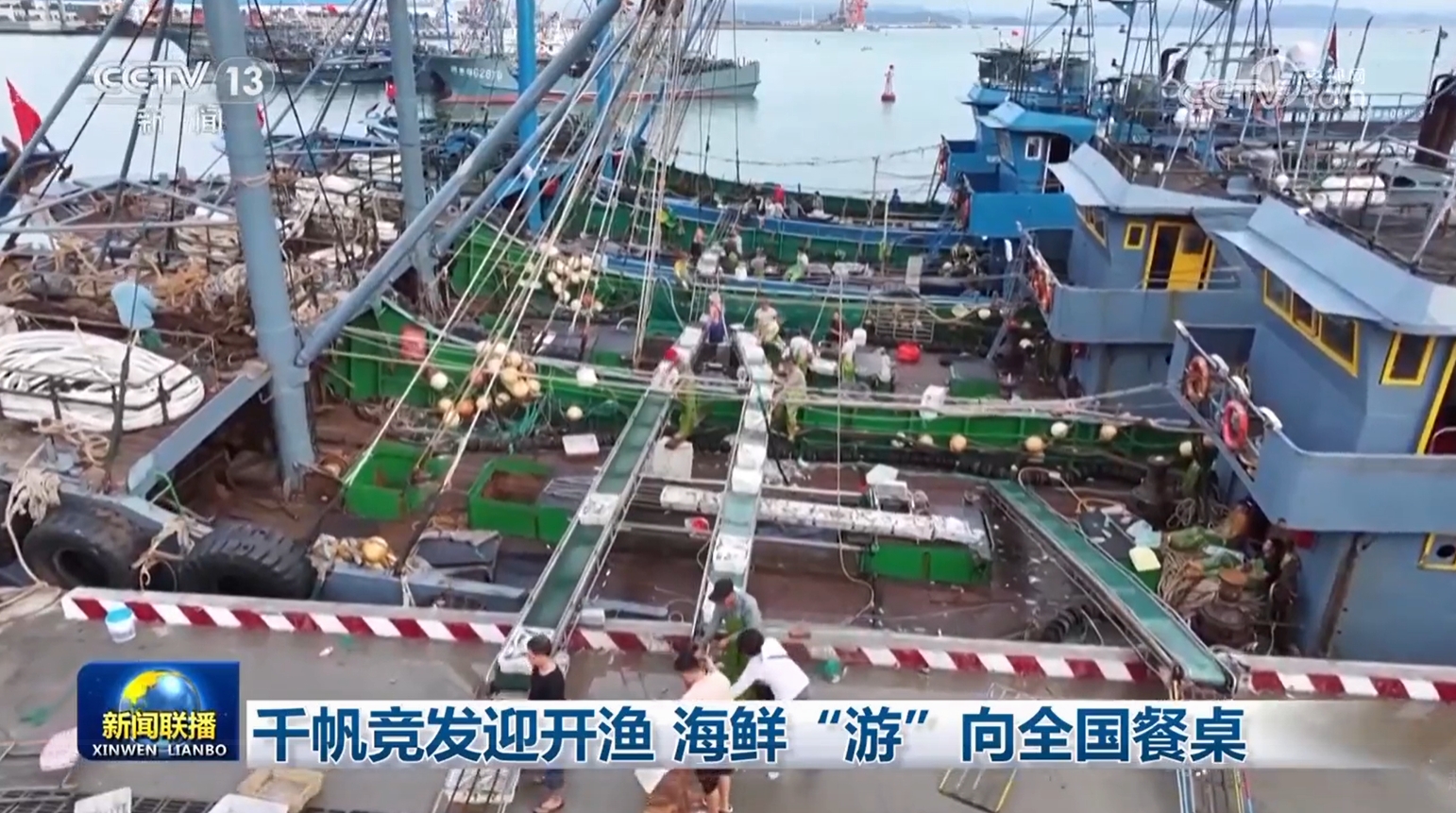
千帆竞发迎开渔 海鲜“游”向全国餐桌
Yang Shi Wang· 2025-09-11 12:43
Group 1 - The fishing season has resumed in various sea areas under China's jurisdiction, including the Bohai Sea and Yellow Sea, leading to an increase in the supply of high-quality seafood to consumers [1] - In Fujian, fishing boats are reportedly catching around 5,000 kilograms of seafood per trip, with a variety of products such as mackerel, squid, and flower crabs available [3] - In Guangdong's Zhanjiang, the seafood market is bustling with activity, featuring live crabs and shrimp as popular products [3] Group 2 - Advanced detection equipment and satellite navigation systems are being utilized on fishing boats in Shandong's Longkou, enhancing operational efficiency and accuracy in locating fishing nets [5] - In Zhejiang's Zhoushan, the peak season for crab has led to nearly 100 fishing boats unloading daily, with peak port volumes reaching 3,250 tons [7] - The Chinese government is promoting the scientific and orderly development of inland aquaculture, with regions like Xinjiang and Ningxia successfully cultivating seafood in inland areas [9] Group 3 - The overall seafood industry in China is undergoing a comprehensive upgrade, transitioning from traditional fishing to smart aquaculture and expanding sales channels from offline to online [11] - From January to July this year, China's total aquatic product output reached nearly 36 million tons, reflecting a year-on-year growth of 4.37% [11]

缩差距促共富,浙江“海上花园”何以蝶变?
Zhong Guo Xin Wen Wang· 2025-09-11 12:06
Core Insights - The article highlights the transformation of Dong'ao Village in Zhejiang Province into a model of shared prosperity through innovative local initiatives and the integration of tourism and agriculture [1][4]. Group 1: Economic Development - The sales revenue of local fishery and agricultural products reached 5 million yuan, with contracts signed with 7 farmers worth nearly 400,000 yuan [3]. - Dong'ao Village has become a popular tourist destination, attracting nearly 1 million visitors annually, with local accommodations fully booked during peak months [3][4]. - The local government has activated over 620 idle farmhouses for the hospitality industry, creating more than 7,000 beds and increasing average household income by 150,000 yuan annually [4]. Group 2: Community Initiatives - The "Fishing Family Chef Workshop" was established to support over 1,200 women in increasing their income through culinary services [4]. - A project called "Seven Villages United for Common Prosperity" was launched to connect seven fishing villages, enhancing resource sharing and community development [4]. Group 3: Infrastructure and Services - The region has improved healthcare access with a smart health station in Dongsha Village, allowing residents to monitor their health conveniently [5][8]. - Ongoing infrastructure projects include the construction of new ports and highways to enhance transportation and logistics, supporting local industries [7]. Group 4: Future Outlook - The income disparity between urban and rural residents in the area has been reduced to 1.49, with rural income ranking second among similar regions in Zhejiang Province [7]. - The local government aims to continue promoting harmonious development between urban and rural areas, leveraging marine resources for future growth [7].

全球数千种海产品集结广州 开启缤纷海鲜世界
Zhong Guo Xin Wen Wang· 2025-09-11 10:16
Core Insights - The 11th Guangzhou International Fisheries Expo showcases thousands of seafood products from around the world, attracting over 650 enterprises from more than 20 countries [1][3] - The event features six major exhibition areas, integrating resources across the entire seafood industry chain, including marine ranching, domestic specialty products, international seafood, aquaculture and animal health equipment, prepared food processing, and cold chain logistics [4] Industry Overview - The expo includes participation from countries such as the Netherlands, Ecuador, Argentina, Uruguay, Japan, and South Korea, highlighting a diverse range of seafood products and advanced equipment [3] - Domestic exhibitors come from various regions including Shandong, Fujian, Dalian, Guangzhou, and others, with notable companies like Guangdong Marine Investment Group and Zhanjiang Agricultural Development Group [3] Market Dynamics - Buyers from 82 countries and regions are present, with significant representation from major seafood trading nations in Asia, Europe, and the Americas [3] - The domestic purchasing power encompasses wholesale markets, restaurant chains, supermarkets, e-commerce, marine ranches, and aquaculture equipment buyers [3] Production Forecast - In 2024, China's total seafood production is projected to reach 73.58 million tons, marking a year-on-year growth of 3.39% [4] - Guangdong's seafood production is expected to be 9.66 million tons, with marine aquaculture production reaching 3.77 million tons, a growth rate of 5.47%, the highest in a decade [4] - Marine fish farming production is anticipated to be 975,400 tons, with a year-on-year increase of 7.93%, accounting for nearly half of the national output [4]
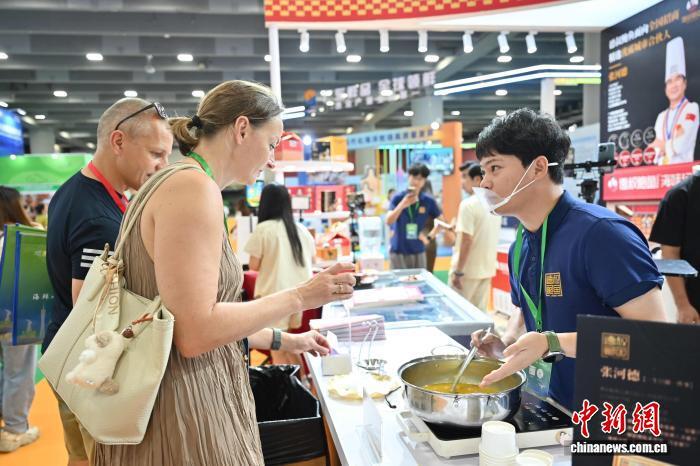
渔业板块9月11日跌0.2%,大湖股份领跌,主力资金净流出4862.4万元
Zheng Xing Xing Ye Ri Bao· 2025-09-11 08:40
Core Viewpoint - The fishery sector experienced a slight decline of 0.2% on September 11, with major stocks like Dahu Co. leading the drop, while the overall market indices showed positive performance with the Shanghai Composite Index rising by 1.65% and the Shenzhen Component Index increasing by 3.36% [1] Summary by Category Market Performance - On September 11, the Shanghai Composite Index closed at 3875.31, up 1.65% - The Shenzhen Component Index closed at 12979.89, up 3.36% [1] Fishery Sector Stocks - The fishery sector stocks showed mixed performance, with the following notable changes: - Zhongshui Fishery (000798) closed at 8.33, up 0.60% - Kaichuang International (600097) closed at 11.53, down 0.09% - Guolian Aquatic Products (300094) closed at 3.79, down 0.26% - Haodangjia (600467) closed at 2.56, down 0.39% - Zhangzidao (002069) closed at 4.37, down 0.46% - Dahu Co. (600257) closed at 5.66, down 0.53% [1] Capital Flow - The fishery sector saw a net outflow of 48.62 million yuan from main funds, while retail investors contributed a net inflow of 33.09 million yuan [1] - Detailed capital flow for individual stocks includes: - Zhongshui Fishery: Main funds net outflow of 0.94 million yuan, retail net inflow of 1.77 million yuan - Guolian Aquatic Products: Main funds net outflow of 2.67 million yuan, retail net outflow of 0.66 million yuan - Kaichuang International: Main funds net outflow of 3.91 million yuan, retail net inflow of 6.28 million yuan - Zhangzidao: Main funds net outflow of 4.76 million yuan, retail net inflow of 0.10 million yuan - Dahu Co.: Main funds net outflow of 7.73 million yuan, retail net inflow of 2.08 million yuan - Haodangjia: Main funds net outflow of 28.62 million yuan, retail net inflow of 23.52 million yuan [2]


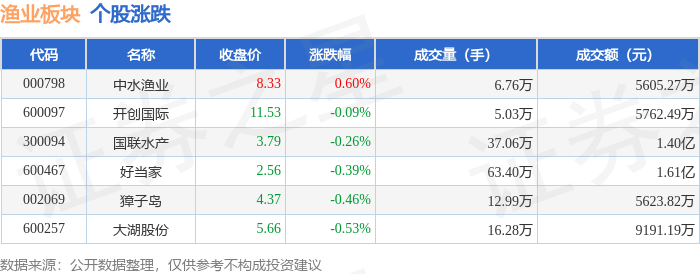
第11届广州国际渔业博览会在穗开幕
Zhong Guo Xin Wen Wang· 2025-09-11 06:19
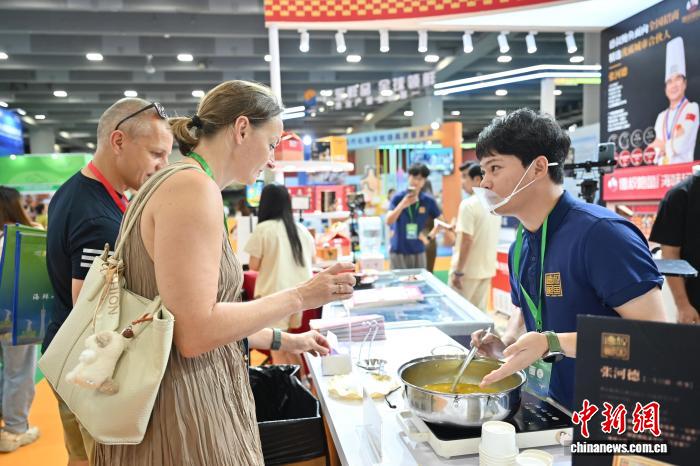
Group 1 - The 11th Guangzhou International Fisheries Expo has opened in Guangzhou, showcasing a variety of seafood products and attracting numerous attendees [1][9] - Various booths featured popular food items such as bamboo tube shrimp and Buddha Jumps Over the Wall, drawing significant interest from participants [3][5] - The event has become a platform for seafood suppliers and buyers to connect, with many vendors reporting high levels of inquiries and engagement from potential customers [7]
新技术、新模式、新品种……秋日田园满满“科技范儿” 铺展丰收画卷
Yang Shi Wang· 2025-09-10 10:31
Group 1: Agricultural Innovations in Jilin Province - Jilin Province's western region is one of the world's three major soda saline-alkali land distribution areas, with 100,000 acres of saline-alkali land currently thriving with rice and abundant shrimp and crabs [1] - The rice base in Longhai area has successfully implemented biological remediation techniques, allowing for immediate planting after soil improvement [3] - A new ecological agricultural model has been introduced in Daan City, enabling the co-cultivation of rice, crabs, and shrimp, leading to a successful crab harvest even before the rice harvest [4] Group 2: Economic Impact of Aquaculture in Daan City - Daan City's Xinda Agricultural Cooperative has 200,000 juvenile crayfish ready for market, with 1,200 acres of modern crayfish facilities expected to generate a revenue of 25 million yuan [5] - The ecological agriculture model not only improves soil conditions but also broadens income channels for farmers, transforming saline-alkali land into a "treasure basin" [5] Group 3: Harvesting Success in Zhejiang and Xinjiang - In Zhejiang's Changxing, catfish harvesting has begun, with a daily yield of 15,000 pounds, generating over 100,000 yuan in daily income [6] - Xinjiang's Ili River Valley has completed the harvest of over 1.4 million acres of wheat, with the highest yield reaching 850.21 kg per acre, marking a successful grain production year [7][10] Group 4: Gansu's Grape Industry Development - Gansu's Tianshui City is in the midst of harvesting over 30,000 acres of grapes, with more than half already sold [14] - The introduction of 16 high-quality grape varieties and technical improvements have led to staggered harvests, enhancing farmers' income [15]
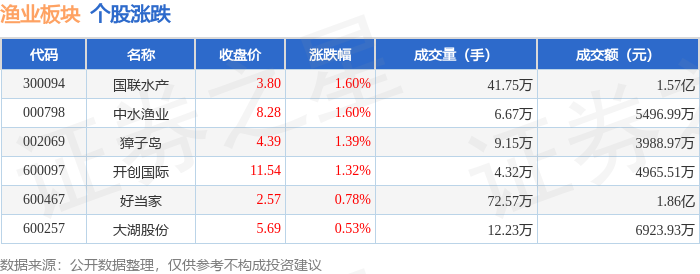
渔业板块9月10日涨1.22%,国联水产领涨,主力资金净流出260.92万元
Zheng Xing Xing Ye Ri Bao· 2025-09-10 08:30
Core Viewpoint - The fishery sector experienced a rise of 1.22% on September 10, with Guolian Aquatic leading the gains, while the overall market indices showed modest increases [1] Group 1: Market Performance - The Shanghai Composite Index closed at 3812.22, up 0.13% [1] - The Shenzhen Component Index closed at 12557.68, up 0.38% [1] - Key stocks in the fishery sector showed the following closing prices and percentage changes: - Guolian Aquatic: 3.80, +1.60% - Zhongshui Fishery: 8.28, +1.60% - Zhangzidao: 4.39, +1.39% - Kaichuang International: 11.54, +1.32% - Haodangjia: 2.57, +0.78% - Dahuhua: 5.69, +0.53% [1] Group 2: Capital Flow - The fishery sector saw a net outflow of 2.6092 million yuan from institutional investors and 4.4373 million yuan from speculative funds, while retail investors had a net inflow of 7.0466 million yuan [1] - Detailed capital flow for key stocks includes: - Guolian Aquatic: 19.8058 million yuan net inflow from institutions, -12.59% from speculative funds, -757.17 thousand yuan from retail [2] - Zhangzidao: -59.17 thousand yuan from institutions, -155.64 thousand yuan from speculative funds, 214.80 thousand yuan from retail [2] - Kaichuang International: -175.33 thousand yuan from institutions, 103.99 thousand yuan from speculative funds, 71.34 thousand yuan from retail [2] - Zhongshui Fishery: -325.52 thousand yuan from institutions, 712.51 thousand yuan from speculative funds, -386.99 thousand yuan from retail [2] - Dahuhua: -432.19 thousand yuan from institutions, -294.00 thousand yuan from speculative funds, 726.20 thousand yuan from retail [2] - Haodangjia: -1249.29 thousand yuan from institutions, 412.81 thousand yuan from speculative funds, 836.48 thousand yuan from retail [2]
清新桂花鱼勇攀黄山 “南北双鲜”联动书写文旅融合新篇章
Nan Fang Nong Cun Bao· 2025-09-10 07:01
Core Viewpoint - The event "Climbing Huangshan" featuring the "Qingxin Osmanthus Fish" marks a significant cultural and tourism innovation practice, promoting the integration of agriculture, culture, and tourism between Guangdong and Anhui provinces [2][4][34]. Group 1: Event Overview - The "Qingxin Osmanthus Fish" launched a unique challenge event on September 9, aimed at promoting cross-regional cultural tourism [2][3]. - Seven staff members dressed as "osmanthus fish" engaged in an interactive journey along the classic Huangshan climbing route, exploring new paths for deep integration of agriculture, culture, and tourism [3][4]. Group 2: Cultural and Brand Promotion - The event featured a "North-South Fresh Dialogue," highlighting the cultural differences in fishery practices between the two regions, showcasing the heritage of Huizhou stinky mandarin fish and the ecological farming of Qingxin osmanthus fish [7][8]. - Participants interacted with tourists, enhancing brand visibility and engagement through cultural storytelling and creative gifts [10][11]. Group 3: Economic Impact and Industry Development - The full industrial chain of Qingxin osmanthus fish is projected to reach a value of 1.97 billion yuan in 2024, capturing 20% of the provincial market share [19][20]. - The collaboration between Qingxin and Huangshan focuses on a model where Qingxin handles standard processing while Huangshan manages deep processing and sales, promoting a cross-province collaboration in local specialty products [21][22]. Group 4: Future Initiatives - Qingxin plans to continue enhancing the "agriculture + technology + culture" model, with upcoming events such as the "Qingxin Osmanthus Fish Food Festival" and various promotional activities to expand the "Qingxin Osmanthus Fish" brand [28][30][31]. - The initiative aims to inject vitality into rural revitalization and contribute to high-quality agricultural development [35].

挪威三文鱼在华份额创近15年新高 挪威海产局将加码对华投资
Xin Jing Bao· 2025-09-10 06:19
Core Insights - The Norwegian seafood industry is celebrating the 40th anniversary of its salmon sashimi in China, with significant growth in market share and exports expected by 2025 [1][2] Export Growth - In the first eight months of the year, Norway's salmon exports to China increased by 120% in volume and 66% in value, reaching 61,300 tons and 5.425 billion Norwegian Krone respectively [3] - By June 2025, Norway's salmon market share in China is projected to reach 71%, the highest in the past 15 years [1][4] Market Potential - The Norwegian Seafood Council plans to increase its investment in the Chinese market by 70%, recognizing the unprecedented potential of the Chinese salmon market [4] - China has become the sixth largest global export market for Atlantic salmon, with the fastest growth among the top ten markets [4] Consumer Trends - The demand for safe, healthy, and delicious seafood in China is steadily increasing, with a growing trend towards a hybrid consumption model that includes both offline and digital channels [4] - Norwegian salmon is becoming more integrated into Chinese consumers' daily lives through various retail and delivery channels [4] Strategic Partnerships - The Norwegian Seafood Council aims to collaborate with local industry partners and digital platforms to enhance marketing and reach more Chinese consumers [4][5]